 The Itinerary
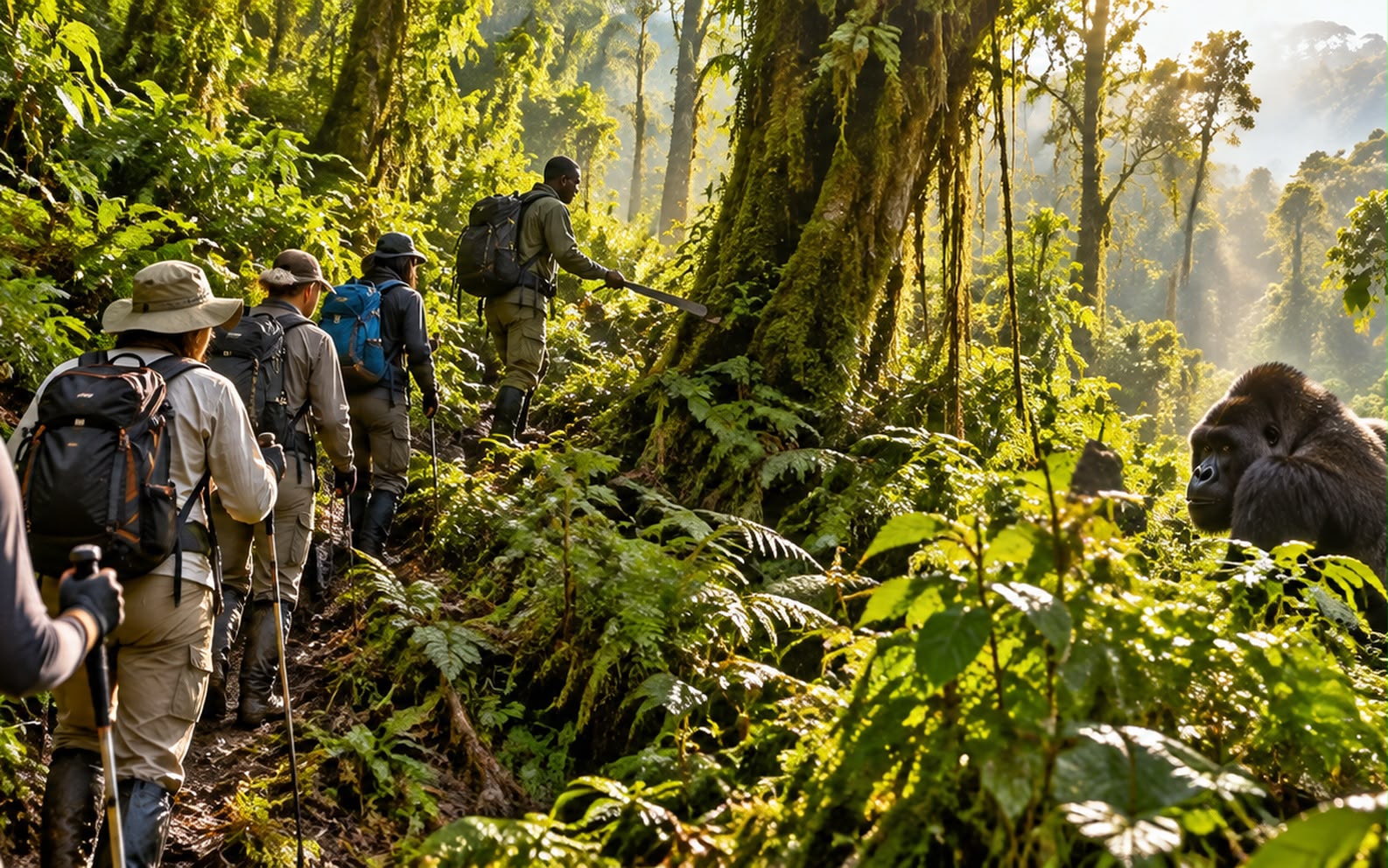
Rwanda and Uganda in 10 days: gorillas twice, chimpanzees and the Rift Valley
The mountain gorilla lives in one forest split across three borders, and this is the two halves of it you can reach — a steep hour in Rwandan bamboo and a hard one in Ugandan rainforest, with chimpanzees, tree-climbing lions and the Rift Valley in between.
- East Africa
- 10 days
- ≈ AED 18,750 / person
- Two gorilla treks in two countries, and the price difference that explains the route
Before you go
Before you go: the admin
The permits are the trip
- Everything on this route is built around gorilla permits. Book them first, then arrange flights, lodges and transfers around the dates you get.
- Rwanda’s permit is $1,500 per person; Uganda’s is $800. That gap is the practical reason to do both — Rwanda is an hour from Kigali’s airport and trivially easy, Uganda is a long drive and half the price, and together they give you two very different treks.
- Permits are limited to a few dozen a day in each country and sell out months ahead for the dry seasons.
- The minimum age is 15 in both, and you will be turned away with a cold or flu — the rule protects the gorillas, who share our respiratory infections.
Visas, and the one that covers both
- The East Africa Tourist Visa covers Rwanda, Uganda and Kenya for 90 days and multiple entry. It is the right visa for this route and costs less than two singles.
- Buy it from the country you enter first — Rwanda’s online system is the smoother of the two.
- A yellow fever certificate is mandatory for both and is checked at the border as well as the airport.
Flights and the crossing
- Fly into Kigali and out of Entebbe, which is the efficient direction. Kigali is the better-run airport and is 2 hours from Volcanoes; Entebbe is 8–10 hours from Bwindi by road.
- The Cyanika or Katuna border between Rwanda and Uganda takes about an hour. Your operator handles the vehicle paperwork.
- A domestic flight from Kihihi or Kisoro to Entebbe saves a full day at the end and is worth the cost.
Money
- Rwandan and Ugandan francs and shillings, neither usable in the other.
- Permits, lodges and tips are quoted and paid in US dollars. Bring clean, post-2013 notes.
- Cards work in Kigali, Kampala and at lodges and nowhere else useful. Mobile money runs everyday payments in both.
One gentle brief
- Plastic bags are illegal in Rwanda and confiscated at the airport. Bring none — including bin liners and, by some interpretations, ziplocks.
- Rwanda is strikingly clean and orderly. The last Saturday of each month is Umuganda, a national community work morning when most things close until midday.
- Hire a porter for every trek. It costs little, the ground is steep and muddy, and it is the main route by which trekking money reaches the surrounding villages.
Day by day
Day 1 — Land in Kigali
- 10:00 — Arrive and go to the Genocide Memorial. It is essential and it is harrowing — 250,000 people are buried there. Allow two hours and do not schedule anything afterwards.
- 14:00 — Lunch, and nothing demanding.
- 16:00 — The Nyamirambo Women’s Centre walking tour in the afternoon is the other side of the city and is run by the women who live in it.
- 19:00 — Kigali is among the safest capitals in Africa and the evening is worth walking.
- Plastic bags are banned in Rwanda and are confiscated at the airport — repack before you fly.
Day 2 — To Volcanoes National Park
- 09:00 — Two hours north-west through the terraced hills — Rwanda is “le pays des mille collines” and the drive earns the name.
- 13:00 — The Dian Fossey tomb hike at Karisoke in the afternoon, if you are not trekking tomorrow — three hours return to the graves of Fossey and the gorillas she studied, including Digit.
- 17:00 — Stay near Kinigi for the 7am briefing.
- 19:00 — Lay out your kit tonight: long sleeves, gloves, gaiters and boots with grip. The nettles are the reason for all of it.
Day 3 — Gorillas in Rwanda
- 07:00 — The briefing is at 7am at Kinigi, where you are allotted a family by fitness and preference. Say honestly how fit you are; they place people well.
- 08:30 — The trek is anything from one to five hours through bamboo and nettle, at 2,500–3,000m, on volcanic soil that is steep rather than technical.
- Hire a porter. It costs very little, it helps enormously, and it is how the park spreads income to the villages.
- One hour with them, seven metres back, masks worn. It is the shortest and best hour on this site.
- 15:00 — The afternoon for the Twin Lakes of Burera and Ruhondo, or the golden monkey trek, which is a separate permit and a gentler walk.
Day 4 — Cross into Uganda, to Lake Bunyonyi
- 09:00 — The Cyanika border is 40 minutes from Kinigi and takes about an hour.
- The East Africa Tourist Visa covers Rwanda, Uganda and Kenya and is worth having if you are doing both countries.
- 12:00 — Lake Bunyonyi on the far side — 29 islands, 900m deep in places, and no bilharzia, no crocodiles and no hippos, which makes it the only large lake in the region you can swim in freely.
- 15:00 — A dugout to Punishment Island and the terraced shores, which are some of the steepest cultivated land in Africa. The dugouts spin if you paddle them wrong; take the lesson in good humour.
- 18:00 — It sits at 1,960m and is cold at night.
Day 5 — To Bwindi
- 08:00 — Three to four hours on a hard road to Buhoma or Ruhija. Which sector you stay in must match the gorilla family on your permit — confirm it before you set off.
- 13:00 — Bwindi Impenetrable Forest is accurately named — 331km² of tangled montane rainforest, unbroken since the last ice age, and it holds roughly half the world’s mountain gorillas.
- 15:00 — The Batwa Experience at Buhoma, run by the forest’s displaced original inhabitants, which is worth doing and worth thinking about.
- 17:00 — Afternoon for the waterfall trail and the birding, which is world-class — 350 species including 23 Albertine Rift endemics.
Day 6 — Gorillas in Uganda
- 08:00 — The briefing is at 8am, and this trek is harder than Rwanda’s — dense, wet, steep, and often involving a machete cutting the path ahead of you.
- The hour is the same and the setting is completely different — Rwanda is open bamboo on a volcano, Bwindi is thick forest where you are often ten metres from an animal you cannot see.
- Doing both is the argument for this route. Most people find Bwindi the more extraordinary and Rwanda the more photogenic.
- Gorilla habituation permits at Rushaga give four hours instead of one, cost more, and are the serious option — book these a year out.
- 16:00 — Back, and a long shower. Everything you wore is wet.
Day 7 — To Queen Elizabeth National Park
- 08:00 — Three to four hours north through the Ishasha sector.
- 12:00 — The Ishasha tree-climbing lions are the draw — a local behaviour nobody has fully explained, with lions draped in fig trees through the heat of the day. They are not guaranteed. Midday is when to look, which is the opposite of normal game-viewing advice.
- 16:00 — Kob, topi and elephant across the savanna, and the Rift Valley escarpment behind it.
- 18:30 — Into Mweya for the night.
Day 8 — The Kazinga Channel and the crater lakes
- 06:30 — The explosion craters on the Mweya loop in the morning, and the Katwe salt lake, worked by hand since the sixteenth century — the workers stand in brine all day and the cooperative there explains what that costs them.
- 12:00 — The equator crossing is on the road here, with the usual monument and the usual demonstration involving a basin of water, which is physics theatre.
- 15:00 — The Kazinga Channel boat in the afternoon — 32km linking Lakes Edward and George, with one of the highest hippo concentrations in the world and elephants coming down to drink.
- 18:30 — Sunset over the channel, which is what the afternoon boat buys you.
Day 9 — Kibale, or back towards Entebbe
- 06:00 — Kibale Forest is two hours north and has the highest primate density in Africa — 13 species, and chimpanzee tracking with a success rate above 90%. Tracking starts at eight and again at two.
- 12:00 — The Bigodi Wetland Sanctuary next to it, community-run, for the swamp walk and the birds.
- 15:00 — The crater lakes around Fort Portal, which are the prettiest corner of the country and almost unvisited.
- Or start the drive back, breaking at Fort Portal or the crater lakes.
Day 10 — Fly or drive to Entebbe, and out
- 07:00 — The drive from Kibale to Entebbe is five to six hours; from Bwindi it is eight to ten, which is the argument for the domestic flight.
- 14:00 — The Entebbe Botanical Gardens or the Uganda Wildlife Education Centre if there is time, both on the lake and ten minutes from the terminal.
- Leave real margin. Ugandan roads and domestic flights both slip — and the Kampala stretch of the road is the one that swallows hours.
Costs and practicalities
Best time to visit
June–September and December–February are the two dry seasons, and gorilla trekking is judged by them.
- June–September — the long dry season and the best trekking conditions in both forests. The busiest and the hardest to get permits for.
- December–February — the short dry season, also good and slightly quieter. Bwindi is never actually dry, but the trails hold.
- March–May — the long rains. Bwindi’s trails become deep mud and Volcanoes’ slopes are slick. Permits are easier to get and the forest is at its most beautiful, and some lodges discount heavily.
- October–November — the short rains, with afternoon storms.
Gorillas are tracked year-round and permit prices do not change by season — only the walking does. Chimpanzees at Kibale are easier in the wet, when they stay lower in the canopy, and Queen Elizabeth’s game viewing is best in the dry.
Travel tips
- Book permits before anything else. They are limited, dated and sell out months ahead for the dry seasons; the whole trip arranges around the dates you get.
- Do not go if you have a cold. You will be refused at the briefing, and rightly — gorillas die of human respiratory infections.
- Hire a porter on every trek. It is cheap, the ground is genuinely hard, and it is how trekking money reaches the villages around the parks.
- Bring no plastic bags into Rwanda. They are illegal and confiscated at the airport.
- Gaiters and gardening gloves for Bwindi. The nettles and the thorns are the thing nobody warns you about, and the gloves let you grab vegetation on a steep slope.
- Malaria prophylaxis is essential and a yellow fever certificate is mandatory and checked at the land border.
- Tipping is expected and structured — guide, trackers, porters and lodge staff, with guidance given at the briefing and at check-in.
What this trip actually costs
Two people, 9 nights, mid-range lodges, international flights excluded:
| Item | Cost |
|---|---|
| Gorilla permits: one Rwanda and one Uganda trek each | USD 4,600 (≈ AED 16,894) |
| Lodges, 9 nights, mostly full board | USD 2,700 (≈ AED 9,916) |
| 4x4 with driver-guide, 10 days | USD 1,400 (≈ AED 5,142) |
| Park fees: Volcanoes, Bwindi, Queen Elizabeth, Kibale | USD 600 (≈ AED 2,204) |
| Food, drink, porters and tips outside full board | USD 500 (≈ AED 1,836) |
| Transfers, the border crossing and the Entebbe flight | USD 400 (≈ AED 1,469) |
| Total for two | USD 10,200 (≈ AED 37,460) |
- Roughly USD 5,100 (≈ AED 18,730) per person, and the permits are nearly half of it. That is not a markup — it is a fixed government fee and it funds the conservation that took mountain gorillas off the critically endangered list.
- Doing only the Ugandan trek saves $1,400 for two and costs you the easier, more photogenic half.
- Habituation permits at Rushaga give four hours instead of one for roughly double, which is the upgrade worth considering.
- Hotel picks here are chosen on location, not on commission — always check prices and recent reviews before booking.
What to pack
- Gaiters and sturdy waterproof boots, broken in.
- Gardening gloves. For grabbing nettles and thorns on a steep slope, and the single most recommended item by anyone who has trekked Bwindi.
- A proper waterproof. It rains in both forests in every season.
- Long sleeves and long trousers tucked into socks — safari ants are a genuine nuisance.
- A warm layer. Kinigi is 2,300m and Bunyonyi 1,960m, and both are cold at night.
- Masks for the gorilla hour, and the honesty to stay behind if you are ill.
- Clean post-2013 US dollars for permits, tips and extras.
FAQ
Why trek gorillas twice? Because the two forests are completely different. Rwanda is open bamboo on a volcano at altitude; Bwindi is dense, wet montane rainforest. Most people find Bwindi more extraordinary and Rwanda more photogenic, and the Ugandan permit is half the price.
Which country should I trek in if I only do one? Rwanda if you want it easy and photogenic and are short of days — it is two hours from a good airport. Uganda if you want the harder, wilder version and the permit saving.
How fit do I need to be? Reasonably. Treks run one to five hours on steep, muddy ground at 2,300–3,000m. Porters carry your bag and will pull you up slopes; the altitude is the part people underestimate.
Does the East Africa Tourist Visa cover both? Yes — Rwanda, Uganda and Kenya on one visa, 90 days, multiple entry. It is the right visa for this route.
Can I add Kenya or Tanzania? Kenya is covered by the same visa and adds a classic savanna safari, which is a different kind of trip entirely. It needs another week — Kenya in 7 days is exactly that week.
Prices and entry rules change, and what you need depends on your passport; last checked 9 November 2026, so confirm with the embassy or your airline before booking.


