 The Itinerary
Kenya and Tanzania in 12 days: the Mara, the Serengeti, Ngorongoro and Zanzibar
The Mara and the Serengeti are one ecosystem with a border through the middle, and doing both is the only way to follow the herds rather than hope. Then a volcanic caldera with its own resident lions, and an Indian Ocean island to stop moving on.
- East Africa
- 12 days
- ≈ AED 18,350 / person
- Both halves of the same migration, then a week's worth of beach in three days
Before you go
Before you go: the admin
Two visas, and one that covers both
- The East Africa Tourist Visa covers Kenya, Uganda and Rwanda for 90 days and multiple entry — but not Tanzania, which is the one you need here. Do not buy it for this trip.
- Kenya replaced its visa with an eTA — an electronic travel authorisation required of almost everyone, applied for online and usually approved in three days. Apply at least a week out.
- Tanzania issues an e-visa in about ten days, or a visa on arrival at Kilimanjaro and Zanzibar. US passport holders must buy the multiple-entry visa, which costs more.
- If you fly out of Zanzibar and back through Nairobi you re-enter Kenya, so check whether your eTA covers it.
Flights, which are most of the logistics
- Fly into Nairobi and out of Zanzibar, or the reverse. With a week rather than twelve days, Kenya in 7 days is the Mara half of this route on its own.
- Light aircraft do the safari legs: Nairobi to the Mara, the Mara to the Serengeti (via the Migration Airstrips, clearing immigration at a bush strip), and Arusha or Seronera to Zanzibar.
- Luggage is limited to 15–20kg in a soft bag with no wheels or frame. This is enforced and not negotiable — the aircraft are 12-seaters.
- The overland alternative — Nairobi to Arusha by road and then driving the northern circuit — is cheaper, adds three days of driving, and is a legitimate different trip.
Money
- Both countries run on US dollars for tourism — park fees, lodges and tips are quoted and often paid in them. Bring clean, post-2013 notes; older or marked ones are refused.
- M-Pesa runs everyday Kenya and cards work at lodges and in Nairobi. Tanzanian shillings and Kenyan shillings are for markets and small purchases.
- Park fees are a large, fixed, per-person-per-24-hours cost and are the reason safari pricing looks the way it does.
One gentle brief
- The Mara and the Serengeti are one ecosystem. The wildebeest do not recognise the border and neither should your itinerary — which is the whole argument for doing both.
- Vehicle etiquette is a real thing. Good operators keep distance, do not block an animal’s path and do not crowd a kill. The crowded-sighting photographs that circulate are the cheap trips.
- Zanzibar is conservative outside the beach resorts. Shoulders and knees covered in Stone Town, and more during Ramadan.
Day by day
Day 1 — Land in Nairobi
- Arrive, and do not try to do anything ambitious.
- 11:00 — The David Sheldrick elephant orphanage has a public hour at 11am and fostering visits in the afternoon. Book ahead — the public hour is the only slot and it is one hour exactly.
- 13:00 — The Giraffe Centre next door, where the Rothschild’s giraffe take pellets off the platform.
- 15:00 — Karen Blixen’s house if the Out of Africa connection appeals, ten minutes away.
- Nairobi National Park is a genuine curiosity — rhino and lion with the city skyline behind them — and works as a morning drive if you arrive the day before.
- 18:00 — Back to the hotel. The Wilson flight tomorrow is early and the bag allowance is strict.
Day 2 — Fly to the Masai Mara
- Light-aircraft luggage is soft bags only, 15kg, and the camps hold the rest in Nairobi.
- 09:00 — Forty-five minutes in a light aircraft and you are on a grass strip.
- Stay in a conservancy rather than the main reserve if you can — Naboisho, Olare Motorogi, Mara North. Vehicle numbers are capped, off-road driving is permitted, and night drives and walking safaris are possible. The national reserve allows none of those.
- 12:00 — Lunch at camp, and the middle of the day is for sitting still. The animals do the same.
- 16:00 — An afternoon game drive to get your eye in, and the first sundowner.
- 19:30 — Dinner, and an early night: tomorrow starts before light.
Day 3 — The Mara: a full day out
- 05:30 — Leave at first light with a packed breakfast. The best three hours of any safari day are between six and nine.
- 06:00 — The Mara is the best big-cat density in Africa. Lion are near-certain, cheetah likely, leopard a matter of luck and a good guide.
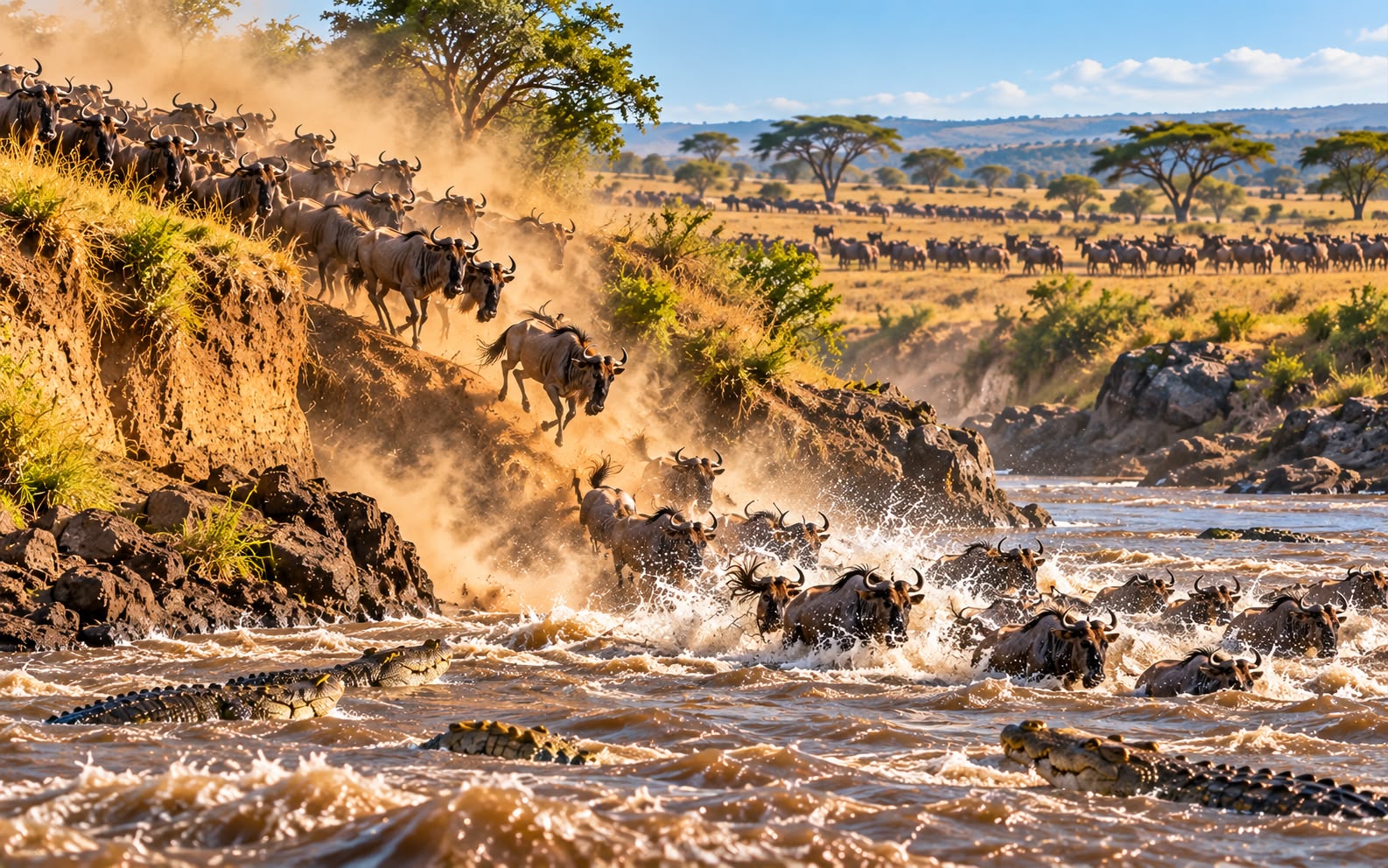
- 09:00 — The Mara River if the herds are in — the crossings usually happen between July and September and are chaotic, violent and over in minutes. You wait hours for them and nobody can tell you when.
- 13:00 — Breakfast or lunch under a tree, which is the point of taking the whole day.
- 16:00 — A Maasai village visit if it is run by the community, and ask your camp which ones are. Several are staged and the money does not reach the village.
- 18:30 — Sundowner on a rise, which every guide knows the right one for.
Day 4 — Mara to the Serengeti
- 08:00 — A bush-strip immigration crossing — you clear Kenya at Migori or the Mara strip and Tanzania at Kogatende, in a hut, in about twenty minutes.
- Carry your yellow fever certificate; it is checked on this crossing.
- 11:00 — The northern Serengeti around Kogatende is where the herds are in the same months as the Mara crossings, with far fewer vehicles.
- 16:00 — Afternoon drive along the Mara River’s Tanzanian bank, where the crossings happen from the other side.
- 18:30 — Camp. The northern camps are mobile and move with the herds.
Day 5 — The Serengeti: the centre
- 06:00 — The Seronera valley in the centre has the best year-round resident game and the highest leopard density — the sausage trees along the river are where to look.
- The Serengeti is 15,000km². Moving between its sectors costs half a day by road or forty minutes in the air — so decide which sector you are in before you book, not on the day.
- 11:00 — A picnic by a kopje, the granite outcrops where lion lie up.
- 16:00 — The afternoon drive, and the light from five is the best of the day for photographs.
Day 6 — The plains, or a balloon
- 05:00 — A balloon flight at dawn if the budget allows — an hour over the plains, finishing with a breakfast on the grass. It is expensive and nobody regrets it.
- The southern plains at Ndutu are the place from December to March, when around half a million wildebeest calve in a few weeks and every predator in the ecosystem turns up.
- 10:00 — Back for a slow morning.
- 15:30 — A long afternoon drive, further out than yesterday.
- 19:00 — Pack for the rim. Ngorongoro is cold and most people have not brought the layer they need.
Day 7 — Ngorongoro
- 08:00 — The drive up from the Serengeti via Olduvai Gorge, where the Leakeys found the hominin fossils, with a small and genuinely good museum.
- 13:00 — Lunch at the gorge, looking out over it.
- 16:00 — Stay on the crater rim — it is 2,300m, cold, and often in cloud by the afternoon, and the dawn view down into the caldera is why you pay for it.
- 18:00 — The rim viewpoint before the cloud closes, if it has not already.
Day 8 — The crater, then down to Arusha
- 06:00 — Descend at six when the gate opens. By ten the crater floor has a hundred vehicles on it and the lions are asleep.
- The crater floor is 260km² and holds around 25,000 large animals permanently, including the best chance of black rhino on the northern circuit.
- 07:30 — A half-day on the floor, with the Lerai forest for elephant and the Munge stream for flamingo on the soda lake.
- The Maasai still graze the crater under a conservation-area agreement, which is why Ngorongoro is not a national park — you will pass herds on the floor.
- 13:00 — Up and out; vehicles must leave by six and most do far earlier.
- 16:00 — Down to Arusha in the afternoon, or fly direct to Zanzibar from Lake Manyara strip.
Day 9 — Fly to Zanzibar, and Stone Town
- 10:00 — An hour and a quarter from Arusha.
- 13:00 — Stone Town is UNESCO-listed and is a Swahili, Omani, Indian and Persian city rather than an African one — carved doors, overhanging balconies and lanes too narrow for cars.
- 15:00 — The former slave market and the Anglican cathedral built over it, which is the serious hour here — the altar stands where the whipping post was.
- 17:00 — Get lost in the lanes, which is the only way to see it; every lane comes out somewhere.
- 18:30 — Forodhani Gardens at dusk for the street-food stalls, and the sunset dhows.
Day 10 — To the east coast
- 09:00 — Cross the island in an hour to Paje, Jambiani or Matemwe.
- 11:00 — Jozani forest for the red colobus, which exists only here, on the way across.
- The tide dominates everything. The east coast’s lagoon empties almost completely at low water — swimming is a tide-table activity, which catches people out. Get the table from your hotel on arrival and plan around it.
- 15:00 — The beach, or the low-tide walk out to the reef edge, which is its own thing.
- 18:00 — Sunset is on the other coast — the east gets the sunrise, which is the better trade.
Day 11 — The water
- 06:00 — Sunrise over the Indian Ocean, which from this coast comes straight out of the water.
- 08:00 — Mnemba atoll for snorkelling or diving, an hour north by boat from Matemwe.
- Or dolphins off Kizimkazi — choose an operator that does not chase them, because most do. The good ones stop the engine and wait.
- Kitesurfing at Paje is world-class from June to September and December to February, and the schools take beginners.
- 17:00 — A sunset dhow from the north coast if you are at Nungwi or Kendwa, where the beach does not empty at low tide.
Day 12 — Fly out of Zanzibar
- 09:00 — A spice farm on the way to the airport — cloves, nutmeg, vanilla and cinnamon, which is what the island was built on.
- Buy spices and Zanzibari coffee rather than carvings.
- Leave three hours. Zanzibar’s airport is small and the international queues are slow — and the new terminal has not changed that as much as it should have.
Costs and practicalities
Best time to visit
July–October for the river crossings and January–February for the calving, which are two different trips rather than two grades of the same one.
- July–October — the herds are in the Mara and the northern Serengeti, and the Mara River crossings usually fall between July and September. Peak season, peak prices, peak vehicles.
- January–February — the calving season on the southern Serengeti plains at Ndutu, when half a million wildebeest are born in a few weeks and the predator action is the best of the year. Arguably the better wildlife weeks.
- March–May — the long rains. Green, dramatic, far cheaper, and some camps close. The Ndutu and Mara roads become difficult.
- November–December — the short rains, brief and usually afternoon only. Good value and the migration moves south.
- Zanzibar is driest June–October and December–February, and wettest in April and May, when many beach hotels close.
The migration is a year-round circuit, not an event. Pick the camps for the month rather than the other way round.
Travel tips
- Soft bags only, 15–20kg. The light aircraft enforce it and there is nowhere to leave the hard case.
- Book a conservancy over the main Mara reserve if the budget stretches. Capped vehicles, off-road driving, night drives and walking — the national reserve permits none of it.
- Clean, post-2013 US dollars. Torn or older notes are refused across both countries.
- Tipping is expected and structured — guide and camp staff separately, usually in envelopes, with suggested amounts given at check-in. Budget $20–25 per guest per day for the guide.
- Malaria prophylaxis is essential for both countries and Zanzibar, and a yellow fever certificate is required if you arrive from an endemic country — including if you fly Nairobi to Tanzania, which catches people out.
- Pack neutral colours and a warm layer. Dawn drives are genuinely cold and the crater rim is 2,300m; black and dark blue attract tsetse flies.
- Check the Zanzibar tide table before booking an east-coast hotel for a swimming holiday.
What this trip actually costs
Two people, 11 nights, mid-range camps and lodges, international flights excluded:
| Item | Cost |
|---|---|
| Safari camps and lodges, 8 nights, full board | USD 4,400 (≈ AED 16,159) |
| Park, conservancy and crater fees | USD 1,800 (≈ AED 6,611) |
| Light aircraft legs, two people | USD 1,600 (≈ AED 5,876) |
| Guides, game-drive vehicles and transfers | USD 1,200 (≈ AED 4,407) |
| Zanzibar hotel, 3 nights | USD 600 (≈ AED 2,204) |
| Food, drink and tips outside full board | USD 400 (≈ AED 1,469) |
| Total for two | USD 10,000 (≈ AED 36,725) |
- Roughly USD 5,000 (≈ AED 18,363) per person. This is the most expensive route on the site and the figure is honest — East Africa at this standard does not come cheaper.
- Park fees are a third of the cost and are fixed. They are charged per person per 24 hours and no operator can discount them.
- Going overland instead of flying saves perhaps $1,200 and costs three days of driving.
- A balloon flight adds around $600 per person and is not in this figure.
- Hotel picks here are chosen on location, not on commission — always check prices and recent reviews before booking.
What to pack
- A soft duffel, 15kg, and nothing with a frame.
- Neutral colours — khaki, olive, grey. Not black or dark blue.
- A fleece and a windproof. Dawn drives and the crater rim are cold.
- Binoculars, one pair each. Sharing is the most common regret on a first safari.
- A dust blower and more memory than you think.
- Modest clothing for Stone Town and a scarf for women.
- Reef shoes for Zanzibar’s lagoon, which is coral at low tide.
FAQ
Do I need to do both countries? If you want the migration, yes — the Mara and the Serengeti are one ecosystem and the herds move between them. For a first safari with a fixed budget, one country done well beats two done thinly.
Does the East Africa Tourist Visa cover Tanzania? No. It covers Kenya, Uganda and Rwanda only. Tanzania needs its own visa.
When are the river crossings? Usually July to September, but it is a moving population and nobody can guarantee a crossing on a given day. A week in the right area in the right month is the best anyone can offer.
Is Ngorongoro worth the crowds? Yes, if you descend at six when the gate opens. It is the best black rhino chance on the circuit and the setting is unmatched. By mid-morning it is a car park.
Can I do this more cheaply? Yes — overland instead of flying, camping or budget lodges, and the green season in March to May. The park fees do not change.
Prices and entry rules change, and what you need depends on your passport; last checked 9 November 2026, so confirm with the embassy or your airline before booking.


