 The Itinerary
Ethiopia and Kenya in 14 days: Lalibela, the Omo valley and the Masai Mara
Eleven churches carved out of the ground rather than built on it, a valley where a dozen peoples live as they have for centuries, and then the Rift Valley running south into the Mara — two countries that share a geology and almost nothing else.
- East Africa
- 14 days
- ≈ AED 16,150 / person
- Churches cut downwards into rock, and the savanna an hour's flight south
Before you go
Before you go: the admin
Check the advice before anything else
- Parts of Ethiopia carry severe travel warnings — Tigray, Amhara and parts of Oromia have seen conflict, and the position changes. This route stays in Addis, Lalibela and the far south, which have generally been outside it, but check your own government’s current wording before booking.
- The Omo valley is in the far south near the Kenyan border and is reached by internal flight plus a long drive. It carries its own advice.
- Kenya is straightforward by comparison; check for the Somali border counties, which this route does not go near. The Kenya guide covers the eTA and the Mara’s park fees in detail.
Visas and the one that saves money
- Ethiopia issues an e-visa online in a few days. Apply through the official portal.
- Kenya replaced its visa with an eTA, required of almost everyone, applied for online and usually approved in three days. Apply a week out.
- The East Africa Tourist Visa covers Kenya, Uganda and Rwanda — not Ethiopia, so it does not help here unless you are extending.
- A yellow fever certificate is required for both and is checked.
Flights
- Fly into Addis and out of Nairobi. Ethiopian Airlines connects both and is the obvious carrier.
- Ethiopia’s domestic fares are heavily discounted if you flew in on Ethiopian Airlines — sometimes by more than half. Book the internal legs through them and say so.
- Addis to Lalibela is an hour; Addis to Jinka for the Omo is ninety minutes and then four hours by road.
- Nairobi to the Mara is a 45-minute light aircraft hop with a 15kg soft-bag limit, enforced.
Money
- Ethiopian birr and Kenyan shillings, neither usable in the other.
- Bring clean US dollars. Ethiopian cards and ATMs are unreliable and the birr has been volatile; Kenya runs on M-Pesa and cards work at lodges and in Nairobi.
- Park fees, lodges and tips in Kenya are quoted in dollars.
One gentle brief
- The Omo valley is the hardest ethical question on this site. The peoples there — Hamar, Mursi, Karo, Dassanech — now receive a steady flow of photographers, and a per-photograph payment system has grown up around it. It has changed what it is. Go with an operator who works with the communities on agreed terms, pay what is asked without haggling, and think about whether you want the photograph before you take it.
- Ethiopia runs on its own calendar and clock. Thirteen months, seven to eight years behind the Gregorian, and the day starts at dawn — “three o’clock” may mean nine in the morning. Confirm every time.
Day by day
Day 1 — Addis Ababa
- 10:00 — The National Museum for Lucy — the 3.2 million year old Australopithecus afarensis skeleton found in the Afar in 1974. The original is in the vault and the cast is on display, which the museum is honest about.
- 12:30 — The Ethnological Museum in Haile Selassie’s palace, which is the better of the two — his bedroom and bathroom are left as they were.
- 15:00 — Merkato, one of the largest open markets in Africa. Go with someone; it is vast and disorienting.
- 17:00 — Coffee. Ethiopia is where it comes from, and the full ceremony — roasting, grinding, three servings — takes an hour and is worth every minute. Refusing the third cup is rude.
- Addis is 2,350m — take the first day gently for that reason alone.
Day 2 — Lalibela
- 08:00 — An hour’s flight north.
- Domestic flights are far cheaper if your international ticket is with Ethiopian Airlines — book them together.
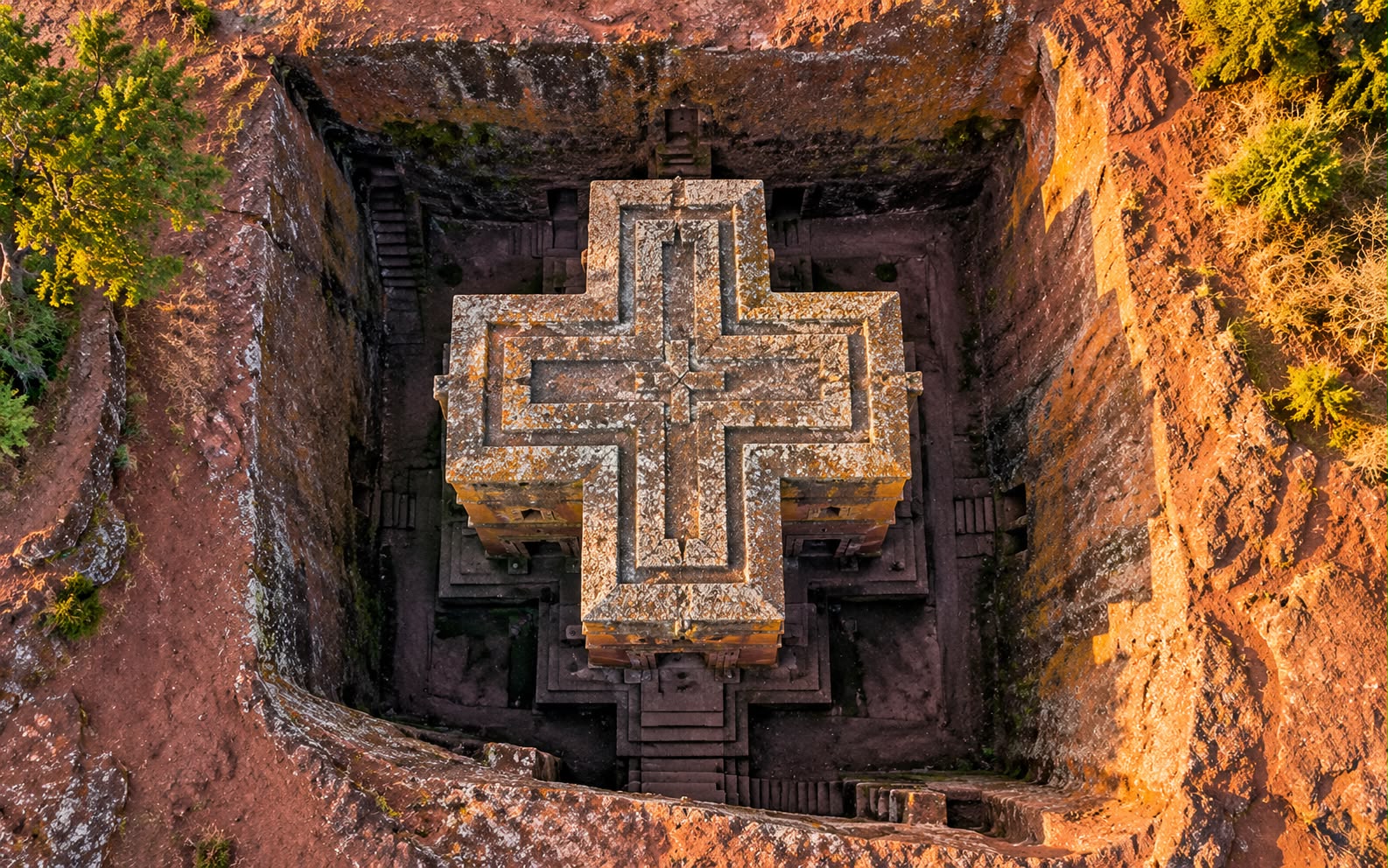
- 13:00 — Eleven churches carved downwards out of solid rock in the twelfth and thirteenth centuries — not built, excavated, with the roofs at ground level and trenches cut around them. UNESCO-listed and still in continuous use.
- Shoes off at every church, shoulders and knees covered, and some require a small payment to the attendant. Take thick socks; the floors are cold stone.
- 15:00 — The northern cluster, Bete Medhane Alem and Bete Maryam, with a guide — the tunnels between them are unlit and the symbolism needs explaining.
- 18:00 — The ticket is valid several days, so do not rush the first afternoon.
Day 3 — Lalibela at dawn
- 05:00 — Go at dawn. The priests hold services from five, the white shawls fill the trenches, and it is a working pilgrimage site rather than a monument.
- 07:30 — Bete Giyorgis, the cross-shaped one in its pit, is the image everyone knows — and the view down onto it from the rim is the photograph.
- 10:00 — The southeastern cluster, and Bete Abba Libanos with its roof still attached to the rock.
- 14:00 — Asheton Maryam on the mountain above, by mule or on foot, which almost nobody does.
- Genna, Ethiopian Christmas on 7 January, brings tens of thousands of pilgrims and is extraordinary and completely booked out — if those are your dates, book a year ahead.
Day 4 — To the Omo valley
- 08:00 — Fly to Jinka, via Addis, then drive.
- This is four days of hard driving on poor roads and the accommodation is basic. It is also unlike anywhere else.
- 15:00 — The Jinka museum for the background before you meet anyone, which makes a real difference to the days following.
- Agree the photography arrangement with your guide before you arrive at a village, pay what is asked, and accept a refusal.
- 18:00 — Jinka for the night.
Day 5 — Mago and the Mursi
- 06:00 — Mago and the Mursi, two hours in on a rough track, and the early start is what keeps it from being a procession.
- The lip plates are worn by choice and increasingly for visitors; the relationship is transactional on both sides and it is better to understand that than to pretend otherwise.
- 12:00 — Back to Jinka for lunch.
- 15:00 — The Key Afer market if it is Thursday — the markets run on fixed weekdays and are the best place to meet people on ordinary terms rather than as subjects.
- 18:00 — South toward Turmi, three hours.
Day 6 — The Hamar around Turmi
- 07:00 — The Hamar around Turmi, whose women wear ochred hair and heavy copper collars.
- The Hamar bull-jumping ceremony — a coming-of-age rite — is the one event worth timing for and happens most often between harvest and the rains, roughly July to October. It is not staged and attendance is by invitation through your guide.
- 11:00 — The Turmi market on its day, which is the better of the two big ones.
- 15:00 — The Karo at Korcho above the river, an hour out, on a bluff over the Omo — the best setting in the valley.
- 18:30 — Back to Turmi.
Day 7 — The Dassanech, and back north
- 07:00 — The Dassanech near the Kenyan border, reached by dugout across the Omo at Omorate.
- You are within a few kilometres of Kenya here and the border post is not one you can use — the crossing is done by air, back through Addis.
- 11:00 — North toward Arba Minch, four hours, which breaks the long drive back.
- 16:00 — Nechisar National Park or the boat on Lake Chamo for the crocodile market — some of the largest Nile crocodiles anywhere.
- 18:30 — The view over the two lakes from the Arba Minch ridge.
Day 8 — Back to Addis, fly to Nairobi
- 07:00 — Jinka or Arba Minch to Addis, then the two-hour hop south. A long day.
- 15:00 — Nairobi. The David Sheldrick elephant orphanage has a public hour at 11am and fostering visits in the afternoon, booked ahead — the afternoon slot is the one that fits today.
- Or Nairobi National Park, which is rhino and lion with the city skyline behind them, and is a genuine curiosity.
- 19:00 — Dinner, and repack into a soft bag: the Mara flight allows 15kg.
Day 9 — To the Masai Mara
- 09:00 — Forty-five minutes in a light aircraft onto a grass strip.
- Stay in a conservancy rather than the main reserve if you can — Naboisho, Olare Motorogi, Mara North. Vehicle numbers are capped, off-road driving is allowed, and night drives and walking are possible. The national reserve permits none of them.
- 12:00 — Lunch at camp, and the middle of the day off.
- 16:00 — The first afternoon drive, and a sundowner.
Day 10 — A full day out
- 05:30 — A full day out with a packed breakfast beats two short drives; the best three hours are between six and nine.
- The Mara has the best big-cat density in Africa. Lion are near-certain, cheetah likely, leopard a matter of luck and a good guide.
- 09:00 — The Mara River crossings happen July to September when the wildebeest are up from the Serengeti. You wait, often for hours, and it is worth it.
- 13:00 — Lunch under a tree.
- 17:00 — A night drive, which the conservancies permit and the reserve does not — genet, serval, aardvark if you are lucky.
Day 11 — The Mara, on foot
- 06:30 — A walking safari with an armed Maasai guide, which changes the scale of the place entirely — tracks, dung, insects, and the sense of being in it rather than above it.
- 10:00 — Back for breakfast.
- 15:30 — A last long drive, out to a sector you have not covered.
- 18:30 — Sundowner, and pack tonight.
Day 12 — To Amboseli
- 10:00 — A short hop south-east, usually via Wilson.
- Amboseli is elephants and Kilimanjaro — the mountain is in Tanzania and the view of it is from here, and it is clearest at dawn and dusk before the cloud builds.
- 14:00 — Settle, and the swamps in the afternoon. The swamps fed by snowmelt keep the elephants here year-round, and the family groups are among the most studied in the world — Cynthia Moss’s project has run since 1972.
- 17:30 — Observation Hill for the whole basin, which is the only place you are allowed out of the vehicle.
Day 13 — Amboseli
- 06:00 — Dawn for the mountain, which is the one hour it is reliably out.
- 09:00 — The elephant research camp if a talk is running, which some lodges arrange.
- 13:00 — The middle of the day off. Amboseli is dusty and hot and the game sits it out.
- 16:00 — A Maasai village visit if it is community-run — ask your camp which ones are.
- 18:00 — Dusk at the swamp, the second window for the mountain.
Day 14 — Fly out of Nairobi
- 09:00 — Back to Wilson, transfer to Jomo Kenyatta.
- Allow three hours between them; Nairobi traffic is severe and they are different airports — this is the single most common way people miss a flight on this route.
Costs and practicalities
Best time to visit
June–October suits both, which is lucky, because the two countries’ seasons do not otherwise agree.
- June–October — the best window. Ethiopia’s main rains have ended by late September but June to September is the kiremt wet season in the highlands, so the ideal is late September to October for Lalibela. Kenya’s July–October is the migration window, with the Mara River crossings usually July to September.
- October–November — the best of the year for Ethiopia: the highlands are green after the rains, the wildflowers are out and the light is clear. Kenya has the short rains, brief and usually afternoon only.
- December–February — dry, hot and clear in both. Genna, Ethiopian Christmas on 7 January, and Timkat on 19 January are the two great festivals; Kenya’s January–February is excellent game viewing with Amboseli’s Kilimanjaro views at their best.
- March–May — Ethiopia’s belg rains and Kenya’s long rains. Green, cheap, and some Mara camps close.
- The Omo valley is best November to March, when the roads hold; the Hamar bull-jumping is most frequent July to October, which is the trade-off.
Travel tips
- Check current advice for Ethiopia region by region. Tigray, Amhara and parts of Oromia carry severe warnings and the position changes; Addis, Lalibela and the far south have generally been outside them.
- Book Ethiopian domestic flights through Ethiopian Airlines if you flew in with them — the discount is substantial and frequently more than half.
- Ethiopia’s calendar and clock are different. Thirteen months, seven to eight years behind, and the day starts at dawn. Confirm every time and date in writing.
- Think about the Omo before you go, not while you are there. Agree the photography arrangement with your guide in advance, pay what is asked without haggling, and be willing to put the camera down.
- Soft bags, 15kg, for the Kenyan light aircraft. Enforced.
- Shoes off and shoulders covered at every Ethiopian church, and small notes for the attendants.
- Allow three hours between Wilson and Jomo Kenyatta in Nairobi. Different airports, severe traffic.
What this trip actually costs
Two people, 13 nights, mid-range comfort, international flights excluded:
| Item | Cost |
|---|---|
| Lodges, camps and hotels, 13 nights | USD 3,000 (≈ AED 11,018) |
| Internal flights in both countries, two people | USD 1,800 (≈ AED 6,611) |
| Omo valley 4x4, driver and guide, 4 days | USD 1,600 (≈ AED 5,876) |
| Mara and Amboseli park and conservancy fees | USD 1,200 (≈ AED 4,407) |
| Guides, church entries and community fees | USD 600 (≈ AED 2,204) |
| Food, drink and tips outside full board | USD 600 (≈ AED 2,204) |
| Total for two | USD 8,800 (≈ AED 32,318) |
- Roughly USD 4,400 (≈ AED 16,159) per person. The Kenyan half is the more expensive — park fees alone are a large fixed cost and no operator can discount them.
- Ethiopia is remarkably cheap on the ground and the internal flights are the main expense, which the Ethiopian Airlines discount softens considerably.
- Dropping the Omo saves about $2,000 for two and four days, and turns this into a Lalibela-and-safari trip, which is a perfectly good shorter version.
- Hotel picks here are chosen on location, not on commission — always check prices and recent reviews before booking.
What to pack
- A soft duffel, 15kg, for the Kenyan flights.
- Neutral colours for the Mara and Amboseli — not black or dark blue, which attract tsetse.
- A fleece and a windproof. Addis is 2,350m, Lalibela 2,500m and dawn game drives are genuinely cold.
- Shoes that come off easily and socks for the rock churches.
- Clean US dollars in small notes, and more than you expect for Ethiopia.
- Dust protection for cameras — the Omo roads and the Mara tracks are both severe.
- Binoculars each, and malaria prophylaxis for the Omo, the Mara and Amboseli.
FAQ
Is Ethiopia safe to visit? Parts of it are not, and the position changes. Tigray, Amhara and parts of Oromia carry severe warnings; Addis, Lalibela and the far south have generally been outside them. Check current advice rather than relying on this page.
Should I visit the Omo valley? It is the honest question this route raises. The photography economy has changed what those communities are to visitors. If you go, go with an operator working on agreed terms with the villages, pay what is asked, and be prepared not to take the picture.
Why Lalibela rather than the whole northern circuit? Because Axum, Gondar and the Simiens are in Tigray and Amhara, which have carried the severe warnings. Lalibela alone is the cautious version and it is the single most extraordinary site in the country.
When are the Mara river crossings? Usually July to September, and nobody can promise one on a given day — it is a moving population across a huge landscape.
Can I use one visa for both? No. Ethiopia and Kenya are separate, and the East Africa Tourist Visa covers Kenya, Uganda and Rwanda but not Ethiopia.
Prices and entry rules change, and what you need depends on your passport; last checked 9 November 2026, so confirm with the embassy or your airline before booking.


