 The Itinerary
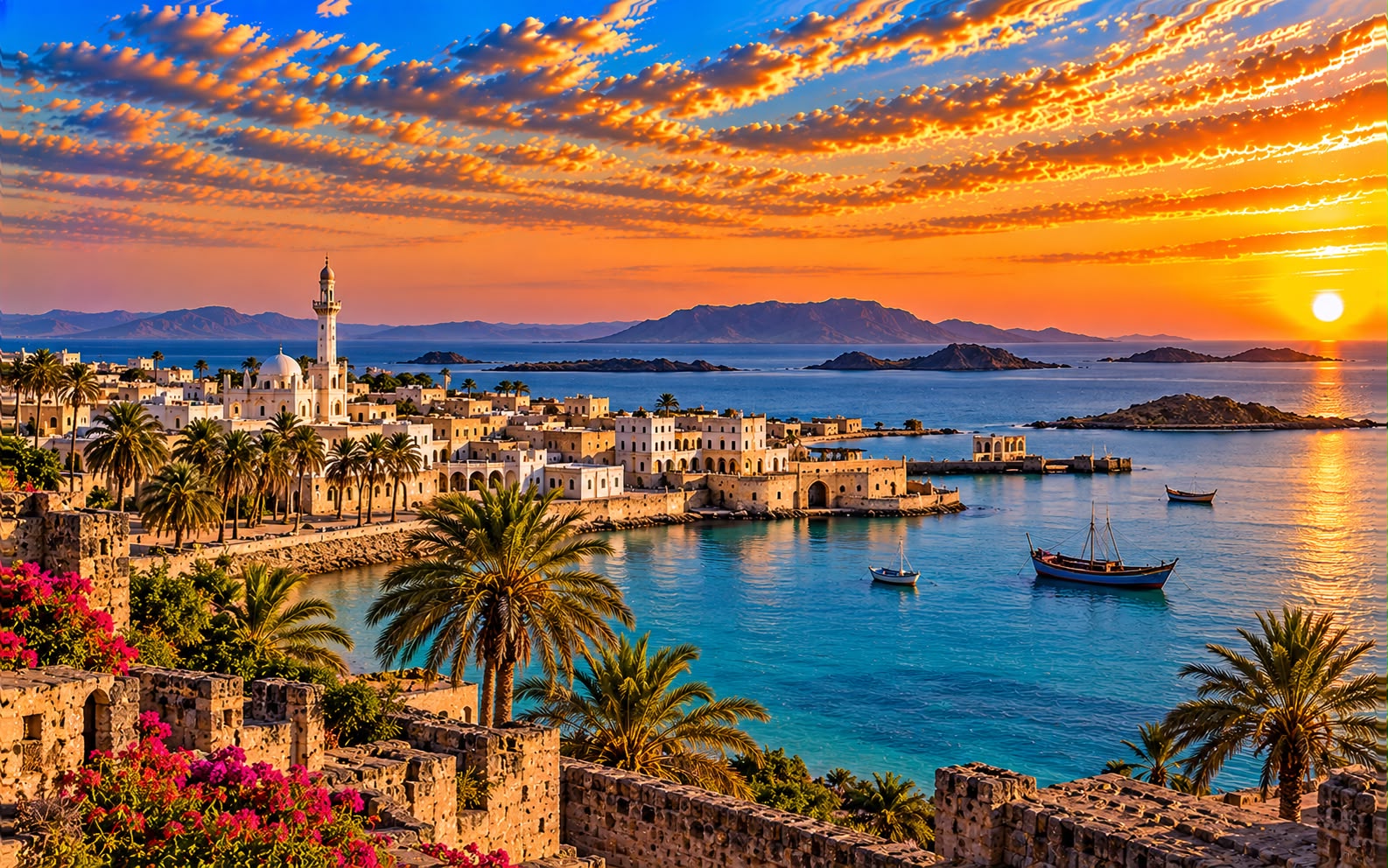
Eritrea in 8 days: Asmara's modernism, the Massawa road and the Dahlak islands
A capital listed by UNESCO for its 1930s modernism — a petrol station shaped like an aeroplane, cinemas with their original seats — reached by a steam railway that climbs from the Red Sea, in one of the most closed countries on earth where every road out of the city needs a permit.
- East Africa
- 8 days
- ≈ AED 4,200 / person
- A whole city of Italian futurist architecture, and a railway that climbs 2,300 metres on steam
Before you go
Read this first
Advice on Eritrea varies more than for most countries on this list, and is generally against all but essential travel, with stronger warnings for the border regions.
- The borders with Ethiopia, Sudan and Djibouti carry the strongest warnings; some remain militarised and landmines persist from the 1998–2000 war.
- There has been no national election since independence in 1993 and no implemented constitution. President Isaias Afwerki has held office throughout.
- Indefinite national service conscripts much of the adult population, which is the single largest driver of emigration and is the thing nobody will discuss with you.
- Travel permits are required for every journey outside Asmara, obtained in advance, specifying route and dates. Travelling without one means detention.
- Photography is tightly restricted and enforced — see below.
- Independent journalism is not permitted. Eritrea has ranked at or near the bottom of press freedom indices for two decades. Do not arrive on a tourist visa intending to report.
- Consular representation is limited, and communications are poor: internet is slow, expensive and monitored.
Eritrea is not a conflict zone. Asmara is widely described as calm and the street crime risk is low. The constraints here are political and bureaucratic rather than violent, and they are absolute. Check your own government’s advice, which reflects this week rather than this year.
Asmara is a UNESCO World Heritage site, listed in 2017 as “Africa’s Modernist City”, and it is unlike anywhere else on the continent. Italy built it as the capital of its colony in the 1930s, in rationalist and futurist styles that were being argued about in Milan at the same moment, and then the world lost interest and nothing was knocked down.
The Fiat Tagliero is the building everyone photographs: a 1938 service station shaped like an aeroplane, with two 15-metre concrete wings cantilevered out with no supports — the engineer reportedly had to stand under them with a pistol to prove it. The Cinema Impero of 1937 still has its original seats and its lion-head facade. The Africa Pension, the Bar Zilli, the covered market, the Enda Mariam Orthodox cathedral and the Great Mosque are all within a walk of each other.
The city sits at 2,300 metres, is cool, and is walkable in a way almost no African capital is. Coffee culture here is Italian, serious, and cheap, and the evening passeggiata along Harnet Avenue is a real institution rather than a tourist-board invention.
The Massawa road drops from Asmara to the Red Sea in about 110 kilometres, through switchbacks and cloud, alongside the Eritrean Railway — a 950mm narrow-gauge line built by the Italians, destroyed in the wars, and rebuilt by hand by retired railwaymen in the 1990s. It runs on steam, for charters.
Massawa was one of the great Ottoman and Egyptian ports of the Red Sea; it was shelled heavily in the independence war and much of the old town is still damaged. The Dahlak Archipelago beyond it is 200-odd mostly uninhabited islands with unexploited reefs.
Eight days. Figure USD 1,150 (≈ AED 4,223) per person. October to March — Massawa in summer is among the hottest places on earth.
Before you go: the 15-minute admin
Entry
- A visa is required and takes time. Apply through the embassy with an itinerary and hotel confirmations; approval is not guaranteed and reasons are not given.
- Yellow fever certificate if arriving from an endemic country.
- Asmara International is the entry point, usually via Cairo, Dubai, Addis Ababa or Istanbul.
- Travel permits for everywhere outside Asmara are applied for at the Ministry of Tourism once you arrive — allow a working day, and have your hotel or guide do it.
Money
- The nakfa (ERN) is fixed by decree at 15 to the dollar and is not convertible. The official rate is not a rate anyone transacts at and the parallel market is illegal.
- You must declare foreign currency on arrival and the form is checked on departure. Keep every exchange receipt. Discrepancies cause real problems at the airport.
- Change money only at banks or the hotel, against receipts.
- Cards do not work. None of them, anywhere. Bring every dollar in cash.
- You cannot take nakfa out, and you cannot change it back without receipts.
On the ground
- Permits before every journey. Carry them; they are checked at roadblocks between regions.
- Do not photograph military, police, government buildings, the airport, bridges, dams, the port, or anything that could be called infrastructure. This is enforced and people are detained for it. Asmara’s architecture is fine; ask about anything else.
- Do not discuss national service, politics or the president with anyone. Not because you will be harmed, but because they might be.
- Internet is slow and limited and roaming generally does not work. Tell people at home you will be out of contact.
- Fuel shortages affect intercity transport periodically.
Day by day
Day 1 — Asmara
- Travel permits are required for everywhere outside Asmara, issued by the Tourism Ministry and taking a day or two. Your first day is partly the permits.
- Declare your foreign currency on arrival and keep the form; you have to reconcile it on the way out and people have had money taken for not.
- 10:00 — Walk Harnet Avenue end to end, which takes twenty minutes and orients the whole city.
- 11:00 — The Fiat Tagliero, the 1938 service station built as an aeroplane with 15-metre cantilevered concrete wings and no supports — the engineer was made to sign a guarantee before they removed the formwork.
- 14:00 — The Cinema Impero, the Cinema Roma, the Opera House and the Governor’s Palace.
- 18:00 — Harnet Avenue again at six, when the whole city is out — the passeggiata is a genuine daily event here.
- Do not photograph government buildings, the airport or anything military. This is enforced.
Day 2 — The market, and the tanks
- 09:00 — The covered market, and the medebar, the recycling quarter, where oil drums become cooking stoves and the sound is remarkable — hundreds of hammers at once.
- 12:00 — Coffee at the Bar Zilli or the Sweet Asmara Caffé, which is the point of the city as much as any building. Macchiato, standing at the counter.
- 15:00 — The Tank Graveyard on the edge of town — a vast field of wrecked Soviet and Ethiopian armour from the independence war. Confirm photography is permitted before you lift a camera here.
- 17:30 — The Nda Mariam cathedral and the mosque and synagogue on the same street, which Asmara makes nothing of and which is worth noticing.
- Collect the permits tonight for tomorrow.
Day 3 — Keren
- 07:00 — Permit in hand, two and a half hours north-west, through the escarpment.
- 10:00 — The Monday camel market, which is the real thing and not staged — so make this a Monday if you can shape the week around it.
- 12:30 — The Tigu, the Egyptian fort above the town.
- 14:00 — The Mariam Dearit shrine — a statue of the Virgin inside the trunk of a living baobab, which is a pilgrimage site every May.
- 16:00 — The Commonwealth War Cemetery from the 1941 battle, which is immaculately kept and very quiet.
- 18:30 — Back to Asmara, and the road is not one to drive after dark.
Day 4 — Down to Massawa
- 08:00 — The steam railway, if a charter can be arranged — it is run for groups and costs real money, and the section from Asmara to Nefasit through the tunnels and along the cliff edge is one of the great railway journeys anywhere.
- Otherwise drive the Massawa road, which runs alongside it and is spectacular in its own right: 2,300 metres down to sea level in two and a half hours.
- 13:00 — Into Massawa, and the heat. Massawa is brutal from April onwards and warm even in January.
- 17:00 — Massawa old town on Batsi island — Ottoman coral-block houses with carved wooden balconies, the Sheikh Hanafi mosque, the Imperial Palace still shell-damaged and roped off.
- 19:30 — Fish at the harbour, grilled whole.
Day 5 — Massawa, and the causeway
- 07:00 — The old town again before the heat, which is the only sensible hour for it.
- 09:00 — The causeway islands — Taulud and Batsi — and the Dahlak hotel ruins, which are a 1970s wreck.
- 12:00 — Out of the sun entirely. Massawa at midday in summer is 45°C with full humidity.
- 16:30 — The port approaches and the market, and the Ottoman and Egyptian layers of the town are easiest to read late.
- Arrange the Dahlak permit and boat tonight.
Day 6 — The Dahlak Archipelago
- 07:00 — A boat out to Dissei or Madote, a couple of hours each way.
- Permits cover the islands separately. Your guide arranges this with the Massawa port authority.
- 10:00 — The reefs are genuinely unexploited and the visibility is good from October to March. Bring your own snorkel gear; the rental situation is unreliable.
- 13:00 — A few islands are inhabited by Afar and Rashaida communities, and visits are arranged rather than improvised.
- 17:00 — Back to Massawa.
Day 7 — Back up, and the Debre Bizen road
- 07:00 — The climb back to Asmara, which is a different drive in this direction.
- 09:00 — Stopping at Nefasit for the Debre Bizen monastery on the mountain above it — a two-hour walk up, founded in 1361, and men only, which is the rule and is not negotiable.
- 14:00 — Dekemhare or Segheneyti on the way, for the dragon blood trees on the escarpment.
- 17:00 — Into Asmara, and the avenue again at six.
Day 8 — Asmara and out
- 09:00 — The National Museum for the Qohaito and Adulis material — the pre-Aksumite ports and cities on the Red Sea trade route.
- 11:00 — Buy coffee and honey from the market.
- 13:00 — Reconcile your currency declaration before the airport, not at it. This is the single most common way visitors have a bad last hour in Eritrea.
- Leave wide margins. Flights are few and the formalities are long.
Costs and practicalities
Best time to visit
October–March. Eritrea has three climates stacked on top of each other and the altitude matters more than the month: Asmara sits at 2,350m and is temperate, while Massawa at sea level is one of the hottest ports on earth.
- October–March — the best window. Asmara is cool and clear, and Massawa and the Dahlak islands are merely hot rather than impossible. Diving visibility in the Dahlaks is best from October to March.
- April–May — rapidly warming; Massawa becomes difficult.
- June–September — Massawa routinely passes 45°C with humidity, and the Red Sea coast is best avoided entirely. Asmara has its main rains July–August, with afternoon storms.
Asmara is cold at night all year. At 2,350m the evenings catch out everyone who packed for Africa.
Travel tips
- A travel permit is required for every journey outside Asmara, applied for at the Ministry of Tourism and checked at roadblocks. Allow a working day and have your guide do it.
- No card works, anywhere. Bring the entire budget in US dollars cash, declare it on arrival, and keep every exchange receipt — the declaration is checked on departure.
- The nakfa is fixed by decree and is not convertible. You cannot take it out and cannot change it back without receipts.
- Photograph the architecture, nothing else. Military, police, government buildings, the airport, bridges, dams and the port are all prohibited and this is enforced.
- Do not discuss national service, politics or the president with anyone — the risk is to them, not to you.
- Internet is slow, expensive and limited, and roaming generally does not work. Tell people at home you will be out of contact.
- Warm layers for Asmara and light clothing for Massawa. You need both on the same trip.
What this trip would cost
Two people, 7 nights, mid-range comfort, international flights excluded:
| Item | Cost |
|---|---|
| Hotels, 7 nights | USD 700 (≈ AED 2,571) |
| Car with driver and guide, 8 days | USD 800 (≈ AED 2,938) |
| Food, drink and coffee, 8 days | USD 300 (≈ AED 1,102) |
| Permits, Dahlak boat, entries | USD 500 (≈ AED 1,836) |
| Total for two | USD 2,300 (≈ AED 8,447) |
- Roughly USD 1,150 (≈ AED 4,223) per person. Eritrea is cheap on the ground and expensive to reach — the flights are the real cost.
- A steam railway charter is not in this figure. It is arranged for groups and runs into four figures for the train, so it only makes sense shared.
- Every dollar in cash, declared on arrival, with receipts kept.
- Figures are indicative.
- Hotel picks here are chosen on location, not on commission — always check prices and recent reviews before booking.
What to pack
- US dollars in cash for the whole trip, and the discipline to keep every receipt.
- Warm layers for Asmara. At 2,300 metres the evenings are cold and this surprises everybody.
- Light clothing for Massawa, which is a different climate entirely.
- Your own snorkel and mask for Dahlak.
- Any medication you need — pharmacies are limited.
- A book. The internet will not entertain you.
FAQ
Can I visit Eritrea? Yes, with a visa that takes time and may be refused without explanation. Advice is generally against all but essential travel, with stronger warnings for border regions. It is not a conflict zone; the constraints are political.
Do I really need a permit to leave Asmara? Yes, for every journey, specifying route and dates, and it is checked at roadblocks. Travelling without one means detention.
Will my cards work? No. Nothing. Bring the entire budget in cash, declare it on arrival, and keep your exchange receipts for the departure check.
Can I photograph the architecture? Asmara’s buildings, generally yes. Anything military, official, or infrastructural, no — and that includes bridges, the port and the airport. Ask your guide every time.
Does the steam train still run? Yes, for chartered groups, maintained by retired railwaymen who rebuilt the line by hand in the 1990s. It is not a scheduled service.
What language do they speak? Tigrinya and Arabic are the working languages; English is the language of secondary education and is widely understood. Italian survives among older Asmarinos.
Prices and entry rules change, and what you need depends on your passport; last checked 29 October 2026, so confirm with the embassy or your airline before booking.


