 The Itinerary
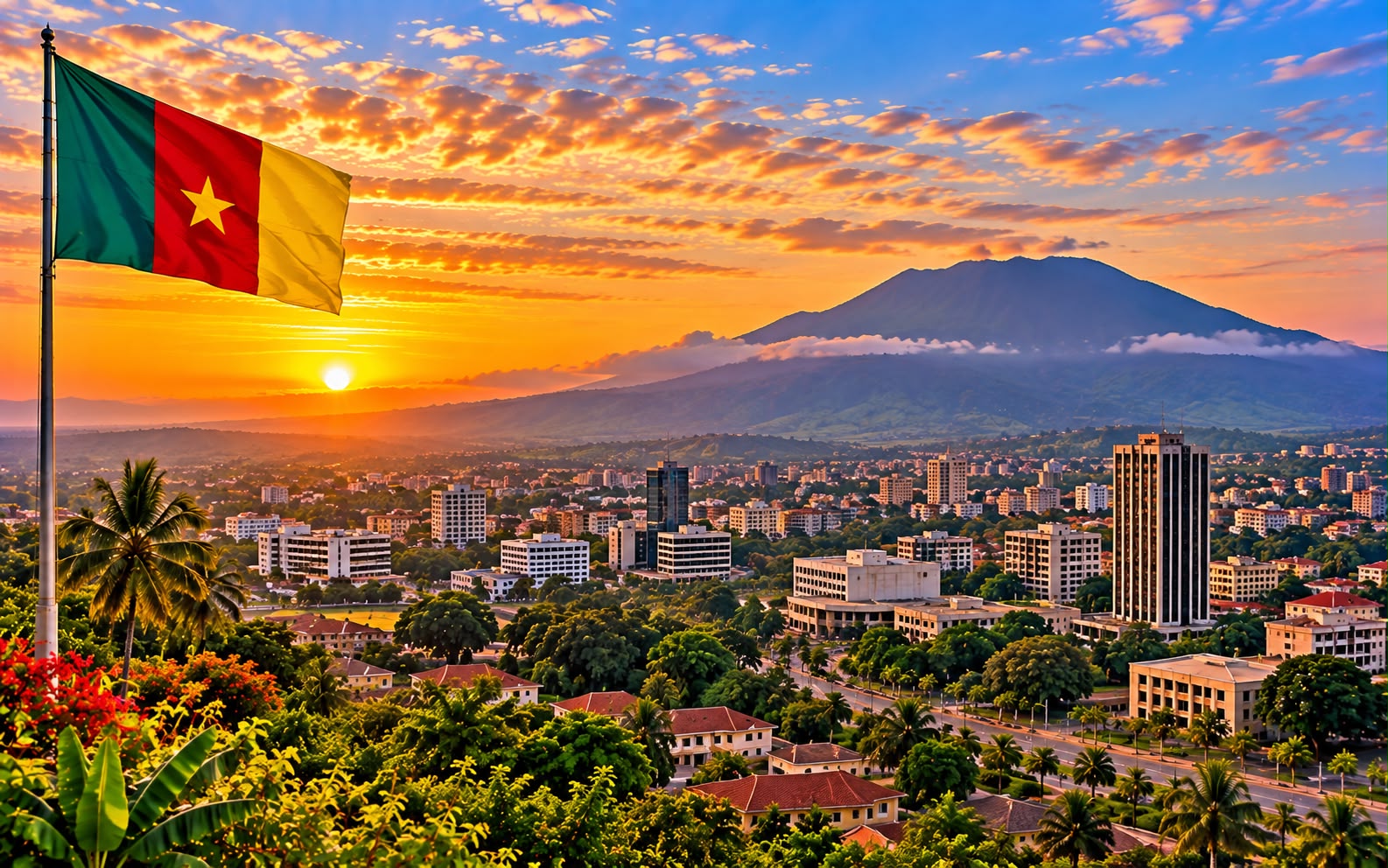
Cameroon in 8 days: Kribi's beaches, the Bamoun palace and the western highlands
A river that drops straight into the Atlantic over a rock shelf, a 1917 palace where the Bamoun sultans still hold court, volcanic highlands of crater lakes and chiefdoms — routed deliberately around the three regions that carry travel warnings.
- Central Africa
- 8 days
- ≈ AED 3,100 / person
- A waterfall that falls into the sea, and a sultan's palace still in use
Before you go
Cameroon is called Africa in miniature because it has nearly everything the continent has: desert in the far north, rainforest in the south, a 4,000-metre volcano on the coast, savanna, highlands and a beach where a river falls into the sea.
It also has three regions that carry serious travel warnings, and they contain several of the famous sights. This itinerary is built around that constraint rather than pretending it does not exist — the first section below says exactly which regions and why, and the route stays out of all of them.
What is left is still a very good eight days.
Kribi has the Lobé Falls, where the river drops over a rock shelf directly into the Atlantic — one of very few places on earth where that happens — on a coast of white sand and grilled fish.
Foumban has the Sultan’s Palace, built in 1917 by Sultan Njoya, who also invented a writing system for his own language and drew up his own legal code. The Bamoun dynasty goes back to the fourteenth century and still occupies the building, with a museum beside it holding the thrones, the masks and the beaded regalia.
The Western highlands around Bafoussam are volcanic, cool and green, dotted with crater lakes and with the chiefdoms — chefferies — of the Bamileke, whose carved and thatched compounds are among the best vernacular architecture in Africa.
Eight days, based on Yaoundé and Douala. Figure USD 850 (≈ AED 3,122) per person excluding flights. Go November–February, the main dry season.
Before you go: the 15-minute admin
Three regions this trip deliberately avoids
- Far North. Boko Haram activity near the Nigerian and Chadian borders. Most governments advise against all travel. Waza National Park, the Mandara Mountains and Rhumsiki are all here.
- North-West and South-West. The Anglophone separatist conflict has run since 2016, with “ghost town” lockdowns, roadblocks and kidnappings. Most governments advise against all travel. Mount Cameroon at Buea, Limbe, Bamenda and the Ring Road are all here.
- Parts of the Adamawa and East regions near the Central African Republic border also carry warnings.
- This itinerary stays in the Centre, Littoral, South and West regions, which are not normally in that category. The West region around Bafoussam and Foumban is a different administrative region from the North-West around Bamenda — the names are confusingly similar and the distinction matters.
- Read your own government’s current advice before booking, and check it again before you fly. It changes, and so do the boundaries of what is named.
- Check your insurance covers the regions you will actually be in.
Visas and vaccinations
- Most nationalities need a visa in advance. An e-visa system exists; many still apply through the embassy with a hotel booking, a return ticket and a yellow fever certificate.
- Yellow fever vaccination is compulsory and is checked at the airport.
- Malaria is present year-round and is the real health risk here. Take prophylaxis and take advice early.
- Carry printed copies of everything. Paper is asked for.
Money
- The Central African CFA franc (XAF), pegged to the euro at a fixed rate. Note it is not interchangeable with the West African CFA used in Benin and Senegal, despite the identical name and value.
- Bring euros in cash. Cards work at a few Douala and Yaoundé hotels and nowhere else; ATMs in the big cities sometimes take foreign cards and should not be relied on.
- Mobile money is how the country actually pays for things, and your guide can use it on your behalf.
- Costs are moderate: cheap food, reasonable hotels, and transport as the main expense.
SIM and data
- MTN and Orange sell SIMs; passport required. Coverage is good along the south and west.
Getting around
- Hire a car with a driver. Around $110–140 a day. Roads between the main cities are sealed and busy; driving standards are poor and night driving is a bad idea.
- Yaoundé to Douala is about four hours by road. There is also a train, which is slow and has a chequered reliability record.
- Douala to Kribi is about three hours; Douala to Bafoussam about five.
- Expect frequent police checkpoints. Carry your passport, your vaccination certificate and copies of everything. Let your driver handle it. Small “facilitation” requests are common; your driver will know how to deal with them.
Language
- French and English are both official, but the split is regional: the Francophone majority covers everywhere this itinerary goes. English is the first language of the North-West and South-West, which this route avoids.
- In practice, French is what you need.
Travelling with kids?
- Kribi is a genuine beach holiday and works well.
- The drives are long and the roads are tiring.
- Medical facilities outside Douala and Yaoundé are limited. Evacuation cover is essential, as is malaria prophylaxis.
Day by day
Day 1 — Yaoundé
- Afternoon — Arrive at Yaoundé Nsimalen, 45 minutes from the centre. The city is spread over seven hills and is cooler and calmer than Douala.
- 16:00 — The National Museum in the former presidential palace: masks, thrones and bronzes from the Grassfields and the forest kingdoms, well presented.
- 18:00 — Mont Fébé for the view over the city at dusk.
Where to stay in Yaoundé (two nights across the trip)
- Mid-range: Bastos, the diplomatic quarter, quiet and green.
- Value: the centre around Nlongkak.
Day 2 — South to Kribi
- 07:30 — Drive south-west to Kribi, about four hours through rubber and palm plantations.
- 12:30 — Lunch on the beach. Kribi grills prawns and fish on the sand and has done for decades.
- 15:00 — The Lobé Falls, a few kilometres south — the Lobé river coming down over a wide rock shelf directly into the sea. You can take a pirogue upriver, and swim in the pools above the drop.
- 17:00 — The beach at Londji or the long stretch north of town.
Where to stay in Kribi (two nights)
- Mid-range: the hotels along the beach road south towards Lobé.
Day 3 — Kribi
- A deliberate slow day. Beach, pirogue up the Lobé, and the fish market.
- Optional: a guided visit to a Bagyeli community inland, arranged through a responsible operator. Do this only through someone who works with the community regularly — the alternative is the sort of visit nobody involved benefits from.
- Evening — The grilled fish shacks on the beach are the best meal of the trip.
Day 4 — Douala
- 09:00 — North to Douala, about three hours.
- 13:00 — Douala is the economic capital, a port, hot, humid and loud. The Doual’art centre and the Marché des Fleurs are the manageable half of it; La Nouvelle Liberté, the sculpture at the Deido roundabout made from scrap, is the city’s own emblem.
- 16:00 — The Musée Maritime or the colonial Pagode — the palace built for King Manga Bell — if it is open.
Day 5 — Up to the Western highlands
- 07:30 — North-west to Bafoussam, about five hours, climbing out of the heat into volcanic highlands at 1,500 metres.
- 14:00 — The Bandjoun chiefdom, one of the best preserved Bamileke chefferies: a great thatched conical meeting house on carved pillars, with the compound around it, and a museum.
- 17:00 — Bafoussam for the night. It is noticeably cool after the coast.
Where to stay in Bafoussam or Foumban (two nights)
- Mid-range: Bafoussam town for choice, or a guesthouse near Foumban’s palace for atmosphere.
Day 6 — Foumban
- 08:30 — East to Foumban, about an hour and a half, and a different kingdom — the Bamoun, Muslim where the Bamileke are not, with a dynasty traced to 1394.
- 10:00 — The Sultan’s Palace, built in 1917 by Sultan Njoya, who devised the Bamoun script for his own language, wrote a history of his people in it, and drew up a legal code. The palace is still the sultan’s residence. The museum beside it holds the thrones, the royal masks, the beaded figures and the double gong.
- 13:00 — The artisans’ quarter on the road below — bronze casters, beadworkers and carvers, several of them families who have supplied the palace for generations.
- 16:00 — Back to Bafoussam, stopping at the Chutes de la Métché or a crater lake on the way.
Day 7 — The highlands, and back south
- 08:00 — The Bamendjou or Bafut-style chiefdoms around Bafoussam, and the Lac Baleng crater lake.
- 11:00 — The long drive back to Yaoundé, about five hours.
- 17:00 — Yaoundé. Last dinner.
Day 8 — Fly out
- Morning — The craft market at Mvog-Mbi or the artisanal centre for masks and beadwork.
- Afternoon — Nsimalen airport. Allow plenty of time for the road.
Costs and practicalities
Best time to visit
November–February in the north and the dry months generally, though Cameroon is called “Africa in miniature” for a reason — the south is equatorial and the far north is Sahelian, and they do not share a season.
- The south and west (Douala, Kribi, Bamenda highlands) — two dry spells, December–February and a shorter one in July–August. The rest is wet, and Debundscha near Mount Cameroon is one of the wettest places on earth.
- The north (Garoua, Maroua, Waza) — dry November–April, and Waza National Park is only worth visiting in the dry, when game concentrates on the waterholes. March and April are extremely hot.
- Mount Cameroon is climbable in the drier months; the annual Race of Hope is in February.
- Kribi’s beaches are best in the short dry season from December to February.
Travel tips
- Travel advice for the Far North, the Northwest and Southwest regions is severe — Boko Haram in the north, the Anglophone crisis in the west. Check current wording before routing anything through them.
- Carry your passport everywhere. Checkpoints are frequent and police will ask; a photocopy is not always accepted.
- Cameroon is bilingual on paper and French in practice for about four-fifths of the country. English works in Bamenda and Buea, which is part of the political problem.
- The CFA franc is pegged to the euro. Bring euros; cards work in Douala and Yaoundé hotels only.
- A yellow fever certificate is required and checked on arrival. Malaria is year-round and chloroquine-resistant.
- Do not photograph military, police, airports, bridges or government buildings. This is enforced hard.
- Agency buses between cities are far safer than shared taxis. Avoid night travel on any road.
What this trip actually costs
Two people, 7 nights, mid-range comfort, flights excluded:
| Item | Cost |
|---|---|
| Hotels, 7 nights | USD 560 (≈ AED 2,057) |
| Car with driver, 6 days | USD 720 (≈ AED 2,644) |
| Food and drink, 8 days | USD 280 (≈ AED 1,028) |
| Entries, guides, chiefdom fees | USD 140 (≈ AED 514) |
| Total for two | USD 1,700 (≈ AED 6,243) |
- Roughly USD 850 (≈ AED 3,122) per person. The driver is nearly half of it and is not the place to economise.
- Chiefdoms and palaces charge a visitor fee and usually expect a guide; both are small and both are worth paying.
- Mobile money is how most things are actually settled — agree with your driver how you will handle it.
- Cash only, in euros, changed in Douala or Yaoundé.
- Hotel picks here are chosen on location, not on commission — always check prices and recent reviews before booking.
What to pack
- Yellow fever certificate and malaria prophylaxis — both essential, the first checked at the border.
- Euros in cash and copies of every document.
- A warm layer for the highlands, which are cold at night at 1,500 metres.
- Rain gear — the south is one of the wettest places in Africa, even in the dry season.
- Modest clothing for Foumban, which is Muslim, and for the chiefdoms.
FAQ
Can I climb Mount Cameroon? Not on this itinerary. Mount Cameroon is at Buea in the South-West region, which carries an advise-against-all- travel warning from most governments because of the Anglophone conflict. That has been the position since 2016 or so. Check current advice if it matters to you, but do not assume it has changed.
Is Cameroon safe? It depends entirely on the region, which is why that is the first section of this guide. The Centre, Littoral, South and West — where this route goes — are not normally subject to the warnings that cover the Far North and the two Anglophone regions.
What about the national parks? Waza, the most famous, is in the Far North and is effectively off the table. Dja Faunal Reserve, a UNESCO rainforest in the South, is accessible but needs several days and real planning; Campo Ma’an near Kribi is the practical option on a trip like this.
Do I need French? Yes, or a guide who has it. The regions where English is the first language are the ones this itinerary avoids.
Is eight days enough? For the south and west, yes. Cameroon’s problem is not distance but that the famous north is currently out of reach.
Prices and entry rules change, and what you need depends on your passport; last checked 8 October 2026, so confirm with the embassy or your airline before booking.


