 The Itinerary
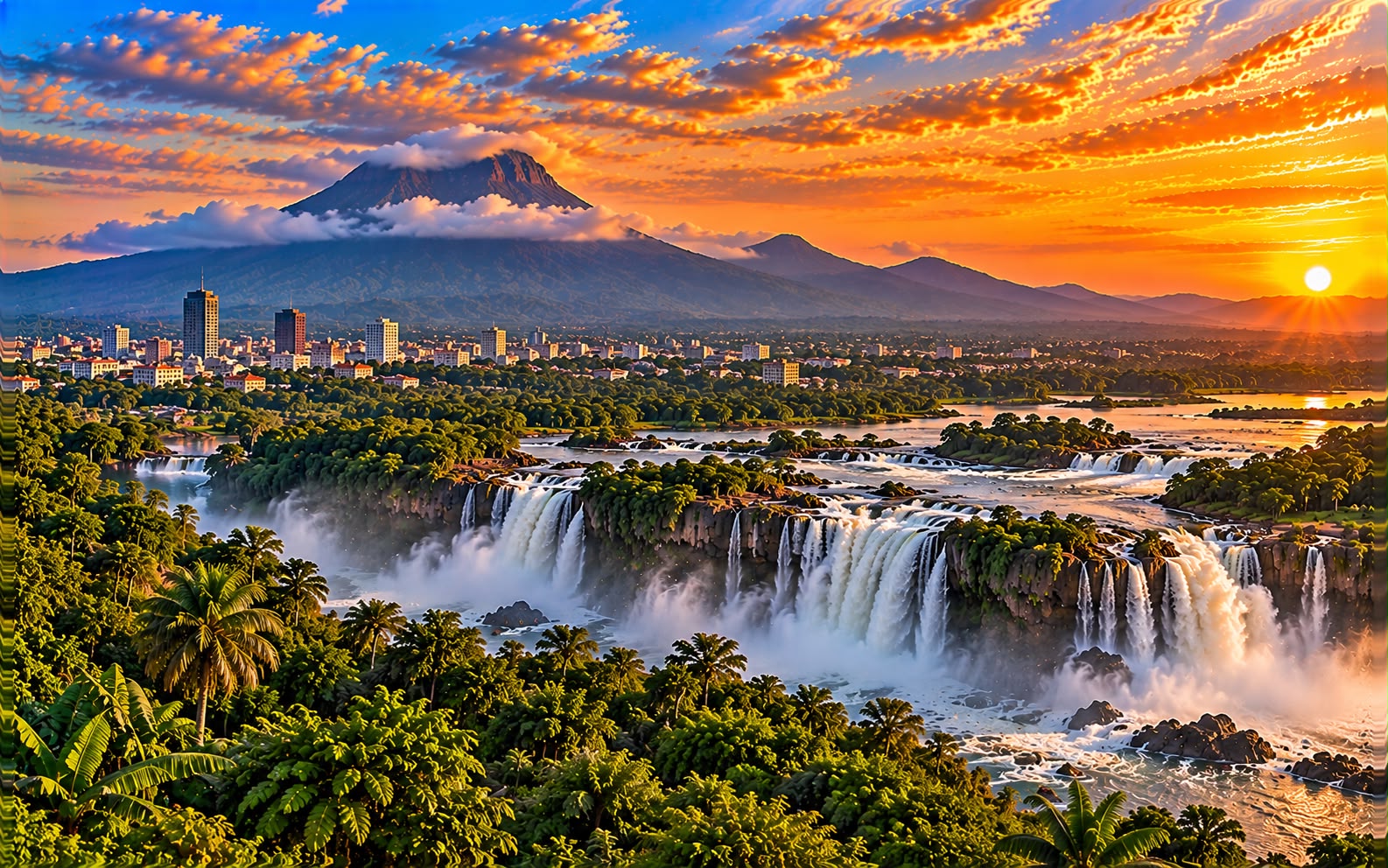
DR Congo in 7 days: Kinshasa, the bonobos of Lola ya Bonobo and the river — and the east you cannot reach
An ape that exists on one side of one river and nowhere else on earth, a sanctuary outside a city of seventeen million, and the rumba that half a continent dances to — alongside Virunga's gorillas and Nyiragongo's lava lake, which are the country's great draw and are currently closed.
- Central Africa
- 7 days
- ≈ AED 5,150 / person
- The only great ape found nowhere but here, and the loudest music city in Africa
Before you go
Read this first
The Democratic Republic of the Congo is two entirely different propositions, and conflating them is how people get hurt.
The east — North Kivu, South Kivu, Ituri — is at war. Most governments advise against all travel to it.
- M23, backed by Rwanda according to UN experts, took Goma in January 2025 and holds territory across North and South Kivu.
- The ADF, affiliated to the Islamic State, attacks civilians in Ituri and North Kivu.
- Dozens of other armed groups operate across the east.
- Virunga National Park has been closed to tourism since 2021 and the 2025 offensive removed any remaining question. More than two hundred of its rangers have been killed protecting it.
- Kahuzi-Biega, near Bukavu, holds Grauer’s gorillas and is in the same conflict zone.
The west — Kinshasa and its surroundings — carries a lesser warning, typically against all but essential travel, and functions.
- Crime in Kinshasa is serious, particularly at night and around the airport road.
- Police and military shakedowns at checkpoints are routine and are best handled by a local fixer, not by you.
- Photography is restricted in a way that catches visitors out constantly — see below, because this one lands people in a cell.
- Ebola outbreaks have occurred repeatedly, usually in the north and east, and are generally contained.
This guide covers the west. It describes the east so you know what is there and why you cannot go. Check your own government’s advice, which reflects this week rather than this year.
The bonobo lives on the left bank of the Congo River and nowhere else on earth. Not in Congo-Brazzaville across the water, not in Uganda, not anywhere — the river itself is the boundary, and they have been on the south side of it for perhaps two million years. They are the ape that resolves conflict with sex rather than violence, live in female-led groups, and are the closest living relative of humans alongside the chimpanzee.
Lola ya Bonobo, on the edge of Kinshasa, is the only bonobo sanctuary in the world. It takes in orphans of the bushmeat trade, rehabilitates them in forest enclosures, and has run the only successful great ape reintroduction programme of its kind, releasing groups into the Basankusu forest since 2009. Paradise for bonobos is what the name means in Lingala.
Kinshasa is seventeen million people and the loudest music city in Africa. Congolese rumba was inscribed by UNESCO in 2021 — Franco, Tabu Ley, Papa Wemba, Koffi Olomidé, and the soukous that travelled from here to every dancefloor on the continent. The SAPE, the Society of Ambianceurs and Persons of Elegance, is here too, and is less a subculture than a running argument about dignity conducted in tailoring.
The Congo River at Kinshasa is a vast brown sheet of water with Brazzaville visible on the far bank — the only place on earth where two capital cities face each other across a river. Downstream it falls through the Livingstone cataracts, which is why no ship has ever sailed from the Atlantic to Kinshasa.
Salonga National Park, UNESCO-listed and the largest tropical rainforest reserve in Africa, is accessible only by river and has effectively no visitor infrastructure. Garamba and the Okapi Wildlife Reserve are both listed, both in danger, and both in the troubled north-east.
Seven days. Figure USD 1,400 (≈ AED 5,142) per person. June to September, the dry season in the west.
Before you go: the 15-minute admin
Entry
- A visa is required and needs a letter of invitation from a sponsor in the country — a hotel, an operator or an organisation. Start six weeks out.
- Yellow fever vaccination is mandatory and genuinely checked at N’djili airport.
- Arrival at N’djili is a process. Arrange a meet-and-greet through your hotel. It is worth every franc and it is normal here.
- Do not travel to the east on this visa and assume it is fine.
Money
- The Congolese franc (CDF) is used for small purchases; US dollars run everything else, and Kinshasa quotes in them.
- Dollars must be clean, post-2013, unmarked and untorn. Older or damaged notes are refused outright. This catches people out more than anything else on this list.
- Cards work at a handful of hotels. Carry cash for everything else.
On the ground
- Use a fixer or a hotel driver. Not a convenience — the thing that makes checkpoints and the airport road routine instead of expensive.
- Do not photograph bridges, the river frontage, government buildings, the airport, uniforms, or anything that might be infrastructure. People are detained for this regularly, including for photographing apparently innocuous things near the river. Ask your fixer before raising a camera anywhere in the city.
- Avoid moving at night outside a vehicle you arranged.
- Demonstrations happen and are policed hard. Leave the area.
Day by day
Day 1 — Kinshasa, arriving
- Clear the airport with help, get to the hotel, and do nothing ambitious.
- The Gombe quarter in the late afternoon, which is the part of the city that works for a first walk.
- The Congo at sunset from a riverside terrace, with Brazzaville across the water.
Day 2 — Lola ya Bonobo
- Forty-five minutes south on the Route de Matadi to the sanctuary at Petites Chutes de la Lukaya.
- The enclosures are forest, not cages, and the groups are genuinely social. A keeper will explain who is related to whom, and the stories are how each of them arrived.
- Go in the morning. Feeds are earlier and the apes are far more active before the heat.
- The reintroduction programme is the part worth asking about — releases into Basankusu, and what it takes to make a released group survive.
- Book ahead. It is a sanctuary with a research and welfare programme attached, not a zoo with a gate.
Day 3 — The city properly
- The Marché de la Liberté or Marché Central, with your fixer, for the scale of it.
- The Académie des Beaux-Arts, which is the best single stop in Kinshasa: sculpture and painting being made in the courtyards, and work for sale directly from the artists.
- The Musée National de la RDC, in its Korean-built home on Mont Ngaliema, holding a collection that spent decades in storage.
- The Symphonie des Arts or whichever orchestra and choir are rehearsing — Kinshasa has a symphony orchestra assembled largely from self-taught musicians and it is extraordinary.
Day 4 — Zongo Falls
- Three hours south-west on the Inkisi River, where the water drops about sixty-five metres into a gorge.
- A long day trip or an overnight at the lodge, which is the better version.
- The road is the trip as much as the falls — the Bas-Congo countryside is a different country from Kinshasa.
Day 5 — The river
- A boat on the Congo, upstream towards Maluku, past fishing villages and the barges that are the only transport for a thousand kilometres inland.
- Kinkole fish market in the morning for the river’s catch, including the capitaine that ends up on every menu in the city.
- Do not photograph from the boat without clearing it first.
Day 6 — Music
- Find out what is on. Kinshasa’s live music does not advertise in any form you can read from abroad; your fixer will know.
- A rumba or ndombolo night in Matonge, which is the quarter the music came out of.
- The SAPE are visible on Sunday afternoons in Bandal and Matonge, and will generally be pleased to be photographed — ask, and expect it to be a transaction.
Day 7 — Out
- Leave several hours for N’djili, and use the hotel’s transfer.
- Keep small dollars accessible for the exit formalities.
Costs and practicalities
What the east holds, and why it is closed
- Virunga National Park is Africa’s oldest, UNESCO-listed in 1979 and in danger since 1994. It holds a third of the world’s mountain gorillas, the Nyiragongo lava lake — the largest permanent one on earth — and the Rwenzori glaciers. Tourism has been suspended since 2021. Over two hundred rangers have died defending it.
- Kahuzi-Biega holds Grauer’s gorilla, the largest primate alive, found only in eastern DRC and down by perhaps 80% in two decades.
- Nyiragongo erupted in May 2021, killing dozens and destroying part of Goma. Goma fell to M23 in January 2025.
- None of this is bookable. Operators who offer it are selling you something they cannot deliver safely. If this changes, it will change through Virunga’s own channels first.
Best time to visit
June–September, the dry season in the west, which is the half of the country this guide routes.
- June–September — the long dry season in Kinshasa and the Bas-Congo. Lower humidity, passable roads to Zongo, and the most comfortable months.
- October–May — the rains, hot and humid, with heavy afternoon storms. The Inkisi river is at its fullest, which makes Zongo Falls most impressive around March and April and the access road worst.
- A short drier break in January–February is often reliable.
Lola ya Bonobo is open year-round and the bonobos are most active in the cool of the morning in any month. Nothing in the east is on a season — Virunga has been closed to tourism since 2021 and the 2025 offensive settled the question.
Travel tips
- Dollars must be clean, post-2013, unmarked and untorn. Older or damaged notes are simply refused. This catches out more visitors than anything else here.
- Congolese francs are for small purchases; dollars run everything above about ten.
- Use a fixer or hotel driver. It is what turns checkpoints and the airport road from expensive into routine.
- Do not photograph bridges, the river frontage, government buildings, the airport or anyone in uniform. People are detained for this regularly — ask your fixer before raising a camera anywhere.
- Arrange a meet-and-greet at N’djili airport. It is normal practice and worth every franc.
- A yellow fever certificate is mandatory and genuinely checked on arrival.
- Book Lola ya Bonobo ahead. It is a sanctuary with a research and welfare programme, not a zoo with a gate.
What this trip would cost
Two people, 6 nights, mid-range comfort, international flights excluded:
| Item | Cost |
|---|---|
| Hotels, 6 nights | USD 1,200 (≈ AED 4,407) |
| Driver, fixer and vehicle, 7 days | USD 840 (≈ AED 3,085) |
| Food and drink, 7 days | USD 360 (≈ AED 1,322) |
| Lola ya Bonobo, Zongo, boat and entries | USD 400 (≈ AED 1,469) |
| Total for two | USD 2,800 (≈ AED 10,283) |
- Roughly USD 1,400 (≈ AED 5,142) per person. Kinshasa hotels are the surprise — this is one of the more expensive cities in Africa and the mid-range is not cheap.
- The fixer is the line that saves money, not the one that costs it.
- All of it in clean, post-2013 US dollars.
- Figures are indicative.
- Hotel picks here are chosen on location, not on commission — always check prices and recent reviews before booking.
What to pack
- Clean US dollar notes, post-2013, unmarked, in a mix of denominations.
- A yellow fever certificate, which you will be asked for on arrival.
- Malaria prophylaxis.
- Long sleeves for evenings and light clothing for everything else.
- A power bank, because the grid is not dependable.
- A copy of your passport and visa to hand over at checkpoints instead of the original.
FAQ
Can I see mountain gorillas in the DRC? No. Virunga has been closed to tourism since 2021 and the east is at war. Rwanda and Uganda are where mountain gorilla trekking currently happens.
What is a bonobo and why only here? A great ape found exclusively south of the Congo River, in this country and nowhere else. They are matriarchal, famously peaceable, and share roughly as much DNA with us as chimpanzees do.
Is Kinshasa safe? It carries a lesser warning than the east, generally against all but essential travel. Crime is serious, checkpoints are frequent, and a local fixer changes the experience completely.
Can I take photographs? Not freely. Bridges, the river, government buildings, the airport and anyone in uniform are all off-limits and detentions happen. Ask your fixer every time.
What language do they speak? French is official. Lingala is the language of Kinshasa and of the music; Swahili, Kikongo and Tshiluba are the other national languages.
Prices and entry rules change, and what you need depends on your passport; last checked 8 October 2026, so confirm with the embassy or your airline before booking.


