 The Itinerary
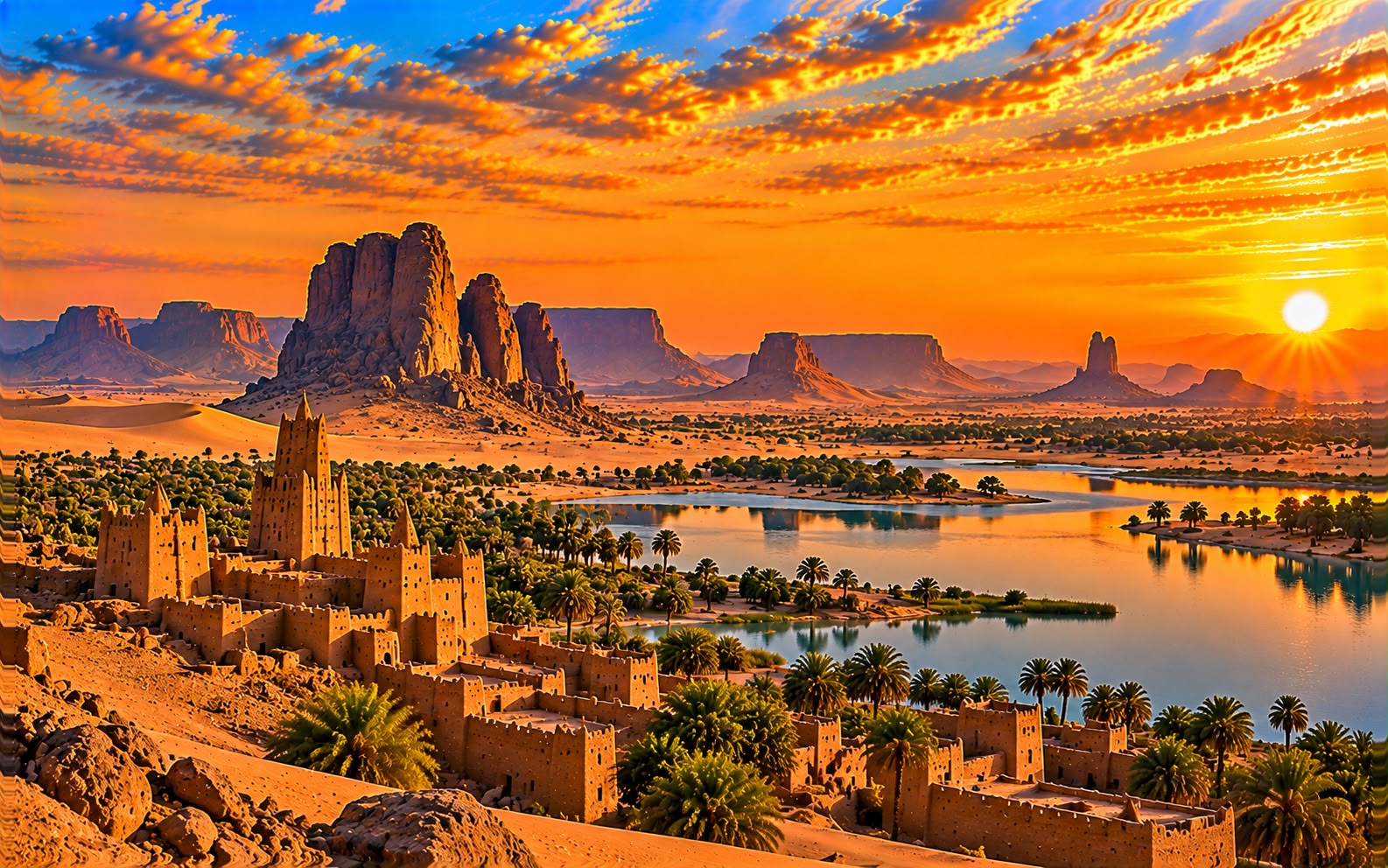
Chad in 9 days: the Ennedi arches, the Lakes of Ounianga and Zakouma
Sandstone arches and towers across a massif the size of Switzerland, a canyon holding the last desert crocodiles in the Sahara, a chain of lakes that should not exist, and a park where elephants went from four thousand to four hundred and are climbing back.
- Central Africa
- 9 days
- ≈ AED 12,850 / person
- Crocodiles in a Saharan gorge, eighteen lakes in a desert that gets no rain, and the best elephant recovery in Africa
Before you go
Read this first
Most governments advise against all travel to large parts of Chad, including the north, the Lake Chad basin, and the borders with Libya, Sudan, Niger and the Central African Republic — and against all but essential travel to the rest, N’Djamena included.
- The Sudan war next door has pushed more than a million refugees and returnees into eastern Chad since April 2023. The east is under severe strain.
- The north and the Tibesti see banditry, trafficking and occasional armed incursion, and landmines remain from the Libyan conflicts of the 1980s.
- Boko Haram and ISWAP operate in the Lake Chad basin.
- Kidnapping of foreigners is a stated risk, particularly in the east and in border areas.
- Political violence has followed contested transitions; the demonstrations of October 2022 were put down with lethal force.
- The Ennedi and Ounianga, in the far north-east, sit inside areas most advisories rule out entirely — and are also the reason anyone comes.
This guide does not tell you to go. A small number of specialist desert operators run Ennedi expeditions in winter with permissions, convoys and satellite communications. That is a considered risk taken with current information. Check your own government’s advice, which reflects this week rather than this year.
Chad has two UNESCO World Heritage sites, and both of them are improbable.
The Ennedi Massif is listed as a mixed site, for landscape and for culture. It is a sandstone plateau roughly the size of Switzerland, eroded into arches, towers, mushrooms and slot canyons. The Aloba Arch is around 120 metres high. The Guelta d’Archei, a permanent pool at the bottom of a narrow gorge stained black by centuries of camel dung, holds the last Saharan crocodiles — a relict population left behind when the desert dried, surviving in a pool a few hundred metres long. Rock art across the massif runs back seven thousand years and records cattle, giraffe and rhino where there is now sand.
The Lakes of Ounianga are eighteen lakes in the middle of the Sahara, in a region that receives essentially no rain. They are fed by fossil groundwater and kept from evaporating by a floating mat of reeds on the largest ones; some are fresh, some are hypersaline, and they sit within a kilometre of each other in colours that do not look real.
Zakouma National Park is the other reason. Elephant numbers fell from more than four thousand in 2002 to around four hundred and fifty by 2010 under industrial poaching. African Parks took over management in 2010 and the herd has been growing since, alongside Kordofan giraffe, lion, buffalo in thousands and one of the great bird concentrations in Africa at the Rigueik pans.
Nine days, if and when it is possible. Figure USD 3,500 (≈ AED 12,854) per person. November to March — Zakouma’s roads are impassable in the rains and the park closes.
Before you go: the 15-minute admin
Entry
- A visa is required and must be sponsored. Your operator arranges it; independent application is difficult.
- Yellow fever vaccination is mandatory.
- N’Djamena is the entry point.
- Travel to the Ennedi requires an authorisation (autorisation de circuler) issued in N’Djamena, plus permissions checked at military posts along the way. This takes days and your operator does it.
Money
- The Central African CFA franc (XAF) is pegged to the euro.
- Cash in euros, all of it. There are ATMs in N’Djamena that sometimes work. North of it, nothing.
- Cards are not usable outside one or two hotels in the capital.
On the ground
- This is expedition travel, not touring. The Ennedi is three days’ driving from N’Djamena each way, in convoy, carrying your own fuel, water and recovery gear.
- Satellite communication is essential and your operator should carry it as standard.
- Military checkpoints are constant and the paperwork is checked properly.
- Do not photograph anything military or official, and ask before photographing people — in the north this matters more than most places.
- Landmines persist in parts of the north. Stay on tracks the guides use.
Day by day
Day 1 — N’Djamena
- A quiet first day. The permissions are being finalised while you are in it, and nothing about the Ennedi is confirmed until they are.
- 10:00 — The Musée National, which holds the Toumaï cast — Sahelanthropus tchadensis, found in the Djurab desert in 2001 and around seven million years old, among the oldest hominin fossils known.
- 14:00 — The Grand Marché.
- 17:00 — The riverside where the Chari meets the Logone, which is the border with Cameroon and where the pirogues cross.
- Cash euros only, and photography anywhere near officials, bridges or the presidency is a serious mistake.
Day 2 — Fly in to Zakouma
- 09:00 — Fly in. The charter is the only practical way; the drive is two long days each way.
- 12:00 — Into camp, and the middle of the day is for sitting still.
- 16:00 — The first afternoon drive. Lion, buffalo, roan, tiang and Lelwel hartebeest, and a genuinely good chance on all of them.
- 18:30 — Sundowner, and Zakouma’s night sky is as dark as the Ennedi’s.
- Zakouma was almost emptied by poaching — 4,000 elephants down to a few hundred — and has recovered under African Parks since 2010. That recovery is the story of the place.
Day 3 — The pans
- 05:30 — Out at first light.
- 06:30 — The Rigueik and Maniam pans in February and March, when the receding water concentrates thousands of crowned cranes, black crowned cranes, storks and quelea in numbers that are hard to describe. The quelea flocks move like smoke.
- 10:00 — Kordofan giraffe, a subspecies down to a few thousand animals globally, and Zakouma holds a significant share.
- 13:00 — Back through the heat.
- 16:00 — A second pan in the late light, which is when everything comes to water.
Day 4 — The elephants
- 05:30 — The elephants, which move as one very large herd rather than family groups — a behavioural response to the poaching years that has persisted. Finding them is a radio exercise and can take hours.
- 11:00 — The research camp and the collaring work, if a talk is running.
- 15:00 — A walk with an armed scout, which Zakouma permits and which changes the scale of the place.
- 18:00 — A last evening. Pack tonight; the drive north starts in the dark.
Day 5 — North toward Fada
- 05:00 — Two long driving days, through Abéché or on the northern route, with checkpoints and a night in the desert.
- Permits for the Ennedi are checked repeatedly and your operator carries them; expect to stop a great deal.
- 13:00 — Abéché or a roadside stop, and the landscape turns from savanna to sand through the afternoon.
- 18:00 — Camp in the open, which out here needs no site and no permission.
Day 6 — Into the Ennedi
- 06:00 — On north.
- 12:00 — Fada, the administrative centre of the Ennedi, where the final permissions are checked.
- 15:00 — The first arches come as you enter the massif, and the scale takes a while to read because there is nothing to compare them to. Put a person at the base of one and it resolves.
- 18:00 — Camp among the towers, and the temperature drops hard after dark.
Day 7 — The Guelta d’Archei
- 07:00 — The walk in through the gorge, past the camel herds that come down to drink in the hundreds. They come in the morning, which is why this is an early start.
- 09:00 — The crocodiles at the far end, in a pool the colour of ink — a relict Nile crocodile population left behind when the Sahara dried.
- Watch from the rim. The Toubou herders have a working relationship with this place that does not include visitors climbing down to it.
- The acoustics in the gorge are the thing nobody mentions in advance — the camels’ noise arrives from every direction at once.
- 15:00 — Back out, and another valley in the afternoon.
Day 8 — The Aloba Arch, Bachikélé and the rock art
- 06:30 — Aloba, around 120 metres high and roughly 77 wide, which is among the largest natural arches on earth. Dawn is when it is lit from underneath.
- 10:00 — The Bachikélé guelta and the painted shelters nearby — cattle in red ochre, hunters, and in the older layers animals that have not lived here in five thousand years.
- Touch nothing and do not wet the rock, which people still do to bring the pigment up and which destroys it.
- 15:00 — More of the massif, which is 60,000km² and you are seeing a corner.
- 18:00 — Camping in the massif, which is the only way to see it at dawn and the reason to do this at all.
Day 9 — Ounianga, and the long way back
- 06:00 — Ounianga Kebir and Ounianga Serir, UNESCO-listed in 2012. Lake Yoan is hypersaline and deep blue; the Serir lakes are separated by dunes and partly covered in reed mats that stop them evaporating.
- They survive on fossil groundwater in a place with almost no rain, which is why they are listed.
- 12:00 — The drive back is two to three days, or a charter from Faya if the budget and the aircraft both exist.
- Build slack into the end of this trip. Sand, breakdowns and checkpoint delays all happen and none of them care about your flight.
Costs and practicalities
Best time to visit
November–March, and the constraint is absolute at both ends: Zakouma’s roads are impassable in the rains and the park closes, while the Ennedi in summer sits above 45°C.
- November–December — the rains have gone, the tracks have dried, and Zakouma reopens.
- January–February — the best of the Ennedi: cool enough to walk the gorges, and the desert nights drop close to freezing, which surprises everyone.
- February–March — the best weeks at Zakouma, when the Rigueik pans shrink and concentrate thousands of cranes, storks and quelea.
- April–May — rapidly getting too hot for the desert, and the last weeks before the park closes.
- June–October — the rains. Zakouma is shut, the Ennedi is unbearable, and the northern tracks are not worth attempting.
Travel tips
- This is expedition travel, not touring. The Ennedi is three days’ driving from N’Djamena each way, in convoy, carrying fuel, water and recovery gear.
- An autorisation de circuler is required for the north, issued in N’Djamena and checked at military posts. Your operator spends days on it.
- Bring euros in cash. The CFA franc is pegged to the euro; ATMs exist in N’Djamena and nowhere north of it.
- Satellite communication is not optional on the Ennedi leg, and a good operator carries it as standard.
- A sleeping bag rated for genuine cold. January nights in the massif catch out everyone who packed for the Sahara.
- Watch from the rim at the Guelta d’Archei. The Toubou herders have a working relationship with that water that does not include visitors climbing down to it.
- Landmines persist in parts of the north from the Libyan conflicts. Stay on the tracks the guides use.
What this trip would cost
Two people, 8 nights, expedition standard, international flights excluded:
| Item | Cost |
|---|---|
| Zakouma charter and park fees, two people | USD 2,400 (≈ AED 8,814) |
| Ennedi expedition: vehicles, crew, fuel, permits | USD 3,600 (≈ AED 13,221) |
| Camping, lodges and meals throughout | USD 600 (≈ AED 2,204) |
| N’Djamena hotels and transfers | USD 400 (≈ AED 1,469) |
| Total for two | USD 7,000 (≈ AED 25,708) |
- Roughly USD 3,500 (≈ AED 12,854) per person. Chad is the most expensive country on this site, and the reason is distance: everything north of N’Djamena has to be carried in.
- The Ennedi line is not negotiable down. Fuel for 2,000 kilometres of desert, a spare vehicle and satellite comms are what make it a trip rather than an incident.
- All of it in cash, in euros, unless your operator takes a transfer in advance — most do, and most prefer it.
- Insurance does not appear because no standard policy covers travel against government advice. Specialist expedition cover exists and costs real money.
- Hotel picks here are chosen on location, not on commission — always check prices and recent reviews before booking.
What to pack
- Euros in cash.
- A yellow fever certificate.
- Malaria prophylaxis for the south and Zakouma.
- A sleeping bag rated properly for cold — the Ennedi at night in January is close to freezing, which surprises people every year.
- A chèche, goggles and lip balm for the sand.
- Far more memory and battery than you plan for, and a dust blower.
- Your own medication, because there is no pharmacy for three days in any direction.
FAQ
Can I visit Chad now? Most governments advise against all travel to the north and east — which is where the Ennedi and Ounianga are — and against all but essential travel elsewhere. Specialist operators run winter expeditions. Check current advice.
Are there really crocodiles in the Sahara? Yes. A relict population of West African crocodiles survives in the Guelta d’Archei, left behind when the region dried out. They are small, few, and the last of their kind in the central Sahara.
Is Zakouma worth it? It is one of the most convincing conservation recoveries in Africa, and in February and March the bird concentrations at the pans are on a scale you will not see elsewhere. It is also a charter flight away from anywhere.
When can I go? November to March. Zakouma closes in the rains and the Ennedi in summer is above 45°C.
What language do they speak? French and Arabic are both official; Chadian Arabic is the lingua franca. Toubou and Zaghawa are what you will hear in the Ennedi.
Prices and entry rules change, and what you need depends on your passport; last checked 29 October 2026, so confirm with the embassy or your airline before booking.


