 The Itinerary
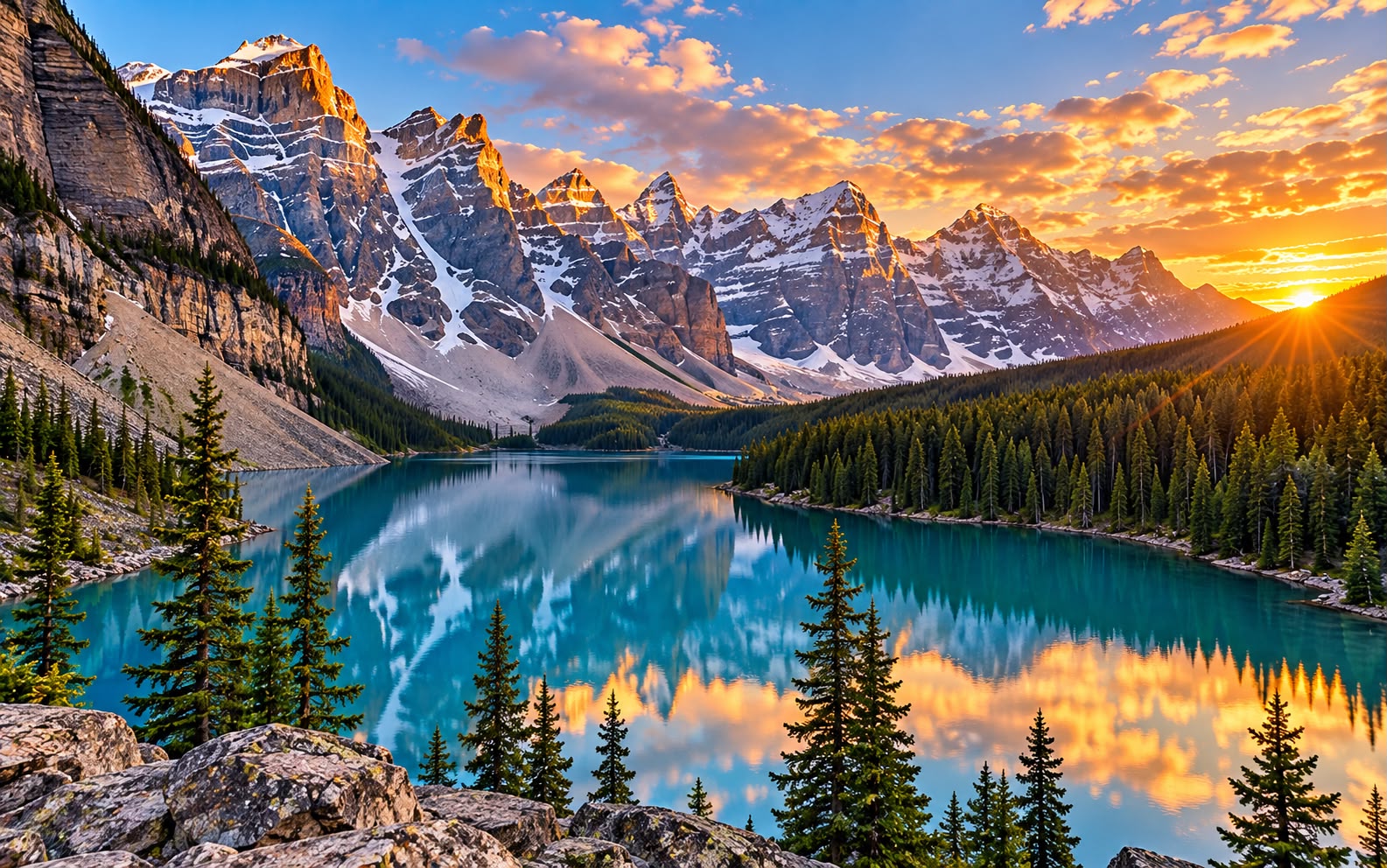
Canada in 8 days: the Canadian Rockies
Lakes the colour of toothpaste ads, a highway ranked among Earth's great drives, a glacier you stand on before lunch — Calgary to Banff to Jasper and back, with the visa timeline that needs months (or the eTA shortcut for US-visa holders), the Moraine Lake shuttle war, and 2026's free-entry summer decoded.
- Canada
- 8 days
- ≈ AED 6,750 / person
- Mountains + road trip
Before you go
The Canadian Rockies are what happens when glaciers spend two million years sculpting and then fill their own quarries with meltwater: Lake Louise and Moraine Lake glow an un-Photoshopped turquoise (rock flour suspended in the water — science, not filters), the Icefields Parkway strings 230 kilometres of them together, and elk wander through town like they pay rates.
Two pieces of homework decide this trip. First, the visa: processing commonly runs 30–60 days, and longer from some countries — this is a book-months-ahead trip, though there’s an eTA shortcut if you hold a valid US visa (details below). Second, Moraine Lake: private cars are banned for good; the shuttle booking game has rules, and this guide plays them for you.
The route: Calgary → Banff (3 nights) → the Parkway → Jasper (2 nights) → back, self-drive, June–September (the Moraine road itself runs 1 June–12 October). Figure CAD 2,600 (≈ AED 6,764) per person excluding international flights — with 2026’s pleasant surprise that park entry is free all summer under the Canada Strong Pass.
Before you go: the admin
The visa, and the eTA shortcut
- The visitor visa (TRV), honestly: CAD 100 + CAD 85 biometrics per person at your nearest visa centre, filed like a Schengen-plus (proof of residence, bank statements, employment letter, ties, itinerary) — and processing commonly runs 30–60 days, longer from some countries, plus passport-return time. Translation: apply 3–4 months before summer dates. The prize is generous: TRVs are usually multiple-entry, valid up to 10 years.
- The eTA shortcut (check this first): Indian citizens who hold a valid US non-immigrant visa or have held a Canadian visa in the past 10 years can instead apply for a CAD 7 eTA — minutes online — valid for arrival by AIR only. If your US visa from the USA guides is current, this trip’s paperwork just became a web form. Verify eligibility on canada.ca before relying on it.
Flights and park entry
- Flights: no non-stops from the Gulf to Calgary — one-stop via Toronto (Emirates DXB–YYZ + Air Canada), London, or Frankfurt; ~US$1,100–1,750 return, 16–20 h door to door.
- Park entry: normally CAD 12.25/adult/day (family/group CAD 24.50) or the annual Discovery Pass (family CAD 167.50) — but in 2026, 19 June– 7 September, admission is FREE under the Canada Strong Pass. Outside that window, the family daily rate wins for this trip length.
Driving and wildlife
- Driving: most foreign licences in English work for visits; roads are wide, calm and moose-aware. Fuel ~CAD 1.50–1.75/L; fill up in Banff or Saskatchewan River Crossing — the Parkway has one expensive pump.
- Wildlife rules (they’re serious): never feed or approach; 30 m from elk, 100 m from bears; a “bear jam” means stay IN the car; carry bear spray (~CAD 50, rentable) for any real hike and know how to use it. Fines are large and the animals’ lives depend on the rules more than yours does.
Day by day
Day 1 — Land in Calgary, drive into the wall
- Afternoon — Land at YYC, collect the car (book months ahead for summer; ~CAD 85–100/day), grocery-run at a Calgary superstore (Banff prices will thank you).
- 17:00 — The TransCanada west: prairie flatness for 45 minutes, then the Rockies stand up on the horizon like a special effect. Check in — Calgary tonight (cheaper) or straight to Banff if you land early.
- Dinner note for the audience: Calgary’s northeast is one of Canada’s great desi food quarters — a proper halal shawarma-and-karahi send-off before mountain prices begin.
Day 2 — Banff: town and the classics
- 09:00 — Banff Avenue with its postcard mountain backdrop.
- 10:30 — Banff Gondola up Sulphur Mountain (~CAD 70–85 online, dynamic) — the boardwalk summit ridge is the view.
- 14:00 — Bow Falls and the Fairmont Banff Springs castle photo stop.
- 17:00 — Soak at the Banff Upper Hot Springs (CAD 17.50) as the alpenglow arrives.
- 20:00 — Elk on the golf-course road, reliably. Thirty metres, and the bulls in September are genuinely dangerous.
Where to stay in Banff (three nights — book first, before flights; summer sells out by spring)
- Luxury: Fairmont Banff Springs — 4.4/5 on TripAdvisor (~9,900 reviews), the 1888 “castle in the Rockies”. CAD 800+.
- Mid-range: Moose Hotel & Suites — 4.6/5 (~1,700 reviews), rooftop hot pools facing the peaks. ~CAD 350–450.
- Value: Banff Aspen Lodge — 4.2/5 (~2,600 reviews), walkable, hot tubs, breakfast add-on. ~CAD 240–300. (True budget: HI-Banff Alpine Centre from ~CAD 60/bed.)
Day 3 — The lakes day, the one you planned months ago
- Moraine Lake: private vehicles banned. Book the Parks Canada shuttle (CAD 12.75 adult + CAD 3.50 booking fee) the moment your 40%-advance window opens (15 April 2026 for the season), or fight for the 48-hours-before release of the remaining 60% at 8 am Mountain Time.
- 04:00 — Sunrise obsessives: the Alpine Start shuttles (4 & 5 am) or private sunrise buses (~CAD 60–90) with hotel pickup.
- 07:00 — Moraine’s Valley of the Ten Peaks first — the old $20 bill view.
- 10:00 — The shuttle ticket includes the Lake Connector, so do both. Over to Lake Louise.
- 11:00 — Walk the shoreline to the far end where the crowds evaporate, or the 3.5 km teahouse trail to Lake Agnes — cash for tea and scones at the 1905 teahouse.
- 16:00 — Back down, and the lakeshore once the day buses have gone.
Day 4 — Choose your Banff
- 09:00 — Paddle Lake Minnewanka or Vermilion Lakes (canoe ~CAD 65/h), which is the calm-water option and best before the afternoon wind.
- Or the Johnston Canyon catwalk falls — go before 9 or after 5, because the car park is the bottleneck and it fills by ten.
- 11:00 — Or Yoho’s Emerald Lake + Takakkaw Falls over the BC line — the connoisseur’s add-on. The time zone changes and Takakkaw’s access road is closed until June.
- 18:00 — Bow Valley Parkway wildlife loop at dusk, which is the quiet alternative to the highway and where the animals actually are.
Day 5 — The Icefields Parkway
- 08:00 — Fuelled, snacked, camera charged: the 230 km Banff→Jasper Parkway, routinely called one of the world’s great drives. The stop list that matters: Bow Lake (mirror mornings), Peyto Lake (10-min walk to the wolf-head turquoise overlook), Saskatchewan Crossing (fuel), the Weeping Wall, and the big bend up Sunwapta Pass.
- 13:00 — Columbia Icefield: the Ice Explorer + Skywalk combo (~CAD 126 adult / 82 child, book 2+ weeks out for the price and the slot) — a monster-truck bus onto the Athabasca Glacier (stand on 200 m of ice, fill a bottle with glacier melt) then the glass horseshoe 280 m over the Sunwapta valley. Touristy and glorious; afternoon slots after 3:30 run ~20% cheaper.
- 16:30 — Waterfall dessert: Sunwapta Falls and Athabasca Falls roadside stops, then into Jasper by evening — bighorn sheep committee likely en route.
Where to stay in Jasper (two nights) — with the honest note: the 2024 wildfire took a bite of the town’s hotel stock; rebuilt Jasper is open and welcoming, but inventory is tighter and prices firmer — book these nights first, and forgive the odd construction corner.
- Splurge: Fairmont Jasper Park Lodge — the lakeside cabin resort across the water (check current reviews/rates; CAD 600+).
- Mid-range: Forest Park Hotel — 3.7/5 (~3,600 reviews), the dependable big lodge. ~CAD 280–360.
- Value: Jasper Inn & Suites — 3.8/5 (~3,100 reviews), kitchenette rooms. ~CAD 220–280.
Day 6 — Jasper: Maligne country
- 08:30 — Maligne Lake (48 km of moose-prone road; eyes up): the Spirit Island cruise (~CAD 95–135, 90 min, book ahead) to the tiny treed island that stands for the whole Rockies in a million calendars. (Budget swap: skip the boat, kayak the lakefront or walk Moose Loop free.)
- 13:00 — Maligne Canyon: the karst slot gorge by bridges 1→4 (go bottom-up to dodge the coaches); picnic by the Athabasca.
- 16:00 — Town afternoon: Jasper’s main-street brewery and fudge economy, or Pyramid Island’s boardwalk sunset.
- Dark — Jasper is a Dark Sky Preserve (the world’s second largest): drive five minutes out, kill the lights, and let the Milky Way do the encore. October’s Dark Sky Festival is the seed of a future trip.
Day 7 — Parkway southbound, Calgary landing
- 08:30 — The Parkway in reverse — morning light flips every view; stop at whatever you rationed (Mistaya Canyon deserves its 20 minutes), brunch-picnic at Bow Lake.
- 14:00 — Optional last hit: Johnston Canyon if missed, or Canmore’s café strip — Banff’s cheaper, quieter sibling.
- 17:30 — Roll into Calgary, drop bags; farewell dinner in the northeast’s desi quarter or 17th Ave’s global row.
Day 8 — Fly home
- Morning YYC return (fuel the car before the airport ramp), one-stop home. Maple syrup and smoked-salmon packs at the airport cost +40% — you did that shopping at the Calgary superstore on Day 1, obviously.
Costs and practicalities
Best time to visit
June–September for almost everything, because outside it the country is very cold and a good deal of it closes.
- June–September — the Rockies’ lakes are thawed (Moraine Lake’s road opens around early June and shuts in October), the Icefields Parkway is clear, and the east is warm.
- July–August — peak, and Banff and Jasper are genuinely full. Book park accommodation months ahead.
- Late September–mid October — the maple colour in Quebec and Ontario, which is a real phenomenon and worth timing a trip to. The Rockies are quiet and golden with larch.
- November–April — ski season at Whistler, Banff and Tremblant, and northern lights in the Yukon and Northwest Territories, which need the dark months.
- Churchill’s polar bears are October–November; its beluga whales are July–August.
Travel tips
- The distances are continental. Toronto to Vancouver is a five-hour flight. Pick one region per trip.
- An eTA is required for visa-exempt air arrivals and takes minutes online. It is tied to your passport.
- Tipping is expected and high — 15–20% in restaurants, and card machines will prompt you. Tax is added at the till, so the shelf price is not the price.
- Wildlife rules are not decoration. Keep 100m from bears and 30m from elk, never leave food in a tent, and use the bear-proof bins.
- Moraine Lake has no private cars at all — shuttle, bus or bike only. Book the shuttle well ahead.
- Cell coverage drops out across long highway stretches. Download offline maps before the Icefields Parkway.
- Quebec operates in French and the law requires it in signage. A greeting in French goes a long way; most people switch happily.
What this trip actually costs
Two people, 7 nights, mid-range, excluding international flights (~US$1,100–1,750 return):
| Item | Cost |
|---|---|
| Visitor visas + biometrics ×2 (or CAD 7 eTAs — see shortcut) | CAD 370 (≈ AED 963) |
| Calgary hotel, 2 nights (first + last) | CAD 360 (≈ AED 937) |
| Banff hotel, 3 nights | CAD 1,050 (≈ AED 2,732) |
| Jasper hotel, 2 nights | CAD 600 (≈ AED 1,561) |
| Car hire, 7 days + fuel | CAD 810 (≈ AED 2,107) |
| Parks pass (FREE 19 Jun–7 Sep 2026; Discovery family otherwise) | CAD 170 (≈ AED 442) |
| Moraine Lake shuttle ×2 + booking fee | CAD 30 (≈ AED 78.05) |
| Banff Gondola ×2 | CAD 150 (≈ AED 390) |
| Columbia Icefield Adventure + Skywalk ×2 | CAD 250 (≈ AED 650) |
| Maligne Lake Spirit Island cruise ×2 | CAD 250 (≈ AED 650) |
| Food, 8 days (grocery breakfasts + one town meal) | CAD 1,000 (≈ AED 2,602) |
| eSIM | CAD 30 (≈ AED 78.05) |
| Buffer: hot springs, canoe hour, fudge audit | CAD 130 (≈ AED 338) |
| Total for two | CAD 5,200 (≈ AED 13,529) |
- CAD 2,600 (≈ AED 6,764) per person. The honest levers: the eTA shortcut (saves CAD 356 and three months of waiting if you qualify), the free-entry 2026 summer window, September travel (rooms drop ~30%, larches turn gold), and the grocery-breakfast habit in a town where eggs cost like jewellery.
- Book in this order: visa/eTA decision FIRST (months matter) → Banff + Jasper hotels (the real scarcity) → flights → car → Moraine shuttle on 15 April (or the 48-h release at 8 am MT) → Icefield Adventure + Maligne cruise → everything else is a road with pullouts.
- Hotel picks are unsponsored — no affiliate links in this article. Chosen on location and current TripAdvisor ratings; check recent reviews and prices before booking.
What to pack
- Layers for genuine ranges: July valley afternoons hit 25°C; the glacier and dawn lakes sit near 5°C. Fleece + shell always in the daypack.
- Proper walking shoes (teahouse trail, canyons), sandals for hot springs.
- Sunscreen + sunglasses (altitude + lake glare), bug spray for June–July dusk.
- Binoculars for the bear jams (from the car!), zoom lens, polariser filter — turquoise water rewards it.
- Refillable bottles (glacier-fed taps), cooler bag for the grocery system.
- Type A/B (US-style) plugs — most of the world needs an adapter.
- Swimwear for hot springs; a warm hat for the Skywalk even in August.
FAQ
Is the visa really the hard part? It’s the long part. The file itself is standard (steady employment + travel history helps); the queue is the issue — hence the 3–4 month runway, and hence the eTA check first: a valid US visit visa in your passport converts this whole section into a CAD 7, ten-minute form (air arrivals only). Families mixing statuses: everyone needs their own authorisation.
Halal and vegetarian food? Calgary is genuinely strong — one of Canada’s big halal cities (northeast Calgary’s Pakistani/Afghan/Arab strips, plus downtown shawarma). In Banff and Jasper, formal halal thins out fast: the working pattern is seafood/veg dining plus the grocery system (both towns’ supermarkets stock basics; Calgary superstores stock everything, halal meat included — hence the Day 1 shop). Vegetarians do fine everywhere: mountain towns love a veggie burger, and Indian restaurants exist in both Banff and Jasper.
Moraine Lake with zero shuttle luck — any way in? Yes, three: the 48-hour release (60% of all seats, 8:00 am MT, two days out — set the alarm, it works), Roam public transit route 10 from Lake Louise village, and private sunrise shuttles (~CAD 60–90 with pickup) — which are also the only sane sunrise play. What doesn’t work: driving up to “see” — the road gate is enforced and turnaround chaos is real.
When exactly should we go? Late June–early September for full access (Moraine road, teahouses, glacier tours all open) — July–August is peak everything, including prices. The connoisseur pick: mid-September — golden larches above Lake Louise, thinner crowds, sharp light — accepting that the free-entry window has closed and first snow can dust the passes. Winter is a magnificent, different (ski) trip.
Is Jasper fully open after the 2024 fire? Open, rebuilt in large part, and visibly grateful for visitors — tourism IS the recovery. About a third of the town’s buildings were lost; some hotels are new-build fresh, some views carry burn scars (the Parkway approach shows regrowth already greening). Book early, tip well, and know Maligne, the canyon and the lakes were untouched.
What’s Canada guide #2? The eastern classic — Toronto, Niagara, Montréal and Québec City by rail — or Vancouver + Sea-to-Sky joined to this very route as the 12-day western epic. Votes welcome; both on the list.
Prices and entry rules change, and what you need depends on your passport; last checked 9 November 2026, so confirm with the embassy or your airline before booking.


