 The Itinerary
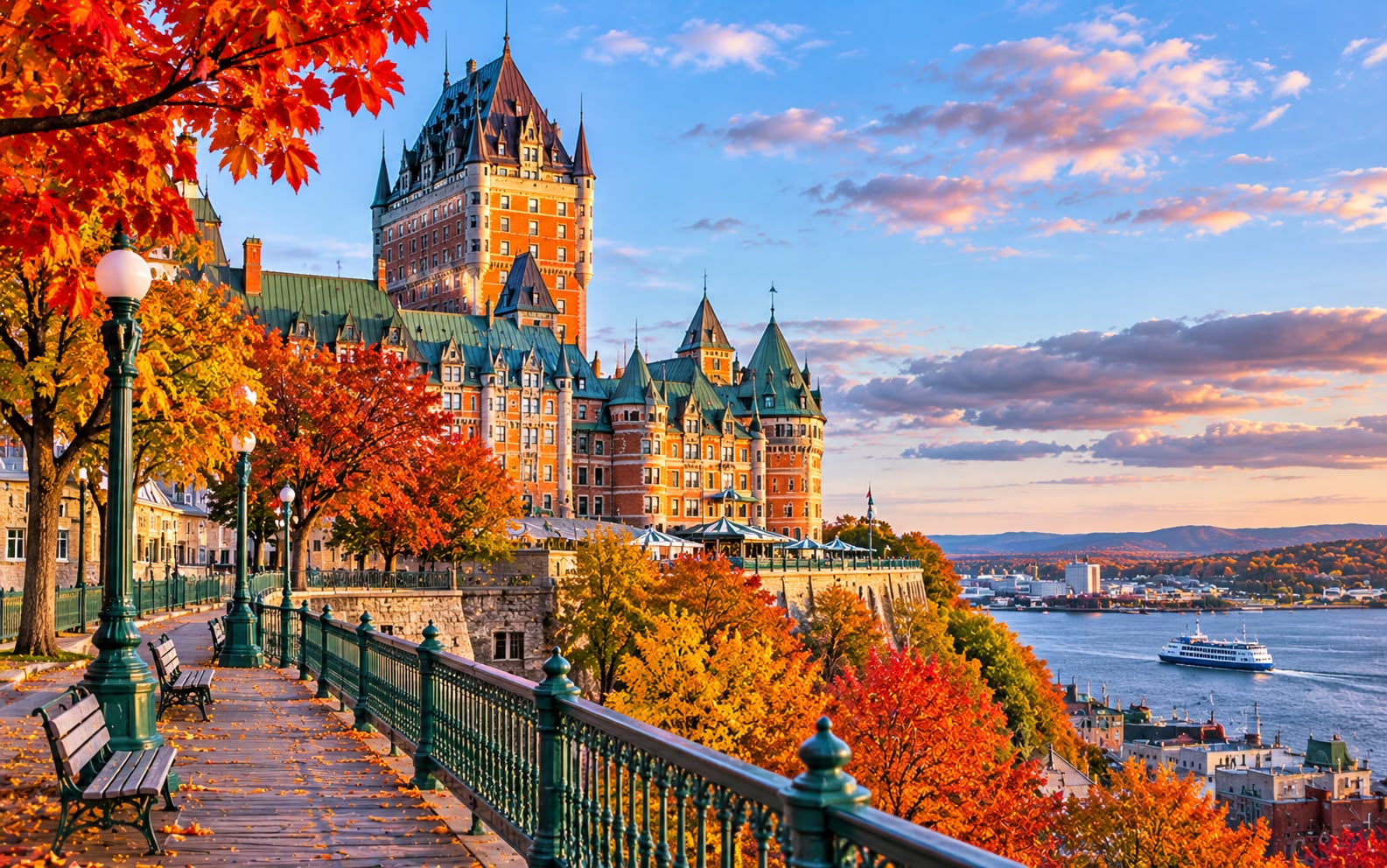
Québec in 7 days: Montréal, Québec City and the whales at Tadoussac
Montréal's neighbourhoods, the only walled city north of Mexico, then north along the St Lawrence to where belugas live year round. Which season you pick changes the trip completely — and winter tyres are the law, not a suggestion.
- Canada
- 7 days
- ≈ AED 6,000 / person
- French North America, and belugas in a fjord
Before you go
Canada’s one guide on this site is the Rockies — Calgary, Banff, Jasper. This is the other Canada, 3,000 kilometres east and in another language.
Québec is not France and it is not the rest of Canada. The working language is French, the civil law is French-derived, and Québec City is the only walled city in North America north of Mexico.
Then north for the whales. Where the Saguenay fjord meets the St Lawrence, cold deep water rises and the feeding is extraordinary — belugas live here all year, and in summer fin, minke and sometimes blue whales come in.
Which season you choose changes everything. Autumn colour, deep winter and green summer are three different holidays, and this itinerary works in all three with different days.
Figure CAD 2,300 (≈ AED 5,984) per person. Late September to mid-October for colour; June to September for whales; February for winter.
Before you go: the admin
Entry
- Most visa-exempt travellers need an eTA before boarding a flight to Canada. It is cheap, takes minutes, and is applied for on the official government site — not the agencies that advertise above it.
- Everyone else needs a visitor visa, and processing times run to months for some countries. Start it first.
- If you are connecting through the United States, you need US authorisation as well, even in transit.
- Last checked: 3 November 2026.
French, and how it actually works
- French is the official language and the default in shops, signage and government.
- Montréal is comfortably bilingual. Québec City less so, and Charlevoix and Tadoussac less again — you will meet people with little English, and it is entirely normal.
- The whole etiquette is one word: open with bonjour. In Montréal you will often hear “Bonjour, hi”, which is an invitation to choose. Opening in English without trying is the only thing that reads as rude.
- A few words go a long way here and are met with real warmth.
Driving, and the winter-tyre law
- Driving is on the right. Roads are good and distances are manageable — Montréal to Québec City is under three hours.
- Winter tyres are legally mandatory on all vehicles registered in Québec from 1 December to 15 March, including hire cars. A car hired in Québec will have them; one hired in Ontario may not. Confirm at the desk.
- You do not want a car in Montréal or inside Québec City’s walls. Both are walkable and parking is expensive and scarce. Collect the car on Day 3 and drop it before the last night.
- Right turns on a red light are legal in Québec — except on the island of Montréal, where they are prohibited.
- Moose and deer on the roads north of Québec City, especially at dawn and dusk.
The seasons, which are genuinely different trips
- Late September to mid-October: the maples turn, Charlevoix and the Laurentians are the reason people come, and the whales are still there. The best single window.
- June to September: warm, green, festival season in Montréal, and peak whale watching.
- February: deep winter. Québec City’s Winter Carnival, the ice hotel, dog sledding, and −20°C as a normal day. Whale boats do not run; belugas are still there but you will not be on the water.
- March and April: sugar shack season — maple sap runs, and the cabane à sucre meal is a genuine institution.
- November and early December are the gap: no colour, no snow yet, and many Charlevoix businesses closed.
Day by day
Day 1 — Montréal
- Stay in the Plateau or Old Montréal. The Plateau is where people live; Old Montréal is where they visit.
- Morning — Old Montréal on foot: Notre-Dame Basilica, whose interior is deep blue and gold and genuinely stops people, then the cobbled streets and the Old Port.
- 13:00 — Smoked meat. The institution is on The Main and the queue is part of it. Medium fat, rye, mustard, nothing else.
- 15:00 — Mount Royal. Walk up through the park to the Kondiaronk belvedere for the whole city and the river.
- Evening — Boulevard Saint-Laurent or Rue Saint-Denis for dinner. Many Montréal restaurants are apportez votre vin — bring your own wine — and the shop is usually next door.
Where to stay in Montréal (two nights)
- Grand: a design hotel in Old Montréal in a converted warehouse.
- Mid-range: a hotel in the Quartier des Spectacles or the Plateau.
- Simple: apartments in Mile End or Villeray, both on the metro and far better value.
Day 2 — Mile End, markets and the museums
- 09:00 — Mile End, and a bagel from one of the two wood-fired bakeries that have been arguing since the 1950s. Montréal bagels are smaller, sweeter and boiled in honey water — they are not New York bagels and the difference is the point.
- 11:00 — Jean-Talon Market in Little Italy, or Atwater if you are staying west.
- 14:00 — The Montreal Museum of Fine Arts, or the Pointe-à-Callière archaeology museum, which is built over the city’s founding site and takes you underground through it.
- 17:00 — The Lachine Canal on foot or a hired bike.
- Evening — Poutine, properly, at least once.
Day 3 — To Québec City
- 09:00 — Collect the car. Drive north-east, about two and a half to three hours.
- The slower alternative: the Chemin du Roy, the old king’s road along the north shore, which adds an hour and passes through villages with silver-roofed churches.
- 13:00 — Québec City. Park outside the walls or at your hotel and leave the car there.
- 14:30 — Old Québec on foot: the Château Frontenac — the most photographed hotel in the world, by most counts — the Dufferin Terrace boardwalk above the river, and Petit Champlain down the Breakneck Steps, which is the oldest commercial street in North America.
- 18:00 — Place Royale, where Champlain founded the city in 1608.
- Evening — Dinner in the Old Town, or in Saint-Roch, which is where the city actually eats.
Where to stay in Québec City (two nights)
- Grand: Fairmont Le Château Frontenac, because it is the building you came to look at.
- Mid-range: a small hotel inside the walls on Rue Saint-Louis.
- Simple: Saint-Roch or Saint-Jean-Baptiste, a ten-minute walk downhill and much cheaper.
Day 4 — The Citadelle, the falls, and Île d’Orléans
- 09:00 — The Citadelle, a working military installation and the largest British-built fortress in North America. The changing of the guard runs in summer only.
- 11:00 — Montmorency Falls, ten minutes east — higher than Niagara, if much narrower — with a suspension bridge across the top and a staircase down the side.
- 13:00 — Île d’Orléans, over the bridge: a farming island twenty minutes from the city, circled by one road, with cider houses, strawberry fields, chocolate makers and 300-year-old farmhouses. Ice cider is the local specialty and travels well.
- 18:00 — Back to the city.
- Evening — The Plains of Abraham at dusk, where the 1759 battle settled which empire got Canada.
Day 5 — North to Tadoussac
- 08:00 — Drive north-east along the St Lawrence, about three hours, into Charlevoix — a landscape sitting inside a meteor crater, which is why it looks like that.
- Stop at Baie-Saint-Paul, an artists’ town, and at the Charlevoix viewpoints where the river is wide enough to be a sea.
- 13:00 — The ferry at Baie-Sainte-Catherine, which crosses the mouth of the Saguenay to Tadoussac. It is free, runs frequently, and you may well see belugas from the deck.
- 15:00 — A whale-watching trip, booked. Zodiacs get you closer and are cold and wet; the larger boats are stabler and better for children.
- Belugas are resident year round and protected — boats may not approach them, so sightings are at a distance and on their terms. Minke and fin whales are the summer regulars; blue whales are occasional.
- Evening — Tadoussac, which is a village.
Where to stay in Tadoussac (one night)
- Grand: the red-roofed hotel above the bay, which has been there since 1864.
- Mid-range: a gîte or small inn in the village.
- Simple: the campground and cabins, or Baie-Sainte-Catherine across the water.
Day 6 — The fjord, then south
- 08:00 — The Saguenay fjord. Cap de Bon-Désir or the Pointe-Noire interpretation centre are both shore-based whale watching — you sit on rocks and whales surface in front of you, which many people prefer to the boats.
- 11:00 — Drive back south. Break at La Malbaie or the Hautes-Gorges park if the weather is good.
- 16:00 — Back towards Québec City or push on to Montréal, depending on your flight.
- Drop the car rather than pay city parking overnight.
Day 7 — Out
- Montréal’s airport is 20 minutes from downtown; Québec City’s is smaller and has fewer long-haul connections.
- If you have the morning: the Botanical Garden and the Biodôme in Montréal, which are next to each other and are the best wet-weather option in the city.
Costs and practicalities
Best time to visit
Late September to mid-October if you want one answer.
- June to September — warm, green, and Montréal’s festival season runs all summer. Peak whale watching, peak prices, and the busiest the old city gets.
- Late September to mid-October — the best window. The maples turn through Charlevoix and the Laurentians, the whales are still in, and the crowds thin after Canadian Thanksgiving.
- November and early December — the dead zone. No colour, no reliable snow, several Charlevoix businesses closed.
- January and February — deep winter and genuinely good. Québec City under snow is extraordinary, the Winter Carnival is in February, and dog sledding and the ice hotel are real attractions. Boat-based whale watching does not run. Expect −20°C.
- March and April — sugar shack season, slush underfoot, and very low prices.
Travel tips
- Open with bonjour. It is the entire etiquette.
- No car in Montréal or inside Québec City’s walls. Collect it on Day 3.
- Winter tyres are the law from 1 December to 15 March on Québec-registered vehicles. Confirm your hire car has them.
- No right turn on red on the island of Montréal — legal everywhere else in the province.
- Book whale-watching ahead in July and August.
- Take the free Tadoussac ferry even if you are not crossing; belugas are often visible from it.
- Many Montréal restaurants are bring-your-own-wine. Check before you book.
- Watch for moose at dawn and dusk north of Québec City.
- Dress for −20°C in February, which means layers and real boots, not a winter coat alone.
What this trip actually costs
Two people, 6 nights, mid-range throughout, international flights excluded:
| Item | Cost |
|---|---|
| Hotels, 6 nights | CAD 1,700 (≈ AED 4,423) |
| Food and drink, 7 days | CAD 1,200 (≈ AED 3,122) |
| Hire car, 5 days, with fuel | CAD 750 (≈ AED 1,951) |
| A whale-watching trip, two people | CAD 400 (≈ AED 1,041) |
| Museums, the Citadelle, Montmorency | CAD 350 (≈ AED 911) |
| Metro, parking and extras | CAD 200 (≈ AED 520) |
| Total for two | CAD 4,600 (≈ AED 11,968) |
- Roughly CAD 2,300 (≈ AED 5,984) per person for seven days.
- Québec is the cheapest of Canada’s big destinations — rooms cost well under Vancouver or Banff for the same standard.
- Tip 15–20% on restaurant bills, which is the North American norm and is not included.
- Taxes are added at the till, not shown on the shelf. Budget roughly 15% on top of displayed prices.
- Shore-based whale watching at Cap de Bon-Désir costs a fraction of a boat and is often better.
- Hotel picks here are chosen on location, not on commission — always check prices and recent reviews before booking.
What to pack
- Layers, in every season. Québec’s weather moves fast.
- Waterproof outer layer for the whale boats, which are wet even in sun.
- Walking shoes with grip for Québec City’s hills and steps, which ice over from November.
- A warm hat and gloves from October, and proper insulated boots for February.
- Sunglasses — snow glare in winter is severe.
- A Type A or B adapter, 120V.
Part of a bigger trip?
- Canada in 8 days is the Rockies — Banff, the Icefields Parkway and Jasper.
- Eastern USA and Canada in 13 days links Montréal and Québec City with New York and Niagara.
- Add the Laurentians north of Montréal for two days of lakes and, in winter, skiing at Mont-Tremblant.
- Toronto and Niagara are a five-hour drive or a short flight west.
FAQ
Do I need to speak French? No, but you should open with bonjour. Montréal is bilingual and Québec City mostly manages, but in Charlevoix and Tadoussac you will meet people with little English. Trying first and then switching is met with warmth; starting in English without trying is the only thing that lands badly.
When can I see whales? Boat-based trips run roughly May to October, with July to September the peak for minke and fin whales. Belugas are resident year round, but they are protected and boats may not approach them, so those sightings are distant. The shore stations at Cap de Bon-Désir and Pointe-Noire are open in the same season and are often the better experience.
Is winter worth it? Genuinely, yes, if you are equipped for −20°C. Québec City walled and under snow is one of the great winter sights in North America, the Winter Carnival is in February, and dog sledding and the ice hotel are real. What you give up is the boats — no whale watching — and some Charlevoix roads and businesses.
Do I need a car? Not for Montréal or Québec City, where it is a liability. You need one from Day 3 for Île d’Orléans, Charlevoix and Tadoussac, which have no useful public transport. Collect it as you leave Montréal and drop it before your last night.
What is the winter-tyre rule? Winter tyres are legally required on vehicles registered in Québec from 1 December to 15 March, hire cars included. A car hired in the province will have them fitted; one hired in Ontario and driven in may not. Confirm at the desk rather than assume.
Prices and entry rules change, and what you need depends on your passport; last checked 3 November 2026, so confirm with the embassy or your airline before booking.


