 The Itinerary
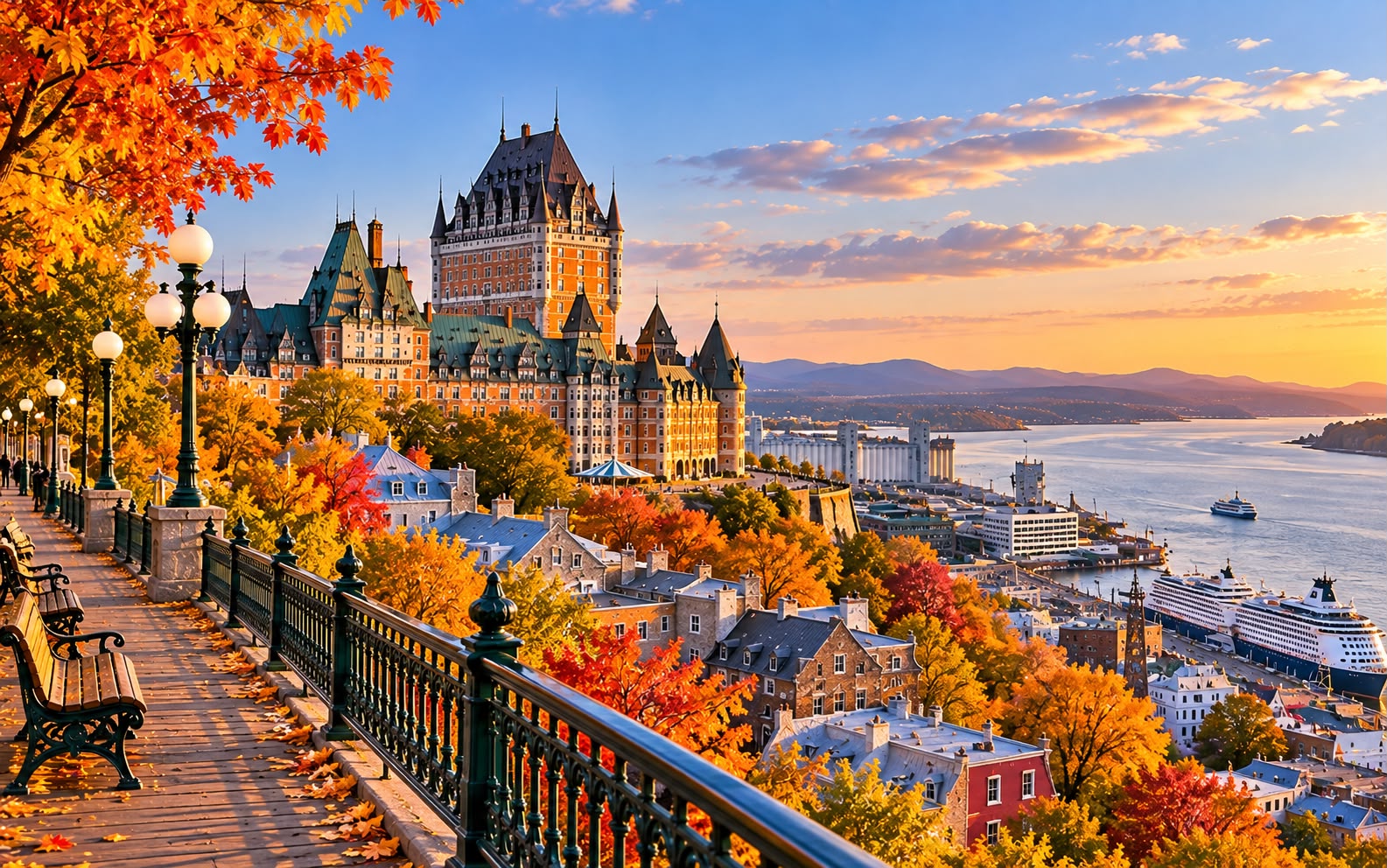
Eastern USA and Canada in 13 days: New York, Niagara, Toronto, Montreal and Quebec
New York and Boston on one side, Toronto and the French-speaking cities on the other, with Niagara at the hinge. Thirteen days of cities you can walk, trains and short flights between them, and a border crossing that changes the language without changing the continent.
- United States
- 13 days
- ≈ AED 15,400 / person
- Two countries, four hundred years of North America, and a waterfall in the middle
Before you go
Most people do New York. Fewer realise that six hours north of it there is a city where the street signs are in French, the oldest walled town in North America sits above a river, and the whole thing is reachable on the same trip without a long-haul flight in the middle.
This is the eastern seaboard and the St Lawrence, and it works because the distances are short and the contrast is sharp. New York and Boston are the United States at its densest and most historic. Niagara is the hinge — it sits on the border and you cross it there. Toronto is the multicultural, glass-and-lake Canada that surprises people. Montreal and Quebec City are French North America, which is not France and not Canada-as-advertised but a third thing entirely.
Quebec City’s Old Town is the only walled city north of Mexico, UNESCO-listed, and in winter it is the best-looking place on this entire route.
Thirteen days, seven stops, and nothing more than a few hours apart. Figure USD 4,200 (≈ AED 15,425) per person. Late September to mid-October is the best window, and the reason is the leaves.
Before you go: the admin
Two countries, two sets of paperwork
- You need entry permission for both, and they are separate systems. The United States wants ESTA if you hold a Visa Waiver passport, or a B-2 visitor visa if you do not. Canada wants eTA for visa-exempt nationals, or a visitor visa otherwise.
- Check both before you book anything. An approved ESTA does not help you at the Canadian border and the reverse is equally true.
- A US visa interview can take months in some countries. This is the single thing most likely to delay the trip, so start with it.
- You cross the border twice if you fly home from the US, and once if you fly out of Montreal or Quebec. Flying into New York and out of Quebec City or Montreal is the better routing — no backtracking, and most airlines price an open-jaw at roughly the same as a return.
- Indian, UAE and most Gulf passports need full visas for both. Apply for the US one first and the Canadian one alongside it.
Getting between the stops
- New York to Boston is four hours on Amtrak’s Acela or three and a half on the slower Northeast Regional, which is cheaper and nearly as good.
- Boston to Niagara is the one awkward leg. Fly to Buffalo — about ninety minutes — and drive the half hour to the falls. The train exists and takes most of a day.
- Niagara to Toronto is ninety minutes by road once you are across.
- Toronto → Ottawa → Montreal → Quebec City is all VIA Rail along the Corridor, and it is comfortable, punctual enough and far nicer than driving. Roughly four hours, two hours and three hours respectively.
- A car is optional and mostly a liability. Every city on this route has parking you will resent paying for. Hire one only for the Niagara leg if you want it.
Money
- US dollars and Canadian dollars, and they are not the same. The Canadian dollar is usually worth meaningfully less, so prices in Canada read higher than they are.
- Cards work everywhere in both. You barely need cash.
- Tipping is not optional in either country. Fifteen to twenty per cent in restaurants, and it is how serving staff are paid. Budget for it as part of the meal, not on top.
- Sales tax is added at the till, not shown on the label, and it differs by state and province. The number on the shelf is not the number you pay.
One thing about distances
- This looks close together on a map of the world and is not. New York to Quebec City is about the distance from London to Vienna. The stops are short hops; the whole is a long way.
- Do not add Washington or Chicago. People try, and the trip stops being a holiday and becomes a schedule.
Day by day
Day 1 — New York, downtown
- Three days is the minimum and it is not enough. Accept that and pick rather than sprint.
- 09:00 — The Statue of Liberty and Ellis Island by the first ferry of the day. Book the pedestal or crown weeks ahead — the crown sells out months out — and the Ellis Island immigration museum is the better half for most people.
- 14:00 — The 9/11 Memorial and Museum. Allow longer than you think and do not plan anything cheerful immediately after.
- 17:00 — Walk the Brooklyn Bridge towards Manhattan at dusk, not away from it. The skyline is behind you the other way. Start at the Brooklyn end; the subway drops you there.
- 20:00 — Dinner in Dumbo or the Lower East Side.
Day 2 — Midtown and the museums
- 09:00 — The Metropolitan Museum, which needs a whole morning — and the admission is pay-what-you-wish for New York State residents only, so budget the full price.
- 13:00 — Central Park on foot, ideally from the top down — the northern end is quiet and almost nobody goes there. The Conservatory Garden and the Ravine.
- 16:00 — Or MoMA, which needs half a morning, if painting since 1880 is more your register than everything before it.
- 18:00 — A view: Top of the Rock looks at the Empire State Building, which is why it beats the Empire State Building. Summit One Vanderbilt is the newest and the most theatrical.
- 20:30 — A Broadway show, with same-day tickets from the TKTS booth if you did not book.
Day 3 — The free city
- 09:00 — Grand Central, the whispering gallery and the ceiling, which is painted backwards and nobody has ever properly explained why.
- 11:00 — The High Line from Hudson Yards down to the Meatpacking District, and Chelsea Market at the end.
- 14:00 — Greenwich Village — Washington Square, the brownstones, and the record shops that are still there.
- 16:30 — The Staten Island Ferry, which is free and passes the statue, if you did not do the island.
- These are the parts that cost nothing and are what people remember.
- 19:00 — The East Village or Koreatown for the last evening.
Day 4 — To Boston
- 09:00 — Four hours by train, and the train is the pleasant way — the Acela is faster and the regional costs half.
- 14:00 — The Freedom Trail — two and a half miles of red brick set into the pavement, linking sixteen sites from Boston Common to Bunker Hill. It is the best-organised history walk in the country and you can do it unguided.
- 17:30 — The North End for Italian food and Paul Revere’s house, the oldest building in downtown Boston — which is on the trail, so finish there.
- 20:00 — Dinner on Hanover Street, and the cannoli argument between the two bakeries is a real one.
Day 5 — Cambridge, and the Gardner
- 09:30 — Harvard and MIT across the river in Cambridge, half an hour on the Red Line. The Harvard Art Museums are free and the glass flowers at the natural history museum are extraordinary.
- 13:00 — The Isabella Stewart Gardner Museum, a Venetian palazzo built in Boston by a woman who left instructions that nothing be moved — so the empty frames of the 1990 theft still hang where the paintings were. Anyone named Isabella gets in free.
- 16:00 — Fenway Park if the Red Sox are home. It is the oldest ballpark in the major leagues and the atmosphere does not need you to understand baseball. Tours run on non-game days.
- 19:30 — Back Bay or the Seaport for dinner.
Day 6 — Niagara Falls
- 08:00 — Fly Boston to Buffalo, then drive half an hour.
- Cross to the Canadian side and stay there. This is not patriotism, it is geometry: the falls face Canada, so the view from Ontario is the view, and the American side looks at the edge.
- 13:00 — The Horseshoe Falls are the big one — 670 metres across, and the mist comes up a hundred metres.
- 15:00 — The boat. It is Niagara City Cruises on the Canadian side and Maid of the Mist on the American, and they go to the same place. You will be soaked and the ponchos do not work.
- 17:00 — Journey Behind the Falls puts you in tunnels cut through the rock to portals beside the sheet of water.
- 21:00 — Stay the night. The falls are lit after dark and there are fireworks on summer and some autumn evenings, and everybody on a day trip has gone by then.
- Skip Clifton Hill unless you have children, in which case it is unavoidable and you may as well enjoy it.
Day 7 — To Toronto
- 09:30 — Ninety minutes by road from the falls, with Niagara-on-the-Lake and the wine route on the way — icewine is the local speciality and is made from grapes picked frozen.
- 13:00 — St Lawrence Market, which is the best food hall in the country, and a peameal bacon sandwich is the thing to have. It is closed Mondays.
- 15:30 — The CN Tower — 553 metres, the glass floor, and the EdgeWalk around the outside of the pod for anyone who wants to be harnessed to a building.
- 18:00 — Distillery District in the evening — Victorian industrial brick, cobbles and no cars.
Day 8 — Toronto
- 09:30 — Kensington Market and Chinatown on foot, which is where the city’s actual character is.
- 13:00 — The Royal Ontario Museum or the Art Gallery of Ontario — the AGO for the Group of Seven, who are the Canadian painters nobody outside Canada has heard of and should have.
- 16:00 — The Toronto Islands by ferry, fifteen minutes, for the skyline from the water. Ward’s Island is the residential one and the quietest.
- 19:30 — Dinner on Ossington or in Little Italy.
Day 9 — Ottawa
- 08:30 — Four hours by VIA Rail from Toronto.
- 13:00 — Parliament Hill and the Changing of the Guard at ten in summer — so if that is the point, come a day earlier. The Centre Block is under a long restoration, so check what is open.
- 14:30 — The National Gallery of Canada — the glass tower, the giant spider outside, and the best Indigenous art collection in the country.
- 16:30 — The Rideau Canal, UNESCO-listed, and in winter it freezes into the world’s largest skating rink — nearly eight kilometres of it, and people commute to work on it.
- 18:00 — The ByWard Market for dinner and a BeaverTail.
- One night is right. Ottawa is a good day and a short evening.
Day 10 — To Montreal
- 09:00 — The Canadian Museum of History across the river in Gatineau, which is the better museum of the two and in Quebec, so your phone changes province. Give it two hours.
- 13:00 — Two hours by train, and the language changes. French first, and the effort is noticed and appreciated.
- 16:00 — Vieux-Montréal — cobbles, seventeenth-century stone, and Notre-Dame Basilica, whose interior is deep blue and gold and genuinely startling the first time.
- 19:30 — Smoked meat at Schwartz’s, where the queue is part of it. Medium fat, and do not ask for it lean.
Day 11 — Montreal
- 09:00 — Mount Royal on foot for the view the city is named after. The walk up through the park takes forty minutes.
- 12:00 — Jean-Talon Market in Little Italy, which is open-air and seasonal and the best in the city.
- 14:30 — Mile End for the bagels — St-Viateur and Fairmount, which are wood fired, sweeter and smaller than New York’s and the subject of an argument that will outlive everyone. Both are open 24 hours.
- 16:30 — The Underground City — thirty-odd kilometres of connected tunnels, malls and metro, which exists because of the winters and is genuinely useful in February.
- 19:30 — Montreal is the best eating city on this route by a distance, and it is not close. Book something.
Day 12 — Quebec City
- 09:00 — Three hours by train, and the best stop is last.
- 13:00 — Old Quebec is UNESCO-listed and the only walled city north of Mexico. Walk the ramparts — they go most of the way round.
- 15:00 — The Château Frontenac, which is the most photographed hotel in the world and looks it. Dufferin Terrace in front of it runs along the cliff above the St Lawrence.
- 16:30 — Quartier Petit-Champlain, the lower town — the oldest commercial district in North America, reached by the funiculaire or the Escalier Casse-Cou, the Breakneck Stairs.
- 17:30 — Place Royale, where Champlain founded the settlement in 1608.
- 20:00 — Dinner in the lower town, which is where the good restaurants are.
Day 13 — The falls, the island, and out
- 09:00 — Montmorency Falls, fifteen minutes out, which are thirty metres higher than Niagara and almost nobody outside Quebec knows that. The suspension bridge crosses directly above the lip.
- 11:30 — Île d’Orléans in the river, which is farms, cider and three hundred years of the same families — a 67km loop road, so take the northern half if time is short.
- 15:00 — Fly home from Quebec City via Montreal or Toronto, or take the train back to Montreal and fly from there — the train is three hours, so decide which before you book this morning.
Costs and practicalities
Best time to visit
Late September to mid-October is the best window of the year, and the reason is that the maples turn.
- Late September–mid October — the autumn colour runs south through Quebec and Ontario over about three weeks, the air is cool and clear, the summer crowds have gone and the cities look their best. Book ahead: this is peak season in Quebec and the leaf-peeping traffic is real.
- May–June — warm, long days, everything open and fewer people than July. Niagara is at its fullest from the spring melt. A very good second choice.
- July–August — hot, humid and busy. New York in August is unpleasant and Montreal runs its festivals, which is either the reason to go or the reason not to.
- November–March — cold, and seriously so: Quebec City and Montreal sit below freezing for months. But this is when Quebec is most beautiful — snow on the Château Frontenac, the Carnaval de Québec in February, the Rideau Canal frozen for skating, and Christmas markets in both French cities. Pack properly and it is the most memorable version of this trip.
Avoid the last week of June in Quebec, when Saint-Jean- Baptiste and Canada Day fall days apart and the province moves house — 1 July is traditionally moving day and the roads prove it.
Travel tips
- Fly into New York and out of Quebec City or Montreal. An open-jaw usually costs the same as a return and saves you a day of backtracking.
- Sort the US visa or ESTA first. It is the longest lead time on the whole trip and everything else is bookable at short notice.
- Stay on the Canadian side at Niagara. The falls face Canada; the American side looks at the lip of them.
- Book the VIA Rail Corridor legs in advance. Fares rise as the train fills and the cheap buckets go early.
- Tip fifteen to twenty per cent in both countries and budget for it. It is wages, not a bonus.
- Prices exclude sales tax on the shelf in both countries. Add roughly 13% in Ontario and 15% in Quebec.
- French in Quebec: open with bonjour and almost everyone switches to English immediately. Not opening with it is the thing that lands badly.
- Niagara in winter partly freezes and is spectacular, but the boats do not run from about November to April.
What this trip actually costs
Two people, 12 nights, mid-range comfort, international flights excluded:
| Item | Cost |
|---|---|
| Hotels, 12 nights | USD 3,900 (≈ AED 14,323) |
| Food and drink, 13 days | USD 1,800 (≈ AED 6,611) |
| Internal flight, Amtrak and VIA Rail | USD 1,300 (≈ AED 4,774) |
| Attractions, museums and the Niagara boat | USD 1,000 (≈ AED 3,673) |
| City transport, transfers and taxis | USD 400 (≈ AED 1,469) |
| Total for two | USD 8,400 (≈ AED 30,849) |
- Roughly USD 4,200 (≈ AED 15,425) per person, and hotels are the line that moves. New York alone is a quarter of the accommodation budget for three of the twelve nights.
- Tips are inside the food figure, not on top of it. Leaving them out understates a North American trip by about a tenth.
- This is the expensive end of the site. The same thirteen days in Southeast Asia costs a third of it.
- Savings worth having: city passes in New York and Toronto if you will do three or more paid attractions, booking rail early, and a night in Niagara rather than two.
- Hotel picks here are chosen on location, not on commission — always check prices and recent reviews before booking.
What to pack
- Shoes you can walk ten miles in. This is a walking trip in all seven stops.
- A waterproof — for Niagara above all, where the boat will soak you regardless of the poncho.
- Layers. Autumn mornings are cold and afternoons are not, and every building is air-conditioned to an unreasonable degree in summer.
- A proper coat, hat and gloves if you are going between November and March. Quebec in January is a different proposition from cold weather at home.
- A universal adapter — both countries use the same North American plug, so one type covers the trip.
- Both entry approvals printed or saved offline, plus your onward ticket.
FAQ
Which side of Niagara should I stay on? The Canadian side. The falls face Canada, so Ontario has the view and New York State has the edge. Crossing on foot over the Rainbow Bridge takes a few minutes if you want to see both.
Do I need two separate visas? Yes. The United States and Canada run entirely separate systems — ESTA or a B-2 for the US, eTA or a visitor visa for Canada — and one is no help with the other. Start with the US one, which takes longest.
Is the train better than driving? For this route, yes. The Toronto–Ottawa–Montreal–Quebec corridor is comfortable and central-to-central, and every city on the list has parking you will resent. Hire a car only for the Niagara leg if at all.
How cold is it really in winter? Quebec City and Montreal sit below freezing from December to March, often well below. It is also when they are at their most beautiful. It is a genuine trade and warm clothing settles it.
Can I add Washington DC or Chicago? You can, and the trip stops working. Thirteen days is already seven stops. Either drop one of these or give Washington its own trip.
Prices and entry rules change, and what you need depends on your passport; last checked 29 October 2026, so confirm with the embassy or your airline before booking.


