 The Itinerary
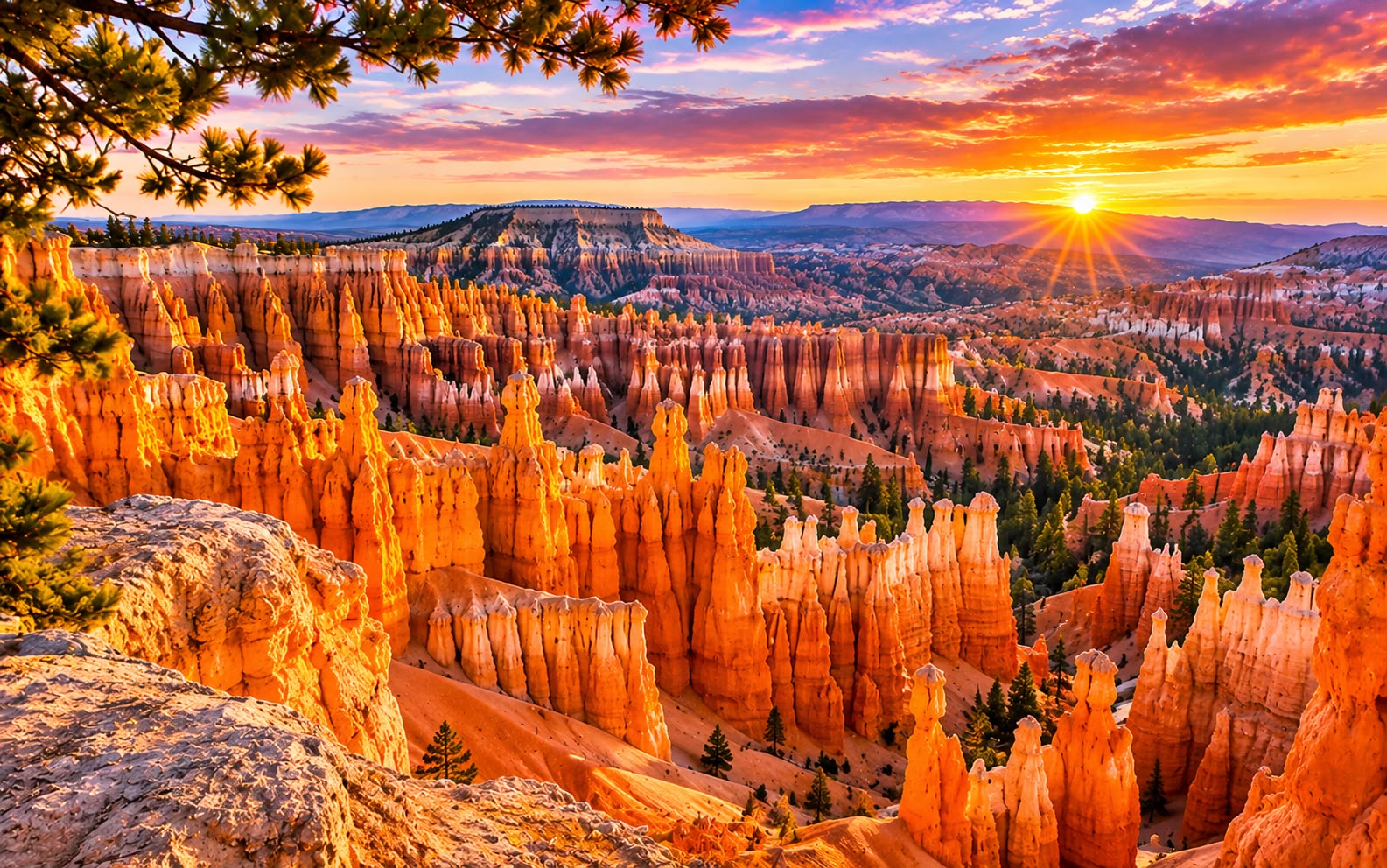
US national parks in 10 days: Zion, Bryce and the Grand Canyon
The Southwest loop that fits in ten days: Zion's canyon floor, Bryce's hoodoos at sunrise, Antelope and Horseshoe Bend at Page, and the Grand Canyon's South Rim. The permit lotteries, the shuttle rules and the altitude nobody warns you about.
- United States
- 10 days
- ≈ AED 10,850 / person
- The Colorado Plateau on one tank-and-a-half
Before you go
Four of the best landscapes in North America sit within a day’s drive of each other, and almost nobody outside the United States realises it. Las Vegas is the cheap way in — it has the long-haul flights and the cheap hire cars, and Zion is two and a half hours up the road.
This is a loop, not a line. You return the car where you found it, which in the American Southwest is worth several hundred dollars in one-way fees.
Ten days is the right length. Eight is a forced march and fourteen means adding Monument Valley, Arches and Canyonlands, which is a different and longer trip.
Figure USD 2,950 (≈ AED 10,834) per person. April to May, or late September to October.
Before you go: the admin
The permit and the lottery
- Angels Landing in Zion requires a permit, awarded by lottery. There is a seasonal lottery months ahead and a day-before lottery for leftovers. No permit, no chains — rangers check at the base. Check the current system before you plan around it; it has changed more than once.
- The Narrows needs no permit from the bottom up, only the willingness to walk in a river. Check the flow rate and the flash-flood forecast the morning you go, every time.
- Antelope Canyon is on Navajo Nation land and can only be entered with a Navajo-authorised guide. Book the slot weeks ahead in season; there is no walk-up.
- An annual parks pass covers the whole route and costs less than paying at three gates separately. Buy it at the first entrance.
Entry to the United States
- Check whether you need an ESTA or a visa. Visa Waiver nationals need an approved ESTA before boarding — apply at least 72 hours ahead on the official site, not the agencies that outrank it in search. Everyone else needs a B-2 visa, and interview waits run to months in some countries, so this is the first thing to start, before the flights.
- Last checked: 2 November 2026.
The car, which is the whole trip
- Book an SUV or a mid-size, not the cheapest compact. Some of these roads are long, fast and exposed, and you will live in this car.
- Americans drive automatics. This is the one place a manual licence costs you nothing.
- Fuel up whenever you are below half. Between Bryce and Page there are stretches with nothing, and phone signal goes with it.
- Download offline maps for the whole loop. Coverage in the parks is poor to absent.
- Under-25 drivers pay a daily young-driver surcharge, and some firms will not rent at all. Check before booking flights.
Altitude, heat, and the gap between them
- Zion’s canyon floor is about 4,000 feet. Bryce’s rim is around 8,000 to 9,000. You will drive between them in 90 minutes. Expect to be short of breath at Bryce, and expect it to be perhaps 20°F colder.
- Bryce can hold snow into May while Zion is in shorts weather the same week. Pack for both.
- Summer in Zion routinely passes 38°C on the canyon floor. Hike early, finish by noon.
Day by day
Day 1 — Land in Las Vegas
- Collect the car at the airport and get the admin done — insurance, fuel policy, the photographs of existing damage.
- Stay off the Strip if you want sleep, on it if you want the one night of spectacle.
- Evening — The Strip once, on foot, which is enough. The Bellagio fountains and the Fremont Street canopy downtown are the two free things worth the walk.
- Buy the groceries tonight. Park food is poor and expensive, and a cool box of water and lunch supplies changes every day that follows.
Day 2 — Drive to Zion
- Morning — Las Vegas to Springdale, about two and a half hours. Stop in St George if you need anything; it is the last real town.
- Stay in Springdale, immediately outside the gate, and walk or shuttle in. Lodges inside the park book out close to a year ahead.
- Afternoon — Ease in: the Pa’rus Trail along the river is flat, paved and forgiving of a travel day.
- Evening — The Watchman at sunset from the bridge by the visitor centre, which is the photograph everyone takes and is still right.
Where to stay in Zion (two nights)
- Inside the park: Zion Lodge — the only lodging inside the canyon, and the reason to book a year out.
- Mid-range: a Springdale hotel on the shuttle route — most have canyon views and a pool.
- Simple: the campgrounds, which also book out, or the chain hotels in Hurricane twenty minutes away.
Day 3 — Zion properly
- The park shuttle is mandatory in season and private cars are barred from the scenic drive. It runs early; the first buses are the quiet ones.
- If you have an Angels Landing permit: go first, and go at first light. The chains are exposed, the drop is real, and people have died on it. If heights are a question, the answer is Scout Lookout, which is most of the view without the spine.
- If you do not: Observation Point via East Mesa gives a higher view with no chains and no permit, or the Narrows from the bottom — rent neoprene and a stick in Springdale and walk upstream as far as the day allows.
- Afternoon — Emerald Pools or the Riverside Walk, both short, both shaded.
- Evening — Springdale, and an early night.
Day 4 — Over the pass to Bryce
- Morning — The Zion–Mount Carmel Highway east out of the park: switchbacks, a mile-long tunnel, and slickrock country on the far side. Large vehicles need a tunnel escort and pay a fee — relevant if you hired something big.
- Stop at the Checkerboard Mesa pull-off, then on.
- Midday — Bryce Canyon, about 90 minutes. It is not a canyon but the eroding edge of a plateau, and the hoodoos are the result.
- Afternoon — Drive the rim road to Rainbow Point and work back through the viewpoints.
- Dress warmer than you think. The rim is high and the temperature drops hard at dusk.
Where to stay in Bryce (one night)
- Inside the park: The Lodge at Bryce Canyon — a short walk from the rim, open seasonally.
- Mid-range: the cluster at Bryce Canyon City, a couple of minutes from the gate.
- Simple: Tropic, fifteen minutes down the road and cheaper.
Day 5 — Bryce at sunrise, then Page
- Before dawn — Sunrise Point or Sunset Point. The hoodoos light from the top down and turn orange for about twenty minutes. This is the single best hour of the trip and it costs you one early alarm.
- 07:30 — Down the Navajo Loop and up the Queen’s Garden, the classic three-mile combination that puts you among the hoodoos rather than above them. Remember the altitude on the climb out.
- 11:00 — Drive to Page, about three hours, through Grand Staircase–Escalante country. Fuel before you leave.
- Afternoon — Horseshoe Bend: a short walk from a paid car park to an unfenced overlook above a 300-metre drop. Hold on to children.
- Evening — Page is a functional town, not a destination. Eat and sleep.
Day 6 — Antelope Canyon and Lake Powell
- Your booked Antelope Canyon slot. Upper is the one with the light beams, easier walking, and the crowds; Lower is narrower, involves ladders, and is more interesting to walk. Both are guided and both are on Navajo land.
- Light beams are a midday, late-spring-to-summer phenomenon. Outside that window the canyon is still extraordinary and the photographs are different.
- Afternoon — Lake Powell: a boat hour, a swim off a beach, or the Glen Canyon Dam overlook if the water is low and the bathtub ring is the story.
- Evening — Early night; tomorrow is the long one.
Day 7 — To the Grand Canyon
- Morning — Page to the South Rim, about two and a half hours, entering by the east gate.
- Come in on Desert View Drive, which is the better approach: the Desert View Watchtower first, then the overlooks west with the canyon opening as you go.
- Afternoon — Check in, then the Rim Trail on foot. It is paved, mostly flat, and strings the viewpoints together.
- Sunset — Hopi Point or Yavapai Point. Take the shuttle; parking at sunset is a sport.
Where to stay at the Grand Canyon (two nights)
- Inside the park: El Tovar on the rim, a 1905 lodge, booked a year ahead. Bright Angel Lodge is the cheaper rim option.
- Mid-range: Tusayan, ten minutes outside the gate.
- Simple: Williams or Flagstaff, an hour away, with far more choice and lower prices.
Day 8 — Into the canyon, or along it
- The hike: Bright Angel or South Kaibab, partway down and back. Going down is optional; coming up is not. Allow twice as long for the return, carry far more water than feels sensible, and turn round at the time you set, not the point you wanted. Do not attempt the river and back in a day — this is the warning the rangers repeat most, and people ignore it every summer.
- The alternative: the full Rim Trail by shuttle and foot, Hermit Road to its end, and the geology museum at Yavapai.
- Evening — The rim after dark. The park is a certified dark-sky place and the Milky Way is plainly visible on a clear moonless night.
Day 9 — Back towards Las Vegas
- Morning — Last rim walk and coffee, then drive west, about four and a half hours.
- The worthwhile stop: Seligman and the old Route 66 stretch, which is kitsch but genuine, or Hoover Dam for the engineering as you come into Nevada.
- Evening — Las Vegas. Return the car tonight if your flight is early, or keep it for the airport run.
Day 10 — Out
- Morning — Fuel the car and return it with the margin for the inspection queue, which at Las Vegas can be slow.
- Allow three hours at the airport for an international departure.
Costs and practicalities
Best time to visit
April to May, or late September to October. The shoulders are the whole answer here.
- April and May — Zion is perfect and Bryce may still hold snow at the rim. Fewer people, and the Narrows may be closed to high spring runoff. Check the flow.
- June to August — Zion’s floor passes 38°C, the parks are at their fullest, and lodging prices peak. It is also the only reliable window for Antelope Canyon’s light beams. Hike at dawn or not at all.
- Late September and October — arguably the best of the year: warm days, cold nights, thin crowds, and the cottonwoods turning in Zion.
- November to March — Bryce under snow is magnificent and the hoodoos look better for it, but roads and trails close, the Grand Canyon’s North Rim shuts entirely, and the days are short.
Travel tips
- Start the ESTA or visa before anything else. Interview waits are the long pole.
- Buy the annual parks pass at the first gate. It pays for itself on this route.
- Carry more water than you think, and salt with it. Dehydration on the Bright Angel is the commonest rescue.
- Fuel at half a tank, not a quarter.
- Download offline maps. There is no signal in most of this.
- Book Zion Lodge, El Tovar and the Bryce lodge close to a year ahead, or stay outside the gates and stop worrying about it.
- Respect the unfenced overlooks. Horseshoe Bend and much of the South Rim have no railing at all.
- Check Antelope Canyon and Angels Landing rules before you depend on them. Both have changed in recent years.
What this trip actually costs
Two people, 9 nights, mid-range throughout, international flights excluded:
| Item | Cost |
|---|---|
| Hotels and lodges, 9 nights | USD 2,700 (≈ AED 9,916) |
| Hire car, 9 days, with fuel | USD 1,150 (≈ AED 4,223) |
| Food and drink, 10 days | USD 1,100 (≈ AED 4,040) |
| Parks pass, Antelope Canyon tour, Horseshoe Bend parking | USD 450 (≈ AED 1,653) |
| Las Vegas: the one night out, and the Strip | USD 350 (≈ AED 1,285) |
| Shuttles, laundry, tips and contingency | USD 150 (≈ AED 551) |
| Total for two | USD 5,900 (≈ AED 21,668) |
- Roughly USD 2,950 (≈ AED 10,834) per person for ten days.
- Beds are the biggest line and the most controllable one. Staying in Tropic, Hurricane and Williams rather than inside the parks takes several hundred dollars out of it, at the cost of driving at dawn.
- The car plus fuel is the second line and is not compressible — this loop is roughly 1,400 kilometres.
- A cool box and a supermarket run cuts the food line hard. Park restaurants are a captive market.
- Hotel picks here are chosen on location, not on commission — always check prices and recent reviews before booking.
What to pack
- Proper walking boots, broken in. This is not a trainers trip.
- Layers for a 20°F swing in a single day, and a warm jacket for the Bryce rim at dawn.
- A litre bottle each at minimum, plus electrolyte tablets.
- Sun hat, high-factor sunscreen, lip balm. The plateau is high, dry and unshaded.
- A head torch for pre-dawn starts and the dark-sky evening.
- A cool box, bought on day one and left behind on day ten.
- Neoprene socks and boots are rented, not packed, if you are walking the Narrows.
Part of a bigger trip?
- USA West in 10 days is the cities version — Los Angeles, Las Vegas and San Francisco.
- California road trip takes the Pacific Coast Highway and Yosemite.
- USA in 10 days is the east — New York, Washington and Niagara.
- Add Monument Valley, Arches and Canyonlands and this becomes a fourteen-day loop through Moab, which is the natural extension.
FAQ
Is ten days really enough for all four? Yes, and it is close to the minimum. The driving is the constraint: roughly 1,400 kilometres across the loop, with two long transfer days. Cutting to eight means losing either the Narrows or a full Grand Canyon day, and both are the reason to come.
Do I need a permit for anything? Angels Landing in Zion, by lottery, and that is the main one. The Narrows from the bottom needs none. Antelope Canyon needs a booked Navajo-guided tour rather than a permit. All three have changed their systems in recent years, so confirm before you build a day around them.
How bad is the altitude at Bryce? Noticeable rather than dangerous for most people. The rim sits around 8,000 to 9,000 feet, and you will have driven up from 4,000 that morning. The climb out of the Queen’s Garden is where people feel it. Walk slower than you want to and drink more than you want to.
Can this be done without a car? Not really. There are tour buses from Las Vegas that hit the highlights, but they move on a fixed schedule and the best hours here are dawn and dusk, which is exactly when a coach is not there. If nobody can drive, this is the wrong trip.
Is it suitable for children? Very, with two caveats. The overlooks are mostly unfenced, including Horseshoe Bend and long stretches of the South Rim, so small children need holding. And the big hikes are not realistic for young legs — but the Rim Trail, the Pa’rus, Emerald Pools and the Queen’s Garden all are, and the hoodoos at sunrise do the rest.
Prices and entry rules change, and what you need depends on your passport; last checked 3 November 2026, so confirm with the embassy or your airline before booking.


