 The Itinerary
Florida with kids in 8 days: Orlando, the Space Coast and the Gulf
Three days of theme parks, a rocket, a Gulf beach to recover on, an airboat through the Everglades and out from Miami. Date-based ticket pricing, resort fees, the afternoon thunderstorm, and why the second half of this trip matters more than the first.
- United States
- 8 days
- ≈ AED 10,100 / person
- Three park days, then an actual holiday
Before you go
Most Florida trips are a theme-park trip with a day tacked on, and the children come home more tired than their parents. This one front-loads the parks and then drives away from them.
Three park days, not six. Three is where the enjoyment peaks and the queueing starts to outweigh it — and it halves the single largest line in the budget.
Then west to the Gulf for two nights, which is the part people remember, and south through the Everglades to Miami. Fly into Orlando and out of Miami; doubling back is a wasted day.
Figure USD 2,750 (≈ AED 10,099) per person. March to May, or late October to November.
Before you go: the admin
Entry to the United States
- Visa Waiver nationals need an approved ESTA before boarding — apply at least 72 hours ahead on the official government site, not the agencies that outrank it in search results.
- Everyone else needs a B-2 visa, and interview waits run to months in some countries. Start this before you book anything else.
- Children need their own ESTA or visa, regardless of age.
- Last checked: 2 November 2026.
Theme park tickets — read this before you buy
- Pricing is date-based and changes constantly. The same ticket can differ substantially between a Tuesday in May and a Saturday in July. Any price quoted in an article, including this one, is indicative only — check the official sites for your dates.
- Multi-day tickets cost much less per day than single days. Three days bought together is far cheaper than three singles.
- Some parks require a reservation for the date as well as a ticket. Check whether yours does before you assume the ticket is enough.
- The paid line-skipping systems are separate purchases and in peak weeks they change the day materially. In quiet weeks they are often not worth it.
- Buy from the parks themselves or an authorised reseller. The discount-ticket market here has a long history of worthless paper.
The car, and the fees nobody mentions
- You need a car from the airport. Orlando’s attractions are spread over 30 kilometres and the Gulf and Everglades legs have no alternative.
- Child seats are required by law and hire companies charge a daily rate for them. Bringing your own is usually cheaper and guarantees it fits.
- Tolls are everywhere on Florida’s expressways. Take the hire company’s transponder or check their by-plate billing; the administrative fees for unpaid tolls are punitive.
- Resort fees and self-parking charges are added nightly at most Orlando and Miami hotels, on top of the rate you booked. Budget them; they are not optional and they are not in the headline price.
- Under-25 drivers pay a daily surcharge.
Heat, storms and wildlife
- From June the afternoon thunderstorm is close to daily — it arrives around two or three, is violent, and passes in an hour. Parks close outdoor rides during lightning. Plan indoor things for mid-afternoon rather than fighting it.
- Hurricane season runs June to November, with the real risk weighted to August, September and October. Take travel insurance that covers it, and watch the forecast rather than the headlines.
- Do not swim in fresh water. Alligators are in essentially every lake, canal and pond in the state, including ornamental ones. This is not a dramatisation; it is the local rule.
- Lovebugs swarm for a few weeks in May and again in September and coat the front of the car. Harmless, and they damage paint if left — wash them off.
Day by day
Day 1 — Land in Orlando
- Collect the car and get the transponder and child seats sorted at the desk.
- Stay near the parks, either on-site or in the Lake Buena Vista and International Drive cluster. On-site costs more and buys early entry and transport; off-site costs less and means driving and parking each day.
- Afternoon — Do nothing. The flight is long, the time change is real, and tomorrow starts early.
- Evening — A supermarket run. A cool box of water, fruit and breakfast things is the single best money-saving move of the trip — park food is a captive market.
Where to stay in Orlando (four nights)
- On-site: a park resort hotel, for the early-entry hour and the shuttles.
- Mid-range: a Lake Buena Vista hotel with a pool and a free park shuttle — the usual compromise.
- Simple: a rented condo or apartment with a kitchen, which for a family is often both cheaper and saner.
Day 2 — First park day
- Be at the gate before opening. The first ninety minutes are worth any two hours later in the day, and this is the whole strategy.
- Do the headline ride first, then work outward.
- Take the midday break seriously. Go back to the pool from about one until four. Everyone who skips this is miserable by six, and in summer you are avoiding both the heat and the storm.
- Return in the late afternoon for the evening, the parade and the fireworks.
- Mobile orders for food save a queue in most parks now; order an hour before you want to eat.
Day 3 — Second park day
- Same shape: early, break, evening.
- Pick a different park, not the same one again. Variety is what keeps children going on day three.
- Ride height limits are strict and measured at the gate. Check them in advance against each child — a surprise at the front of a queue is a bad hour.
- Most parks have a rider-swap system so two adults can take turns on a ride a child is too small for, without queueing twice. Ask at the ride entrance.
Day 4 — Kennedy Space Center
- An hour east, and a complete change of register.
- The Space Shuttle Atlantis is displayed with its payload bay open, at an angle, a few metres away. The Saturn V hall is a 110-metre rocket lying on its side with the Apollo control room preserved at one end.
- The bus tour out to the launch complexes is included and takes a couple of hours. Allow a full day.
- Check the launch schedule before you pick the date. Launches are frequent now, and seeing one is a different order of experience — but they also close parts of the site and sell separate viewing tickets.
- Evening — Back to Orlando, or Cocoa Beach for an hour on the Atlantic before driving back.
Day 5 — West to the Gulf
- Morning — Last park morning if you want one, or a slow start.
- Midday — Drive west and south to Siesta Key or Sarasota, about two and a half hours.
- Siesta Key’s sand is quartz rather than coral — it is brilliant white and stays cool underfoot even in August, which genuinely matters with children.
- Afternoon — The beach, and nothing else.
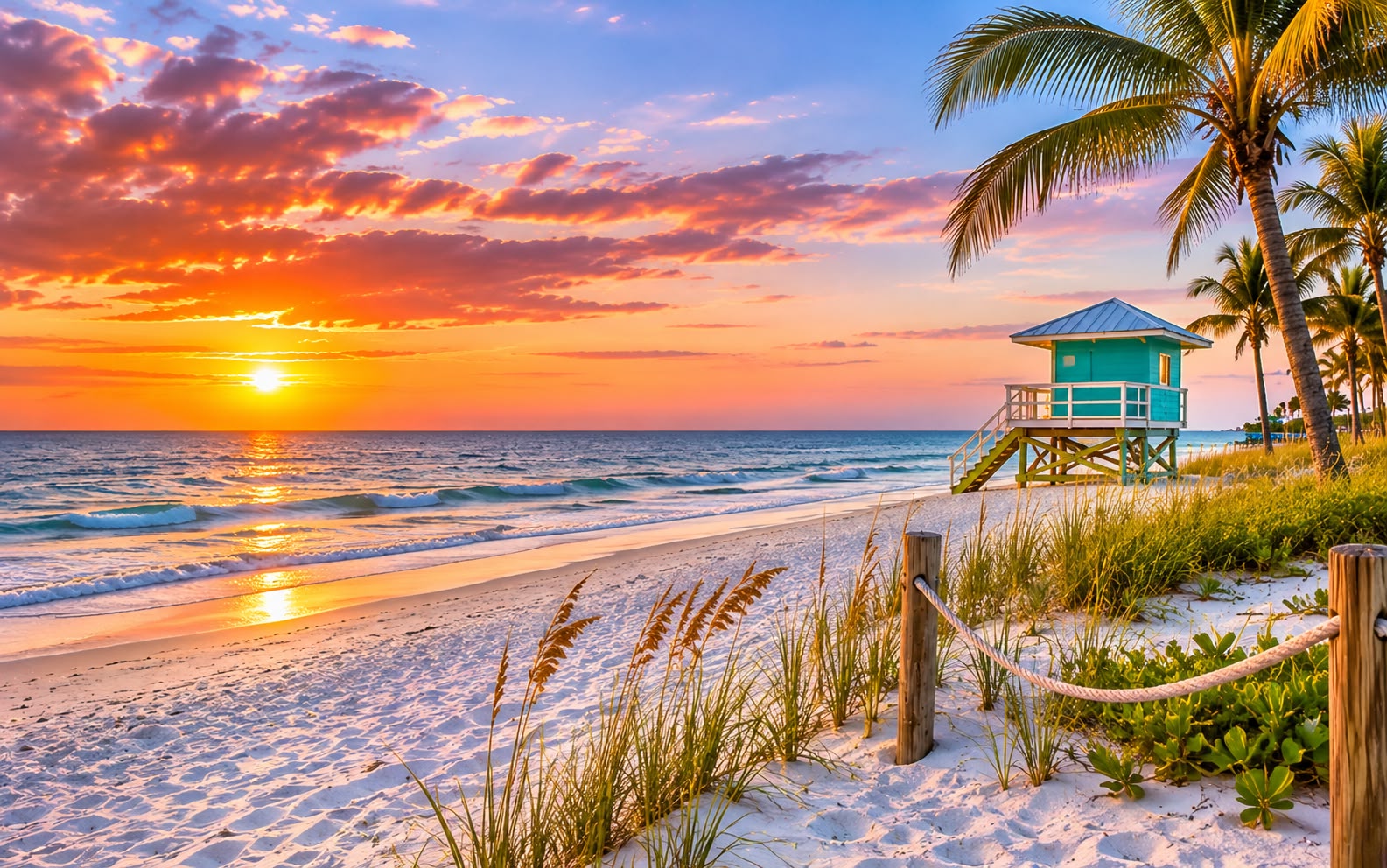
- Sunset — The Gulf faces west, so this is the coast where the sun goes down over the water. It is a nightly event and people clap.
Where to stay on the Gulf (two nights)
- Grand: a beachfront resort on Siesta or Lido Key.
- Mid-range: a motel or condo a street back from the sand, which is a fraction of the beachfront rate and a two-minute walk.
- Simple: Bradenton or Venice, twenty minutes either side and quieter.
Day 6 — A Gulf day
- Morning — Shelling. The Gulf coast is one of the best shelling shores in the world, and the hour after low tide is when to do it. Children will spend three hours at this.
- Midday — Mote Marine Laboratory in Sarasota, an aquarium and working research centre, if the sun needs escaping.
- Afternoon — Myakka River State Park for alligators seen properly — a boardwalk, a canopy walkway and an airboat on the lake. Or stay on the beach, which is a legitimate answer.
- Evening — Dolphins are routinely visible from shore at dusk. Not guaranteed, but common.
Day 7 — The Everglades, and on to Miami
- 08:30 — Drive south to the Everglades, about two and a half hours down the Gulf coast past Naples.
- 11:00 — An airboat. Fast, loud, and the thing children remember from the whole trip. Ear defenders are provided and small children should use them.
- Note: airboats are restricted inside Everglades National Park and most operate on the fringes or in the Big Cypress area. Shark Valley, inside the park, offers a tram tour and a cycle path along a canal lined with alligators instead — which is the better wildlife and the worse thrill.
- 14:00 — The Tamiami Trail east, which runs straight through the sawgrass with alligators on the verge.
- 16:30 — Miami. Check in around South Beach or Brickell.
- Evening — Ocean Drive’s art deco frontage lit up, and a Cuban dinner. Little Havana is the better food and a short drive.
Where to stay in Miami (one night)
- Grand: an art deco landmark on Ocean Drive.
- Mid-range: a hotel in South Beach a few streets back from the sand.
- Simple: Brickell or Coral Gables — cheaper, calmer, and better for families than South Beach at night.
Day 8 — Miami, and out
- Morning — The beach, or Little Havana on Calle Ocho for the cafés and the domino park, or the Wynwood Walls for the murals if the children are older.
- Drop the car at Miami airport with the usual margin, and allow three hours for an international departure.
Costs and practicalities
Best time to visit
March to May, or late October to November. Florida’s problem is not cold, it is heat, storms and school holidays.
- March and April — warm, dry and lovely, but spring break fills the parks and the beaches for several weeks. Check the dates and work around them.
- May — one of the best months: hot but not yet stormy, and quiet until the end of it. Lovebugs.
- June to August — hottest, wettest and busiest, with a near- daily afternoon thunderstorm and the parks at capacity. This is when most families can travel, so the advice is to plan around it rather than avoid it: early mornings, long midday breaks.
- September and October — the peak of hurricane season and the quietest the parks ever are. A real trade.
- Late October to November — warm, dry, uncrowded. Arguably the best window of the year.
- December to February — mild, dry and pleasant, with the Christmas and New Year fortnight the single busiest and most expensive period in the parks.
Travel tips
- Three park days, not six. The enjoyment curve turns down and the cost curve does not.
- Gate at opening, pool at one, back at four. The whole park strategy in one line.
- Check ticket prices on the official sites for your exact dates — anything quoted elsewhere, including here, is indicative.
- Budget the resort fee and the parking charge, nightly, on top of the room.
- Bring your own child seats if you can; the daily hire rate adds up fast.
- Check ride height limits against each child before you queue.
- Never swim in fresh water. Alligators are in all of it.
- Take hurricane cover on the insurance from June onwards.
- A cool box and a supermarket run will save more than any other single decision.
What this trip actually costs
Two adults, 7 nights, mid-range throughout, international flights excluded. Children’s tickets, beds and food are additional — see the note below.
| Item | Cost |
|---|---|
| Hotels, 7 nights, including resort fees and parking | USD 1,750 (≈ AED 6,427) |
| Theme park tickets, two adults, three days | USD 1,100 (≈ AED 4,040) |
| Food and drink, 8 days | USD 900 (≈ AED 3,305) |
| Hire car, 8 days, with fuel and tolls | USD 750 (≈ AED 2,754) |
| Kennedy Space Center, airboat, Mote, Myakka | USD 500 (≈ AED 1,836) |
| Child seats, contingency and extras | USD 500 (≈ AED 1,836) |
| Total for two | USD 5,500 (≈ AED 20,199) |
- Roughly USD 2,750 (≈ AED 10,099) per person for eight days.
- Two children typically add most of another park-ticket line and roughly half again on food, while often sharing the room at no extra charge up to a stated occupancy. Check the per-hotel occupancy limit — it is usually four, sometimes five.
- Park tickets are the most compressible line. Two days rather than three takes several hundred dollars out immediately.
- A condo with a kitchen is usually cheaper than two hotel rooms and removes a meal a day from the food line.
- Resort fees and self-parking are the commonest budget surprise. They are charged nightly and quoted nowhere in the booking headline.
- Hotel picks here are chosen on location, not on commission — always check prices and recent reviews before booking.
What to pack
- Trainers that can take 25,000 steps a day. Park days are walking days.
- A second pair of shoes, because the afternoon storm will soak the first.
- Ponchos rather than umbrellas — umbrellas are awkward in queues and some parks restrict them.
- High-factor sunscreen and hats for everyone. Florida sun in June is not European sun.
- Refillable bottles. Most parks have free water stations and will fill a cup at any counter.
- A portable battery. Park apps, mobile ordering and queue times will drain a phone by lunchtime.
- Swimwear for the midday break, which is the whole point of it.
- A cool box, bought on arrival and left behind.
Part of a bigger trip?
- US national parks in 10 days is the opposite kind of American holiday — Zion, Bryce and the Grand Canyon.
- USA in 10 days covers New York, Washington and Niagara, and pairs naturally with Florida on a longer trip.
- USA West in 10 days is the California version.
- Add a Caribbean week from Miami — the Bahamas are under an hour by air.
FAQ
Why only three theme park days? Because that is where the enjoyment peaks. By day four the novelty has gone, the queues feel longer and children are tired rather than excited — and tickets are the largest controllable cost in the whole trip. Three days of parks followed by a Gulf beach produces a better holiday than six days of parks, for less money.
How much are park tickets, really? It depends entirely on your dates, and it changes often. Pricing is date-based, multi-day tickets cost far less per day than singles, and the line-skipping systems are priced separately on top. The figure in the table above is indicative for two adults over three days — check the official sites for your actual dates before you budget.
Is hurricane season a reason not to go? Not by itself, but it is a reason to insure properly. The season runs June to November with the real weight in August to October. Most trips are unaffected; the ones that are not are seriously so. Take cover that includes hurricane disruption, and watch the National Hurricane Center rather than the news.
Are the alligators actually a risk? Not if you follow one rule: do not swim in fresh water, and do not let children near the edge of any lake, pond or canal. They are in essentially all of it, including ornamental water on resorts and golf courses. Seen from a boardwalk or an airboat they are one of the best things about the state.
Is Miami worth the last two days? For one night and a morning, yes — the art deco frontage, Little Havana and the beach are a genuine change of scene, and it is the better airport to leave from. If your children are young, stay in Brickell or Coral Gables rather than South Beach, which is loud late and not aimed at families.
Prices and entry rules change, and what you need depends on your passport; last checked 3 November 2026, so confirm with the embassy or your airline before booking.


