 The Itinerary
USA and Canada in 12 days: Banff, the Icefields Parkway, Jasper and Glacier
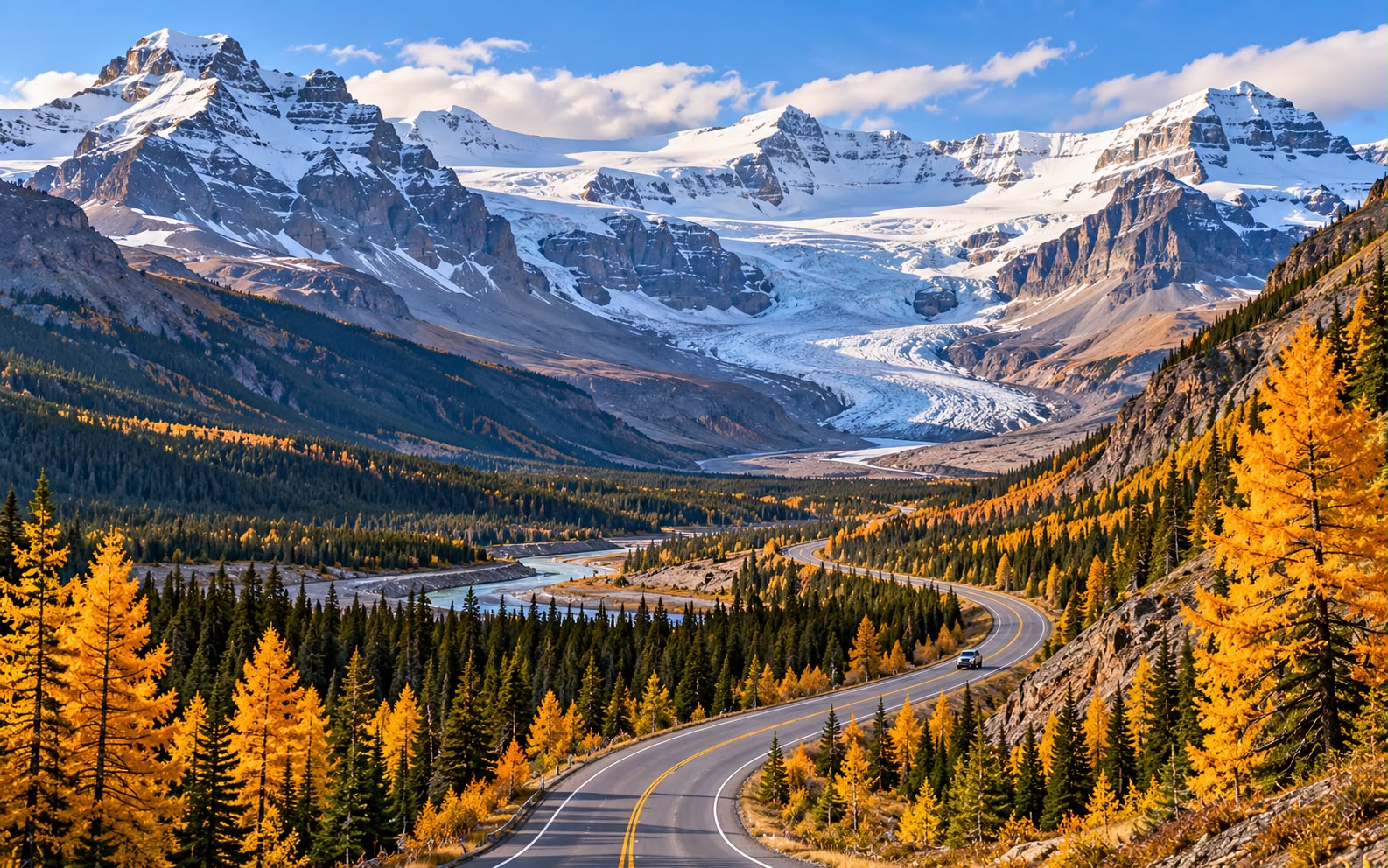
Lakes the colour of antifreeze, a 230km parkway along the spine of the continent with glaciers hanging over it, and then south across the 49th parallel to a park that calls itself the Crown of the Continent.
- Canada
- 12 days
- ≈ AED 11,000 / person
- One mountain range, one road, two park systems and a border in the middle
Before you go
Before you go: the admin
Two entries, and the border is the bit to plan
- Canada requires an eTA for visa-exempt air arrivals — minutes online, tied to your passport. Arriving by land you need no eTA, which catches people out in both directions.
- The USA requires ESTA for visa-waiver nationals, approved before you board, and the Visa Waiver Program’s land-crossing rules differ from the air ones — you still need ESTA, and you may be issued an I-94 and charged a fee at the land border.
- Apply for both at least 72 hours ahead, and use only canada.ca and esta.cbp.dhs.gov. The agent sites charge several times the fee.
- Check your hire car may cross. Most Canadian companies allow it with notice; a few do not, and the insurance needs to be valid both sides.
Flights and the shape
- Fly into Calgary and out of Calgary, which makes this a loop, or out of Kalispell if you want to end in Montana.
- A one-way international car drop is very expensive. The loop back to Calgary costs a day and saves several hundred dollars.
- This is a driving trip. Calgary to Jasper is 400km and the Icefields Parkway between them is the point rather than the transit.
Money and the park passes
- Canadian and US dollars, both decimal, neither usable in the other, and roughly 1.35 CAD to the USD.
- Parks Canada Discovery Pass covers Banff, Jasper, Yoho, Kootenay and Waterton for a year and pays for itself in about a week.
- The America the Beautiful pass covers Glacier and every other US federal site for a year, per vehicle.
- Buy both. Day rates on two park systems add up fast.
- Cards work everywhere, and tipping is 18–20% in both — tax is added at the till, so the shelf price is never the price.
The things that actually catch people out
- Moraine Lake has no private cars at all. Shuttle, Parks Canada bus, or a commercial operator. Book weeks ahead.
- Lake Louise parking fills by six in the morning in July and August, and is paid.
- Going-to-the-Sun Road in Glacier requires a vehicle reservation in peak season, released in blocks ahead of time, and it does not open fully until late June or early July and closes again in October.
- Wildlife rules are not decoration: 100m from bears and wolves, 30m from everything else, no food in tents, and the bear-proof bins exist because people ignored them.
Day by day
Day 1 — Land in Calgary
- Arrive, collect the car, and drive west. Banff is 90 minutes and there is no reason to spend a night in Calgary unless the Stampede is on in July.
- A Parks Canada pass covers Banff, Yoho and Jasper — buy the annual one if you are here more than a week; it pays for itself in five days.
- 16:00 — Banff townsite for the evening — the Bow River, Cascade Mountain at the end of the main street, and the Banff Springs Hotel looking like a castle somebody misplaced.
- 18:00 — Bow Falls, a ten-minute walk from town.
- 20:00 — Dinner on Banff Avenue, and book the Moraine Lake shuttle tonight if you have not.
Day 2 — Banff
- 08:00 — The Cave and Basin, the hot spring that started the whole Canadian national park system in 1885.
- 10:30 — The Banff Gondola up Sulphur Mountain for the whole Bow valley, and the boardwalk along the ridge to the old meteorological station.
- 14:00 — Lake Minnewanka and the Two Jack lakeshore, twenty minutes out, with a boat cruise if the weather is good.
- 17:00 — Vermilion Lakes at golden hour, which is where the Mount Rundle reflection is.
- 19:30 — The Banff Upper Hot Springs in the evening, which is the right end to a cold day.
Day 3 — Lake Louise and Moraine Lake
- 06:00 — Moraine Lake first, on the shuttle, booked. Ten peaks behind a lake that is genuinely that colour — glacial rock flour, not a filter. The road is closed to private cars; the shuttle is the only way in.
- Go at dawn or late afternoon. Between ten and four both lakes are a car park with a view.
- 09:00 — Lake Louise and the walk to the Lake Agnes Tea House, which is 3.5km up and has been serving since 1905. It takes cash only.
- 12:30 — The Plain of Six Glaciers beyond it if the legs hold, which is the better walk and has its own tea house.
- 17:00 — Back down, and the lakeshore path when the crowds have gone.
Day 4 — Yoho, across in British Columbia
- 08:30 — Forty minutes west over the Kicking Horse Pass, and the time zone changes — British Columbia is an hour behind Alberta.
- 09:30 — Takakkaw Falls, one of the highest in Canada at 373m, fed directly off the Daly Glacier. The access road has a switchback buses must reverse around and is closed until June.
- 12:00 — Emerald Lake and the Natural Bridge, with a canoe on the lake if the wind is down.
- The Burgess Shale is here — the Cambrian fossil bed that rewrote what we know about early animal life — and the hikes to it are guided, limited and booked months ahead.
- 16:00 — The spiral tunnels viewpoint, where the railway loops through the mountain to lose height.
- 18:30 — Back to Lake Louise, and fuel up for tomorrow.
Day 5 — The Icefields Parkway
- 08:00 — 230km from Lake Louise to Jasper, and it is routinely called one of the best drives in the world. Allow the whole day; three hours of driving and six of stopping.
- 09:30 — Peyto Lake from the Bow Summit viewpoint, which is wolf-head shaped and improbably blue.
- 11:30 — Fuel at Saskatchewan River Crossing — it is the only pump for 150km and it is expensive.
- 13:00 — The Columbia Icefield — the Athabasca Glacier comes down to the road, and the Ice Explorer takes you onto it. The glacier has retreated about 1.5km since 1890 and the markers along the approach show you by how much per decade, which is the most sobering thing on this route.
- 15:30 — The Skywalk, a glass floor over the Sunwapta valley.
- 17:00 — Athabasca Falls and Sunwapta Falls on the run into Jasper.
- There is no mobile signal for most of this road. Download the map before you set off.
Day 6 — Jasper
- 08:00 — Maligne Canyon, 50m deep and narrow enough to touch both sides in places. Walk down to the fifth bridge and back.
- 11:00 — Maligne Lake and Spirit Island, which is reached by boat only and is the photograph on half the posters of Canada. Book the cruise ahead in summer.
- 16:00 — Mount Edith Cavell and the Angel Glacier, with the trail to the moraine below it — the road is narrow, one-way in places, and closed until late June.
- 19:00 — Elk walk through the townsite. They are not tame and the bulls in September are genuinely dangerous — thirty metres is the rule and it is not a suggestion.
- 22:00 — Jasper is a Dark Sky Preserve — one of the largest in the world — and the stargazing is the reason to stay two nights.
Day 7 — Jasper, the quieter side
- 07:00 — The Valley of the Five Lakes, a 4.5km loop that is the best short walk in the park and empty at seven.
- 10:30 — The Jasper SkyTram to 2,263m, with the ridge walk above the top station.
- 14:00 — Pyramid Lake and the island boardwalk, or a canoe on Patricia Lake.
- 17:00 — Miette Hot Springs, an hour east, which are the hottest in the Rockies and far quieter than Banff’s.
- Carry bear spray and know how to use it. Both parks sell it and both will tell you the same thing.
Day 8 — Back south, and east to Waterton
- 07:00 — The Parkway again in the other direction, which looks entirely different, then south past Calgary. It is a long day — about eight hours of driving in total.
- 13:00 — Lunch at Saskatchewan River Crossing or Bow Lake.
- 18:00 — Waterton Lakes is Banff’s quiet southern cousin — the Prince of Wales Hotel on its bluff, and Upper Waterton Lake running straight across the border.
- Waterton and Glacier are jointly a UNESCO site — the world’s first International Peace Park, designated in 1932 — which is the route’s whole argument in one designation.
- 20:00 — The wind at Waterton is famous and the hotel bluff is the worst of it.
Day 9 — Cross into Montana
- 08:00 — The Chief Mountain crossing is seasonal, usually open late May to September; Carway is open year-round.
- Declare everything — the US agricultural rules are strict and fruit, meat and plants all count. Bear spray is also declarable and sometimes refused.
- 11:00 — Many Glacier on the eastern side, which is the best valley in the park and the most reliable for grizzly.
- The Grinnell Glacier trail if you have the day — 17km return and the finest walk in Glacier. The boat across the two lakes cuts 5km off it.
- 18:00 — Swiftcurrent Lake at dusk, where the moose come down.
Day 10 — Going-to-the-Sun Road
- 06:30 — A vehicle reservation is required in season, and the road does not open fully until late June or early July, depending on when the plough teams get through.
- 07:00 — 80km over Logan Pass, cut into the cliff face in the 1930s and an engineering landmark in its own right.
- 09:00 — The Highline Trail from Logan Pass — a ledge path with a cable handrail in one section, and mountain goats and bighorn on it. The Logan Pass car park is full by eight in summer.
- 14:00 — Lake McDonald on the western side for the coloured pebbles under clear water.
- 18:00 — Sunset at Lake McDonald, which faces the right way and is the best of the park’s easy viewpoints.
Day 11 — Glacier, the west side
- 08:00 — Avalanche Lake or the Trail of the Cedars, both short and both good — the Cedars boardwalk is flat and the lake adds 3km each way.
- 12:00 — Apgar and a kayak on Lake McDonald.
- 15:00 — The glaciers are going. There were around 150 when the park was founded in 1910 and there are fewer than 30 now; the park’s own signage is direct about it.
- 17:00 — Whitefish or Columbia Falls for the last evening, or back east to shorten tomorrow.
Day 12 — Back to Calgary and out
- 07:00 — About five hours back north through the border and across the prairie, which changes from mountain to flat within half an hour and is worth the window.
- Leave plenty for the crossing, which is slower northbound at weekends.
- Drop the car at Calgary — and check whether your rental allows the cross-border return, because several do not.
Costs and practicalities
Best time to visit
Late June to September, and the window is set by the roads rather than the temperature.
- Late June–early July — Going-to-the-Sun Road usually opens fully in this window and the Icefields Parkway is clear. Waterfalls at full snowmelt, wildflowers, and fewer people than August.
- July–August — peak, warmest, and the parks are at capacity. Lake Louise parking fills by six in the morning, the Moraine shuttle sells out weeks ahead, and accommodation needs booking months out.
- September — the best of the year. The larches turn gold around Lake Louise in the last ten days of September, the crowds thin after Labor Day, and the elk rut is in full voice. Going-to-the-Sun starts closing in October.
- October–May — Going-to-the-Sun is closed over Logan Pass and much of Glacier is inaccessible. Banff and Lake Louise become a ski resort, the lakes freeze and Lake Louise’s ice-skating rink is genuinely lovely. This itinerary does not work in winter; a Banff ski trip is a different one.
Travel tips
- Book the Moraine Lake shuttle and the Going-to-the-Sun vehicle reservation as far ahead as they release. Both sell out, and without them two of the best days on this route are not available at all.
- Check Going-to-the-Sun’s opening date before you book. It does not fully open until late June or early July and the date moves every year with the snow.
- Buy both park passes — Parks Canada Discovery and America the Beautiful. Day rates across two systems cost more.
- Carry bear spray and know how to use it, and make noise on blind corners. 100m from bears and wolves, 30m from everything else, and never between a mother and young.
- Tell the hire company you are crossing, and declare all food at the border both ways.
- Cell coverage drops out along the Icefields Parkway. Download offline maps before you leave Lake Louise.
- Fuel at Saskatchewan River Crossing or you will not make Jasper.
What this trip actually costs
Two people, 11 nights, mid-range comfort, international flights excluded:
| Item | Cost |
|---|---|
| Hotels and lodges, 11 nights | USD 2,640 (≈ AED 9,695) |
| Food and drink, 12 days | USD 1,100 (≈ AED 4,040) |
| Car hire, 11 days, with cross-border cover | USD 900 (≈ AED 3,305) |
| Gondolas, the Icefield Explorer, boats and tours | USD 660 (≈ AED 2,424) |
| Fuel and parking | USD 400 (≈ AED 1,469) |
| Parks Canada and America the Beautiful passes | USD 300 (≈ AED 1,102) |
| Total for two | USD 6,000 (≈ AED 22,035) |
- Roughly USD 3,000 (≈ AED 11,018) per person. Accommodation inside the parks is the expensive line — Banff and Jasper townsites and the Glacier lodges all price accordingly.
- Staying in Canmore instead of Banff saves a third on the accommodation and costs twenty minutes each way.
- Both park passes together are about $300 for two and are the best value on the page.
- Hotel picks here are chosen on location, not on commission — always check prices and recent reviews before booking.
What to pack
- Layers, and a warm one. Logan Pass and the Columbia Icefield are cold in August, and mountain weather turns in an hour.
- Proper walking boots for the Highline and Grinnell trails.
- Bear spray — buy it there, since it cannot fly — and know how to use it before the trailhead.
- Insect repellent for Jasper in June and July.
- Sunglasses and SPF. Altitude and snowfield glare both burn.
- A cooler box. Park food is expensive and the picnic spots are the best lunch venues in North America.
- Binoculars for the Many Glacier grizzly slopes.
FAQ
Do I need to book anything in advance? Yes — the Moraine Lake shuttle, the Going-to-the-Sun vehicle reservation, and accommodation in Banff, Jasper and Glacier. All four sell out, and two of them gate access entirely.
When does Going-to-the-Sun Road open? Usually late June or early July over Logan Pass, depending on the snow, and it starts closing in October. Check before booking, as the date moves every year.
Is the Icefields Parkway really that good? Yes. It is 230km with glaciers hanging above the road for much of it, and it deserves a full day rather than a transfer.
Can I do this in winter? Not this itinerary. Going-to-the-Sun closes and much of Glacier is inaccessible. Banff in winter is a ski trip and a good one, but a different plan.
How likely am I to see a bear? Fairly, over twelve days — black bears commonly, grizzly most reliably at Many Glacier and along the Icefields Parkway. Carry spray and keep the distance; the rules exist because the bears that learn about human food get killed.
Prices and entry rules change, and what you need depends on your passport; last checked 29 October 2026, so confirm with the embassy or your airline before booking.


