 The Itinerary
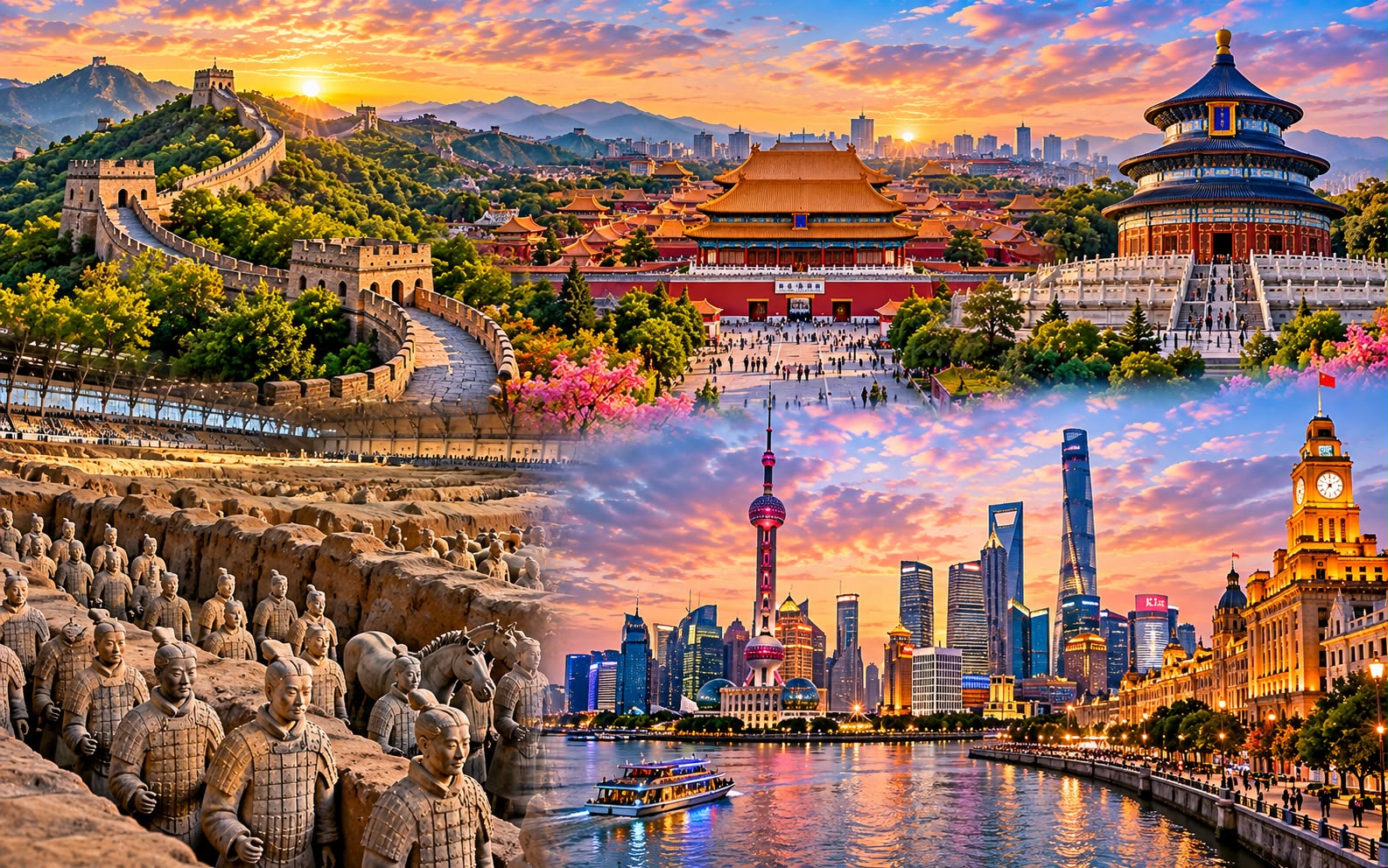
China in 10 days: Beijing, Xi'an and Shanghai
The golden route at 350 km/h: the Great Wall with a toboggan exit, the Forbidden City's 7-day ticket sprint, an 8,000-man terracotta army, and Shanghai's sci-fi skyline — plus the two make-or-break setups (Alipay and your eSIM) that decide whether China is effortless or impossible.
- East Asia
- 10 days
- ≈ AED 5,500 / person
- First-time visitors
Before you go
China is the trip that rearranges your sense of scale. The Great Wall runs longer than the distance from Dubai to London; the Forbidden City has 980 buildings; Xi’an buried an army of 8,000 individually-faced soldiers and forgot about it for 2,200 years; Shanghai built the skyline of the 22nd century while nobody was looking. And the whole circuit now runs on bullet trains that make Europe’s feel quaint.
Here’s the honest headline, though: China is the most logistics-sensitive guide on this site. Not because it’s hard — because it’s different. Payments are app-based, the internet is filtered, tickets are passport-locked, and everything rewards the traveller who set up three things before boarding. Do the prep in this guide’s first section and China is startlingly smooth, astonishingly safe and cheaper than you think. Skip it and you’ll spend Day 1 hungry outside a cashless noodle shop.
Go April–May or September–October — but never during Golden Week (Oct 1–7) or Chinese New Year, when 500 million domestic travellers have the same idea and every ticket evaporates. Summer is hot-humid; winter is cold, clear and crowd-free at the Wall. All costs are in Chinese yuan (CNY).
Before you go: the three setups that make or break China
1. The visa
- Check whether you need one at all. China has opened up sharply: ordinary passports from much of Europe, plus Japan, Korea, Singapore, Malaysia, Australia and New Zealand among others, now enter visa-free for short stays, and the 240-hour visa-free transit scheme covers a longer list again through the major airports. Neither covers everyone — India is not on either list, for instance, so an Indian passport needs a visa. Check the current list for your passport before you assume anything; it has been revised repeatedly.
- If you do need one, you apply through a Chinese Visa Application Service Center (CVASC) rather than the embassy directly: book at visaforchina.cn, and expect biometrics. Fees vary by nationality and by the post you apply at — single-entry commonly runs US$70–90 (double ~US$100–120), often payable in cash at the counter.
- Standard processing is about 4 working days; apply 3–4 weeks out. Documents: passport (6+ months), proof of residence if you are applying somewhere other than your home country, a photo to China’s strict spec, flight and hotel bookings, and the form filled online first.
- The same system runs in every country that has a CVASC, so the process is consistent; what varies is demand. Busy posts want more lead time.
2. Payments — set up Alipay before you fly
China is functionally cashless: street food, taxis, temples and vending machines all live on QR codes, and foreign cards fail at most shop terminals.
- Install Alipay at home, verify your passport, and link an international Visa/Mastercard — it works as a tourist wallet now, with small fees only above ~¥200 per transaction. Add WeChat Pay as backup.
- Inside Alipay live the mini-apps you’ll actually use: DiDi (China’s Uber), metro QR codes, translation, trains.
- Still carry ¥300–500 in cash — ruins ticket offices, tiny stalls and emergencies. ATMs at Bank of China take foreign cards.
3. The internet — read this twice
- Blocked on Chinese networks: Google (Search, Maps, Gmail), WhatsApp, Instagram, Facebook, YouTube.
- The clean fix: a travel eSIM (Airalo-style) routes your data through your home country — everything works, no VPN, no drama. Buy and install it before departure.
- Hotel Wi-Fi is Chinese network = blocked apps, so anything you need on Wi-Fi requires a VPN installed before arrival (they can’t be downloaded inside China).
- Download offline before flying: a translation pack (Chinese), your hotel names in Chinese characters, and Amap or Apple Maps — Google Maps is a decorative app in China. Trip.com is the foreigner’s workhorse for trains and tickets.
The other rules of the road
- Your passport is your ticket — literally. Trains, the Forbidden City and the Terracotta Army are “real-name” booked and entered by passport scan. Carry it every day.
- Hotels must be licensed for foreigners — not all are. Every pick below is; when booking elsewhere, confirm “accepts foreign guests” (Trip.com flags it).
- Safety honesty: violent and street crime against tourists is genuinely rare — China is one of the safest places you’ll ever wander at midnight. The actual hazards: the Nanjing Road “tea ceremony” scam (charming students invite you to tea; the bill is ¥2,000 — decline all invitations), and silent electric scooters at crossings.
- Tipping: not expected anywhere. Enjoy that.
- Kids: China treats children like celebrities; expect photo requests. The toboggan, the bullet trains, the pandas on every screen — it’s a superb family trip.
Day by day
Day 1 — Land in Beijing, duck by dinner
Stay near Wangfujing/Dongcheng — walking distance to the Forbidden City, metro everywhere.
- Afternoon — Land at PEK or Daxing (non-stop from many hubs, ~8 h). Airport Express + metro in (~¥30–35), or DiDi ~¥100–150.
- 17:30 — Legs-stretch on Wangfujing and the snack street, drifting toward Qianmen’s restored Qing-era boulevard as the lanterns come on.
- 19:30 — The mandatory first dinner: Peking duck — Siji Minfu (queue, worth it) or Quanjude (the 1864 original) — carved tableside, wrapped in pancakes (~¥150–220 a head).
Where to stay in Beijing (four nights)
- Luxury: Mandarin Oriental Wangfujing — 5.0/5 on TripAdvisor (~2,400 reviews), a small jewel with Forbidden City-roof views. ~¥2,800+.
- Mid-range: JEN Beijing by Shangri-La — 5.0/5 (~4,900 reviews), modern rooms, superb pool and gym, metro at the door. ~¥700–1,000.
- Value: Park Plaza Beijing Wangfujing — 4.5/5, quiet street ten minutes’ walk from the palace moat. ~¥500–700.
Day 2 — Tiananmen and the Forbidden City
The ticket sprint, explained: Forbidden City tickets (¥60 peak / ¥40 winter, +¥10 each for the Treasure and Clock galleries) release exactly 7 days ahead at 20:00 Beijing time and peak dates go in minutes; there are no gate sales, it’s closed Mondays, and you enter by scanning the same passport you booked with. Book on the official site via a booking service or Trip.com if the Chinese interface defeats you — and set the alarm.
- 08:00 — Tiananmen Square (passport security check to enter): the world’s largest public square, Mao’s portrait on the gate, the scale already recalibrating you.
- 09:00 — Through the Meridian Gate into the Forbidden City: 72 hectares of vermilion walls and golden roofs, the ceremonial halls on the axis, then the quieter eastern courtyards and the Treasure Gallery’s nine-dragon wall. Four hours; audio guide ¥40.
- 14:00 — Late noodle lunch, then climb Jingshan Park (¥2) directly behind — the classic overhead shot of the entire golden-roofed city you just crossed.
- 16:30 — Rickshaw-free wander of the hutongs around Nanluoguxiang and the Drum Tower — courtyard life, bicycle bells, walnut-shell grandfathers.
- 19:30 — Dinner by Houhai Lake, neon reflections included (~¥80–150 a head).
Day 3 — The Great Wall (with a toboggan)
- 06:30 — Early start for Mutianyu — the restored, forested, less-mobbed section this guide backs over Badaling. Options: a small-group tour (~¥350–500 pp, hotel pickup) or DIY (metro + bus 916 + minibus, ~2.5 h, under ¥60 each way).
- 08:30 — Costs at the wall: entry ¥45, shuttle ¥20, then the choice — cable car (¥140 return) or the correct answer, chairlift up + toboggan down (¥140): a stainless luge chute off the Great Wall of China. Under-1.2 m kids free, brakes explained, grins guaranteed.
- 09:00–13:00 — Walk tower 14 toward tower 20: watchtower after watchtower riding the ridgeline into haze. Spring blossom, autumn flame, winter snow-dust — there is no bad version.
- 15:30 — Back in Beijing: foot-massage recovery hour (~¥100/hour, everywhere, life-changing).
- 19:00 — Dinner in Sanlitun (modern Beijing) or dumpling house near the hotel (~¥60–120 a head).
Day 4 — Heaven, the Summer Palace, and one last hutong night
- 08:00 — Temple of Heaven (through-ticket ¥35): the triple-roofed blue Hall of Prayer where emperors negotiated with the sky — but come early for the park itself: tai chi, sword dancers, choirs, kite men. Beijing’s morning show.
- 12:00 — Lunch, then metro west to the Summer Palace (through-ticket ~¥60): the imperial lake garden — Long Corridor’s 14,000 paintings, the marble boat, a dragon-boat ride across Kunming Lake.
- 17:00 — Optional detour: the 798 Art District’s Mao-era factories turned galleries, or the Bird’s Nest stadium glowing at night.
- 20:00 — Farewell-Beijing hotpot — lamb swished in copper pots, sesame sauce (~¥100–150 a head). Pack; tomorrow you ride the fast ones.
Day 5 — 350 km/h to Xi’an, dinner in the Muslim Quarter
- 09:00 — Beijing West → Xi’an North by G-train: ~4.5 hours, ¥515–555 second class (airline seat, luggage racks, dining car). Book ~2 weeks ahead when 12306’s window opens — Trip.com takes the booking earlier and issues on release; your passport is the ticket. Watch the Yellow River basin blur past at 350 km/h.
- 14:30 — Metro to the Bell Tower; check in.
- 16:00 — Xi’an City Wall first look from the South Gate, then straight into the Muslim Quarter: the Hui community has run these lanes for 1,300 years, and for halal travellers this is the promised land — everything is halal. Eat in sequence: roujiamo (the original burger), yang rou paomo (lamb soup over torn bread), biángbiáng noodles (the character has 58 strokes), cold rice-cake dessert, pomegranate juice (~¥60–100 covers a feast).
- 21:00 — The Great Mosque courtyard if open (a 1,300-year-old mosque built as a Chinese garden — minaret as pagoda), night lights on the Bell and Drum Towers.
Where to stay in Xi’an (two nights)
- Luxury: The Ritz-Carlton, Xi’an — 5.0/5 (~6,600 reviews), the city’s benchmark. ~¥1,200–1,800.
- Mid-range: Novotel Xi’an The Bell Tower — TripAdvisor’s #1 value here: modern rooms, free laundry, five minutes from the wall and the Muslim Quarter. ~¥400–550.
- Boutique: Eastern House Boutique Hotel — 4.6/5, design rooms by the South Gate. ~¥500–700.
- (Doing the warriors at opening? Angsana Xi’an Lintong — 5.0/5, ~11,200 reviews — sits out by the site itself.)
Day 6 — The Terracotta Army
- 07:30 — Out to Lintong: the tourist coach (~¥20, 1 h) from the city, bus 602 via metro Line 9, or a guided tour (US$40–90 with pickup). Tickets are ¥120, real-name, released 7 days ahead — the official site takes passports directly; book the 08:30 opening slot.
- 08:30 — Pit 1 first, before the tour waves: 6,000 soldiers in battle formation under an aircraft hangar of a roof, every face different. Then Pit 3 (the command post), Pit 2 (archers mid-excavation, the kneeling archer in glass), and the bronze chariots — half-scale masterpieces that took eight years to reassemble.
- 13:00 — Lunch by the site (biángbiáng again, no regrets), optional Huaqing Palace hot springs below Mount Li on the way back.
- 17:30 — Back in Xi’an: climb the wall for golden hour, or the free Big Wild Goose Pagoda fountain show (21:00 most nights, Asia’s largest musical fountain).
- 20:00 — A Tang Dynasty dinner show (~¥300–500 with dumpling banquet) for the full costume-drama Xi’an, or round two in the Muslim Quarter — no jury would convict.
Day 7 — Bike the wall, bullet on to Shanghai
- 08:30 — The morning this guide fights for: cycle the Xi’an City Wall — entry ~¥54, bike hire ~¥45 for 2–3 hours — a completely intact 14-km Ming rectangle, 14 metres wide, ridden above the whole city. The single best two hours in Xi’an.
- 12:30 — Noodles, then Xi’an North → Shanghai Hongqiao: ~6 h, ¥620–680 second class (or fly 2h20 if train fatigue has set in — similar money once bags are counted). China rolls past: loess plateaus, wheat plains, canal country.
- 19:30 — Check in, then straight to the Bund: the colonial stone mile face-to-face with Pudong’s neon skyline — Oriental Pearl, the corkscrew Shanghai Tower — lights on until 22:00. The 19th and 22nd centuries staring at each other across a river.
Where to stay in Shanghai (three nights)
- Luxury: Waldorf Astoria Shanghai on the Bund — 4.9/5 (~6,900 reviews), inside the old Shanghai Club at Bund No. 2. ~¥2,000+.
- Mid-range: Grand Kempinski Hotel Shanghai — 5.0/5 (~27,600 reviews), river-view rooms on the Pudong bank. ~¥800–1,100.
- Value: Harbour Plaza Metropolitan — solid rooms, breakfast included, metro-close. ~¥450–600.
Day 8 — Old Shanghai to the sky deck
- 08:30 — Yu Garden (¥40) at opening — Ming rockeries and zigzag bridges — then the bazaar’s dumpling theatre around it.
- 11:00 — Soup-dumpling masterclass: xiaolongbao at a Jia Jia Tang Bao-style counter (~¥30–50) — bite the corner, drink the soup, then eat. Sheng jian bao (pan-fried) for comparison; science requires both.
- 13:00 — The former French Concession: plane-tree avenues, Wukang Road’s mansions, coffee-shop Shanghai at its most livable. Two unhurried hours.
- 16:30 — Choose your altitude: Shanghai Tower’s 118th-floor deck (~¥180 — world’s fastest lifts to the world’s second-tallest building; book a clear day) or the Peace Hotel’s jazz-bar nostalgia at street level.
- 19:30 — Huangpu River night cruise (~¥120, 50 min) — the skyline switched fully on, both banks at once. Dinner in Xintiandi’s restored shikumen lanes (~¥120–250 a head).
Day 9 — Canals or castles: the choice day
- Option A — Zhujiajiao water town (metro line 17, ~1 h, free entry): stone bridges, canal boats (~¥150 per boat), post-office-from-1903 — the Venice-of-the-East postcard without the coach-tour circus of the famous names.
- Option B — Shanghai Disneyland (from ~¥475, kid-driven households already know this is not optional): the Pirates ride here is the best on earth, book via the official app/Trip.com.
- Option C — museums and markets: the Shanghai Museum’s bronzes (free, book ahead), Tianzifang’s craft lanes, fabric-market tailoring if you left three days for a suit.
- 19:00 — Farewell dinner: hairy-crab season (Oct–Nov) if you’re lucky, else a last hotpot; nightcap looking at that skyline one more time.
Day 10 — The 430 km/h goodbye
- Morning — Packing tip made law: ride the Maglev (~¥50, 8 minutes, 430 km/h — the fastest commercial train on earth) to Pudong Airport even if your flight leaves from the other one’s alliance; it’s the correct final toy. Home via the Gulf (~9 h).
Costs and practicalities
Best time to visit
April–May and September–October. China’s summer is hot and wet across most of the east, and the two Golden Weeks are to be avoided or embraced deliberately.
- April–May — blossom, comfortable in Beijing and Xi’an, and the Great Wall at its best.
- June–August — hot and humid in the east, with Shanghai and the Yangtze cities genuinely unpleasant. The Tibetan Plateau and the northwest are at their best.
- September–October — the best month overall: clear, dry, and the autumn colour at the Wall.
- The two Golden Weeks are the single biggest planning factor — Chinese New Year (late January or February) and National Day, 1–7 October. Hundreds of millions of people travel; trains and flights sell out weeks ahead and every site is full.
- November–March — cold and clear in the north, and Harbin’s ice festival runs January to February.
Travel tips
- The internet works differently. Google, WhatsApp, Instagram and most Western services are blocked. Set up a VPN before you arrive — you cannot download one there.
- Cash is nearly extinct. Alipay and WeChat Pay run the country and both now accept foreign cards. Set them up before travelling; this is the single most useful preparation you can do.
- Trains are the way to move. High-speed rail between Beijing, Xi’an and Shanghai beats flying door to door. Book with your passport, which is also your ticket.
- Download offline maps and a translation app. Apple Maps and Baidu work; Google Maps does not.
- Carry your passport at all times. It is needed for train travel, hotel check-in and many site entries.
- Tipping is not customary and can be refused.
- Queueing is loose and personal space is smaller. It is not rudeness; push politely.
What this trip actually costs
Two people, 9 nights (4+2+3), mid-range comfort, international flights excluded:
| Item | Cost |
|---|---|
| China visas for two (CVASC) | CNY 1,200 (≈ AED 660) |
| Hotels, 9 nights | CNY 6,400 (≈ AED 3,519) |
| Bullet trains: Beijing→Xi’an + Xi’an→Shanghai, two seats | CNY 2,400 (≈ AED 1,319) |
| Local transport: metros, airport expresses, DiDi, the Maglev | CNY 900 (≈ AED 495) |
| Great Wall day (Mutianyu tour, entry, toboggan) | CNY 800 (≈ AED 440) |
| Entries: Forbidden City, Temple of Heaven, Summer Palace, Terracotta Army, city wall + bikes, Yu Garden, Shanghai Tower, river cruise | CNY 1,700 (≈ AED 935) |
| Food, 10 days (duck to dumplings) | CNY 5,000 (≈ AED 2,749) |
| eSIM, VPN, extras | CNY 300 (≈ AED 165) |
| Buffer: a Tang show, Disneyland swap, tailoring, tea (bought, not scammed) | CNY 1,300 (≈ AED 715) |
| Total for two | CNY 20,000 (≈ AED 10,996) |
- Roughly CNY 10,000 (≈ AED 5,498) per person (~US$1,400) — China is the best-value great power on this site: five-star beds at three-star prices, ¥30 feasts, and the world’s finest trains for the cost of a European taxi. Hostels and street-food discipline pull it under CNY 7,500 (≈ AED 4,123); Bund-view suites and show tickets push past CNY 15,000 (≈ AED 8,247).
- Book in this order: visa (CVASC, 3–4 weeks out) → flights (into Beijing, home from Shanghai — no backtrack) → Alipay + eSIM + VPN the same week → hotels free-cancel → trains when the ~2-week window opens (Trip.com queues it) → Forbidden City at exactly 7 days, 20:00 Beijing time → Terracotta Army at 7 days → Mutianyu tour and Shanghai Tower a few days out → everything else scans in on your passport.
- Hotel and restaurant picks here are unsponsored — no affiliate links in this article. Chosen on location and current ratings; always check prices and recent reviews before booking.
What to pack
- Your passport’s daily-carry pouch — it is metro card, museum ticket and hotel key deposit in one.
- Power bank (the apps run your whole day) and a Type A/C/I adapter — China’s sockets take most two-pin plugs.
- Walking shoes with wall-and-watchtower grip; the Great Wall is stairs pretending to be a path.
- Layers: Beijing and Xi’an swing hard between noon and night; Shanghai adds humidity.
- Tissues and hand sanitiser (many public toilets are BYO), plus any medicines by brand — pharmacies stock different names.
- A phrase card in Chinese for your hotel addresses, saved offline and screenshotted.
FAQ
Can Indians use China’s visa-free transit? No — the 240-hour transit and visa-waiver lists don’t include India. It’s the CVASC visa (roughly US$70–90 single-entry ~4 working days at most posts) — annoying to assemble, routinely granted for tourism with clean paperwork.
Will my WhatsApp / Google Maps / Instagram work? On a foreign roaming eSIM: yes, all of it — that’s the whole trick, and why the eSIM is bought before you fly. On hotel Wi-Fi: only through a pre-installed VPN. And regardless of connection, Google Maps’ China data is poor — navigate with Amap or Apple Maps.
Is the language barrier manageable? Yes, with tools: hotels and big sights run fine in English; taxis, stalls and everything wonderful do not. Translation apps (offline pack downloaded), the hotel’s Chinese-character card, and pointing at pictures cover 95% of situations. The remaining 5% becomes your best story.
Train or plane, Xi’an to Shanghai? Train if you can spare the six hours: city-centre to city-centre, no baggage fees, and rural China scrolling past beats any in-flight map. Fly if you’re squeezing a day — 2h20 plus the airport overhead makes it roughly even door-to-door.
Halal and vegetarian food? China’s secret: Xi’an’s Muslim Quarter is one of the great halal food destinations on earth, and Hui-run Lanzhou lamian (hand-pulled beef noodle) shops — halal by definition — sit on practically every block in every city. Beijing adds the Niujie mosque quarter. Vegetarians manage with Buddhist restaurants, mapo tofu (ask for no mince), egg-tomato everything and dumpling houses — but broths and cooking fat lean meaty, so learn “wo chi su” (I eat veg) and deploy the translation app.
Is China safe? Can we walk at night? Street-safe to a degree that surprises everyone — midnight noodles are a cultural institution, and children commute alone. The realistic risks are scams (the tea-ceremony classic, “art student” galleries), jaywalking into silent scooters, and queues at Golden Week. Standard document care and you’re fine.
What’s the next China trip? Two pull hardest: Zhangjiajie’s Avatar pillars + Guilin’s karst rivers (the nature epic) and Chengdu’s pandas + Chongqing’s cyberpunk stack (the food-and-wonder city pair). One of them is our second China guide.
Prices and entry rules change, and what you need depends on your passport; last checked 8 October 2026, so confirm with the embassy or your airline before booking.


