 The Itinerary
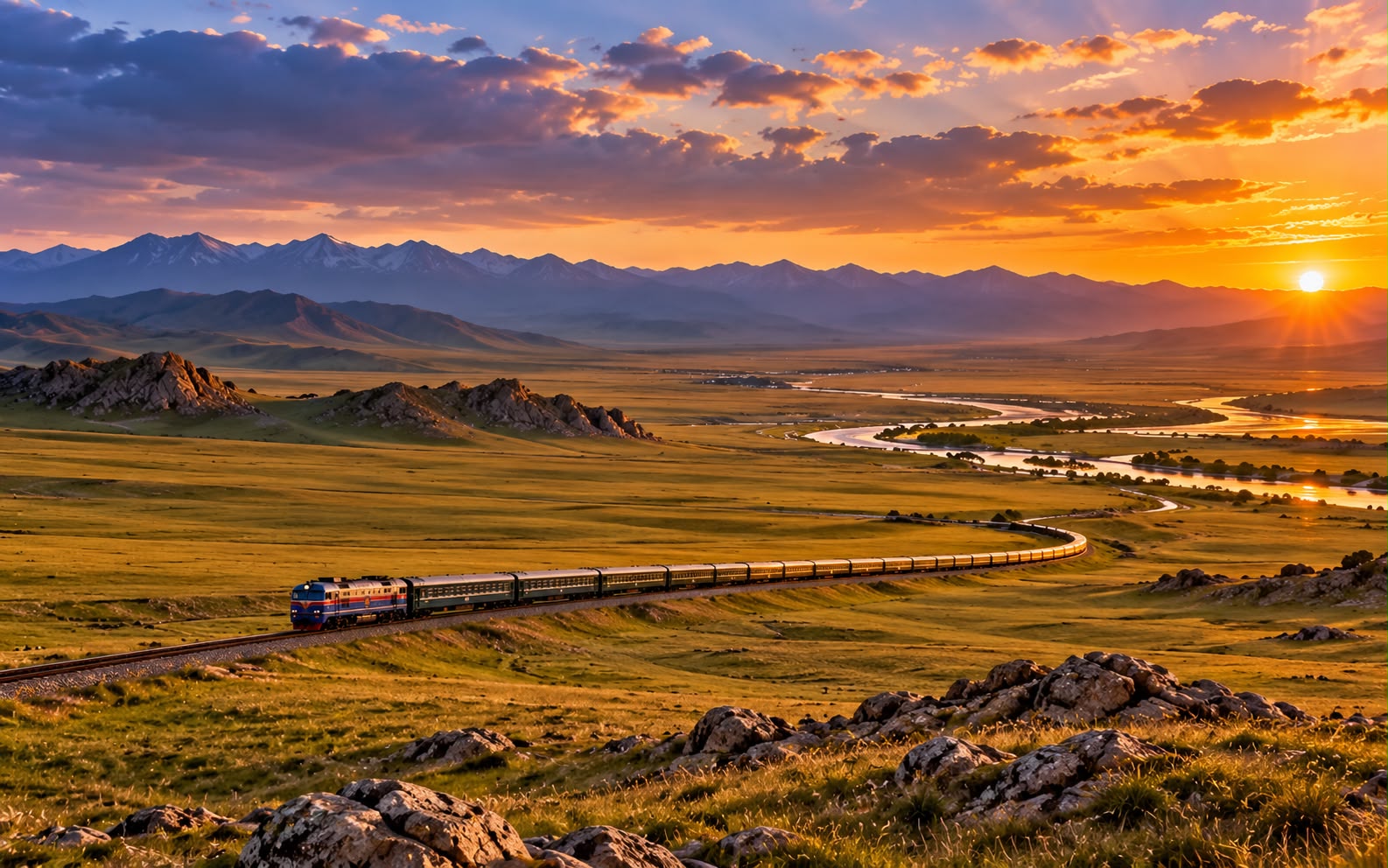
China and Mongolia in 14 days: Beijing, the Trans-Mongolian and the Gobi
The Forbidden City and a wall built to keep the steppe out, then the train that crosses it — thirty hours through the Gobi to a country of three million people and seventy million livestock, where you sleep in a felt tent.
- East Asia
- 14 days
- ≈ AED 11,400 / person
- A thirty-hour train from one of the world's densest cities to one of its emptiest countries
Before you go
Before you go: the admin
The visas are the hard part
- China requires a visa for most nationalities, applied for in person at a visa centre with fingerprints, an itinerary and hotel bookings. Start six weeks out. Several nationalities now have visa-free entry for short stays — check yours, as this has changed repeatedly and generously since 2024.
- Mongolia admits many nationalities visa-free for 30 days, and issues an e-visa for the rest.
- A Chinese transit visa will not cover this trip — you are entering, staying and leaving by land.
- If you plan to return to China after Mongolia you need a double-entry Chinese visa. Applying for a single and discovering this at the border is unrecoverable.
The train, which is the route
- The Trans-Mongolian from Beijing to Ulaanbaatar is about thirty hours. It runs twice a week in each direction in summer and less often in winter.
- Book months ahead. Berths are limited, the route is popular, and the booking is easier through an agency than directly.
- The bogie change at Erenhot takes four to six hours — China and Mongolia use different rail gauges, so the whole train is lifted and the wheelsets swapped underneath you. It happens at night and you can usually watch from the platform.
- Border formalities take most of that time and you stay on the train for the Chinese exit.
- Bring food. The dining car is swapped at the border and the gap is long.
Money
- Chinese yuan and Mongolian tögrög, neither usable in the other.
- China is nearly cashless — Alipay and WeChat Pay run the country and both now accept foreign cards. Set them up before you arrive; it is the single most useful preparation.
- Mongolia takes cards in Ulaanbaatar and nowhere in the countryside. Carry tögrög for the ger camps.
- No Western card works at a Mongolian petrol station in the Gobi. Your driver handles it; budget cash accordingly.
One gentle brief
- The internet works differently in China. Google, WhatsApp, Instagram and most Western services are blocked. Set up a VPN before you arrive — you cannot download one there. Mongolia is unrestricted.
- The contrast is the point. Beijing is 22 million people; Mongolia is the least densely populated sovereign country on earth. The train is how you feel the distance between them.
- Mongolia is a driver-and-cook country. Nothing in the countryside is self-drive and the distances are enormous.
Day by day
Day 1 — Beijing, arrival
- Arrive, and sort the practicalities first. Set up Alipay or WeChat Pay before you fly — cash is awkward and cards are refused almost everywhere.
- 15:00 — The hutongs around Nanluoguxiang and Gulou by bicycle or on foot, which is the old city that is left.
- 17:30 — The Drum and Bell Towers, and the lanes between them.
- 19:30 — Peking duck at a place that has been doing it for a century, carved at the table into 100-odd slices.
- A VPN must be installed before arrival if you need anything from outside the Chinese internet.
Day 2 — The Forbidden City
- 08:30 — The Forbidden City, booked ahead with your passport, which is also your ticket. It is closed on Mondays. Go at opening and walk north to south.
- Tickets release days ahead and sell out. This is not one to leave to the day.
- 11:30 — Tiananmen Square requires a separate security check and ID, and the queue is its own exercise.
- 14:00 — Jingshan Park immediately north, where the hill gives you the whole palace roofline — the best view in Beijing and a ten-minute climb.
- 16:30 — Beihai Park next door, with the white dagoba on its island.
- 19:00 — A night market food street, Guijie for crayfish or Wangfujing for the theatre of it.
Day 3 — The Temple of Heaven and the Summer Palace
- 07:00 — The Temple of Heaven early, when the park is full of retired Beijingers doing tai chi, ballroom dancing and jianzi — which is better than the temple. The park ticket and the temple ticket are separate.
- 11:00 — The Summer Palace and Kunming Lake, half a day — the Long Corridor, the marble boat, and the climb to the Tower of Buddhist Incense.
- 16:00 — A boat across the lake rather than walking back round it.
- 18:30 — The 798 Art District if you want the contemporary city, which is a different place entirely.
Day 4 — The Great Wall
- 06:30 — Go to Jinshanling if you can give it a day. Jinshanling is partly wild and far quieter; it is two and a half hours out and that is exactly why.
- Mutianyu is restored and manageable — ninety minutes, a cable car, and a toboggan down — and Badaling is the one every coach goes to.
- 09:30 — On the wall. At Jinshanling the restored section runs into unrestored towers and you can walk as far as your legs allow.
- 14:00 — Lunch at the village below.
- 18:00 — Back in Beijing, and pack for the train: two nights, no shower, and the dining car takes cash.
Day 5 — The Trans-Mongolian, day one
- Board in the afternoon at Beijing Zhan. Second-class four-berth compartments are the norm; first-class two-berth exists and is worth it if available.
- Bring your own food and a mug. There is hot water at the end of every carriage and the dining car changes with the country.
- 14:00 — The afternoon crosses the North China Plain, flat and farmed the whole way.
- 19:00 — The evening climbs into Inner Mongolia and the landscape opens.
- 23:00 — The Erenhot bogie change at night — several hours, and the moment this journey becomes memorable. The carriages are lifted off their wheels because the gauge changes at the border. You can get off and watch.
Day 6 — The Trans-Mongolian, day two
- 06:00 — Dawn on the Gobi. The second day is empty grassland and desert, with gers, horses and the occasional camel, for twelve hours.
- Mongolian immigration comes aboard at Zamyn-Üüd in the early hours; passports are collected and returned.
- 12:00 — Lunch in the Mongolian dining car, which is attached at the border and is a different place from the Chinese one.
- 16:00 — Arrive in Ulaanbaatar in the afternoon.
- 19:00 — A first proper meal and a shower, both of which you will want.
Day 7 — Ulaanbaatar
- 09:00 — Gandan Monastery, the centre of Mongolian Buddhism, with the 26-metre gilded Migjid Janraisig restored after the purges destroyed the original. Morning chanting starts around nine.
- 11:30 — The National Museum of Mongolia for the Mongol empire rooms and the twentieth century, which is a harder story than most visitors expect — the 1930s purges killed perhaps 30,000 people, most of them monks.
- 14:30 — Naran Tuul market — the “black market” — for a del, boots and saddlery, and for pickpockets, who are the one real crime risk in the city. Front pockets only.
- 17:30 — The Zaisan memorial above the city for the view and the Soviet mosaic.
- 19:30 — A throat-singing and contortion performance, which is touristic and genuinely skilled.
Day 8 — Terelj
- 09:00 — Gorkhi-Terelj National Park, an hour and a half out — granite outcrops, including Turtle Rock, meadows and the Aryabal meditation temple up a staircase.
- 13:00 — Riding if you can sit a horse; the Mongolian saddle is wooden and unforgiving, and the horses are small and fast. They are also only half-broken; say honestly how much you can ride.
- 16:00 — A ger camp for the night. Felt walls, a dung stove lit for you in the evening, and the Milky Way outside.
- Enter a ger clockwise and never step on the threshold — both matter to your hosts.
- 21:00 — The sky, which is the reason to be out here.
Day 9 — Khustain and the takhi
- 08:00 — Khustain Nuruu for the takhi — Przewalski’s horse — the only never-domesticated horse left, extinct in the wild by 1969 and reintroduced here from zoo stock from 1992. It is one of conservation’s genuine successes.
- They are best found at dawn and dusk at the waterholes, so an overnight in the park beats a day trip.
- 13:00 — Lunch with a herder family if your operator arranges it — airag, the fermented mare’s milk, is offered and refusing it outright is rude.
- 17:00 — The evening drive for the horses.
- 19:00 — Back to Ulaanbaatar, or stay in the park.
Day 10 — Fly to the Gobi
- 09:00 — Fly to Dalanzadgad — an hour and a quarter — or drive two long days. Fly if the days are tight.
- The Gobi is 1,300km across. Even flying in, you spend whole days in a van on tracks.
- 14:00 — Yolyn Am, a gorge in the Gurvan Saikhan mountains that holds ice into July, which is not what anyone expects of a desert. The walk in is an easy 2km along the stream.
- 18:00 — A ger camp, and the temperature drops hard after dark even in summer.
Day 11 — Khongoryn Els
- 08:00 — Several hours west on tracks.
- 14:00 — Khongoryn Els, the singing dunes — 180km long, up to 300m high, and the sound they make when the sand slides is the name.
- 16:00 — Camel riding with a herder family, which here is Bactrian and two-humped and far more comfortable than the Arabian kind.
- 18:00 — Climb the main dune for sunset. It takes about an hour and is two steps up for one back; coming down takes four minutes.
Day 12 — Bayanzag, the Flaming Cliffs
- 08:00 — Back east across the desert.
- 16:00 — Bayanzag, the Flaming Cliffs, where Roy Chapman Andrews found the first recognised dinosaur eggs in 1923. Fossils are still visible and taking anything is illegal.
- The cliffs are named for the colour at sunset, which is when to be there.
- 19:00 — Nights in gers with the family rather than a camp if your operator arranges it — that is the difference between seeing the Gobi and staying in it.
Day 13 — The desert, and back
- 08:00 — A last desert morning — the Ongi monastery ruins, or a second dune if you are near one.
- 13:00 — To Dalanzadgad for the afternoon flight, or the long drive north.
- 17:00 — Back in Ulaanbaatar.
- 19:00 — Buy cashmere, which is the one thing Mongolia makes better and cheaper than anywhere, from Gobi or Goyo rather than the airport.
Day 14 — Out
- Fly back, and leave a buffer — Mongolian domestic flights change for weather and aircraft availability, which is the one scheduling risk on this trip.
- 09:00 — The Choijin Lama Temple Museum if you have the morning, which survived the purges because it was turned into a museum of religious oppression.
- Chinggis Khaan International is 50 minutes from the city on the new road, which is further out than the old airport was.
Costs and practicalities
Best time to visit
June to early September, and the window is narrow because the Mongolian winter is not an exaggeration.
- June — the steppe is green, foals and young livestock are out, the gers are up, and there are fewer visitors than July.
- July — warmest and busiest. Naadam, 11–13 July, is the national festival of wrestling, archery and horse racing and is the single best reason to come. Ulaanbaatar fills and domestic transport sells out — book months ahead.
- August — warm, the best grass, and the most reliable Gobi weather.
- September — the best light of the year and cold nights. The Golden Eagle Festival in Bayan-Ölgii is in early October, which is the other date worth planning around and is a long way west of this route.
- October–May — bitterly cold, ger camps close, and the Trans-Mongolian runs less often. Beijing is at its best in September and October and its worst for air quality from November to February.
Beijing and Mongolia disagree slightly: Beijing’s nicest months are September and October, Mongolia’s are June to August. Late August into early September is the compromise.
Travel tips
- Set up Alipay or WeChat Pay before you fly, and a VPN. China is nearly cashless and most Western services are blocked, and neither problem is solvable after arrival.
- Check whether you need a double-entry Chinese visa. If your flight home routes back through China after Mongolia, a single-entry visa strands you.
- Book the Trans-Mongolian months ahead. Berths are limited and it runs twice a week.
- Bring food for the train. The dining car is swapped at the border and the gap is several hours.
- Ger etiquette matters: enter clockwise, never step on the threshold, accept what you are offered with the right hand, and do not point your feet at the stove or the altar.
- Accept the airag — fermented mare’s milk — at least a sip. Refusing outright is a discourtesy.
- Nights are cold in the Gobi even in July. A proper sleeping bag is worth carrying; the ger stove goes out around two in the morning.
What this trip actually costs
Two people, 13 nights, mid-range comfort, international flights excluded:
| Item | Cost |
|---|---|
| Hotels and ger camps, 13 nights | USD 1,800 (≈ AED 6,611) |
| Mongolian 4x4 with driver and cook, 6 days | USD 1,600 (≈ AED 5,876) |
| Food and drink, 14 days | USD 800 (≈ AED 2,938) |
| Beijing entries, guides and the Great Wall | USD 700 (≈ AED 2,571) |
| Trans-Mongolian, Beijing to Ulaanbaatar, two people | USD 700 (≈ AED 2,571) |
| Gobi domestic flights, two people | USD 600 (≈ AED 2,204) |
| Total for two | USD 6,200 (≈ AED 22,770) |
- Roughly USD 3,100 (≈ AED 11,385) per person. Mongolia is the expensive half — the driver, cook and vehicle are the cost of a country with almost no public transport.
- Driving the Gobi instead of flying saves about $600 and costs four days.
- Naadam week roughly doubles Ulaanbaatar accommodation and books out months ahead.
- Hotel picks here are chosen on location, not on commission — always check prices and recent reviews before booking.
What to pack
- A proper sleeping bag or liner. Ger stoves go out overnight and the Gobi gets cold in every month.
- Layers, and a windproof. The steppe has nothing to stop the wind.
- Dust protection for cameras, and more cleaning cloths than seems sane.
- A power bank and a solar charger. Ger camps run generators for a few hours at best.
- Wet wipes and a travel towel — showers in the countryside are occasional.
- Food for the train, and something to read for thirty hours.
- Cash in tögrög for everything outside Ulaanbaatar.
FAQ
How long is the train really? About thirty hours, of which four to six are the bogie change and border formalities at Erenhot in the middle of the night. It is the best part of the trip for most people.
Do I need a double-entry Chinese visa? Only if you return to China after Mongolia — which includes connecting home through a Chinese airport. Check your routing carefully before applying.
Can I do Mongolia without a driver? Not realistically. There is almost no public transport, the roads are tracks, and self-drive in the Gobi without a second vehicle is a bad idea.
Is Naadam worth planning around? Yes, if you book months ahead. It is the national festival and the horse racing out on the steppe is better than the stadium events.
What about continuing to Russia? The Trans-Siberian runs on from Ulaanbaatar to Irkutsk and Moscow. Check current advice and the practicalities — sanctions have changed what is possible for many travellers.
Prices and entry rules change, and what you need depends on your passport; last checked 29 October 2026, so confirm with the embassy or your airline before booking.


