 The Itinerary
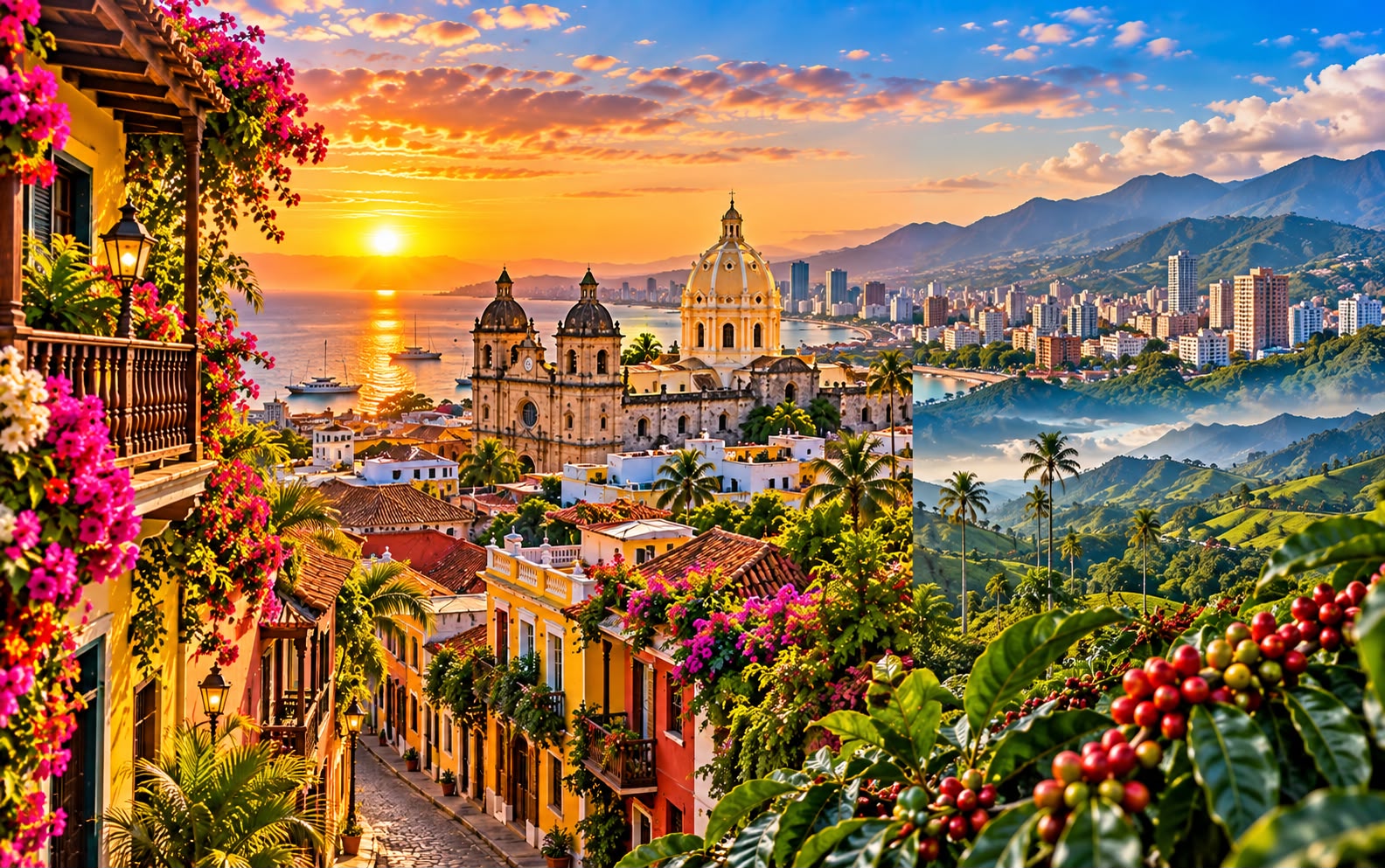
Colombia in 11 days: Cartagena, the coffee region and Medellín
The country that turned itself around, seen at its best: a walled Caribbean city of bougainvillea and balconies, wax palms three times the height of anything around them, a valley city that replaced its reputation with cable cars, and Bogotá's gold — with the altitude order, the safety brief that is neither alarming nor naive, and why domestic flights beat the roads.
- The Andes
- 11 days
- ≈ AED 7,000 / person
- Cities + coffee country
Before you go
Colombia is the most improved travel destination of the last twenty years, and it is still catching up with its own reputation. What you find now is three completely different countries inside one: the Caribbean coast, tropical and Spanish-colonial; the coffee axis, green valleys of palm-lined ridges; and the Andean cities of Medellín and Bogotá, sitting at very different heights.
That last point matters more than it sounds. Cartagena is at sea level, Medellín at 1,500 m, Bogotá at 2,640 m — higher than almost anywhere in Europe. This itinerary climbs gradually rather than dropping you at the top.
Eleven days, three internal flights, and one bus leg that is worth taking rather than flying.
Before you go: altitude, flights and the honest safety brief
Entry, and the climb
- Most nationalities enter visa-free for 90 days — the EU, UK, US, Canada, Australia and most of Latin America. You may be asked for onward travel.
- Proof of yellow fever vaccination is required for some arrivals and recommended for parts of the country. Check for your route.
- Colombia now requires an online entry form (Check-Mig) before arrival and departure. It is free and takes minutes; do it the day before each flight.
- The altitude order is deliberate. Cartagena at sea level, then the coffee region at around 1,900 m, Medellín at 1,500 m, and Bogotá at 2,640 m last. Bogotá first is what makes people feel rotten on day two.
The safety brief, plainly
Colombia’s reputation lags its reality by about fifteen years, but “much safer than it was” is not the same as “no precautions”.
- “No dar papaya” is the local phrase, and the whole philosophy: do not give anyone an easy opportunity. No phone out on a quiet street, no visible jewellery, no bag left on a chair back.
- Use ride-hailing apps rather than hailing taxis, especially in Bogotá and after dark.
- Take what you need for the evening and leave the rest in the hotel.
- Stick to the areas visitors use — Getsemaní and the walled city in Cartagena, El Poblado and Laureles in Medellín, La Candelaria and Chapinero in Bogotá — and take a car between neighbourhoods at night.
- Do not accept drinks or cigarettes from strangers. Scopolamine robbery is rare but real and is the one genuinely nasty risk.
- Outside the cities, this route is calm. Salento and the coffee valleys feel like a different country entirely.
Flying beats driving
- Colombia is mountainous and the roads are slow. Bogotá to Medellín is 45 minutes by air and nine hours by road.
- Book domestic flights early; the low-cost carriers here are genuinely cheap when booked ahead and painful at the gate about baggage. Read the allowance before you pay.
- The one drive worth taking is Pereira or Armenia to Salento, about an hour, through the coffee valleys.
- Cartagena, Medellín, Pereira/Armenia and Bogotá all have airports on this route.
Money and the small print
- The peso (COP), and the numbers are large — a coffee runs into thousands. Fix a mental conversion on arrival.
- Cards work in cities and hotels; carry cash for markets, small restaurants and the coffee region.
- Use bank-branded ATMs inside a bank or mall, not street machines, and decline the terminal’s home-currency conversion.
- Tipping: a 10% propina voluntaria is often added and you may decline it; most people pay it.
- Spanish is essential outside hotels. English is limited, and the effort is warmly received.
Day by day
Day 1 — Land in Cartagena
- 14:00 — Land at Rafael Núñez (CTG), which is unusually close — 15 minutes to the old town.
- 15:00 — Stay inside the walled city for the setting, or Getsemaní just outside it for more life and lower prices. Getsemaní is the better choice and ten minutes’ walk from everything.
- 16:30 — Wait out the heat. It is consistently around 32°C with high humidity and there is no cool season.
- 17:30 — Walk Las Murallas, the 11 km of 16th-century walls built to keep out English privateers, at sunset — Café del Mar on the bastion is the obvious spot and knows it.
- 19:30 — Dinner in Plaza de la Trinidad, Getsemaní’s square, where the street music, the beer sellers and most of the neighbourhood turn up after dark. Nothing is organised and that is the appeal.
Day 2 — The walled city
- 08:00 — Early, before the heat. Plaza Santo Domingo with the Botero reclining woman, Plaza de San Pedro Claver, and the balconied streets hung with bougainvillea that are the actual point of Cartagena.
- 10:00 — Las Bóvedas, the 23 vaulted dungeons built into the ramparts, now craft shops.
- 11:00 — The Palace of the Inquisition for the darker history — the tribunal operated here until 1821 and the museum does not soften it.
- 13:00 — Lunch, then out of the sun.
- 16:00 — Castillo San Felipe de Barajas, the largest Spanish fort in the Americas, with tunnels cut so that footsteps echo and defenders could hear attackers coming.
- 18:00 — Getsemaní’s street art on Calle de la Sierpe and around, which is a neighbourhood project rather than a gallery.
- 20:00 — Dinner, and limonada de coco.
Day 3 — Islands or mud
- Option A — Islas del Rosario, 08:30. A boat hour out to coral islands with the Caribbean water Cartagena’s own beaches do not have. Day trips return around five; a night on Isla Grande is better if you can spare it.
- Option B — Totumo, 09:00. A 15 m mud volcano an hour north that you climb and lower yourself into — warm grey mud so dense you cannot sink, a man massaging you whether you asked or not, and a wash in the lagoon afterwards by women who will also charge you. It is exactly as silly as it sounds and nobody regrets it.
- 16:00 — Back, and a swim.
- 19:00 — Dinner, then pack — tomorrow you fly inland and the climate changes completely.
Day 4 — Into the coffee region
- 09:00 — Fly to Pereira or Armenia, about an hour.
- 10:30 — Land into the Eje Cafetero — green, steep, 1,500 m up and twelve degrees cooler than the coast.
- 12:00 — Drive to Salento, an hour through valleys of bamboo, banana palm and coffee.
- 13:30 — Lunch — trucha, trout, served with a patacón the size of a plate, which is the regional dish and on every menu.
- 15:00 — Calle Real, the painted shopfronts in colours that should clash and do not, and the Mirador at the top of the street for the valley.
- 18:00 — Tejo: the national sport, played in a bar, in which you throw a metal puck at gunpowder packets buried in clay and they explode. It is free if you buy beer. Go.
- 20:00 — Dinner.
Day 5 — Cocora Valley
- 07:00 — A Willys jeep from the plaza to Valle de Cocora, 30 minutes, standing on the back bumper if the seats are full, which is how it is done.
- 07:45 — The valley holds the palma de cera, the wax palm — Colombia’s national tree, the tallest palm on earth at up to 60 m, growing improbably out of cloud-forest ridges.
- 08:00 — The full loop takes five to six hours anticlockwise: down through farmland, into cloud forest, across six swinging bridges over the river, a steep climb to the Acaime hummingbird reserve, then out along the ridge where the palms are.
- 11:00 — Or the short version: the mirador walk gives you the same photograph in 90 minutes, and plenty of people do it.
- 14:30 — Back to Salento, muddy. Boots matter here; it rains most afternoons.
- 19:00 — Dinner.
Day 6 — A coffee farm, properly
- 09:00 — A finca tour. Pick the small family farms — Finca El Ocaso or a campesino-run one — over the large show farms: picking with a basket on your waist, pulping, fermenting, drying on the patio, roasting, and cupping at the end.
- 11:30 — The useful part is the economics: what the farmer is paid per kilo of cherry, what the exporter gets, and why Colombia exports its best beans and drank bad coffee for decades.
- 13:00 — Lunch back in town.
- 15:00 — Filandia, twenty minutes away — quieter and arguably prettier than Salento, with a wooden viewing tower over the valley.
- 18:00 — Back.
- 19:30 — Last valley night.
Day 7 — Fly to Medellín
- 09:30 — Fly from Pereira or Armenia, under an hour.
- 11:00 — Land at José María Córdova, which is 45 minutes and 1,000 m above the city — the descent through the valley is a good introduction.
- 13:00 — El Poblado for restaurants and nightlife, Laureles for somewhere more residential and less expensive.
- 15:00 — The climate is the reason it is called la ciudad de la eterna primavera — 22°C all year, at 1,500 m, in a valley.
- 17:00 — The metro, which is worth a ride for its own sake: it opened in 1995, it is spotless, nobody litters in it, and Medellínenses are visibly proud of it in a way that tells you something about the city’s last thirty years.
- 20:00 — Dinner in Provenza.
Day 8 — Comuna 13 and the cable cars
- 09:00 — Comuna 13, and go with a local guide from the neighbourhood, not a bus tour. This was among the most violent urban districts in the world; Operación Orión in 2002 was a military assault on the hillside. The outdoor escalators installed in 2011 cut a 350-step climb to six minutes and connected the barrio to the city.
- 10:30 — The street art is the neighbourhood telling the story itself, and the guides are usually people who grew up through it. Hip-hop, graffiti and dance were the route out for a generation, and it is not a metaphor.
- 13:00 — Lunch, then the metrocable — gondolas as public transport, running up slopes no bus could serve. Ride Línea K to Santo Domingo and change for Parque Arví, 20 minutes over the ridge into cloud forest above the city.
- 17:00 — Back down. Plaza Botero and its 23 fat bronzes, with the Museo de Antioquia behind.
- 20:00 — Dinner.
Day 9 — Guatapé
- 08:00 — Two hours east by car or bus.
- 10:00 — El Peñón de Guatapé: a 200 m granite monolith with 740 steps zigzagging up a crack in its face. Twenty minutes up if you are fit, and the view at the top is of a reservoir broken into hundreds of islands and fingers — flooded in the 1970s for hydroelectricity, drowning the old town of El Peñol.
- 12:00 — Guatapé town, where every building carries zócalos — painted and moulded panels around the base of the wall, showing what the household does. Sheep for the butcher, bread for the baker.
- 14:00 — Lunch by the water, and a boat on the reservoir past the ruins of Pablo Escobar’s bombed-out country house.
- 17:00 — Back to Medellín.
Day 10 — Fly to Bogotá
- 09:00 — Fly, 45 minutes.
- 10:30 — You are now at 2,640 m. Bogotá is the third highest capital in the world and the first afternoon should be taken gently.
- 12:00 — La Candelaria, the colonial quarter — steep streets, painted doors, and Plaza de Bolívar with the cathedral and the Palace of Justice.
- 14:00 — The Museo del Oro: 55,000 pieces of pre-Columbian goldwork, including the Muisca raft that gave rise to the El Dorado legend. It is the best museum in Colombia and needs two hours.
- 16:30 — The Botero Museum nearby, free, with his own collection of Picasso, Monet and Bacon alongside his.
- 19:30 — Dinner in Chapinero or La Macarena, and an ajiaco — the chicken, corn and three-potato soup that is Bogotá’s own.
Day 11 — Monserrate, then home
- 08:00 — Monserrate by funicular or cable car to 3,152 m — the white church on the ridge, and the whole city of eight million laid out in its bowl of mountains below. Go early; the cloud comes in by eleven and the queues build.
- 10:30 — Down, and the Paloquemao market if you have time — the flower hall at the back is extraordinary, and Colombia is the world’s second largest cut-flower exporter.
- 13:00 — El Dorado airport is 30 minutes from the centre and much more in traffic. Allow for it.
- Note — Carry your passport rather than a copy; it is asked for more often than you expect, including at some museums.
Costs and practicalities
Best time to visit
December–March is the main dry season and the best all-round window, though Colombia sits on the equator and altitude matters more than month.
- December–March — dry in most of the country, and the busiest. Cartagena is at its best and its most expensive.
- July–August — a second dry spell. Medellín’s Feria de las Flores is in early August and is the best week of that city’s year.
- April–May and October–November — the two wet periods. Green, cheap, and the Caribbean coast is still warm.
- The coffee region is pleasant year-round; the main harvest is October–December.
- Whale watching on the Pacific at Nuquí and Bahía Solano runs July–October.
Altitude sets the temperature, not the season. Bogotá at 2,600m is 14°C all year; Cartagena at sea level is 31°C all year.
Travel tips
- “No dar papaya” is the local rule and the best advice here — do not give an opportunity. Phone out of sight, no visible jewellery, and take a taxi after dark.
- Use apps rather than street taxis — Uber, Cabify and inDrive all operate and remove the fare argument.
- Altitude in Bogotá is real. 2,600m takes a day; go easy on the first night.
- Cards are widely accepted in cities; carry cash for the coffee region and small towns. Notes come in large denominations, so check the zeros.
- Scopolamine spiking is a genuine, documented risk in nightlife districts. Never leave a drink, and be wary of unusually fast friendliness.
- Bogotá and Medellín have excellent transport — the TransMilenio and the Metro and cable cars. The comunas are visited with a guide, not alone.
- Learn a little Spanish. English is limited outside Cartagena’s tourist core and Bogotá’s business districts.
What this trip actually costs
Two people, 10 nights, mid-range, excluding international flights:
| Item | Cost |
|---|---|
| Hotels, 10 nights across four places | COP 4,800,000 (≈ AED 5,435) |
| Domestic flights ×3 legs, two people | COP 1,600,000 (≈ AED 1,812) |
| Cocora, finca tour, Comuna 13 guide, Guatapé, museums, boats | COP 1,800,000 (≈ AED 2,038) |
| Food and drink, 11 days | COP 3,000,000 (≈ AED 3,397) |
| Ride-hailing, transfers, eSIM | COP 1,200,000 (≈ AED 1,359) |
| Total for two | COP 12,400,000 (≈ AED 14,040) |
- Roughly COP 6,200,000 (≈ AED 7,020) per person — genuinely good value for a trip this varied, and cheaper than Peru or Argentina.
- The menú del día set lunch is the standard cheap meal and is usually soup, a main, juice and a coffee for very little.
- Coffee-region fincas often include breakfast and are the nicest accommodation on the route for the least money.
What to pack
- Clothes for three climates. Cartagena is hot and humid, Salento is spring-like and rains most afternoons, Bogotá is properly cool and needs a jacket.
- Waterproof and walking shoes for Cocora, which is muddy year-round.
- Insect repellent for the coast.
- Type A/B plugs, 110V.
- A low-profile day bag, in keeping with no dar papaya.
FAQ
Is Colombia safe for tourists now? On this route, yes, with ordinary urban caution applied consistently. Millions visit annually. The phrase to remember is no dar papaya — do not hand anyone an easy opportunity.
Should I add the Caribbean coast beyond Cartagena? Tayrona and Santa Marta are excellent and add three days. They do not fit inside eleven without cutting the coffee region, which would be the wrong trade.
Will the altitude bother me in Bogotá? Possibly, mildly, for a day — which is why it comes last here rather than first. Take the first afternoon slowly and drink plenty of water.
When should I go? December to March and July to August are the drier windows. Colombia sits on the equator, so it is less about temperature than about rain, and the coffee region is green because it rains there all year.
Prices and entry rules change, and what you need depends on your passport; last checked 8 October 2026, so confirm with the embassy or your airline before booking.


