 The Itinerary
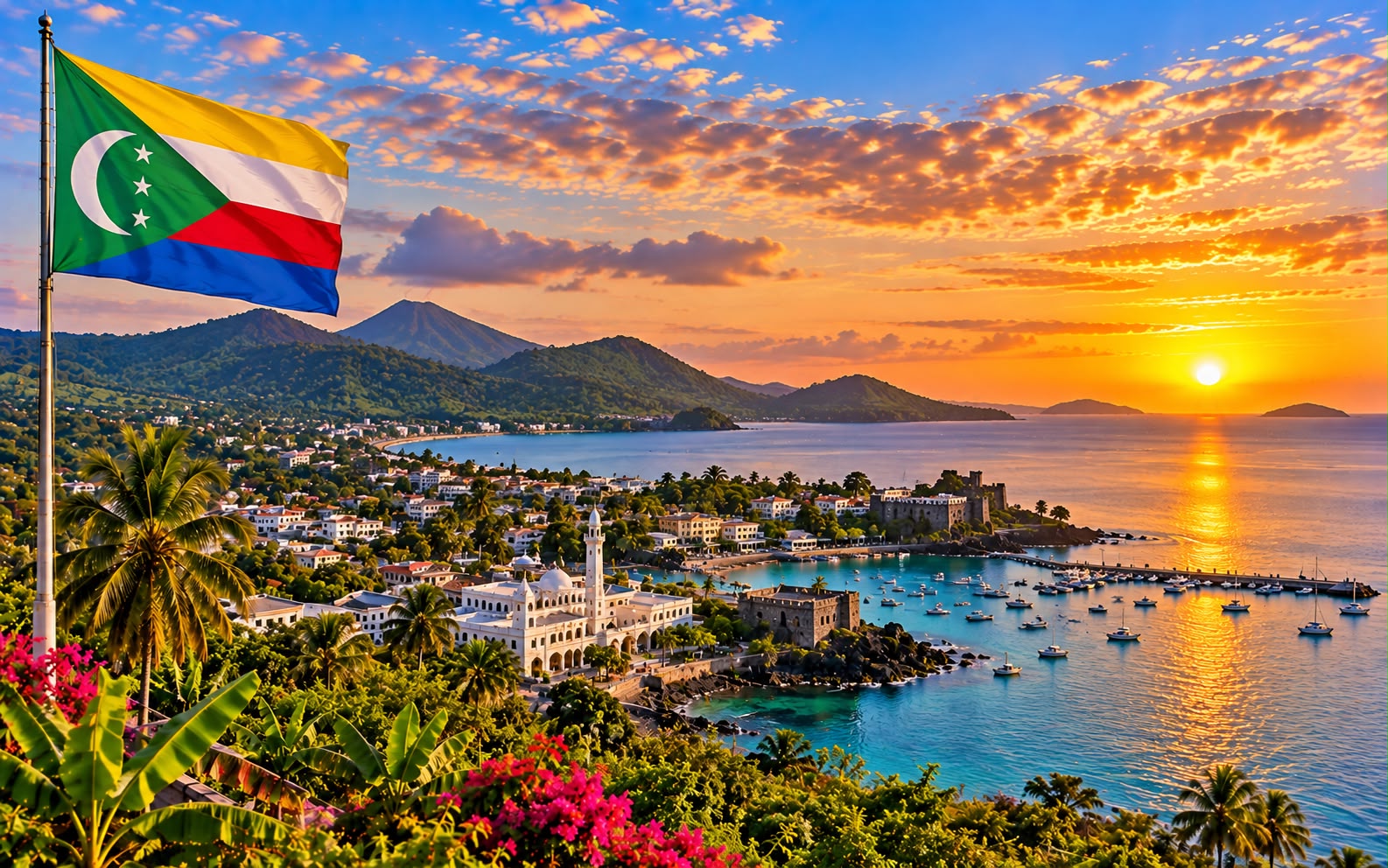
Comoros in 6 days: Karthala's crater, Mohéli's turtles and the perfume islands
An archipelago between Madagascar and Mozambique with a volcano whose crater is three kilometres across, a beach where green turtles come ashore nightly, and ylang-ylang fields that supply the world's perfume houses — reached by almost nobody.
- Indian Ocean Islands
- 6 days
- ≈ AED 2,750 / person
- One of the largest active volcanic craters on earth, and turtles nesting every night of the year
Before you go
The Comoros are four islands between Mozambique and Madagascar, three of which form the Union and the fourth of which, Mayotte, voted to stay French. They receive a few thousand visitors a year.
Mount Karthala, on Grande Comore, is one of the most active volcanoes in the world and has one of the largest summit calderas — a crater roughly three kilometres across, which you walk to the rim of over two days.
Mohéli, the smallest and least developed island, has the country’s marine park. Green turtles come ashore to nest at Itsamia most nights of the year, in numbers that make it one of the most important nesting sites in the western Indian Ocean. Humpback whales pass between July and October, and the Nioumachoua islets off the south coast have reef and dolphins.
The islands are also called the perfume islands, and the name is commercial rather than poetic: Comoros is among the world’s largest producers of ylang-ylang, the blossom distilled into the base note of a great many French perfumes. You can smell the distilleries before you see them.
Moroni is a small, hot, Swahili-Arab capital with a whitewashed medina and the Old Friday Mosque standing on the harbour wall since 1427.
Six days covers two islands properly. Figure USD 750 (≈ AED 2,754) per person excluding flights. Go May–October, the dry season, with July–October for whales.
Before you go: the 15-minute admin
Inter-island travel is the whole plan
- Nothing about getting between the islands is reliable. This is the single thing that decides whether a six-day trip works.
- Small planes link Moroni with Mohéli and Anjouan in about half an hour. They are cheap and they are cancelled, rescheduled and overbooked routinely.
- Ferries run too, take several hours, and are weather and cargo dependent.
- Build in slack days, especially before your international flight home. Being stuck on Mohéli is not a hardship until it is.
- Book inter-island flights through a local agent who will re-book you when it changes, rather than online from abroad.
- Two islands in six days is the right ambition. Three is not.
Visas and entry
- A visa on arrival is issued at Moroni airport to most nationalities, paid in cash. Confirm the current fee and conditions before you fly.
- Yellow fever certificate is asked for if you are arriving from a country where it is endemic, which includes most of the plausible connections.
- Malaria is present. Take prophylaxis and take advice early.
Money
- The Comorian franc (KMF), pegged to the euro.
- Bring euros in cash. There is no useful card acceptance outside one or two Moroni hotels, and ATMs are scarce and unreliable for foreign cards.
- Change at a bank in Moroni, and carry small notes for Mohéli where change is genuinely hard to come by.
- Costs are low except for inter-island flights and guides.
SIM and data
- Comores Télécom and Telma sell SIMs in Moroni. Data is slow and cheap.
- Coverage is reasonable on Grande Comore and thin on Mohéli, which is part of why people go there.
Dress and custom
- The Comoros are conservative and almost entirely Sunni Muslim. Cover shoulders and knees, men included, everywhere except a resort beach.
- Alcohol is barely available and not sold publicly.
- Ask before photographing people, particularly women.
- Ramadan changes opening hours and makes eating in public inappropriate during daylight.
Travelling with kids?
- Turtle watching at Itsamia is a genuine, unstaged wildlife encounter and children remember it for life. It happens after dark, which is the constraint.
- The flights are small and the roads are rough.
- Medical facilities are very limited. Evacuation cover is essential; serious cases go to Réunion or Nairobi.
Day by day
Day 1 — Moroni
- Afternoon — Arrive at Moroni, 20 minutes from town.
- 16:00 — The medina: a tangle of coral-stone lanes barely wide enough for two, carved doors, and almost no concession to visitors.
- 17:30 — The Old Friday Mosque (Ancienne Mosquée du Vendredi), built in 1427, standing on the sea wall with its white minaret over the harbour. Non-Muslims generally view it from outside.
- 18:30 — The port at dusk, where the boats to the other islands load, and the fish market beside it.
Where to stay in Moroni (three nights across the trip)
- Mid-range: the Itsandra coast just north of town, which has the beach and the better hotels.
- Value: small guesthouses in Moroni itself.
Day 2 — Mount Karthala
- 05:00 — Start early with a guide, which is compulsory in practice and sensible in fact.
- The climb is five to seven hours from the trailhead at Boboni to the rim, through forest and then onto bare lava. Most people camp at the top and come down the next morning, which is what makes the crater worth it.
- The caldera is around three kilometres across, with the active vent inside it. The volcano erupted several times in the 2000s and the lava fields from those are what you walk the last hour over.
- A one-day version is possible and brutal, and gives you cloud instead of a view. Camp if you can.
- Check the volcano’s current status before you plan this, and take your guide’s advice without arguing.
Day 3 — Grande Comore by road
- 08:00 — Having come down, take it easy. Circle the island by car, which takes a day.
- 10:00 — Lac Salé, a crater lake in the north with a steep rim of black rock and green-blue water in it.
- 12:00 — Mitsamiouli and the north coast beaches, which are the best on the island.
- 14:00 — Down the east coast past the lava flows that reached the sea.
- 16:00 — An ylang-ylang distillery — simple copper stills over wood fires, and the smell carrying a kilometre. Also cloves and vanilla; the three are what the economy runs on.
Day 4 — To Mohéli
- Morning — Fly or sail to Mohéli. Allow the whole morning and expect the plan to change.
- Afternoon — Nioumachoua on the south coast, and the islets offshore. The Mohéli Marine Park was the country’s first protected area and is community-run. Snorkelling here is excellent and almost unvisited.
- July to October, humpback whales are in these channels with calves, and the boatmen know where.
Where to stay on Mohéli (two nights)
- Simple: community-run bungalows at Nioumachoua or Itsamia. There is nothing luxurious on this island and that is the point.
Day 5 — Itsamia and the turtles
- Daytime — Dziani Boundouni, a crater lake in the interior, or the forest walk for Livingstone’s fruit bat — a flying fox with a nearly 1.5-metre wingspan that exists here and nowhere else.
- After dark — Itsamia. Green turtles come ashore to nest here most nights of the year, and the village association that protects them takes visitors down with a guide. You sit, wait, and watch a animal the size of a coffee table dig for an hour.
- Rules matter here: no white light, no flash, keep behind the turtle, and do what the guide says. The programme is the reason the beach still has turtles on it.
Day 6 — Back to Moroni, and out
- Morning — Fly back to Grande Comore. Leave margin before an international flight — this is the leg that most often goes wrong.
- Afternoon — Last of the medina, and the Volo Volo market for vanilla and ylang-ylang oil.
Costs and practicalities
Best time to visit
May–October, the cool dry season, which is also outside the cyclone window.
- May–October — dry, 24–28°C, calm seas, and the best diving visibility. The most reliable months for the inter-island boats.
- November–April — hot, humid and the rainy season, with cyclone risk from December to March. The Mount Karthala climb is difficult and the crossings to Mohéli are often cancelled.
- July–October — humpback whales pass Mohéli, which is the single best wildlife reason to come.
- Green turtles nest on Mohéli year-round, with a peak around June to September at Itsamia.
Mount Karthala is an active volcano and the climb depends on current activity as much as weather.
Travel tips
- Inter-island transport is the whole difficulty. Flights between Grande Comore, Anjouan and Mohéli are few and change; the ferries are slow and weather-dependent. Build spare days around every hop.
- Bring euros in cash. The Comorian franc is pegged to the euro; cards are essentially unusable and ATMs are scarce and unreliable.
- French and Comorian are the languages; Arabic is widely understood. Very little English.
- This is a conservative Muslim country. Cover shoulders and knees away from the beach, and considerably more during Ramadan.
- Power cuts are routine and water supply intermittent. A head torch and a power bank are genuinely useful.
- Malaria prophylaxis is needed, and the risk is year-round.
- Karthala requires a guide. It is an overnight climb on volcanic scree with no water on the route.
What this trip actually costs
Two people, 5 nights, simple comfort, international flights excluded:
| Item | Cost |
|---|---|
| Hotels and bungalows, 5 nights | USD 400 (≈ AED 1,469) |
| Inter-island flights, two | USD 300 (≈ AED 1,102) |
| Car with driver, 4 days | USD 320 (≈ AED 1,175) |
| Karthala guide, camping and porters | USD 180 (≈ AED 661) |
| Marine park, turtle guide, boats | USD 120 (≈ AED 441) |
| Food and drink, 6 days | USD 180 (≈ AED 661) |
| Total for two | USD 1,500 (≈ AED 5,509) |
- Roughly USD 750 (≈ AED 2,754) per person. Food and rooms are cheap; moving between islands is what costs.
- The Karthala camp is the single best value on the list — a guide, porters and a night on the rim for less than a mid-range hotel room.
- Bring the whole budget in euros, in cash. There is no reliable way to draw more.
- Community fees at Itsamia and the marine park go to the associations that run them. Pay them willingly.
- Hotel picks here are chosen on location, not on commission — always check prices and recent reviews before booking.
What to pack
- Euros in cash, in small denominations.
- Malaria prophylaxis and strong repellent.
- Warm layers and a sleeping bag rating you trust for the Karthala rim, which is cold and wet at 2,300 metres even though the coast is tropical.
- A head torch with a red setting for the turtle beach.
- Modest clothing for everywhere that is not a beach.
- Reef shoes — the shorelines are volcanic and sharp.
FAQ
How many islands can I do in a week? Two, comfortably. Three is possible only if the inter-island flights behave, and planning on that is how people miss flights home.
Is Karthala dangerous? It is an active volcano with a recent eruption history, and climbs are suspended when activity rises. Go with a local guide, check the current status, and take the answer seriously.
Are the turtles seasonal? Green turtles nest at Itsamia year-round, with numbers peaking around the middle of the year. It is one of very few places where a sighting is close to reliable in any month.
What about Mayotte? Mayotte is a French overseas department 70 kilometres away, not part of the Union, and requires a French visa. It is a separate trip.
What language do they speak? Comorian, which is close to Swahili, plus French and Arabic. French is what gets you through.
Prices and entry rules change, and what you need depends on your passport; last checked 8 October 2026, so confirm with the embassy or your airline before booking.


