 The Itinerary
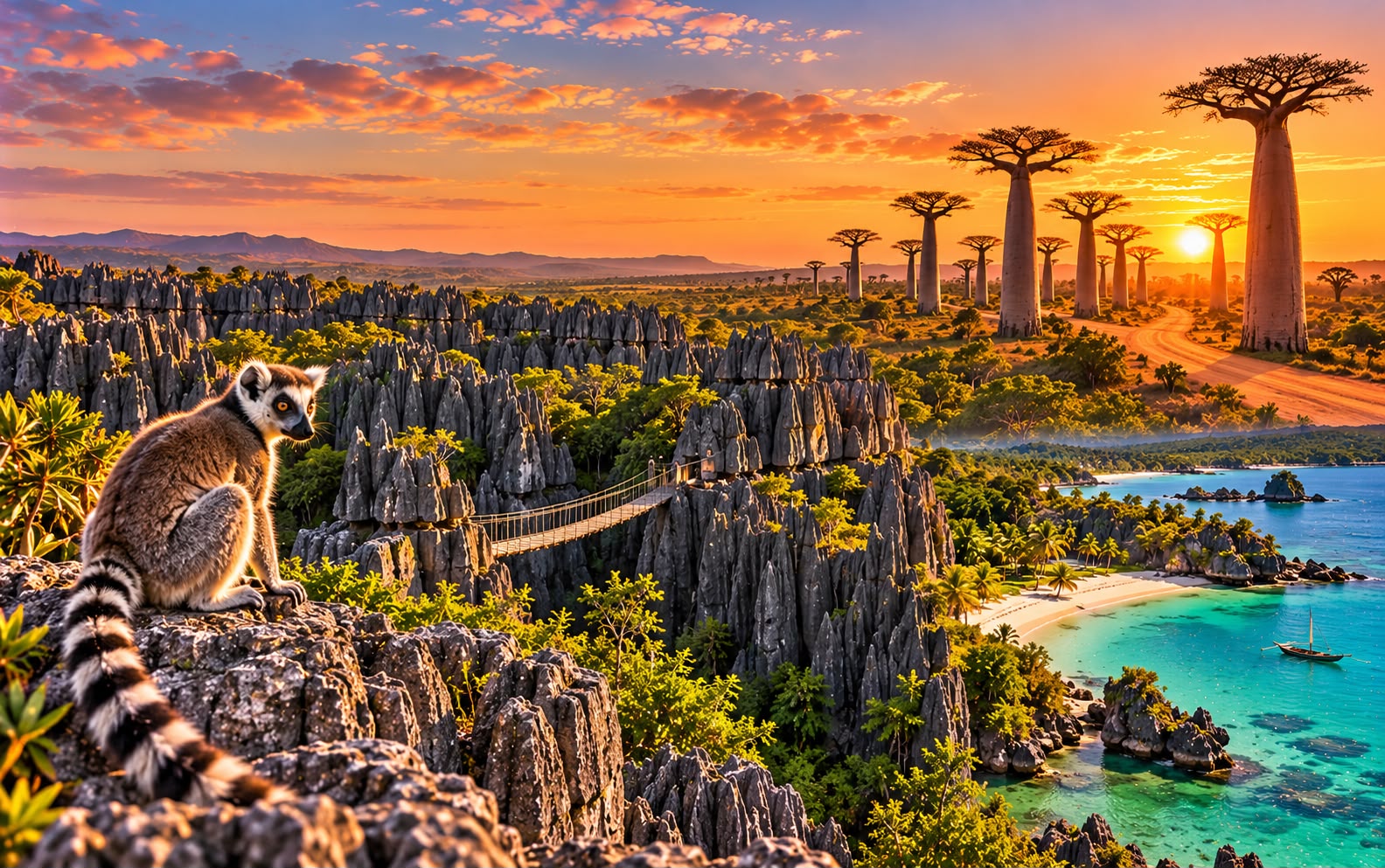
Madagascar in 12 days: lemurs, baobabs and the Tsingy
An island that broke away from Africa 160 million years ago and evolved on its own: lemurs that exist nowhere else, a limestone forest of stone needles, and an avenue of baobabs at sunset — with the honest version of the roads, which are the single biggest thing to plan around.
- Indian Ocean Islands
- 12 days
- ≈ AED 7,600 / person
- Lemurs + endemic wildlife
Before you go
Madagascar separated from Africa long enough ago that almost everything living here evolved separately. Roughly 90% of its wildlife exists nowhere else on earth — more than a hundred lemur species, two-thirds of the world’s chameleons, baobabs found on no other continent.
It is also, bluntly, hard to travel. The roads are the defining constraint: distances that look like a morning take two days, surfaces vary from tarmac to deep rutted track, and the schedule is set by what the vehicle can manage. That is not a warning against going. It is the thing to understand before you book.
This route takes the eastern rainforest for lemurs, the western dry forest for baobabs, and the Tsingy de Bemaraha — a plateau eroded into a forest of limestone blades — which is one of the most extraordinary landscapes anywhere.
Before you go: the roads, the season and the guides
Entry
- Visa on arrival or eVisa for most nationalities, issued at the airport for stays up to 30, 60 or 90 days, with a fee payable in euros or US dollars cash.
- Bring that cash in clean notes. Card facilities at the airport are unreliable.
- Passport valid six months.
The roads are the itinerary
This is the honest brief, and it matters more here than in any other guide on this site.
- There is very little paved road network. The RN7 south and the RN2 east are surfaced; most else is not.
- Antananarivo to Morondava is 700 km and takes two full days by road. Many people fly it instead, in an hour.
- The Tsingy road is the hard part: from Morondava it is roughly 8–10 hours of rough track plus two river ferry crossings on wooden barges, and it is only passable in the dry season.
- You travel with a driver and a 4x4, arranged through an operator. Self-drive is legal and inadvisable.
- Domestic flights exist and are frequently delayed or cancelled. Build slack around them; never connect an internal flight to an international one on the same day.
The season decides what is open
- April to November is the dry season and the only realistic window for this route.
- The Tsingy and its road close in the wet season, roughly December to March, and cyclones affect the east coast in the same months.
- June to September is the reliable core: dry, cooler, and good for wildlife.
- September to November is best for lemur watching — babies are born, and the forests are active.
Guides are compulsory, and worth it
- Every national park requires a local guide. This is not upselling; it is the rule, it funds the parks and the communities, and the guides are extremely good at finding animals you would walk past.
- Night walks are where the mouse lemurs and chameleons are, and are separately arranged.
- Tip properly. Guiding is the main local income at these parks.
Money and health
- The ariary (MGA), and the numbers are large. Cards work in Antananarivo hotels and almost nowhere else.
- Draw cash in Tana, and carry enough for the whole trip outside it.
- Malaria is present across the country. Take advice on prophylaxis well in advance.
- Do not drink tap water. Bottled or filtered only.
- French is the working second language; English is limited outside tourism.
Day by day
Day 1 — Land in Antananarivo
- 13:00 — Land at Ivato (TNR). Immigration and the visa desk are slow; budget an hour before you reach the car park.
- 14:30 — Transfer into the city, 15 km that takes 45 minutes on a good day and well over an hour in afternoon traffic.
- 16:00 — Check in around Isoraka or Tsiazotafo, the two quarters worth walking after dark, and change money at the hotel or a bank — not at the airport, where the rate is poor.
- 17:30 — Walk the Haute-Ville steps for the view over the tin roofs, no more than that; the altitude here is 1,300 m and you have just flown.
- 19:30 — Dinner at a hotely in Isoraka. Zebu steak, rice with everything, and Three Horses Beer.
- 21:00 — Confirm three things before bed: cash in hand for the week, the driver’s arrival time, and whether the Morondava flight is still running. All three change.
Day 2 — East to Andasibe
- 07:00 — Leave early. The RN2 east is 140 km and takes three to four hours, and the last stretch is slow behind trucks.
- 09:30 — Stop at Moramanga for coffee and the roadside stalls. The terraced rice paddies either side of the road are the landscape people picture when they picture Madagascar.
- 12:00 — Arrive Andasibe. Lunch at the lodge, then meet your guide: park walks here are guided by law, and the good guides are booked out by mid-morning.
- 15:00 — An easy first walk in Analamazaotra to get your eye in — chameleons, orchids, and probably a distant indri call.
- 18:30 — Dinner early; you are going out again.
- 19:30 — The night walk along the road outside the reserve (the park itself closes at dusk, so this is roadside, torchlight, and better than it sounds): mouse lemurs, leaf-tailed geckos, tree frogs, sleeping chameleons at eye level.
Day 3 — Indri, and the rainforest
- 06:00 — Into Analamazaotra at opening. The indri calls between roughly 07:00 and 11:00, and the call — a rising siren that carries two kilometres — is what you came for. Reckon on two to three hours of walking to reach a family.
- 10:30 — Back for breakfast, or push on if the indri are moving.
- 13:00 — Mantadia, an hour north on a rough track, for primary forest, diademed sifaka and far fewer people. The road is the reason most visitors skip it.
- 16:00 — Alternative if the track is out: Vakona Private Reserve, where rehabilitated lemurs will land on your shoulders. It is a zoo in all but name — enjoyable, not wild, and worth being clear-eyed about.
- 19:30 — A second night walk if the first one delivered. The guides know which stretch of road has been productive this week.
Day 4 — Back to Tana, and west
- 06:30 — Leave Andasibe early to beat the truck traffic back down the RN2.
- 10:30 — Antananarivo. If you are flying, go straight to Ivato; Tsaradia’s Morondava flights are frequently retimed and occasionally cancelled, and the queue is not fast.
- 13:00 — Fly to Morondava, about an hour. The alternative is two days on the RN34 and RN35, which is a genuine option only if you have the days spare.
- 14:30 — Land into heat and humidity you did not have this morning — the west coast is a different country from the highlands.
- 16:00 — Check in along the sand spit at Nosy Kely.
- 18:00 — Grilled fish and the Mozambique Channel sunset. Early night: tomorrow starts before dawn.
Day 5 — The Avenue of the Baobabs
- 05:00 — Out to the Avenue of the Baobabs, 20 km north on a sand road, 45 minutes. Sunrise is quieter than sunset and the light is just as good.
- 07:30 — Back for breakfast, and the heat of the day off your feet.
- 14:00 — Kirindy Forest, two hours north, and worth the drive: this is the reliable place for fossa, the island’s largest predator, which behaves like a cat that has been told it is a dog.
- 17:00 — Back to the Avenue for sunset, when the tour buses and every vendor in the region arrive. Walk 200 m up the road and the crowd thins to nothing.
- 19:30 — Dinner in Morondava. Confirm the Bekopaka vehicle, the driver, and that the ferries are running — in a dry year they always are, but ask.
Day 6 — North to the Tsingy
- 05:00 — Leave in the dark. This is the day the trip is built around and it is not a comfortable one.
- 08:30 — The Tsiribihina river crossing at Belo: a flat wooden barge, your vehicle driven onto planks, and a wait that runs from twenty minutes to two hours depending on what is ahead of you.
- 12:00 — Lunch at Belo sur Tsiribihina, the only real stop.
- 16:00 — The Manambolo crossing, second barge, same drill.
- 17:30 — Bekopaka, 8 to 10 hours after you left, dusty and rattled. The lodges here are better than the road suggests.
- 19:00 — Dinner, and register for tomorrow at the park office if your lodge has not already done it.
Day 7 — Grand Tsingy
- 06:30 — Park office at opening for the Andamozavaky circuit. Harnesses are issued and their use is compulsory.
- 07:30 — Into the Grand Tsingy: limestone eroded into blades and needles, crossed on fixed cables, steel ladders and a suspension bridge strung between two pinnacles.
- 11:00 — The high traverse and the viewpoint over the whole grey forest of stone. Four to five hours of scrambling in total, some of it through gaps you turn sideways for.
- 13:30 — Out, and lunch. You will be finished for the day.
- 16:00 — Nothing. Sit still. This is not a day you stack anything else onto.
- Note — Not for anyone uneasy with heights or enclosed spaces. Everyone else: one of the best days available outdoors anywhere.
Day 8 — Petit Tsingy, and the gorge
- 07:00 — Petit Tsingy, lower, shorter and far easier than yesterday — two hours, with Decken’s sifaka in the shaded canyon floors.
- 10:30 — A pirogue on the Manambolo gorge, poled upstream between 100 m limestone walls, past Vazimba burial sites tucked into ledges in the cliff. Two hours on the water.
- 13:00 — Lunch at the lodge.
- 15:00 — The cave system near the gorge mouth, or a second short Tsingy walk if legs allow.
- 18:30 — Last night at Bekopaka. Repack for the road — dust gets into everything tomorrow.
Day 9 — Back to Morondava
- 05:00 — The same track south, both ferries again. It is no shorter the second time.
- 12:00 — Belo sur Tsiribihina for lunch.
- 16:30 — Into Morondava with, if the timing has gone your way, an hour in hand.
- 17:30 — The Avenue one last time in the other light. Most people’s best photograph of the trip is this one, not the first.
- 19:30 — Dinner on the beach, and a shower that takes a while.
Day 10 — The coast, or Kirindy properly
- Option A — a slow day. Morondava’s beach is not the Indian Ocean picture-postcard, but after four days of track it is exactly right. Boat out to Betania fishing village across the estuary in the morning.
- Option B — Kirindy, at night. Drive up in the afternoon, stay at the forest camp, and do the night drive: fossa, giant jumping rats, and seven species of nocturnal lemur. The better wildlife day by some distance.
- 16:00 — Whichever you chose, be back for the evening flight to Tana, or start the drive if you are going overland.
Day 11 — Antananarivo
- 09:00 — The Rova on the hill: the Queen’s Palace, burned out in 1995 and rebuilt over two decades, with the whole city below it.
- 11:00 — Analakely market and the covered stairs below it — the loudest, most useful hour in the city.
- 13:00 — Lunch in Haute-Ville.
- 15:00 — Lemurs’ Park, 22 km west, if you want one more easy sighting — nine species in restored forest by the Katsaoka river. Or Andravoahangy market for raffia, woodwork and embroidered linen, which is the better use of the afternoon if you have had your fill of lemurs.
- 19:30 — Last dinner. Zebu again, and you will not mind.
Day 12 — Fly home
- Morning — Free. Most international departures leave late evening, so you have the day, and Tana is a fine place to spend it slowly.
- Afternoon — Transfer to Ivato at least three hours out.
- Do not connect an internal flight to an international one on the same day. Domestic schedules here move, and the connection is the one thing on this trip with no slack in it.
Costs and practicalities
Best time to visit
April–November is the dry season and the practical window, with lemur behaviour and the cyclone calendar both pulling towards it.
- April–June — the best of the year. Green after the rains, roads drying out, and comfortable temperatures.
- July–September — the coolest and driest. Humpback whales off Île Sainte-Marie from July to September is one of the best whale encounters anywhere. Nights are cold in the highlands.
- September–November — warming, and the best lemur viewing: most species give birth from September to November and the babies are visible.
- December–March — the wet season and the cyclone season. Roads wash out, many parks close, and the east coast takes the worst of it.
The baobab avenue at Morondava is dry-season access; the RN8 to it is difficult after rain.
Travel tips
- Distances take far longer than the map suggests. Roads are poor and 200km can be a full day. Domestic flights on Tsaradia save days but are expensive and prone to change.
- Every national park requires a local guide — this is the rule and it is also how the park fees reach the communities. Agree the rate at the office.
- Bring euros in cash. The ariary comes in large numbers, cards work in Antananarivo hotels, and ATMs have low limits.
- French is essential; Malagasy is the first language. English is rare outside the lodges.
- Fady — local taboos — vary by village and are taken seriously. Your guide will tell you what they are; they may cover pointing at a tomb, eating certain foods, or walking a particular path.
- Antananarivo has real street-crime risk. Do not walk at night, and keep phones out of sight.
- Malaria prophylaxis is essential on the coasts; the highlands are lower risk.
What this trip actually costs
Two people, 11 nights, mid-range, excluding international flights:
| Item | Cost |
|---|---|
| 4x4 with driver, 10 days, and fuel | MGA 7,000,000 (≈ AED 5,597) |
| Hotels and lodges, 11 nights | MGA 5,500,000 (≈ AED 4,398) |
| Domestic flights ×2 legs, two people | MGA 2,600,000 (≈ AED 2,079) |
| Park fees, compulsory guides, night walks, ferries | MGA 2,800,000 (≈ AED 2,239) |
| Food and drink, 12 days | MGA 1,100,000 (≈ AED 880) |
| Total for two | MGA 19,000,000 (≈ AED 15,192) |
- Roughly MGA 9,500,000 (≈ AED 7,596) per person. The vehicle and driver are the largest line and are not optional — there is no useful public transport on this route.
- Flying Tana–Morondava saves two days each way and is worth the cost on a twelve-day trip.
- Food, beds and park fees are all inexpensive; the moving is not.
What to pack
- Broken-in walking shoes with grip for the Tsingy, which is sharp limestone.
- Long sleeves and trousers for forest walks and mosquitoes.
- A head torch for night walks, which are the best walks.
- Cash in ariary and euros, drawn and changed in Tana.
- Malaria prophylaxis and strong repellent.
- Binoculars — lemurs are usually high in the canopy.
- Type C/E plugs, 220V, where there is power.
FAQ
How bad are the roads really? Bad enough to plan the trip around. The Tsingy road is 8–10 hours of rough track with two river ferries and is impassable in the wet season. Everywhere else on this route is manageable with a 4x4 and patience.
Is twelve days enough? For this route, yes, and it is already ambitious. Adding the RN7 south to Isalo and Ifaty needs another week; Madagascar does not reward rushing.
When should I go? April to November, and June to September for the most reliable conditions. The Tsingy is closed in the wet season, which removes the best day of the trip.
Will I definitely see lemurs? Yes. Andasibe’s indri are near-certain with a guide, and the habituated groups at Vakona are a guarantee. Fossa are luck.
Prices and entry rules change, and what you need depends on your passport; last checked 8 October 2026, so confirm with the embassy or your airline before booking.


