 The Itinerary
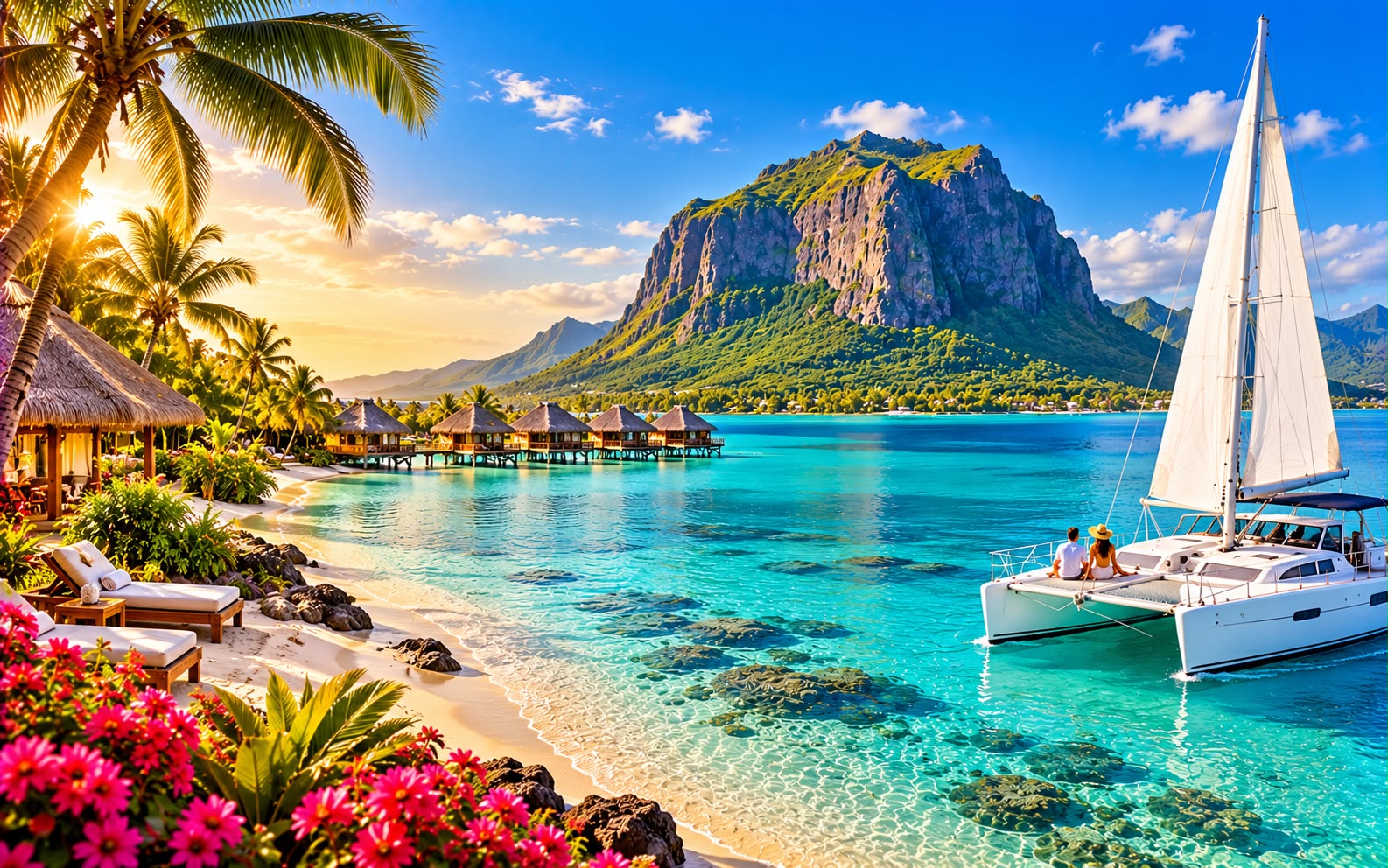
Mauritius honeymoon in 6 days: the north, Le Morne and a catamaran
Six days split between the sheltered north and the dramatic southwest under Le Morne, with a catamaran day to the islands and the Chamarel waterfall and coloured earths on the drive between them. Why the island has two climates at once, and which side to end on.
- Indian Ocean Islands
- 6 days
- ≈ AED 6,250 / person
- Two coasts with different weather, and a mountain in the sea to finish on
Before you go
Mauritius has two climates running at the same time, and a honeymoon that ignores that spends a week on the wrong coast.
The north and northwest are sheltered, calm and warm. The southwest, under Le Morne, is windier, greener and far more dramatic — a basalt monolith rising out of a lagoon, with the famous underwater waterfall illusion off its point.
Two nights north, three southwest, with the Chamarel plateau on the drive between them. The eight-day loop does the whole island; this one trades the east coast for better rooms and fewer moves.
Figure MUR 80,000 (≈ AED 6,248) per person. May to December, avoiding the cyclone months.
Before you go: the admin
Entry
- Visa-free on arrival for a long list of nationalities, typically 60 or 90 days, including India, the GCC states, the EU and the UK.
- You need a confirmed return ticket and accommodation, and six months’ passport validity.
- An online arrival form is usually required before travel.
- Last checked: 30 October 2026. Confirm on the official portal.
The two coasts
- North (Grand Baie, Trou aux Biches, Pereybère) — the calmest water and the best swimming, the most restaurants, and the base for the island-hopping catamarans. Busiest.
- West and southwest (Flic en Flac, Le Morne, Tamarin) — sunsets over the water, dolphins off Tamarin, and Le Morne’s lagoon, which is the island’s signature view. Windier, which is why it is the kitesurfing coast.
- East (Belle Mare) — the finest beaches and the strongest wind. Beautiful and often blowing.
- South — cliffs, wild coast, almost no swimming.
- On a six-day honeymoon, north then southwest is the shape that gives you both calm water and the best view.
Getting around
- Hiring a car is easy and the island is small — 90 minutes end to end. Driving is on the left, roads are good, and roundabouts are the local hazard.
- Taxis by the day are the alternative and are reasonable if you agree the rate.
- Buses are very cheap and very slow.
- The airport is in the southeast, nearer Le Morne than the north — another argument for finishing in the southwest.
Money
- Mauritian rupee. Cards work at hotels, restaurants and supermarkets. Cash for markets, beach vendors and small places.
- Resorts are expensive; the island is not. Eating out beyond the hotel is dramatically cheaper and usually better.
Day by day
Day 1 — Arrive, and the north
- Land in the southeast and drive north, about an hour and a quarter.
- Afternoon — Trou aux Biches or Pereybère. The water here is the calmest on the island and the beaches are public, as all Mauritian beaches are by law.
- 18:00 — Sunset, then dinner in Grand Baie, which is the island’s one properly busy evening strip.
- Eat Mauritian rather than hotel buffet. The food is Creole, Indian, Chinese and French at once — dholl puri from a street stall is the national dish and costs almost nothing.
Day 2 — The catamaran day
- 08:30 — A catamaran to the northern islands. Îlot Gabriel and Île Plate are the standard run — an hour out, a lagoon to swim in, lunch cooked on board, and back mid afternoon.
- This is the best day on the north coast and the one excursion worth booking here.
- Snorkelling over the reef is included on most, and the turtles are genuine rather than a brochure promise.
- 15:30 — Back, and the beach.
- 18:00 — A rum tasting. Mauritian agricultural rum is serious and most distilleries run tours; Rhumerie de Chamarel is on tomorrow’s route if you would rather do it there.
Day 3 — Across to the southwest, the slow way
- 09:00 — Leave north and head south, stopping as you go.
- 10:00 — Port Louis — the Central Market for spices, vanilla and textiles, and the Aapravasi Ghat, the UNESCO-listed immigration depot where half a million indentured labourers entered the British empire. It is a short and important visit.
- 12:30 — Tamarin, and lunch on the bay.
- 14:00 — Chamarel. The Seven Coloured Earths — dunes of volcanic clay in bands of red, brown and violet that do not recombine when mixed — and the Chamarel waterfall, which drops 100m into a gorge just before it.
- 16:30 — Down to Le Morne and check in.
- 18:30 — Sunset behind the mountain, which is the reason you are on this coast.
Day 4 — Le Morne, and the lagoon
- 07:00 — The lagoon early, before the wind gets up. This coast blows in the afternoon almost every day, which is predictable rather than a problem — swim in the morning, sit in the afternoon.
- 09:00 — Le Morne Brabant. The mountain is UNESCO-listed not for its shape but for its history — it was a refuge for escaped slaves, and the name carries that.
- The guided hike to the summit is about three to four hours return and the upper section is steep and needs a guide. The base walk is gentle and most people do that.
- 13:00 — Lunch, and the afternoon on the beach.
- 16:00 — A couples spa treatment, which on this coast comes with the mountain in the window.
- 19:30 — Dinner. The southwest is quieter than the north; the hotel restaurant is more likely to be the evening here.
Day 5 — Dolphins, or the south coast
- 06:30 — Dolphins off Tamarin, if you want them. Spinner dolphins come into the bay in the early morning and leave by mid-morning. Choose an operator that keeps its distance — the practice here has been criticised and the good operators know it.
- Alternatively, the wild south — Gris Gris and the cliffs at Souillac, Rochester Falls, and the coast where the reef stops and the Indian Ocean hits the land directly. No swimming, and that is the point.
- Or Black River Gorges — the island’s one national park, with short walks to viewpoints and the last of the native forest.
- 14:00 — Back to the lagoon.
- Sunset — the last one, from the beach.
Day 6 — Out
- The airport is about 50 minutes from Le Morne.
- Morning — a last swim before the wind.
- If the flight is late, Mahébourg is near the airport — a small waterfront town with a good Monday market and the Naval Museum.
Costs and practicalities
Best time to visit
May to December, with the caveats below.
- May to June — the start of the dry season, warm, quiet and good value.
- July and August — the coolest and windiest months, with the southeast trades at their strongest. Good for kitesurfing, less good for lying on the east coast. Prices rise with European holidays.
- September to November — the best window. Warm, settled, the water at its clearest, and the wind dropping.
- December to March — hot, humid and the cyclone season. Cyclones are infrequent but real, and February is the peak risk. Rates fall accordingly.
- The north is sheltered year round, which is why this itinerary starts there.
Travel tips
- Swim in the morning on the west coast. The wind arrives in the afternoon with great reliability.
- All beaches are public by law. A resort cannot own one, which means the good public beaches are genuinely good.
- Eat outside the hotel. The island’s food is one of its best features and hotel buffets are not it.
- Hire a car. The island is small, the roads are fine, and it removes a great deal of negotiation.
- Book the catamaran from the north, not from your hotel desk at Le Morne — it is a northern excursion.
- Choose a dolphin operator on its distance policy, or skip it.
- Take reef shoes. Several lagoons have urchins.
- The sun here is intense even when the wind makes it feel mild.
What this trip actually costs
Two people, 5 nights, two upscale properties, international flights excluded:
| Item | Cost |
|---|---|
| North coast resort, 2 nights | MUR 36,000 (≈ AED 2,812) |
| Le Morne resort, 3 nights | MUR 66,000 (≈ AED 5,155) |
| Catamaran day with lunch, two people | MUR 12,000 (≈ AED 937) |
| Car hire, 5 days, and fuel | MUR 14,000 (≈ AED 1,093) |
| Couples spa treatment | MUR 9,000 (≈ AED 703) |
| Food, drink and entries | MUR 23,000 (≈ AED 1,796) |
| Total for two | MUR 160,000 (≈ AED 12,497) |
- Roughly MUR 80,000 (≈ AED 6,248) per person for six days, against about 43,000 for eight days on the standard loop — the rooms are the whole difference.
- The car is the cheapest useful thing here. Five days of hire costs less than one dinner for two at a resort.
- Half board at a resort plus eating out twice is usually better value and much better food than full board.
- September to November beats December to March on both weather and price.
- Hotel picks here are chosen on location, not on commission — always check prices and recent reviews before booking.
What to pack
- Reef shoes. Several lagoons have sea urchins.
- Reef-safe sunscreen, and a rash vest for long snorkels.
- A light windproof for the southwest afternoons and the boat.
- Walking shoes if you intend the Le Morne hike.
- Insect repellent for evenings inland.
- A Type C/G adapter, 230V — Mauritius uses both, and the three-pin UK plug is common.
Part of a bigger trip?
- Mauritius in 8 days is the full island loop including the east.
- Seychelles honeymoon is the granite-island alternative in the same ocean.
- The Maldives honeymoon is the one-island, one-villa version.
- Seychelles in 8 days is the three-island route.
FAQ
Which coast should we stay on? Both, in this order: north first for the calmest swimming and the catamarans, southwest second for Le Morne, the sunsets and the proximity to the airport. The east has the finest beaches and the strongest wind.
Is Le Morne worth the extra drive? Yes. The mountain over the lagoon is the island’s signature view, the sunsets face the water, and it is the one place in Mauritius that feels dramatic rather than simply pretty.
When is cyclone season? Roughly December to March, with February the peak risk. Cyclones are infrequent but they do happen, and rates during those months reflect it. September to November is the best weather window of the year.
Should we do the dolphin trip at Tamarin? Only with an operator that keeps a respectful distance. The practice at Tamarin has been criticised for crowding the pods, and some boats behave much better than others. If you cannot verify the operator, skip it.
Do we need to hire a car? Not strictly, but it is cheap, the island is small and the roads are good. It turns the drive between coasts into the Chamarel day rather than a transfer.
Prices and entry rules change, and what you need depends on your passport; last checked 30 October 2026, so confirm with the embassy or your airline before booking.


