 The Itinerary
Seychelles honeymoon in 5 days: Mahé, Praslin and La Digue
Five days across two islands and a day trip to a third: Mahé's beaches and the ferry to Praslin for the Vallée de Mai, then La Digue by bicycle for Anse Source d'Argent. The ferry timetable is the itinerary here, and the islands are expensive in ways that are easy to design around.
- Indian Ocean Islands
- 5 days
- ≈ AED 8,350 / person
- Granite boulders, two islands and a bicycle — the beaches that actually look like the photographs
Before you go
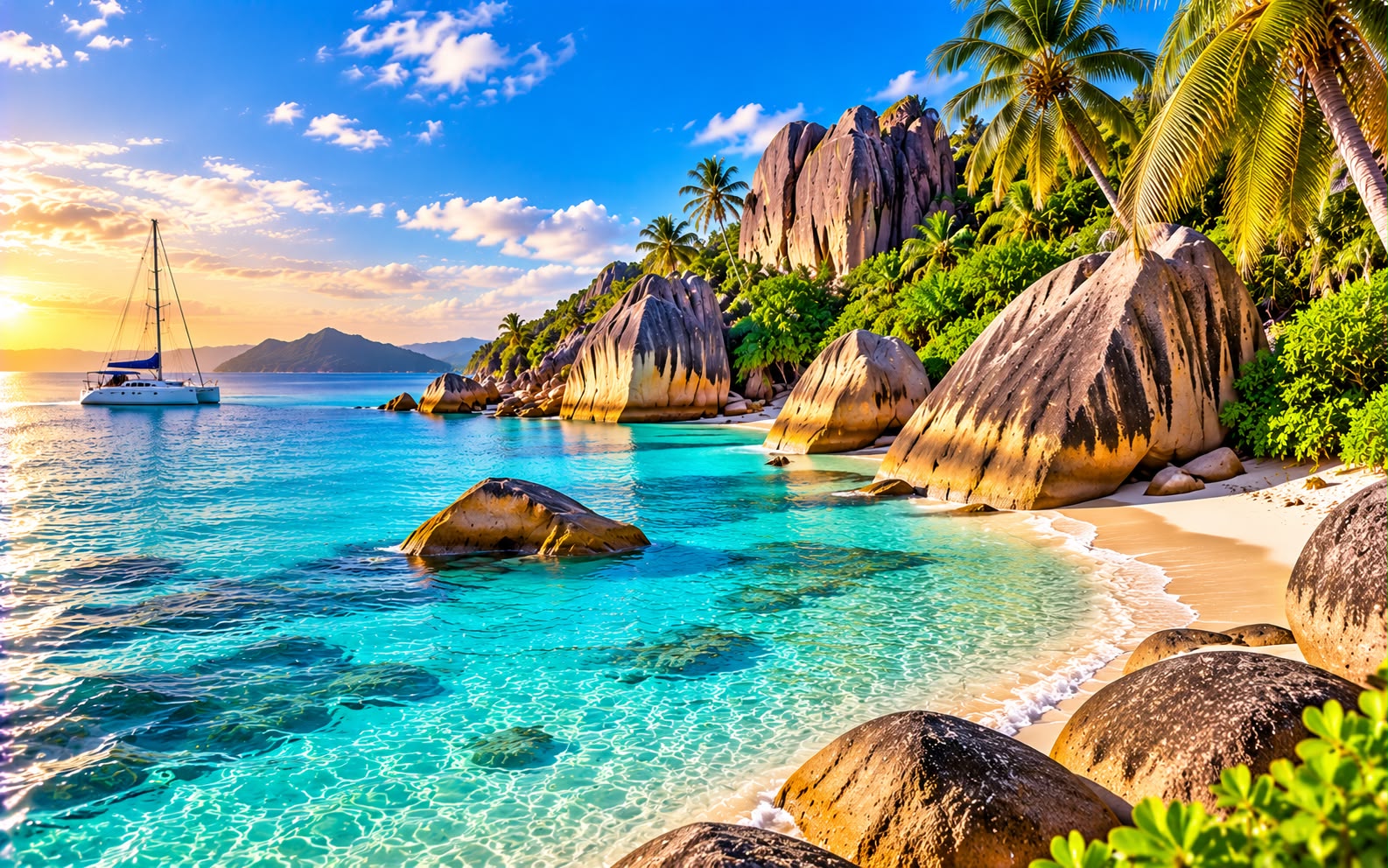
The Seychelles beaches genuinely look like the photographs, which is not true of most places that claim it. The granite boulders are the reason — they are continental rock, not coral or volcanic, and there is nowhere else quite like them.
Five days is two islands and a day on a third. Two nights on Mahé, two on Praslin, and La Digue as a day trip by bicycle — which is the right shape, because La Digue is tiny and the ferry from Praslin takes fifteen minutes.
The eight-day route gives each island its own stay. This compresses it without rushing, and puts the money into the rooms. Figure SCR 33,000 (≈ AED 8,337) per person. April, May, October and November.
Before you go: the admin
Entry
- No visa for any nationality. A visitor’s permit is issued on arrival for up to 30 days, extendable.
- You need a return ticket, confirmed accommodation and proof of funds, and an online travel authorisation is required before departure.
- Last checked: 30 October 2026. Apply on the official site only — there are many lookalikes charging more.
The ferries, which are the itinerary
- Mahé to Praslin is about an hour by fast catamaran. Praslin to La Digue is about fifteen minutes.
- Book the ferries in advance. They sell out, particularly the Mahé–Praslin crossing in season.
- The crossing can be rough between June and September when the southeast trades blow. Take something if you are prone.
- Inter-island flights to Praslin take 15 minutes and are expensive but reliable.
- Build the ferry times into the day. They are not frequent, and a missed one costs you an afternoon.
Where to stay
- Mahé — Beau Vallon for the calm north-coast swimming and the restaurants; the south and west for quieter, more spectacular beaches and more driving.
- Praslin — Côte d’Or is the main beach and the most convenient; Anse Lazio is the famous one and has no hotels on it.
- La Digue — lovely to stay on if you have the nights, but on a five-day trip it works better as a day from Praslin.
Money, and the thing to design around
- Seychellois rupee. Cards work in hotels and better restaurants; cash for takeaways, buses and bike hire.
- The Seychelles is expensive, and the single best saving is eating where locals eat — the takeaway Creole places and the Beau Vallon evening food stalls cost a fraction of a hotel dinner and are better.
- Self-catering is normal here and not a compromise.
Day by day
Day 1 — Mahé
- Land at Mahé, which is where all international flights arrive.
- Afternoon — Beau Vallon, the long north-coast beach, and the calmest swimming on the island.
- 17:00 — The sunset from the beach, and the food stalls if it is a market evening.
- Or Victoria, one of the smallest capital cities in the world — the clock tower, the market, and the botanical gardens where the coco de mer palms grow.
Day 2 — The south of Mahé, then the ferry
- 08:00 — Drive the west coast south. Port Launay and Baie Ternay for calm snorkelling in a marine park; Anse Intendance and Anse Takamaka in the south for the dramatic ones — big surf, huge boulders, and no swimming when it is running.
- Petite Anse and Anse Soleil are the small, sheltered ones.
- 12:00 — A Creole lunch — grilled red snapper, octopus curry, breadfruit chips.
- 14:30 — Back to Victoria for the afternoon ferry to Praslin.
- 16:00 — Arrive Praslin and check in.
- 18:30 — Côte d’Or for the evening.
Day 3 — Vallée de Mai and Anse Lazio
- 08:30 — The Vallée de Mai, UNESCO-listed, and the only place the coco de mer grows wild in any number. The nut is the largest seed in the plant kingdom and the palm is genuinely strange to stand under.
- The walk is an easy hour or two on marked paths. Go at opening — it is cooler and the black parrots are active.
- 11:30 — Anse Lazio, on the north tip — regularly called one of the best beaches in the world, and it is the boulders and the water clarity that earn it. No hotel on it, a couple of restaurants behind.
- Swim at the north end; the current can run at the far end.
- 15:00 — Anse Georgette if you can — access is across a resort’s land and usually needs calling ahead, which is worth doing.
- 19:00 — Dinner on Côte d’Or.
Day 4 — La Digue by bicycle
- 08:00 — The first ferry to La Digue, fifteen minutes.
- 08:30 — Hire bicycles at the jetty. There are almost no cars on the island and a bicycle is how everyone moves. This is the best day of the trip.
- 09:00 — L’Union Estate, through which you reach Anse Source d’Argent — the most photographed beach in the Seychelles, and the granite formations are the reason.
- Go early. The light is best in the morning and the tide matters — at high tide much of the sand disappears. Check it.
- 12:00 — Cycle across the island to Grand Anse, Petite Anse and Anse Cocos — a steep ride then a walk, and far emptier. Grand Anse has strong currents and is often not swimmable; Anse Cocos usually is.
- 15:30 — Back to the jetty, a last swim, and the ferry.
- 18:00 — Praslin.
Day 5 — Out
- The international flight leaves from Mahé, so the ferry or flight back is part of your departure day. Allow a generous margin — this is the single most common way people miss a plane here.
- Morning ferry, then the airport.
- If the timing is tight, take the inter-island flight. It costs more and it removes the risk.
Costs and practicalities
Best time to visit
April, May, October and November.
- April–May and October–November — the transition months between the two trade winds. Calm seas, clear water, light winds. The best diving and snorkelling visibility of the year, and the best all-round window.
- December to March — the northwest monsoon. Warmer, more humid, with heavier rain and seaweed on some northwest-facing beaches. Christmas and New Year are the most expensive weeks.
- June to September — the southeast trades. Cooler, drier and windier; the sea is choppier and the ferry crossing less comfortable. Good for walking, less good for lying still.
- It is a year-round destination. There is no bad season, only different winds.
Travel tips
- Book the ferries in advance and leave a wide margin on departure day.
- Check the tide before Anse Source d’Argent. At high tide the beach largely vanishes.
- Hire bicycles on La Digue, not a buggy. The island is flat along the coast and this is the pleasure of the place.
- Eat at Creole takeaways and the evening stalls. It halves the food line and improves the food.
- Swim at the sheltered end of beaches. Several have strong currents at one end only, and they are not always signed.
- Take reef-safe sunscreen. It is required in places and expensive to buy here.
- Avoid the seaweed season on northwest beaches if you are visiting between December and March; ask the hotel directly.
- Mosquitoes at dusk. Repellent.
What this trip actually costs
Two people, 4 nights, good hotels, international flights excluded:
| Item | Cost |
|---|---|
| Mahé hotel, 2 nights | SCR 16,000 (≈ AED 4,042) |
| Praslin hotel, 2 nights | SCR 22,000 (≈ AED 5,558) |
| Ferries, Mahé–Praslin–La Digue, two people | SCR 6,000 (≈ AED 1,516) |
| La Digue bicycles and L’Union Estate entry | SCR 2,400 (≈ AED 606) |
| Car hire on Mahé, 2 days | SCR 3,600 (≈ AED 910) |
| Food and drink, 5 days | SCR 16,000 (≈ AED 4,042) |
| Total for two | SCR 66,000 (≈ AED 16,675) |
- Roughly SCR 33,000 (≈ AED 8,337) per person, and the food line is where this trip is won or lost — eating only in hotels can double it.
- Self-catering for breakfast and lunch is normal here and saves a great deal.
- The ferry is a real cost, and the inter-island flight is considerably more — worth it only on departure day if the timing is tight.
- April–May and October–November are both the best weather and better value than the December peak.
- Hotel picks here are chosen on location, not on commission — always check prices and recent reviews before booking.
What to pack
- Reef shoes for granite and urchins.
- Reef-safe sunscreen — required in places, expensive locally.
- A rash vest for snorkelling.
- Insect repellent for dusk.
- A dry bag for the ferry and the bicycle day.
- A Type G adapter, 240V — the UK three-pin plug.
Part of a bigger trip?
- Seychelles in 8 days gives each island its own stay.
- Mauritius honeymoon is the other Indian Ocean option, with more to drive to.
- The Maldives honeymoon is the one-island, one-villa version.
- Sri Lanka and the Maldives in 12 days pairs a beach with a country.
FAQ
Is five days enough for three islands? For two stays and a day trip, yes. Mahé and Praslin get two nights each and La Digue is fifteen minutes from Praslin by ferry, so it works as a full day with bicycles. Giving each island its own nights needs eight days.
Ferry or inter-island flight? Ferry for the journey — it is about an hour to Praslin and part of the trip. Take the flight on departure day if your international connection is tight, because a missed ferry is the most common way people miss a plane here.
Which is the best beach? Anse Source d’Argent on La Digue is the most photographed, and the granite formations earn it — but check the tide, because at high water most of the sand goes. Anse Lazio on Praslin is the best for actually swimming.
Is the Seychelles very expensive? Yes, particularly for food if you eat only in hotels. The fix is local: Creole takeaways, the evening food stalls at Beau Vallon, and self-catering for breakfast. That alone can halve the daily cost.
When is the seaweed season? Mainly December to March on northwest-facing beaches, varying by year and by beach. Ask your hotel directly rather than relying on photographs, which are never taken in a seaweed week.
Prices and entry rules change, and what you need depends on your passport; last checked 30 October 2026, so confirm with the embassy or your airline before booking.


