 The Itinerary
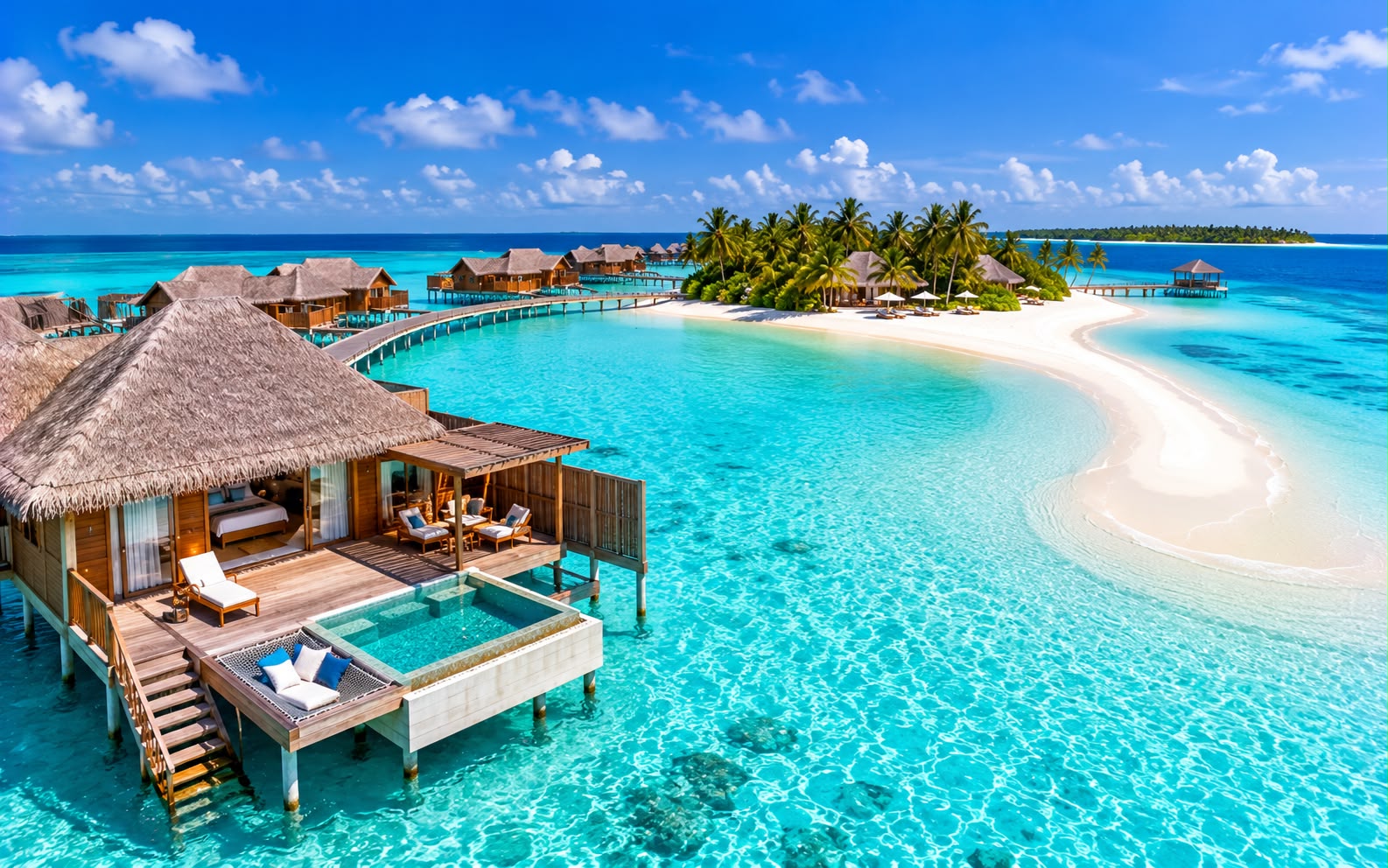
Maldives honeymoon in 5 days: overwater villa, sandbank, reef
The honeymoon version of a Maldives week: an overwater villa chosen on lagoon and house reef rather than price, a private sandbank dinner, and the three excursions that justify getting out of the water. The seaplane window, the half-board arithmetic, and why the resort you pick matters more than anything you do.
- South Asia
- 5 days
- ≈ AED 12,850 / person
- One island, one villa, and a plan that protects the two or three things worth leaving it for
Before you go
The Maldives is the one destination where the itinerary is the hotel. You will not move between islands, you will not sightsee, and the single decision that determines the trip is which resort you book — everything below is downstream of that.
The five-day resort stay costs this out for a standard beach villa. This is the honeymoon version: an overwater villa, a private sandbank dinner, and the excursions worth paying for, at roughly half as much again.
Figure USD 3,500 (≈ AED 12,854) per person. November to April is the dry season.
Before you go: the things that actually decide the trip
Entry
- A 30-day free visa on arrival for every nationality, on a passport with six months’ validity, a confirmed hotel booking and a return ticket.
- Last checked: 30 October 2026.
Choosing the resort, which is the whole game
- The house reef is the thing to check first. A resort with a good house reef means you snorkel from your own steps; one without means every snorkel is a boat trip you pay for.
- Overwater villas vary enormously. Ask about the water depth under the villa at low tide — some sit over sand and glass-bottom panels show nothing.
- Sunset side or sunrise side. Sunset villas cost more and are usually worth it on a honeymoon.
- Check whether the villa has a pool and whether you will use it. You are surrounded by ocean.
Getting there, and the transfer that shapes your dates
- Seaplane or speedboat, decided by the resort’s distance from Malé.
- Seaplanes fly in daylight only. If you land in Malé after about 15:00 you will overnight in Malé or at an airport hotel and fly out the next morning. This catches people constantly — check your arrival time against the resort’s last seaplane.
- Seaplane transfers are expensive and are not optional at distant resorts. Budget them as part of the room rate, because effectively they are.
- Speedboat resorts are cheaper to reach and nearer Malé. The trade is a busier stretch of water.
The board basis, which is the other big number
- Half board is the usual honeymoon choice. Full board or all-inclusive is often cheaper than paying à la carte at resort prices, and resort prices are high.
- Alcohol is only served on resort islands, never on inhabited local islands, and it is taxed heavily. An all-inclusive with drinks can be the better arithmetic.
- Water is included on most boards. Check.
Money
- US dollars are used everywhere on resorts and cards work. You will barely see a rufiyaa.
- Everything on the island is charged to the room and settled at the end. Watch the running total — it builds quietly.
Day by day
Day 1 — Arrive, and do nothing
- Land at Malé and transfer. Book a morning arrival so the seaplane flies the same day.
- The seaplane is the first good hour of the honeymoon — twenty to forty minutes at low altitude over atolls, with the door open at the front and no pretence of a safety briefing.
- Afternoon — check in, and stay in. The first day is for the villa, the steps into the water, and the fact that you have arrived.
- Sunset — from your own deck. You paid for this; use it before you start booking things.
Day 2 — The house reef, and the sandbank
- 07:00 — Snorkel the house reef early. Fish are most active in the first two hours and the light is best for seeing into the water.
- 10:00 — Nothing. This is the correct plan.
- 16:00 — The sandbank dinner. Most resorts run a private sandbank or lagoon dinner — you are taken by boat to a bar of sand and left with a table, a lantern and a waiter who appears twice.
- It is the most photographed thing people do here and it is genuinely worth it once. Book it on arrival, because there is usually one table a night.
- Check what happens if the weather turns. Most resorts move it to the beach.
Day 3 — The one excursion that is not about the resort
- 06:00 — Dolphin cruise at dawn if the resort runs one. Spinner dolphins travel in large pods here and the dawn trip is far better than the sunset version.
- 09:00 — A guided snorkel or dive on an outer reef. Manta and whale shark sites are seasonal and atoll-specific — ask the dive centre what is realistic this month rather than booking on a brochure photograph.
- Whale sharks are most reliably seen in South Ari atoll, and mantas move between atolls with the monsoon. Neither is guaranteed anywhere.
- 14:00 — Back, and the water again.
- 19:30 — Dinner somewhere other than the main restaurant — most resorts have one over-water or beach option worth the supplement once.
Day 4 — A local island, or nothing at all
- This is the day with a real choice in it.
- A local island visit — half a day to an inhabited island, which is the only way to see the country rather than the resort. Dress modestly, no alcohol, and the beaches are not bikini beaches except where a bikini beach is marked.
- It is worth doing once and it makes the resort make more sense.
- Or a couples spa treatment — most overwater spas have glass floors, which is either lovely or a gimmick depending on your temperament.
- Or genuinely nothing. On a five-day honeymoon, one empty day is not a wasted day.
- Sunset — a sunset fishing trip is the low-key resort staple, and the kitchen will cook what you catch.
Day 5 — Out
- Check the seaplane time the night before. It is not your flight time minus a bit — it is scheduled to the resort, and it can be early.
- A last swim before the boat or plane.
- Allow the full transfer plus three hours at Malé for an international departure.
Costs and practicalities
Best time to visit
November to April.
- December to March — the dry season at its most reliable, the calmest water and the best visibility. Christmas and New Year carry the highest rates of the year by a wide margin.
- November and April — the shoulder months, still largely dry, noticeably cheaper, and the best value on this list.
- May to October — the southwest monsoon. It does not rain all day; it rains hard and moves on. Rates fall sharply, and manta activity on some atolls is at its best.
- The Maldives is a year-round destination with a price curve, not a place with a bad season.
Travel tips
- Book the arrival so the seaplane flies the same day. A night in Malé is a wasted night of a short honeymoon.
- Check the house reef before the villa type. It matters more.
- Book the sandbank dinner on arrival. There is usually one.
- Ask the dive centre what is actually around this month.
- Reef-safe sunscreen. Many resorts now require it.
- Take cash in small dollars for tipping, which is customary and not included.
- Do not take coral or shells. It is illegal.
- The sun here is severe. A rash vest beats reapplying sunscreen every hour while snorkelling.
What this trip actually costs
Two people, 4 nights, overwater villa, international flights excluded:
| Item | Cost |
|---|---|
| Overwater villa, 4 nights, half board | USD 4,400 (≈ AED 16,159) |
| Seaplane transfers, two people return | USD 1,000 (≈ AED 3,673) |
| Private sandbank dinner | USD 500 (≈ AED 1,836) |
| Dawn dolphin cruise and a guided outer-reef snorkel | USD 380 (≈ AED 1,396) |
| Couples spa treatment | USD 320 (≈ AED 1,175) |
| Drinks and extras charged to the room | USD 400 (≈ AED 1,469) |
| Total for two | USD 7,000 (≈ AED 25,708) |
- Roughly USD 3,500 (≈ AED 12,854) per person, against about 2,250 for the standard resort stay. The villa and the transfer are the whole difference.
- The seaplane is the line people forget. At a distant resort it is a four-figure cost for two before you have bought anything.
- A speedboat resort nearer Malé removes most of that and is the single biggest saving available here.
- All-inclusive is often cheaper than half board plus drinks at resort bar prices. Do that arithmetic before booking.
- Hotel picks here are chosen on location, not on commission — always check prices and recent reviews before booking.
What to pack
- Reef-safe sunscreen, and more than you think.
- A rash vest for long snorkels.
- Your own mask and snorkel if you have them — resort rental fits badly and a leaking mask ruins a reef.
- Modest cover-up for a local island visit.
- Insect repellent for dusk.
- A dry bag for boat trips.
- A Type D/G adapter, 230V.
Part of a bigger trip?
- The Maldives in 5 days is this trip in a beach villa at standard rates.
- The Maldives in 7 days adds a second island or a longer stay.
- The Maldives on a budget is the guesthouse-and-local-island version, which is a genuinely different country.
- Sri Lanka and the Maldives in 12 days pairs the beach with a country you can travel in.
FAQ
Overwater villa or beach villa with a pool? Overwater for the arrival and the steps into the lagoon; beach villa if you want privacy, shade and more space for the money. On a short honeymoon most people want the overwater villa, and most resorts will let you split the stay between both.
Is the seaplane transfer worth it? It is rarely optional — the resort’s distance decides it. The flight itself is one of the best hours of the trip, but it is a significant cost and it only runs in daylight, which constrains your arrival time.
When will we see manta rays or whale sharks? It depends on the atoll and the month, and neither is guaranteed anywhere. Ask the resort’s dive centre what is actually being seen that month before booking an excursion on the strength of a photograph.
Can we visit a local island? Yes, and it is worth doing once. Dress modestly, expect no alcohol, and use the marked bikini beach if there is one. It is the only part of the trip that shows you the country rather than the resort.
Is half board enough? Often not, once you price à la carte dinners and drinks at resort rates. Run the numbers on full board or all-inclusive before you book — at many resorts it is the cheaper option, not the indulgent one.
Prices and entry rules change, and what you need depends on your passport; last checked 30 October 2026, so confirm with the embassy or your airline before booking.


