 The Itinerary
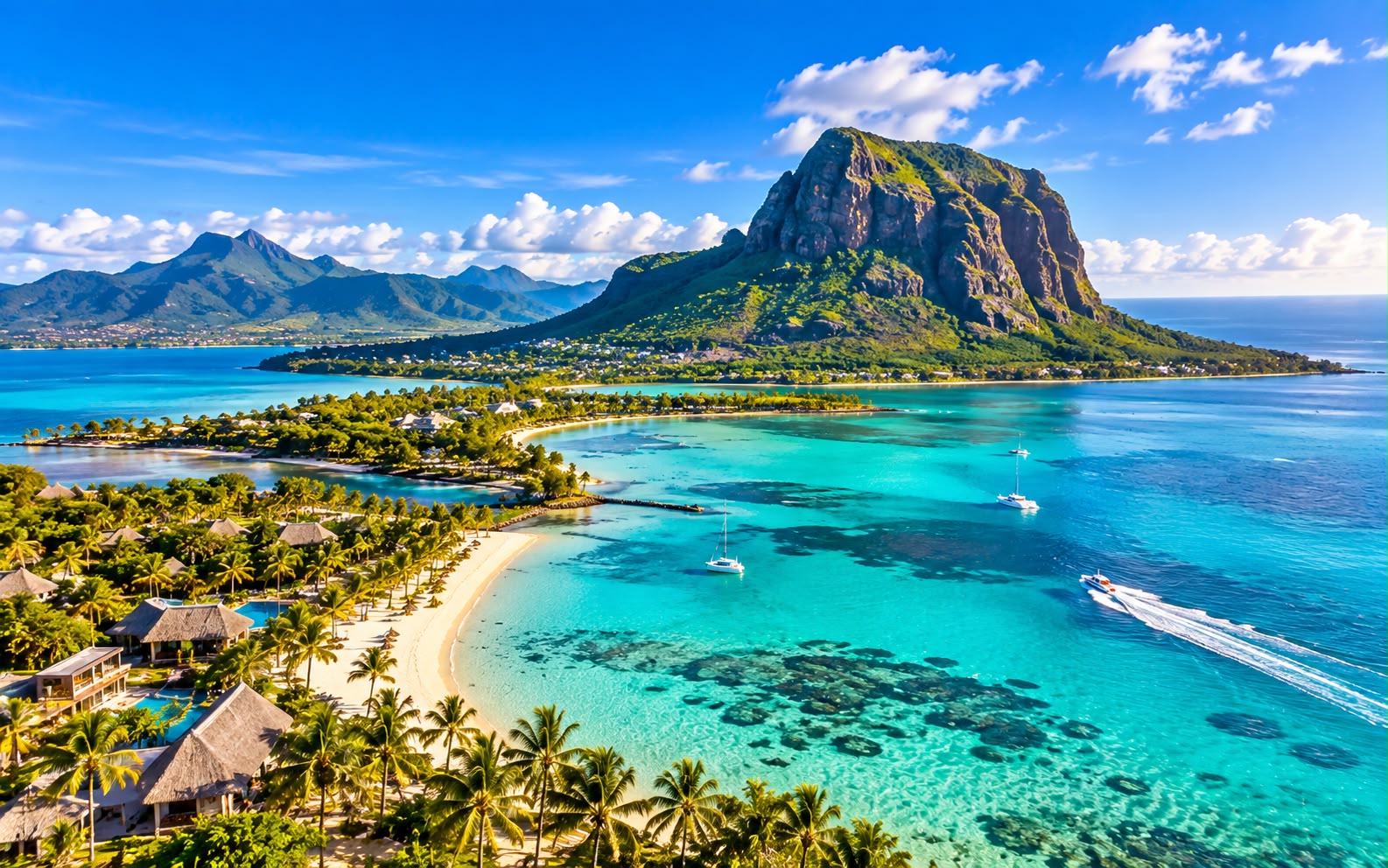
Mauritius in 8 days: the two-base island loop
The island where India meets Africa in the middle of the ocean: sand in seven colours, a sacred lake with a 33-metre Shiva, catamaran days and a mountain the UNESCO list bows to — visa-free for most passports, and cheaper than it photographs.
- Indian Ocean Islands
- 8 days
- ≈ AED 3,350 / person
- Beaches + road trip
Before you go
Mark Twain reported that heaven was copied from Mauritius, and the brochure has coasted on the quote ever since. What the brochure undersells: this is the most Indian island outside India — two-thirds of Mauritians trace their roots to indentured workers who landed at Port Louis’s Aapravasi Ghat, Bhojpuri still floats around the markets, and the street food is dholl puri at thirty rupees — paradise with a kitchen worth flying for.
The practicalities are as friendly as the food: visa-free on arrival for most nationalities — 60 days, zero fee, Indian passports included, non-stops from the Gulf in ~6½ hours and from Europe in around 12, and one free online form is the entire paperwork. This guide does the island properly with two bases and a hire car: the lively north (Grand Baie, 4 nights), then the cinematic southwest under Le Morne mountain (3 nights).
Costs are in Mauritian rupees — figure MUR 43,000 (≈ AED 3,359) per person excluding flights. Best windows: April–June and September–November — between the southern-winter winds and the January–March cyclone lottery.
Before you go: the admin (it barely exists)
Visa-free, and the one form
- Visa-free, free: most passports get 60 days on arrival, no fee — carry the return ticket, hotel bookings and a bank card as your never-asked-for proof of funds (~US$100/day is the official benchmark). Extensions to 6 months per year are possible in-country.
- The one form: the Mauritius All-in-One Travel Digital Form at safemauritius.govmu.org, within 72 hours before arrival — free, instant QR; screenshot it, airlines ask at check-in.
- Passport valid beyond the stay; that’s the whole file.
Driving on the left
- Driving: Mauritius drives on the left — a jolt if you are used to the right, second nature if not. Your Indian licence (in English) is accepted for tourist stays — carry an IDP if you like belt AND braces. Roads are good, distances small (the whole island is 65 × 45 km), speed cameras plentiful.
Money
- Money: cards widespread, but keep MUR 2,000–3,000 cash for street food, markets and beach vendors. ATMs everywhere in towns.
Day by day
Day 1 — Land, drive north, exhale
- Morning — The overnight flight lands early. Collect the car (from ~MUR 1,300–1,700/day for a compact — book ahead in season) and drive north (~1 h) to Grand Baie, the island’s sociable bay.
- 14:00 — First swim at Pereybere, the turquoise pocket-cove two minutes up the coast; gateau piment and alouda from the beach kiosk (MUR 100 covers you both).
- 17:30 — Sunset at La Cuvette beach, dinner in Grand Baie (Creole fish curry or a grill, MUR 400–700 pp) — and note how many menus read half like home.
Where to stay in Grand Baie (four nights)
- Luxury: LUX Grand Baie* — 4.9/5 on TripAdvisor (~1,400 reviews), the island’s glossiest rooftop-bar address. ~MUR 25,000+. (Royal Palm Beachcomber, 4.9, is old-money grandeur.)
- Mid-range: Mauricia Beachcomber — 4.6/5 (~7,100 reviews, the bay’s #1 Best Value), all-inclusive on the beach. ~MUR 9,000–12,000.
- Value: Ocean V Hotel, Pereybere — 4.6/5 (~1,300 reviews), rooftop infinity pool at guesthouse money. ~MUR 3,500–5,000.
Day 2 — Port Louis and the ancestors
- 09:00 — SSR Botanical Garden, Pamplemousses (~MUR 300): giant Amazon water lilies, 85 varieties of palm, and the pond Indian grandmothers photograph for an hour. Guides at the gate (~MUR 200) earn their fee.
- 11:30 — Into Port Louis: start at the Aapravasi Ghat (UNESCO, small/free entry) — the immigration depot steps where half a million indentured workers from India first stood between 1834 and 1920. It is unexpectedly the trip’s heaviest moment: the island’s story starts on these sixteen steps.
- 13:00 — Central Market lunch the correct way: dholl puri (MUR 15–30 each — the national dish is basically a Bihari roti that emigrated), plus pineapple with chilli-salt.
- 15:00 — The Citadel (Fort Adelaide) for the harbour panorama, then Caudan Waterfront’s umbrella street if souvenirs call.
- 17:00 — Back north for a Mont Choisy sunset walk — 3 km of casuarina-backed sand.
Day 3 — Île aux Cerfs: the catamaran day
- 07:30 — Full-day catamaran to Île aux Cerfs from Trou d’Eau Douce (shared boats MUR 2,500–3,500 pp with BBQ lunch; booking with island-wide hotel transfer pushes it toward MUR 4,500 — driving yourself to the jetty is the saving): sails up along the east coast, a snorkel stop on the reef, grilled fish and sega drums on deck, then two hours on the island’s swimming-pool lagoon and white spits.
- The honest note: Île aux Cerfs is beautiful AND busy — it’s the island’s day-trip catwalk. Go for the sailing-day whole of it, not a deserted-island fantasy; the deserted version is tomorrow’s north coast.
- 19:30 — Easy dinner back in Grand Baie; sunburn audit.
Day 4 — The lazy north (your beach day)
- 09:30 — Pick your sand: Trou aux Biches (calm, shallow, family-perfect) or a boat morning to the northern islets (Gabriel/Flat Island cats run ~MUR 2,500 pp if the lagoon is calling again).
- 13:00 — Beach-shack grilled catch (MUR 300–500).
- 15:30 — Cap Malheureux: the red-roofed chapel with Coin de Mire island floating behind — the north’s postcard — then Grand Gaube’s quiet coves.
- 19:00 — Grand Baie last night: Sunset Boulevard browsing, seafood platter splurge or street-food crawl (boulettes — Sino-Mauritian dumpling soup — MUR 150).
Day 5 — South over the spine: tea, the sacred lake, Le Morne
- 09:00 — Check out, drive south into the hills. Stop 1: Bois Chéri tea factory & tasting (~MUR 400) on the misty plateau.
- 11:30 — Ganga Talao (Grand Bassin) — free: the crater lake Hindu Mauritius holds sacred, water from the Ganges ritually mingled in, guarded by a 33-metre Shiva and a matching Durga across the road. During Maha Shivaratri (Feb/Mar) half a million pilgrims walk here barefoot from across the island — the largest Hindu gathering outside India. Cover shoulders; feed no monkeys.
- 13:30 — Into Black River Gorges National Park (free): the Alexandra Falls and Gorges viewpoints — 6,500 hectares of green crumpled mountains with tropicbirds drawing white lines below.
- 16:00 — Down the hairpins via the Maconde viewpoint to the Le Morne coast; check in and watch the mountain — a UNESCO World Heritage site as a monument to escaped slaves who hid on its cliffs — go copper at sunset.
Where to stay around Le Morne (three nights)
- Luxury: The St. Regis Le Morne — 4.7/5 (~3,900 reviews), plantation-house polish directly under the mountain. ~MUR 28,000+. (Dinarobin Beachcomber, 4.8/~5,000, shares the peninsula.)
- Mid-range: Hotel Riu Turquoise — 4.2/5 (~980 reviews), all-inclusive on Le Morne beach — the sensible family engine room. ~MUR 9,000–12,000.
- Value: Villa Seewoo, La Gaulette — 4.9/5 (~350 reviews), a guesthouse with breakfast and mountain views ten minutes from the beach. ~MUR 2,500–3,500.
Day 6 — Chamarel: earth in seven colours
- 09:00 — Chamarel Seven Coloured Earth Geopark (MUR 400 adult / 200 child, includes the 100 m Chamarel waterfall viewpoint and the giant-tortoise pen): volcanic dunes striped red-brown-violet-blue that never mix, best in low morning sun.
- 11:30 — Optional grown-up stop: the Rhumerie de Chamarel distillery tour + tasting (~MUR 650) — or coffee at a planteur’s café with valley views for the abstainers.
- 13:00 — Lunch in Chamarel village (table d’hôte Creole spreads, MUR 500–800).
- 15:00 — Back down for Le Morne public beach: filao trees, kite-surfers streaking the lagoon, the mountain looming — many call it the island’s best free afternoon.
- 19:00 — La Gaulette’s local restaurants do the island’s best-value seafood (ourite — octopus curry — MUR 350).
Day 7 — Dolphins at dawn, slow goodbye
- 06:30 — From Black River/Tamarin, the dolphin cruise (catamaran ~MUR 1,800–2,500 pp, speedboat less): spinner and bottlenose pods commute along this coast most mornings. Ethics check (house rule for wildlife on this site): choose operators who keep distance and never “guarantee swimming ON the pods” — chasing boats are the coast’s known problem; reward the patient ones.
- 11:00 — La Preneuse beach and the Martello tower, or the lower Le Morne trail (the summit push needs a licensed guide, ~MUR 2,000 pp — 3–4 h, worth it for the fit).
- 16:00 — Pool, pack, one last lagoon float.
- 19:30 — Farewell dinner under the mountain.
Day 8 — Fly home
- Morning — It’s ~45 minutes from Le Morne to the airport (SSR International, southeast). Drop the car, board with sand in every zip. Duty-free vanilla and Bois Chéri tea cost half what the resort shop asked.
Costs and practicalities
Best time to visit
April–June and September–November are the two sweet spots — between the cyclone season and the cooler, windier winter.
- April–June — warm, 25–28°C, and the sea at its calmest. The best all-round window.
- July–August — the coolest and windiest, around 22°C. This is when the kitesurfing at Le Morne is at its best and when the west coast is sheltered while the east is blown out.
- September–November — warming, dry, and excellent for diving and for walking in Black River Gorges.
- December–March — hot, humid, wettest, and the cyclone season, with the risk highest January to March. Rates fall sharply.
The island has a wet east and a dry west. The central plateau gets several times the rainfall of the coast in any month.
Travel tips
- Driving is on the left and the roads are good, but the roundabouts are assertive and stray dogs are common at night.
- The rupee is the currency; cards work almost everywhere and ATMs are plentiful.
- Public buses are cheap and cover the island, slowly. They stop by early evening.
- Beaches are all public by law, including in front of the big hotels, and there is usually a public access path.
- Mauritius is religiously plural — Hindu, Muslim, Christian, Buddhist. Cover up at Grand Bassin and at temples, and remove shoes.
- The sun is strong and the lagoon is shallow and shadeless. Reef shoes help; stonefish are present though rare.
- A Dodo-branded souvenir is not a bargain. The real local buys are vanilla, rum and textiles from the markets at Port Louis and Flacq.
What this trip actually costs
Two people, 7 nights, mid-range mix, excluding flights (Dubai–Mauritius ~US$410–760 return on Emirates/Air Mauritius):
| Item | Cost |
|---|---|
| Grand Baie hotel, 4 nights | MUR 24,000 (≈ AED 1,875) |
| Le Morne–area hotel, 3 nights | MUR 18,000 (≈ AED 1,406) |
| Car hire, 7 days + fuel | MUR 13,000 (≈ AED 1,015) |
| Île aux Cerfs catamaran day + BBQ for two | MUR 6,000 (≈ AED 469) |
| Tamarin dolphin cruise for two | MUR 4,000 (≈ AED 312) |
| Entries: Chamarel Geopark, SSR garden, tea route | MUR 1,400 (≈ AED 109) |
| Food, 8 days (dholl puri economy → seafood nights) | MUR 16,000 (≈ AED 1,250) |
| eSIM | MUR 700 (≈ AED 54.67) |
| Buffer: rum tasting, kites’ photos, market finds | MUR 2,900 (≈ AED 227) |
| Total for two | MUR 86,000 (≈ AED 6,717) |
- MUR 43,000 (≈ AED 3,359) per person ≈ US$950 — resort-brochure scenery at road-trip money. The honest lever is the hotel tier: the all-inclusive route adds ~MUR 25,000 for two but swallows most of the food line; the guesthouse+street-food route cuts this budget by a quarter. Both are excellent lives.
- Book in this order: flights → hotels (Le Morne fills first in kite season) → car → the digital form 72 h out (free — ignore paid lookalikes) → catamaran + dolphins a few days ahead → everything else is drive-up.
- Hotel and restaurant picks are unsponsored — no affiliate links in this article. Chosen on location and current TripAdvisor ratings; check recent reviews and prices before booking.
What to pack
- Reef-safe sunscreen + rash vests (the lagoon tricks you: cool water, equatorial UV).
- Reef shoes for rocky entries, snorkel set if you’re particular.
- A light jumper for May–September evenings — the southern winter is real at 19°C — and for Chamarel’s uplands anytime.
- Modest cover for Ganga Talao (shoulders/knees).
- UK-style Type G plugs — UK and Gulf chargers work unchanged (some older hotels also keep two-pin C).
- Motion tablets for catamaran days, mosquito repellent for dusk.
FAQ
Is Mauritius safe? Among the safest destinations on this site — solo women road-trip it routinely. The full caution list: don’t leave valuables visible in the parked car at trailheads/beaches, watch the lagoon current at unmonitored beaches, and respect cyclone-warning classes if travelling January–March (hotels handle it well; it mostly means a pool day indoors).
Halal and vegetarian food? Both are natively easy. Mauritius is ~17% Muslim — halal butchers and restaurants are normal fixtures, especially in Port Louis and the north. Vegetarians eat like royalty: dholl puri, gateau piment, farata, seven-curry temple meals and a Hindu-majority food culture mean the question is “which veg thing”, never “is there one”. Fine-dining resorts handle both with a day’s notice.
When exactly should we go? April–June and September–November are the island’s grins: 24–28°C, low rain, calm lagoons. July–August is dry but windy (the east and south blow — kite-surfers cheer, swimmers move north); December is lovely and pricey; January–March is hot, humid and carries the cyclone lottery — insurable, but know it.
Which side of the island should we base on? This guide’s answer is both — but if forced: the north for swimming, eating out and doing things nightly; the southwest for scenery, hikes and the feeling of being somewhere. The east (Belle Mare) has the dreamiest resort beaches and the least around them — perfect for the honeymoon edition below.
Mauritius or Seychelles or Maldives? The site now has all three, so: Maldives for pure overwater luxury doing nothing beautifully (guide), Seychelles for dramatic granite scenery and short wild hikes (guide), Mauritius for the most COUNTRY per day — road trips, food culture, festivals, history — at the friendliest prices of the trio. Families and first-timers: Mauritius wins more often than the brochures admit.
What’s Mauritius guide #2? The honeymoon edition — Belle Mare/Le Morne resort pairing, seawalk and submarine days, private catamarans — or the flight to Rodrigues, the “Mauritius of 50 years ago”. Votes welcome; both are on the list.
Prices and entry rules change, and what you need depends on your passport; last checked 8 October 2026, so confirm with the embassy or your airline before booking.


