 The Itinerary
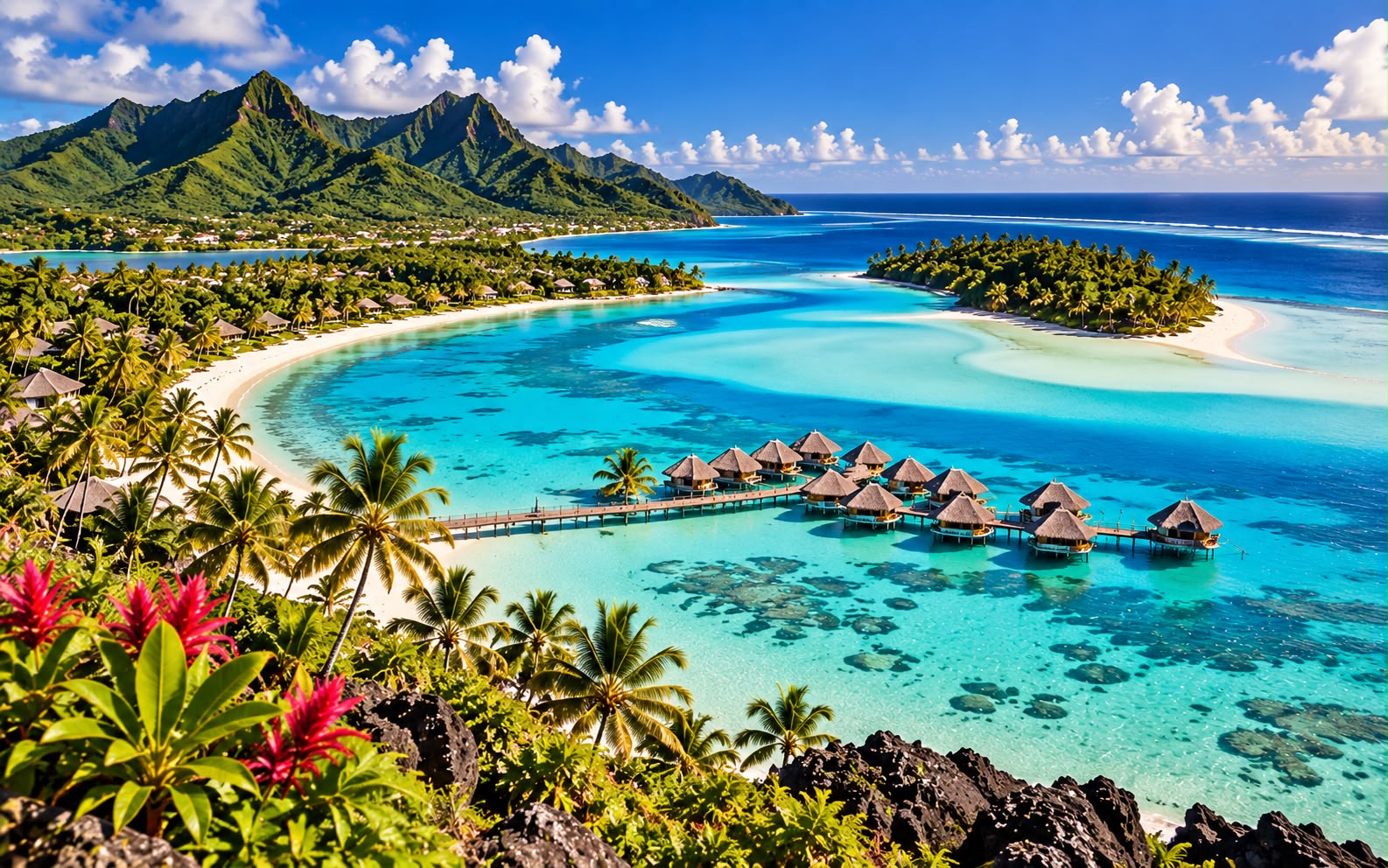
Cook Islands in 8 days: Rarotonga and the Aitutaki lagoon
One island you can circle by bus in 50 minutes, and another whose lagoon is three times the size of the island inside it — turquoise water a metre deep for kilometres, sandbars you stand on in the middle of the sea, and a 45-minute flight between the two.
- Pacific Islands
- 8 days
- ≈ AED 6,950 / person
- The Pacific's best lagoon
Before you go
Aitutaki’s lagoon is the reason to come. It is a triangle roughly 15 km across, enclosed by reef, with an island at one corner and a scattering of uninhabited motu around the rim — and the water inside is shallow, still and a colour that photographs accurately and still looks edited. People who have seen a lot of the Pacific put it at the top.
Rarotonga, the main island, is the other half: a volcanic cone 650 m high ringed by a single 32 km road, with a reef lagoon all the way round, a cross-island track over the middle, and a bus service that runs clockwise and anticlockwise and is called exactly that.
The Cooks are self-governing in free association with New Zealand. English is official, the currency is the New Zealand dollar, and there are no visas for most people — which makes this the most frictionless island trip in the Pacific.
Before you go: the flight, the lagoon day and Sundays
Entry and money
- Most nationalities enter visa-free for 31 days, extendable. You need an onward ticket and accommodation booked.
- New Zealand dollar. Cards work in Rarotonga’s main businesses; Aitutaki and the smaller places are cash, and ATMs are limited. Draw in Rarotonga.
- There are Cook Islands coins in circulation, including a triangular two-dollar — keep one, it is the best souvenir here and worthless anywhere else.
Getting there, and getting between
- Most arrivals are from Auckland (about four hours), with some from Sydney, Los Angeles and Tahiti.
- Flights cross the dateline, so you frequently land the day before you left. Check your dates twice when booking.
- Rarotonga to Aitutaki is a 45-minute flight on Air Rarotonga, several times daily. Book it early — the aircraft are small and the day trips fill them.
- Baggage on the inter-island flight is limited; leave a bag at your Rarotonga accommodation, which everyone does and nobody minds.
Getting around Rarotonga
- The bus is the whole system, and it is excellent: one road round the island, a clockwise bus and an anticlockwise bus, roughly hourly, and you flag it down anywhere.
- Scooters are the local way. A Cook Islands licence is required and is issued at the police station in Avarua — historically after a practical test, which generations of visitors have treated as a rite of passage. Check the current rule when you arrive; it has changed over the years.
- Hire cars exist and are rarely necessary.
Sunday, and church
- Sunday is observed. Most shops shut, many restaurants close, and lagoon tours do not run.
- Go to a church service. The CICC churches hold them mid-morning, the harmony singing is genuinely extraordinary, and visitors are welcomed and often fed afterwards. Dress modestly and sit at the back until shown otherwise.
- Plan a beach day or the cross-island walk for Sunday.
When to go
- April to November is the dry season, with May to October the pick — warm, lower humidity, calm lagoon.
- December to March is the wet and cyclone season: hot, humid, heavy showers, and cheaper.
- Water is swimmable year-round at 25–29°C.
Day by day
Day 1 — Land in Rarotonga
- Arrival — Flights from Auckland typically land in the very early hours, and the airport has a ukulele player greeting every one of them, at four in the morning, which sets the tone.
- 10:00 — Having slept, walk Avarua, the capital: a harbour, a handful of streets, the Punanga Nui Market (best on a Saturday morning), and the Cook Islands Christian Church with its graveyard of elaborate tombs.
- 12:30 — Lunch — ika mata, raw fish in coconut cream and lime, which you will eat repeatedly.
- 14:00 — Pick a side of the island. Muri on the east is the lagoon beach everyone heads for; Aroa and the west have the sunsets.
- 15:30 — First swim. Muri lagoon is waist-deep a long way out with four motu across it, and the snorkelling off the beach is immediately good.
- 18:00 — Sunset, which on the west coast is the event of the day.
- 19:30 — Dinner. Book the Aitutaki flight and a lagoon cruise tonight if you have not already.
Day 2 — Around the island
- 09:00 — Take the clockwise bus and get off wherever looks interesting — this is the correct way to spend a day here.
- 09:30 — Black Rock (Tuoro) on the north-west, where Polynesian belief holds that spirits of the dead departed for Avaiki. Good snorkelling and a rock you can jump off.
- 11:00 — Te Vara Nui or the Highland Paradise marae site above Arorangi — a restored hilltop village with the terraces and sacred ground of the pre-Christian settlement, and a guide from the family that owns it.
- 13:00 — Lunch at a roadside stall. Cook Islands food is genuinely good — rukau (taro leaves), poke (banana and pawpaw pudding), and whatever came off a boat.
- 15:00 — Wigmore’s Waterfall and the Papua stream, inland on the south side.
- 16:30 — Titikaveka beach on the south coast, which has the clearest water on Rarotonga and far fewer people than Muri.
- 19:00 — Dinner, and if it is a Thursday or Saturday the island night shows — drumming and dance, which in the Cooks is fast, percussive and quite unlike Hawaiian hula.
Day 3 — The cross-island track
- 08:00 — The cross-island walk, and start early before the heat. It is about three to four hours, roughly 6 km, from the north side to the south.
- 09:00 — The track climbs steeply through forest to Te Rua Manga — the Needle, a 413 m volcanic plug that stands clear of the ridge. The scramble to its base is steep, rooty and often muddy; there are ropes on the worst of it.
- 11:00 — The view from the Needle takes in both coasts and the reef all the way round.
- 12:00 — Down the south side to Wigmore’s Waterfall, with a pool at the bottom that you will want.
- 13:30 — Bus back round.
- 15:00 — Rest, and swim.
- 18:30 — Dinner. Pack a small bag for Aitutaki and leave the rest.
Day 4 — Fly to Aitutaki
- 08:30 — Fly to Aitutaki, 45 minutes, in a small turboprop. Sit on the left on the way out — the approach over the lagoon is the first time you see the colour and it is worth the seat.
- 09:30 — Land. Aitutaki has about 1,800 people, one village of any size, and a lagoon three times the area of the land inside it.
- 10:30 — Check in, then hire a scooter or a bike — the island is small and flat on the inhabited side.
- 12:00 — Lunch at Arutanga, the main village.
- 14:00 — Maunga Pu, the highest point at 124 m, which is a ten-minute walk and gives you the entire lagoon laid out — the triangle, the reef line, the motu scattered along it.
- 16:00 — Swim off O’otu beach at the eastern end.
- 18:30 — Dinner, and the island is dark and quiet after it.
Day 5 — The lagoon cruise
- 09:00 — The lagoon cruise, and this is the day. Boats run from the main wharf and cross the triangle stopping at the motu.
- 10:00 — Snorkelling at the coral gardens, with giant trevally that come to the boat, and giant clams on the bottom.
- 11:30 — One Foot Island (Tapuaetai), which has a post office that stamps your passport — a genuine novelty stamp, and the only reason anyone brings a passport on a boat. The sandbar off its tip runs out into water a metre deep for several hundred metres.
- 13:00 — Barbecue lunch on the motu, cooked on the beach.
- 14:30 — Honeymoon Island and the sandbars — you stand in the middle of the lagoon with nothing above the water in any direction but your own ankles.
- 16:30 — Back to the wharf, thoroughly sunburnt if you were careless.
- 19:00 — Dinner.
Day 6 — Aitutaki, slow
- 08:30 — Bike the inhabited side: Arutanga’s 1828 church, the oldest in the Cooks, and the marae at Te Poaki o Rae.
- 10:30 — Kayak or paddleboard across to the nearer motu under your own power, which is entirely doable in that water.
- 13:00 — Lunch.
- 14:30 — Bonefishing on the flats if that appeals — Aitutaki is a serious destination for it and the guides pole you across water a foot deep.
- 16:30 — Or simply the beach. Aitutaki does not require a programme.
- 18:00 — Sunset from the western shore.
- 19:30 — Last island dinner.
Day 7 — Back to Rarotonga
- 10:00 — Fly back, 45 minutes, and take a window again.
- 11:30 — Collect the bag you left, and move to whichever side of Rarotonga you did not stay on.
- 13:00 — Lunch.
- 14:30 — Snorkel Titikaveka or take the glass-bottom boat at Muri, which does a motu stop and a fish barbecue and is better than it sounds.
- 17:00 — Punanga Nui Market if it is Saturday — produce, pareu, carving, and a food court that is the best cheap meal on the island.
- 19:30 — Last dinner. Te Vara Nui or an island night if you missed one.
Day 8 — Fly home
- Flights to Auckland typically leave in the small hours, so the last day is usually entirely yours and the night is not. Many accommodations will hold a room or a shower for a late departure — ask.
- Last stop — black pearls from the northern islands, which are the one thing worth carrying home, and the triangular two-dollar coin.
- Note — You cross the dateline again and arrive in Auckland the following day.
Costs and practicalities
Best time to visit
April–November is the dry season and the better half of the year, with the cyclone season falling squarely in the other.
- April–June — warm, dry, and the best value before the southern winter rush.
- June–August — the coolest and driest, around 25°C, and the busiest with New Zealand and Australian visitors. Humpback whales pass Rarotonga from July to October.
- September–November — warming, still dry, and quiet.
- December–March — hot, humid, wettest, and the official cyclone season. Rates fall; the risk is real but most years pass without a direct hit.
Aitutaki’s lagoon is the reason to come and it is calm and swimmable year-round; the difference between seasons is rain on the way to it.
Travel tips
- There is one bus on Rarotonga and it goes clockwise and anti-clockwise. That is the entire network, it is cheap, and it works.
- New Zealand dollars are the currency, alongside local Cook Islands coins which you cannot spend anywhere else — keep one as a souvenir, not as change.
- Sunday is genuinely observed. Most businesses close, and the island goes to church. Attending a service is welcomed; dress for it.
- Cover up away from the beach. Swimwear is for the sand, not the shop.
- The Aitutaki flight is small and the baggage allowance is tight. Check it before packing for the lagoon day.
- Cards are accepted in Rarotonga’s main centres and much less so elsewhere. Carry cash for markets and the punnet stalls.
- Reef shoes matter. The lagoon floor is coral, and stonefish are present though rare.
What this trip actually costs
Two people, 7 nights, mid-range, excluding international flights:
| Item | Cost |
|---|---|
| Rarotonga, 4 nights | NZD 1,400 (≈ AED 2,857) |
| Aitutaki, 3 nights | NZD 1,500 (≈ AED 3,061) |
| Rarotonga–Aitutaki return flights, two people | NZD 1,100 (≈ AED 2,245) |
| Aitutaki lagoon cruise, two people | NZD 400 (≈ AED 816) |
| Scooters, bikes, buses and transfers | NZD 320 (≈ AED 653) |
| Food and drink, 8 days | NZD 1,800 (≈ AED 3,673) |
| Island night, marae tour, extras | NZD 300 (≈ AED 612) |
| Total for two | NZD 6,820 (≈ AED 13,918) |
- Roughly NZD 3,410 (≈ AED 6,959) per person.
- Aitutaki costs more than Rarotonga for everything — rooms, food, fuel — because it all arrives by air or barge.
- The inter-island flight is a sixth of the trip and is not optional if you want the lagoon.
- Self-catering cuts the food line hard. Rarotonga has proper supermarkets; Aitutaki has small shops and higher prices.
What to pack
- Reef shoes. The lagoon floor is coral rubble in places and the reef edge is sharp.
- Reef-safe sunscreen, and a rash vest — you will be in the water for hours and the reflection off that lagoon is brutal.
- Your own mask and snorkel if you have them.
- Cash, drawn in Rarotonga, for Aitutaki.
- A modest outfit for church, if you go, and for the villages.
- Australian/NZ-style Type I plugs, 240V.
- Insect repellent — mosquitoes at dusk, and dengue occurs.
FAQ
Is Aitutaki really worth the extra flight? Yes, and it is the single clearest recommendation in this guide. Rarotonga is a lovely island with a good lagoon; Aitutaki’s lagoon is in a different category and people who have travelled the Pacific widely still rate it first. Three nights is right — day trips exist and waste most of what makes it good.
Cook Islands or French Polynesia? The Cooks are far cheaper, English-speaking and use the NZ dollar; the distances are small and the admin is nil. French Polynesia is more dramatic — Bora Bora’s peak, Moorea’s spires — and roughly twice the price. For a lagoon, Aitutaki holds its own against anything in Tahiti.
How strictly is Sunday kept? Shops and most restaurants close, and tours do not run. Go to a church service — the singing is remarkable and visitors are genuinely welcome — and keep the rest of the day for a beach.
Do I need a scooter licence? The Cook Islands licence requirement has changed over the years and historically involved a practical test at the Avarua police station. Check on arrival rather than relying on anything written in advance. The bus covers Rarotonga perfectly well.
When should I go? May to October. December to March is cyclone season — wetter, hotter and cheaper.
Prices and entry rules change, and what you need depends on your passport; last checked 8 October 2026, so confirm with the embassy or your airline before booking.


