 The Itinerary
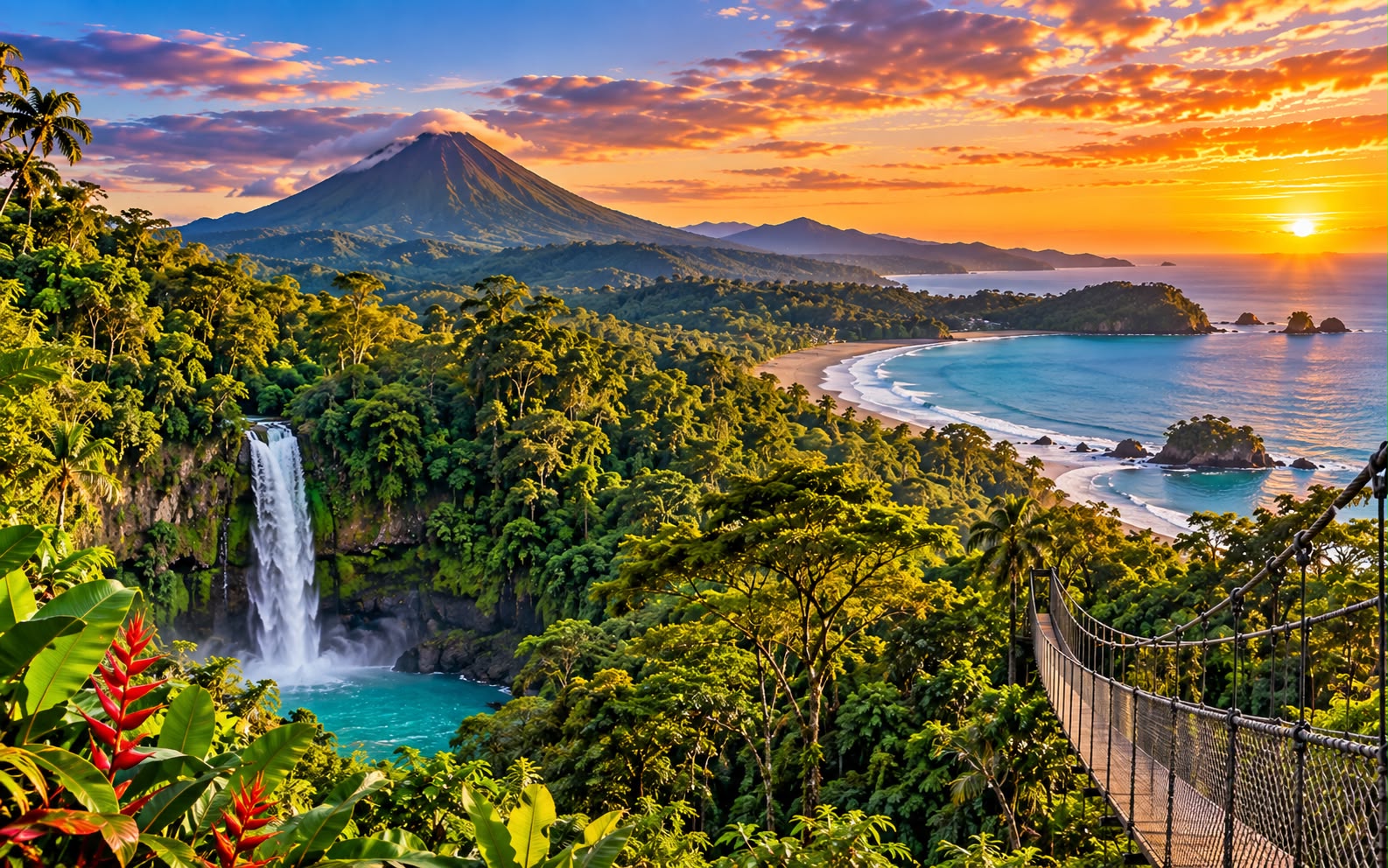
Costa Rica in 10 days: Arenal, Monteverde and the Pacific
A volcano, a cloud forest and a beach with monkeys in the trees above it, linked by the jeep-boat-jeep crossing that saves half a day — with the honest version of the driving, the two seasons that change everything, and why the famous national park is worth the ticket and the queue.
- Mexico and Central America
- 10 days
- ≈ AED 9,300 / person
- Wildlife + rainforest
Before you go
Costa Rica packs more into a small country than seems reasonable: an active volcano, a cloud forest you walk through at canopy height, and a Pacific coast where the monkeys come to the beach. It is also the easiest wildlife trip in the Americas — no malaria on this route, tap water you can drink, and a tourism industry that has been doing this well for forty years.
The classic loop is Arenal → Monteverde → the Pacific coast, and it works because each leg is different rather than more of the same. Fly into San José, out of San José, and spend as little time there as politeness allows — it is a transit city, not a destination.
Two things shape the trip more than anything in the brochures: the season, which is binary here, and the driving, which is slower than any map suggests.
Before you go: seasons, driving and the parks
Entry, and the season that decides everything
- Most nationalities enter visa-free for 90 days — the EU, UK, US, Canada, Australia and many others. Bring proof of onward travel; it is occasionally asked for and always satisfied by a return booking.
- The season is not a preference, it is the trip. December to April is the dry season — reliable sun, higher prices, busier parks. May to November is the green season — cheaper, emptier, spectacularly alive, and wet most afternoons. September and October are the wettest on the Pacific side.
- Green season is better value and better for wildlife. It is not better for lying on a beach.
- There is an exit tax on departure, usually bundled into the airfare. Check yours rather than assume.
The driving, honestly
- Distances are short and journeys are long. Mountain roads, switchbacks, fog on the passes and one-lane bridges mean an 80 km leg can take three hours. Plan by hours, never by kilometres, and do not drive the mountain roads after dark.
- Rent a 4x4 if you are self-driving. Not for glamour — for ground clearance on the unpaved stretches around Monteverde.
- The mandatory insurance is the thing that surprises people: the headline rental rate excludes a compulsory liability policy that you cannot decline, and it often costs more than the car. Get the all-in quote in writing before you book.
- The jeep-boat-jeep between Arenal and Monteverde is the trip’s best small decision: a minibus, a boat across Lake Arenal, another minibus up the other side. It takes about three hours against four-plus by road, and the boat is the nicest part of the day.
- Not driving? Shared shuttles link every stop on this route and cost far less than a car once insurance is counted.
The parks, and when to be there
- Wildlife is a morning activity. Gates open early, animals are active early, and by midday the forest is quiet and hot. Every good day on this trip starts before seven.
- Manuel Antonio caps daily entry and closes one day a week — buy online in advance and check the closure day, which has moved before.
- Hire a guide with a scope at least once. The difference between walking past a sloth and being shown one is a guide, and it is the best money spent on the trip.
- Many private reserves — hanging bridges, night walks, the cloud forest reserves — are separately ticketed and worth it.
Money and the small print
- The colón (CRC), and prices are often quoted in US dollars as well. Both are accepted; you will usually get change in colones.
- Cards work widely. Carry cash for small sodas, roadside fruit and park guides.
- Tap water is safe on this route — a genuine rarity in the region.
- “Pura vida” is not a slogan for tourists. It is hello, goodbye, thank you and never mind, and using it correctly will get you further than Spanish.
Day by day
Day 1 — Land in San José
- 15:00 — Land at Juan Santamaría (SJO), which is in Alajuela, not San José — 20 km from the capital and much closer to where you are going next.
- 16:00 — Collect the car. Take the insurance argument seriously: mandatory liability is extra on top of every quoted rate, so the price you booked is never the price you pay. Photograph every panel before you drive off.
- 17:00 — Sleep in Alajuela or one of the airport hotels. There is no reason to fight into San José and out again tomorrow.
- 18:30 — Alajuela’s central park and the mango trees, then dinner — a casado of rice, beans, plantain and whatever protein, which you will eat most days and not tire of.
- 20:00 — Download offline maps. Signal disappears between towns and Waze is what everyone actually uses here.
Day 2 — North to Arenal
- 08:00 — Drive to La Fortuna, about three hours via the Zarcero road — slower than the alternative and far better, with the topiary gardens at Zarcero as the stop.
- 11:30 — Arrive. The volcano appears when it decides to; if it is clear as you drive in, stop and take the photograph then, because it may not be clear again.
- 13:00 — Lunch in town, then check in.
- 15:00 — La Fortuna waterfall: 500 steps down to a 70 m fall and a pool you can swim in. The climb back out is the workout of the trip.
- 17:30 — Hot springs. Tabacón is the resort version with swim-up bars; the free río Chollín under the road bridge is the same geothermal water with locals and a crate of beer. They are fed by the same volcano.
- 20:00 — Dinner in La Fortuna.
Day 3 — The volcano, up close
- 07:00 — Arenal Volcano National Park at opening. The 1968 lava-field trail crosses the flow from the eruption that destroyed two villages and killed 87 people; the volcano was continuously active from then until 2010 and has been quiet since.
- 10:00 — Cerro Chato is closed, so the sector’s other viewpoint walk instead — two hours, and Lake Arenal behind you.
- 13:00 — Lunch.
- 14:30 — Mistico Hanging Bridges: 3 km of trail with fifteen bridges through the canopy, six of them suspended. Go with a guide — you will see perhaps five times as much, and eyelash vipers are hard to spot when you do not know where they sit.
- 18:30 — Night walk at the Arenal Observatory or a local reserve: red-eyed tree frogs, kinkajous, sleeping birds, and the snakes that were there in daylight too.
- 20:30 — Dinner, and pack — tomorrow’s transfer has a luggage limit in practice if not on paper.
Day 4 — Jeep-boat-jeep to Monteverde
- 08:00 — The jeep-boat-jeep: minibus to the lake, 30 minutes across Lake Arenal with the volcano behind you, then a minibus up the other side. Three hours door to door, about USD 30, and the best transfer in the country — the road round the lake takes twice as long and shows you less.
- 11:30 — Arrive Santa Elena. The temperature drops eight or ten degrees as you climb; this is cloud forest at 1,400 m, and the wind does not stop.
- 13:00 — Lunch, then settle in.
- 15:00 — Walk the town. Santa Elena is small, and the afternoon is for booking two things: tomorrow’s reserve entry with a guide for 07:00, and a zipline slot.
- 17:00 — The Ranario frog pond or the Serpentario — 45 minutes each, genuinely well done, and useful for learning what you are looking at tomorrow.
- 19:30 — Dinner. It gets cold; bring a layer you did not think you would need in Costa Rica.
Day 5 — Cloud forest
- 06:30 — Monteverde Cloud Forest Reserve at opening, with a guide. Entry is capped and slots sell out in high season. The guides carry scopes and know where the resplendent quetzal has been showing — March to May is nesting season and the best odds.
- 10:00 — The suspension bridges inside the reserve, and the continental divide where you can stand with the Caribbean weather hitting one shoulder and the Pacific the other.
- 12:30 — Lunch back in Santa Elena.
- 14:00 — Ziplines. The canopy tour was invented here and the operators are serious about it — thirteen cables, and the 1 km Superman line across a valley if you want it.
- 17:00 — A coffee, chocolate and sugar cane tour at a working farm: three hours, far better than it sounds, and mostly about how a smallholding actually makes a living.
- 19:30 — Dinner.
Day 6 — Down to the Pacific
- 07:30 — The long leg: Monteverde to the coast, four hours. The first 40 minutes are unpaved, steep and slow — this is the road that ate your rental’s suspension, and it is deliberate: Monteverde has voted against paving it to limit visitor numbers.
- 10:00 — Down to the Pan-American and south.
- 12:30 — Tárcoles bridge for the crocodiles — twenty of them, some over four metres, visible from the roadside. Five minutes, free, and mildly alarming.
- 14:30 — Arrive Manuel Antonio or Quepos. Check in and get in the sea.
- 17:45 — Sunset on Playa Espadilla. The Pacific side goes from full sun to dark in about twenty minutes.
- 19:30 — Dinner on the hill road, where the restaurants face the water.
Day 7 — Manuel Antonio National Park
- 06:30 — Be at the gate for opening with a pre-booked ticket — entry is capped daily, closed Tuesdays, and turning up without one does not work.
- 07:00 — The park loop. Sloths — both two- and three-toed — white-faced capuchins, howlers, coatis, and if you are lucky the squirrel monkeys that exist almost nowhere else. Hire one of the guides at the gate: they carry scopes and find in seconds what you would walk past all morning.
- 10:00 — Playa Manuel Antonio, the beach inside the reserve, on a perfect crescent bay. Swim.
- 11:30 — Watch your bag. The capuchins are organised, patient and have done this before; they will open a rucksack while you are in the water.
- 13:30 — Out before the heat peaks, and lunch.
- 16:00 — The afternoon off, or the Nauyaca-style waterfall tours if you still have legs.
Day 8 — The coast your way
- Option A — mangroves. A Damas Island kayak at high tide, three hours through the tunnels, with silky anteaters and white ibis. The quietest thing you will do all trip.
- Option B — the water. A catamaran afternoon out of Quepos, with snorkelling and usually dolphins, or a sportfishing half-day — this is one of the world’s serious sailfish coasts.
- Option C — surf. Lessons on Playa Espadilla, which is a forgiving beach break, or a day trip south to Dominical for something more serious.
- Option D — nothing. Ten days in, this is the right answer more often than people admit.
Day 9 — Back toward San José
- 08:30 — The coastal road north, about three hours on the Costanera — fast, flat and dull compared with everything else you have driven.
- 10:00 — Carara National Park, where the dry north-west and the wet south meet: this is the reliable place for scarlet macaws, which cross to the river mouth in pairs late afternoon and early morning. Two hours on the river trail.
- 13:00 — Lunch in Jacó or Herradura.
- 15:30 — Into Alajuela. Refuel before you return the car — they charge a premium otherwise.
- 17:00 — Airport hotel. Repack, and put the wet things where you can get at them.
Day 10 — Fly home
- Morning — Most departures for Europe and North America leave in the morning, so this is usually an early one.
- Return the car with time in hand. The inspection is thorough and they check every panel against the photographs. Yours should match, because you took them on day one.
Costs and practicalities
Best time to visit
December–April is the dry season on the Pacific side and the standard high season — but the country has two coasts with opposite weather and the “green season” is better than its reputation.
- December–April — dry on the Pacific, sunny, busiest and dearest. Christmas and Easter are at a premium.
- May–November (green season) — mornings are usually clear and the rain comes in the afternoon. The forest is at its best, rates drop sharply, and the wildlife is more active.
- September–October — the wettest on the Pacific, and the driest and best on the Caribbean side at Tortuguero and Puerto Viejo, which runs on an opposite calendar.
- Turtle nesting: green turtles at Tortuguero July–October; arribadas of olive ridleys at Ostional through the wet season.
- Quetzals are easiest to see at Monteverde and San Gerardo from February to July, the breeding season.
Travel tips
- Distances take far longer than the map suggests. Mountain roads, single-lane bridges and fog mean 100km can be three hours. Two or three bases beat a loop.
- A 4x4 is genuinely needed for Monteverde and much of the Nicoya peninsula, and hire insurance here is expensive and mandatory — budget for it rather than being surprised at the desk.
- Tortuguero has no road. It is reached by boat or small plane.
- The US dollar is widely accepted alongside colones, but you will get change in colones at a mediocre rate. Pay in colones where you can.
- A 10% service charge is already on restaurant bills by law, plus tax. Extra tipping is optional.
- Tap water is safe in most of the country, including San José and the Central Valley.
- Do not feed or approach monkeys, and keep food sealed. Human food is making them sick and aggressive at the popular parks.
What this trip actually costs
Two people, 9 nights, mid-range, excluding international flights:
| Item | Cost |
|---|---|
| Hotels, 9 nights | CRC 900,000 (≈ AED 7,284) |
| 4x4 hire, 8 days, insurance included | CRC 480,000 (≈ AED 3,885) |
| Jeep-boat-jeep, park entries, guided walks, ziplines | CRC 360,000 (≈ AED 2,914) |
| Fuel and tolls | CRC 90,000 (≈ AED 728) |
| Food and drink, 10 days | CRC 420,000 (≈ AED 3,399) |
| eSIM, extras | CRC 50,000 (≈ AED 405) |
| Total for two | CRC 2,300,000 (≈ AED 18,615) |
- Roughly CRC 1,150,000 (≈ AED 9,307) per person. Costa Rica is not a cheap Central American country — it is priced closer to southern Europe, and the guided activities are where the money goes.
- The rental insurance is the line people get wrong. Budget for the all-in rate, not the headline one.
- Shared shuttles instead of a car cut the transport line by roughly half if you are two people and not planning detours.
What to pack
- Rain gear you will actually wear, in either season.
- Two pairs of shoes: something that grips wet trails, and something you do not mind soaking.
- Binoculars. The single most useful object on this trip.
- Type A/B plugs, US-style, 120V.
- Reef-safe sunscreen and strong insect repellent for the coast.
- A dry bag for the boat crossing and the kayak day.
FAQ
Dry season or green season? Dry if you want guaranteed beach weather and will pay for it. Green if you want the forest at its best, half-empty parks and lower prices, and can accept rain most afternoons.
Is ten days enough? For this loop, yes. Adding the Caribbean side or Corcovado means adding four days, not two — they are a long way from this route.
Do I need to drive? No. Shared shuttles connect every stop here and are cheaper for two people. Drive if you want to stop at will, and only with a 4x4 and daylight.
Will we actually see wildlife? Yes, on this route, if you go early and hire a guide at least once. Sloths and monkeys are near-certain at Manuel Antonio; quetzals are luck plus an early start at Monteverde.
Prices and entry rules change, and what you need depends on your passport; last checked 8 October 2026, so confirm with the embassy or your airline before booking.


