 The Itinerary
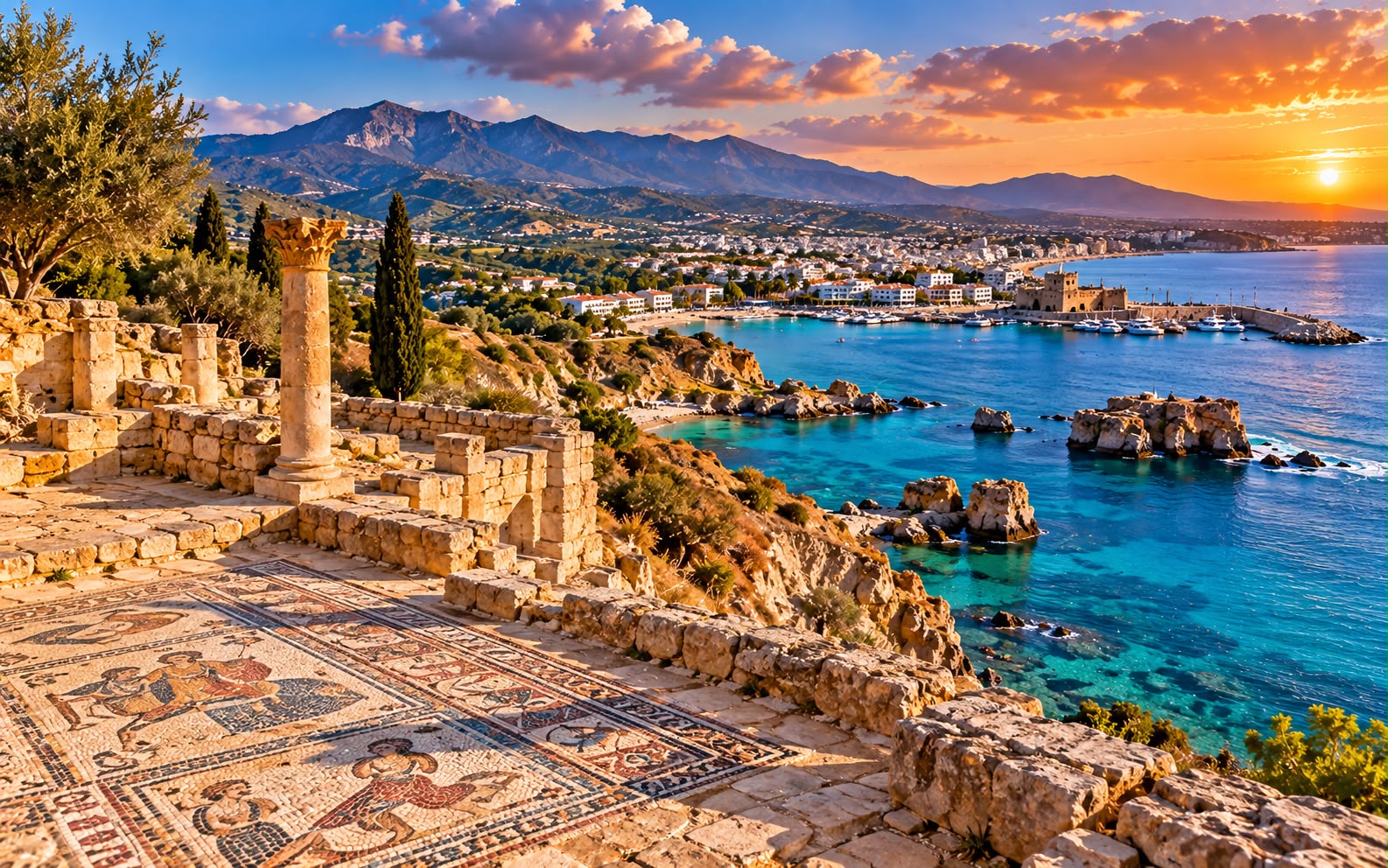
Cyprus in 8 days: Paphos mosaics, the Troodos and a divided capital
Roman floor mosaics still in the houses they were laid in, painted Byzantine churches hidden in pine forest, and the last divided capital in Europe — where you walk through a UN checkpoint in the middle of the shopping street and come out somewhere that feels like a different country.
- Southern Europe
- 8 days
- ≈ AED 4,000 / person
- Ruins, mountains, both sides
Before you go
Cyprus is sold as a beach island and is one, for about five months a year. The rest of it is more interesting.
Paphos has Roman villas whose floor mosaics are still in place in the rooms they were made for, under cover but otherwise as laid. The Troodos mountains hide ten small painted churches on the UNESCO list, barn-roofed and unremarkable outside, covered inside with Byzantine frescoes.
And Nicosia is the last divided capital in Europe. The Green Line has run through the middle of it since 1974, and you cross it on foot at a checkpoint in the main shopping street, show a passport, and walk into the north — which uses a different currency, a different language and a different time of day for lunch.
Before you go: the crossing, the car and the heat
Entry, and the two sides
- The Republic of Cyprus is in the EU; most nationalities enter easily and EU citizens freely. It is not in Schengen.
- The north — the “Turkish Republic of Northern Cyprus” — is recognised only by Turkey. You can cross as a visitor at several points; the Ledra Street crossing in Nicosia is on foot and takes minutes.
- Carry your passport for any crossing. You are stamped on a separate slip, not in the passport.
- Enter the island through the south (Larnaca or Paphos). The Republic regards entry through the north’s airports as illegal entry, and a hire car from the south usually cannot be taken north without buying separate insurance at the checkpoint — which is sold there, for a few euro, in cash.
- This guide crosses on foot in Nicosia and by car to Famagusta, which is the normal and uncomplicated way to do it.
Getting around
- Hire a car. There is no useful rail network, buses between towns are slow, and the Troodos is unreachable without one.
- Driving is on the left, a British inheritance, and the motorways are excellent.
- Distances are small. Paphos to Larnaca is 90 minutes end to end; nothing in this itinerary is more than two hours.
- Two currencies: euro in the south, Turkish lira in the north. Carry some euro cash north — it is widely accepted, usually at a poor rate.
When to go
- April to early June and September to November are the answer: hot without being punishing, sea warm from June, and the Troodos green rather than parched.
- July and August reach the high thirties and the archaeology becomes genuinely unpleasant by eleven.
- December to March is mild on the coast and there is skiing on Mount Olympus — Cyprus is one of very few places where you can ski in the morning and swim in the afternoon, which people do mostly to say they have.
- Note: many archaeological sites close at 16:00 or 17:00 in winter, and museums shut on Mondays.
Day by day
Day 1 — Land at Paphos
- 14:00 — Land at Paphos (PFO), 15 minutes from town. Collect the car here.
- 15:30 — Drop bags in Kato Paphos, near the harbour and the archaeological park.
- 17:00 — The harbour and the medieval castle on the mole — a small Lusignan fort the Venetians dismantled and the Ottomans rebuilt, which is Cypriot history in one building.
- 18:30 — Walk the sea path toward the Tombs of the Kings for the light.
- 20:00 — Dinner — a meze, which is twenty-odd small dishes and arrives whether or not you were ready. Order it for two and do not order anything else. Halloumi, grilled, which is Cypriot and which the island has a protected designation for.
Day 2 — Paphos, and the mosaics
- 08:30 — The Paphos Archaeological Park at opening, before the heat. The reason to be here is the House of Dionysos — a 3rd-century Roman villa whose floor mosaics remain in situ across some 2,000 m², under a modern roof: the triumph of Dionysos, hunting scenes, Narcissus at the pool.
- 10:30 — The Houses of Theseus and Aion next to it, the odeon, and the Saranta Kolones castle ruins.
- 12:30 — The Tombs of the Kings, a kilometre north: no kings in them, but rock-cut Hellenistic tombs built like houses with peristyle courtyards, cut down into the ground beside the sea.
- 14:00 — Lunch, then out of the sun.
- 16:30 — Agios Neophytos monastery, 10 km inland, where a 12th-century hermit carved his own cell and chapel out of the cliff and then commissioned frescoes inside them — including one of himself between two archangels.
- 19:30 — Dinner in Kato Paphos or up in the old town, which is where Cypriots eat.
Day 3 — The west coast and into the hills
- 08:30 — North up the coast to Petra tou Romiou — Aphrodite’s Rock, where the goddess is said to have come ashore out of the foam. It is a sea stack with a pebble beach and the swimming is better than the legend.
- 10:00 — The Akamas peninsula: the island’s wildest corner, with the Baths of Aphrodite at the start of it and a rough track beyond that needs a 4x4 — or walk the Aphrodite trail, 7.5 km, for the coast without the vehicle.
- 13:00 — Lunch at Latchi on the harbour — fish, landed that morning.
- 15:00 — Polis, quiet and un-resorted, or a boat to the Blue Lagoon off the peninsula tip.
- 17:00 — Turn inland and climb toward the Troodos, roughly 90 minutes, through vineyards.
- 19:00 — Check in at a mountain village — Omodos, Platres or Kakopetria.
- 20:00 — Dinner. It is cooler up here, and the menu turns to mountain trout and afelia.
Day 4 — The painted churches
- 09:00 — This is the day Cyprus surprises people. Ten small churches in the Troodos are on the UNESCO list, and from outside they look like barns — steep pitched roofs down almost to the ground, built that way to shed snow.
- 09:30 — Asinou (Panagia Phorbiotissa) first, which is the best of them: a single-aisle 12th-century chapel whose interior is covered floor to vault in frescoes, repainted over four centuries so you can read the styles changing. The custodian keeps the key and will open it.
- 11:30 — Agios Nikolaos tis Stegis near Kakopetria, and Panagia tou Araka at Lagoudera.
- 13:00 — Lunch in Kakopetria, a stone village on a river with its old quarter intact.
- 15:00 — Kykkos Monastery, the richest and most important on the island — gold mosaic everywhere, and founded around an icon attributed to St Luke which nobody is permitted to look at.
- 17:00 — Mount Olympus (1,952 m) for the view, or the Caledonia Falls trail, 3 km down a river valley through pine.
- 19:30 — Back to the village for dinner.
Day 5 — Down to Nicosia, and across the line
- 09:00 — Descend to Nicosia (Lefkosia), about an hour, and leave the car at a hotel or a car park outside the walls.
- 10:30 — The Venetian walls, a perfect circle with eleven heart-shaped bastions, built in 1567 and finished just in time to lose the city to the Ottomans in 1570.
- 11:00 — The Cyprus Museum, which is the best archaeological collection on the island and makes sense of everything you saw at Paphos.
- 13:00 — Lunch in Laiki Geitonia, the restored old quarter.
- 15:00 — Cross at Ledra Street. This is the point of the day: a pedestrian checkpoint in the middle of the main shopping street, a passport, a slip of paper, fifty metres of no-man’s land, and then the north.
- 15:30 — The Büyük Han, a 1572 Ottoman caravanserai around a courtyard, now cafés and craft shops. Then the Selimiye Mosque — which is a French Gothic cathedral, built by the Lusignans in the 13th century, with minarets added after 1570. Standing inside a Gothic nave with a mihrab in it is the clearest possible statement of this island’s history.
- 18:00 — Tea in the Büyük Han, and cross back before the checkpoint’s late closing.
- 20:00 — Dinner in the south.
Day 6 — Famagusta and Salamis
- 08:30 — Drive east and cross by car at Agios Dometios, buying the separate insurance at the booth. Famagusta is about 90 minutes.
- 10:30 — Salamis, a Greek and then Roman city on the shore: a gymnasium with its colonnade re-erected and headless statues along it, a theatre for 15,000, baths, and a basilica — spread over a huge site with pine and sand drifting through it.
- 13:00 — Lunch in Famagusta (Gazimağusa).
- 14:30 — The walled city: Venetian walls that held out against the Ottomans for ten months in 1570–71, Othello’s Tower, and the Lala Mustafa Pasha Mosque — another Gothic cathedral, St Nicholas, converted after the siege, with a minaret on one tower and the other left as it fell.
- 16:30 — Varosha. Once the island’s most fashionable beach resort, abandoned in 1974 when its population fled, fenced off and left to decay for decades. Parts have been reopened to visitors since 2020 and you can now walk a marked route past collapsing hotels with trees growing through them. It is politically contested and uncomfortable, and it is the single most striking thing on the island.
- 18:30 — Drive back south, about two hours to Larnaca.
Day 7 — Larnaca, the salt lake and Lefkara
- 09:00 — Hala Sultan Tekke on the salt lake — the tomb of Umm Haram, a relative of the Prophet, and one of the most important Islamic sites on the island, in a palm grove beside the water.
- 10:00 — The salt lake itself. Between roughly November and March it fills and thousands of flamingos arrive; in summer it dries to a white crust.
- 11:30 — Lefkara, 30 minutes inland: a stone village famous for lefkaritika lace, which Leonardo da Vinci is locally said to have bought here for Milan Cathedral, and for silverwork. Go into a workshop rather than a shop.
- 13:30 — Lunch in Lefkara.
- 15:30 — Back to Larnaca: the Church of Saint Lazarus, built over the tomb of the man raised from the dead, who according to tradition came here afterwards and was bishop for thirty years.
- 17:30 — The Finikoudes palm promenade, and a swim.
- 20:00 — Last dinner on the seafront.
Day 8 — Fly home
- Morning — Larnaca (LCA) is ten minutes from the seafront, which is unusual and welcome.
- If you have hours — Kiti village’s Panagia Angeloktisti has a 6th-century mosaic of the Virgin in the apse, one of very few to survive the iconoclasm, and it is fifteen minutes from the airport.
- Return the car with time for the inspection and note the fuel policy.
Costs and practicalities
Best time to visit
April–early June and September–November. July and August on the coast are genuinely hot — over 35°C — and the archaeology is unpleasant in the middle of the day.
- April–early June — wildflowers, green hills, comfortable walking in the Troodos, and the sea warm enough by late May.
- July–August — peak heat and peak crowds. The Troodos mountains are the escape, 10°C cooler than Nicosia.
- September–November — the best of the year. The sea is at its warmest into October, the sites are quiet, and the grape harvest and Limassol Wine Festival fall in September.
- December–March — mild on the coast, and there is enough snow on Mount Olympus to ski in January and February, which few people expect.
Turtle nesting on the Akamas and Lara beaches runs June to September, with the beaches protected at night.
Travel tips
- The island is divided and the crossing is straightforward. Bring your passport; the Ledra Street crossing in Nicosia is on foot and takes minutes.
- Hire car insurance usually does not cover you in the north. Buy separate cover at the crossing, or take a taxi.
- Driving is on the left, which surprises people arriving from the rest of the Mediterranean.
- The Republic uses the euro; the north uses the Turkish lira. Euros are widely accepted in the north at a poor rate.
- Do not buy property or discuss it casually. Ownership in the north is a live legal dispute, not a bargain.
- A service charge of 10% is often added; check before tipping again.
- Water is scarce and expensive here. Short showers are not a hotel’s meanness.
What this trip actually costs
Two people, 7 nights, mid-range, excluding international flights:
| Item | Cost |
|---|---|
| Hotels, 7 nights (Paphos, Troodos, Nicosia, Larnaca) | EUR 840 (≈ AED 3,439) |
| Car hire, 7 days, fuel and the north insurance | EUR 390 (≈ AED 1,597) |
| Paphos park, Tombs, Salamis, museums, monasteries | EUR 150 (≈ AED 614) |
| Food and drink, 8 days | EUR 480 (≈ AED 1,965) |
| eSIM, parking, extras | EUR 90 (≈ AED 369) |
| Total for two | EUR 1,950 (≈ AED 7,984) |
- Roughly EUR 975 (≈ AED 3,992) per person, which is mid-range for southern Europe and noticeably cheaper outside July and August.
- Sites are inexpensive — most are a few euro and the Paphos park is EUR 4 (≈ AED 16.38).
- The north is cheaper than the south for food and fuel, and a lira cash machine will give you a better rate than paying in euro.
- Resort packages to Ayia Napa undercut this; they also show you one beach.
What to pack
- Serious sun protection. The archaeological sites have no shade at all, and that is the whole problem with July.
- Proper shoes for Salamis and the Paphos park, which are loose stone and sand.
- Shoulders and knees covered for the monasteries and mosques, and a scarf for women at Kykkos and Hala Sultan Tekke.
- A warm layer for the Troodos, which is a thousand metres up and cold after dark in any season.
- Your passport, carried, for the crossings.
- UK-style Type G plugs, 240V.
- Some euro cash for the north, and the insurance booth, which does not take cards.
FAQ
Is crossing to the north complicated? No. At Ledra Street you walk through a checkpoint in a shopping street, show a passport, get a slip of paper, and continue. By car you buy separate insurance at the booth for a few euro in cash. Enter the island through the south, though — arriving through the north’s airports is treated as illegal entry by the Republic.
Is it safe? Yes, on both sides, and the crossings are routine — thousands of people use them daily. The division is political and visible rather than dangerous.
Cyprus or Malta? Different trips. Malta is smaller, denser and its headline is prehistoric — temples older than the pyramids. Cyprus is six times the size with mountains, forests and Roman mosaics, and it has the divided capital, which has no equivalent anywhere.
When is the sea warm? June to October, and warmest in August and September. April and May are glorious on land and cold in the water.
Do I need a car? For this itinerary, yes. The Troodos churches in particular are scattered down side roads with no bus service, and they are the best thing on the island.
Prices and entry rules change, and what you need depends on your passport; last checked 8 October 2026, so confirm with the embassy or your airline before booking.


