 The Itinerary
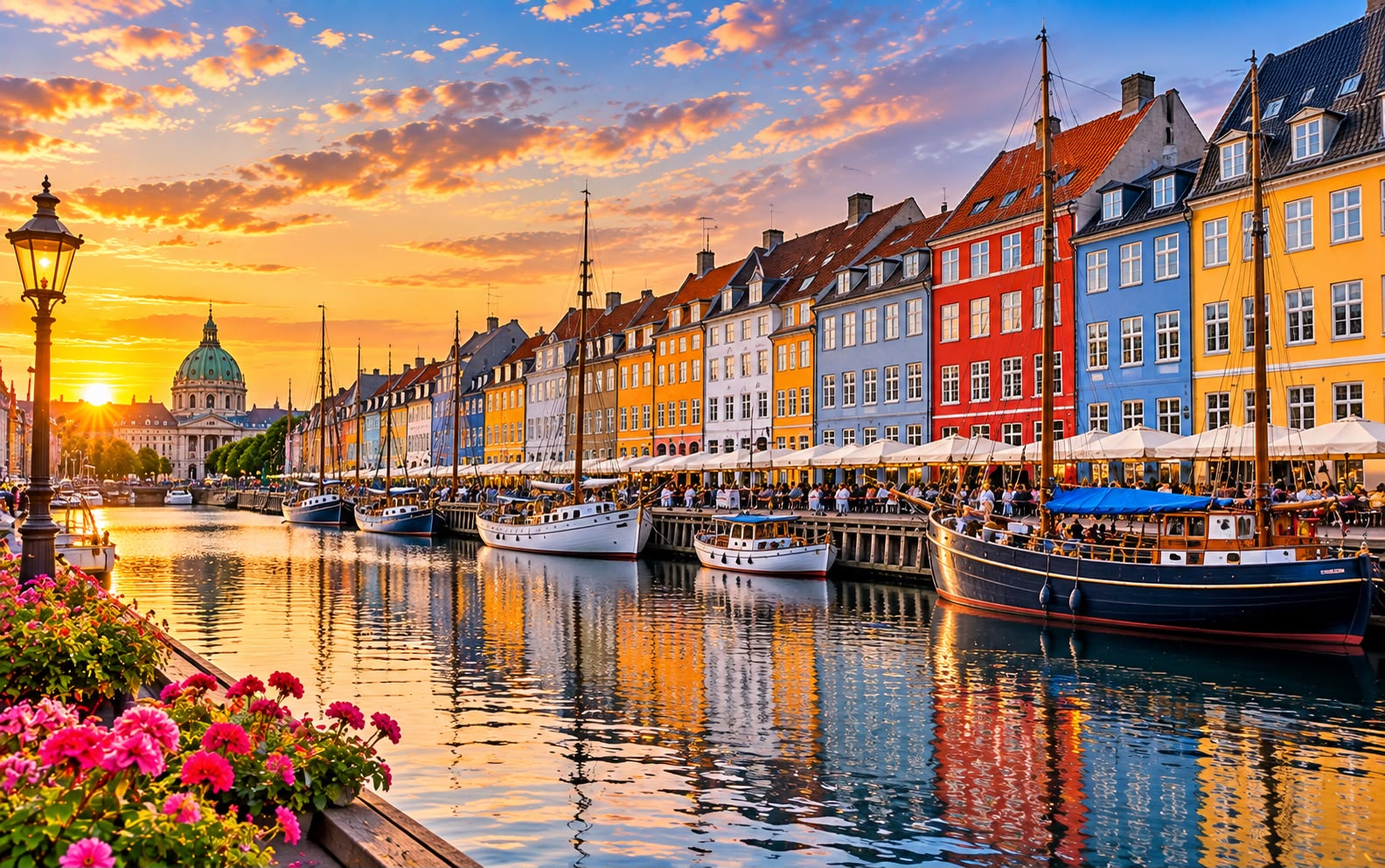
Denmark in 6 days: Copenhagen and the coast
The most liveable capital in Europe, seen the way it was built to be seen — from a bicycle: harbour baths you swim in mid-city, a palace-lined waterfront, Hamlet's castle up the coast and five Viking ships raised from a fjord, plus the honest version of what hygge and Danish prices actually mean.
- Northern Europe
- 6 days
- ≈ AED 7,150 / person
- Design + cycling
Before you go
Copenhagen is the rare capital that has been designed rather than merely grown, and the design decision that matters is the bicycle. More than half the city commutes by bike on separated lanes with their own traffic lights, and renting one for a week is not a gimmick — it is how you see the place.
The city gives you a painted harbour at Nyhavn, a canal-side palace quarter, and — genuinely — harbour baths you can swim in in the middle of a capital city, because the water was cleaned up enough to allow it.
Two short train rides fill out the week: Helsingør, where Hamlet’s castle guards the narrowest point between Denmark and Sweden, and Roskilde, where five Viking ships were raised from the fjord and put in a museum built around them.
Six days is right. Denmark is small, and Copenhagen rewards slowness.
Before you go: bikes, kroner and the cost
Entry and season
- Denmark is in Schengen — one visa covers it. The full process is in our Schengen visa guide.
- Not the euro. Denmark uses the krone (DKK), pegged closely to the euro but a separate currency.
- May to September is the season, and June and July give the long evenings that make the harbour work. Winter is dark and genuinely cold, but December has the best version of Tivoli and the hygge is not marketing at that time of year.
The bicycle is the transport plan
- Rent a bike for the whole stay. It is faster than the metro for most journeys in the centre, and the infrastructure is genuinely separated from cars.
- The rules are enforced: hand signals before stopping and turning, lights after dark (a fineable offence without them), and never ride in the pedestrian zones.
- Stay right, overtake left, and expect Danes to be travelling considerably faster than you.
- Not cycling? The metro runs driverless and 24 hours, and the city is small enough to walk most of.
Money, and the honest cost
- Denmark is expensive, and Copenhagen more so than the rest. Cards work everywhere including on buses; cash is rarely needed.
- Lunch is where the value is — the smørrebrød open sandwiches that are a Danish institution are a lunchtime thing, and cost a fraction of dinner.
- Street food halls — Reffen and the covered markets — are how locals eat out without spending a fortune.
- Tap water is excellent and free everywhere. Refill.
- The Copenhagen Card pays off only if you are doing several paid attractions a day. Price your actual list first; for a slow trip it usually does not.
Small things that help
- Hygge is real but mundane — it means candles, low light and staying in with people, not a purchasable experience.
- Everyone speaks excellent English, and will switch instantly.
- Tipping is not expected. Service is included and rounding up is plenty.
Day by day
Day 1 — Land, and Nyhavn
- 14:00 — Land at Kastrup (CPH). The metro runs to the centre in 15 minutes, driverless, every few minutes — there is no reason to take a taxi.
- 15:00 — Drop bags, then collect a bike. Copenhagen has more bicycles than people and 400 km of protected lane; renting for the trip costs little and turns a walkable city into an easy one. Ride on the right of the lane, signal with your hand, and do not stop in it.
- 16:30 — Nyhavn: the painted 17th-century houses along the canal, with Hans Christian Andersen’s house at number 20. It is the postcard and it is crowded; ten minutes is enough.
- 17:30 — Ride the harbour path to the Opera House and back along Christianshavn’s canals, which is the version of the same thing without the crowd.
- 19:30 — Dinner. Torvehallerne, the glass market halls, for the informal version — smørrebrød, fish, and a beer standing up.
- Note — In June the light lasts past eleven; in December it is dark by half past three and the city runs on candles and hygge instead.
Day 2 — The city by bike
- 09:30 — Rosenborg Castle: the crown jewels in the basement, a Renaissance royal residence above, and the Kongens Have gardens around it — the oldest royal gardens in Denmark and the city’s lunchtime lawn.
- 11:30 — Amalienborg, four identical palaces around an octagonal square, and the changing of the guard at noon if the Queen is in residence (the flag tells you).
- 12:30 — Frederik’s Church, the marble dome opposite.
- 13:30 — Lunch in Nyboder or by the harbour.
- 15:00 — The Little Mermaid, briefly, because you will be asked. She is small, there is a coach party, and four minutes covers it.
- 15:30 — Kastellet next door, which is the better site: a star-shaped fortress from 1664, still a working military area, with a windmill on the rampart and a moat you can ride around.
- 18:00 — Reffen on the harbour — street-food stalls in shipping containers on a reclaimed industrial spit, best reached by bike, and the most enjoyable cheap dinner in the city.
Day 3 — Design, and a swim
- 10:00 — Designmuseum Danmark: chairs, mostly, and it explains why everything in this city — the lamps, the cutlery, the station signage — looks the way it does. Wegner, Jacobsen, Henningsen, in a rococo hospital building.
- 12:30 — Lunch in Nyhavn’s back streets.
- 14:00 — Islands Brygge harbour bath if it is warm enough. The harbour was industrial and filthy within living memory; it was cleaned to swimmable and the city built public pools in it. Free, open to anyone, and the most Copenhagen thing available.
- 15:30 — Alternatively, Christiania — the self-governing free town in an old barracks, founded 1971. Photography is not allowed on Pusher Street and the request is meant.
- 17:30 — Tivoli as the light goes. Opened in 1843, it is the second-oldest amusement park in the world and is far more garden than rides — lanterns, a lake, an open-air stage, and a wooden rollercoaster from 1914 with a brakeman riding in it.
- 20:00 — Dinner inside Tivoli, or Vesterbro outside it.
Day 4 — Helsingør and Hamlet’s castle
- 09:00 — Train north from Central, 45 minutes, along the coast.
- 10:00 — Kronborg, which Shakespeare called Elsinore. A Renaissance fortress at the narrowest point of the Øresund, built to tax every ship passing into the Baltic — which is what paid for it. Sweden is 4 km across the water and clearly visible. The casemates below hold Holger Danske, asleep until Denmark needs him.
- 12:30 — The M/S Maritime Museum next door, built by Bjarke Ingels into a dry dock — the galleries are below ground around the empty dock, which stays open to the sky.
- 14:30 — Train back, stopping at Humlebæk for Louisiana — modern art in a series of low pavilions running down to the sea, with a Calder and a Giacometti on the lawn. One of the best-sited galleries anywhere, and worth more time than you will have.
- 18:00 — Back in Copenhagen.
- 20:00 — Dinner.
Day 5 — Roskilde and the Viking ships
- 09:30 — Train west, 25 minutes.
- 10:00 — The Viking Ship Museum: five ships deliberately sunk around 1070 to block the fjord against raiders, raised in 1962 and reassembled from the fragments. A cargo ship, a longship, a ferry — the working fleet rather than the ceremonial one. The boatyard outside builds full-size replicas by hand with period tools, and in summer you can sail one.
- 13:00 — Lunch in town.
- 14:30 — Roskilde Cathedral, brick Gothic from the 1170s and the burial place of 39 Danish kings and queens — the chapels run chronologically, so you walk through 900 years of changing taste in one building.
- 16:30 — Train back.
- 19:30 — Last dinner, and book it. Copenhagen’s kitchens fill days ahead, and the good mid-range places are harder to get into than the expensive ones.
Day 6 — Fly home
- Morning — The metro to Kastrup takes about fifteen minutes from the centre and runs all night.
- Return the bike the evening before if your flight is early; rental desks keep shop hours.
- Note — Denmark is effectively cashless. Cards work everywhere, including the smallest bakery, and some places take nothing else.
Costs and practicalities
Best time to visit
May–September. Denmark is far enough north that daylight, not temperature, is the thing that changes — seventeen hours in June, seven in December.
- May–June — the best of the year. Long evenings, the parks in use, and Tivoli open from early April.
- July–August — warmest and busiest, with Danes on holiday and the coast in use. Roskilde Festival is at the start of July.
- September–October — crisp, quiet, and good value.
- November–March — dark, wet and cold, but this is when hygge stops being a marketing word and starts being a coping strategy. Tivoli’s Christmas season from mid-November is the best reason to come in winter.
Tivoli closes between seasons, so check its calendar before building a Copenhagen trip around it.
Travel tips
- Denmark is effectively cashless. Cards work everywhere, including market stalls and public toilets. You can complete a trip without touching a krone.
- It uses the krone, not the euro, despite being in the EU.
- Copenhagen is a cycling city and the bike lanes are traffic, not decoration. Look left before stepping off a kerb; cyclists have right of way and use it.
- Tipping is not expected. Service is included and wages are high; rounding up is plenty.
- It is expensive. Lunch from a bakery or a smørrebrød counter costs a third of a restaurant’s.
- Tap water is excellent and restaurants serve it free.
- The Copenhagen Card covers transport and most museums and pays for itself in about a day and a half.
What this trip actually costs
Two people, 5 nights, mid-range, excluding international flights:
| Item | Cost |
|---|---|
| Hotels, 5 nights | DKK 11,000 (≈ AED 6,031) |
| Bike hire, 6 days, and trains to Helsingør and Roskilde | DKK 1,800 (≈ AED 987) |
| Rosenborg, Designmuseum, Kronborg, Viking ships, Tivoli | DKK 2,600 (≈ AED 1,425) |
| Food and drink, 6 days | DKK 9,500 (≈ AED 5,208) |
| eSIM, extras | DKK 1,100 (≈ AED 603) |
| Total for two | DKK 26,000 (≈ AED 14,255) |
- Roughly DKK 13,000 (≈ AED 7,127) per person. Beds and dinners dominate, as in Sweden.
- Lunch at a smørrebrød place and dinner from a street-food hall is the single biggest lever, and neither is a compromise.
- The bike is the cheapest transport decision available, and the most enjoyable.
What to pack
- A waterproof layer. It rains often and briefly, and you will be on a bike.
- Lights for the bike if your rental lacks them — it is a fine, not a suggestion.
- European Type C/F plugs.
- Swimwear in summer for the harbour baths.
- Warm layers outside July and August. The wind comes off the sea and the city is flat and open.
FAQ
Is six days too long for Copenhagen? No, because two of them are day trips. The city alone would be three full days; Kronborg and Roskilde justify the rest.
Should I get the Copenhagen Card? Only if you are visiting several paid attractions daily. Price your actual list — for a slower trip it usually does not repay.
Is it really that expensive? Beds and dinners, yes. Lunch, transport and street food, much less so. Eating the Danish way — the big meal at midday — makes a noticeable difference.
Can I combine it with Sweden? Easily. Malmö is about 35 minutes across the bridge from Copenhagen, and Stockholm is a short flight or a five-hour train.
Prices and entry rules change, and what you need depends on your passport; last checked 8 October 2026, so confirm with the embassy or your airline before booking.


