 The Itinerary
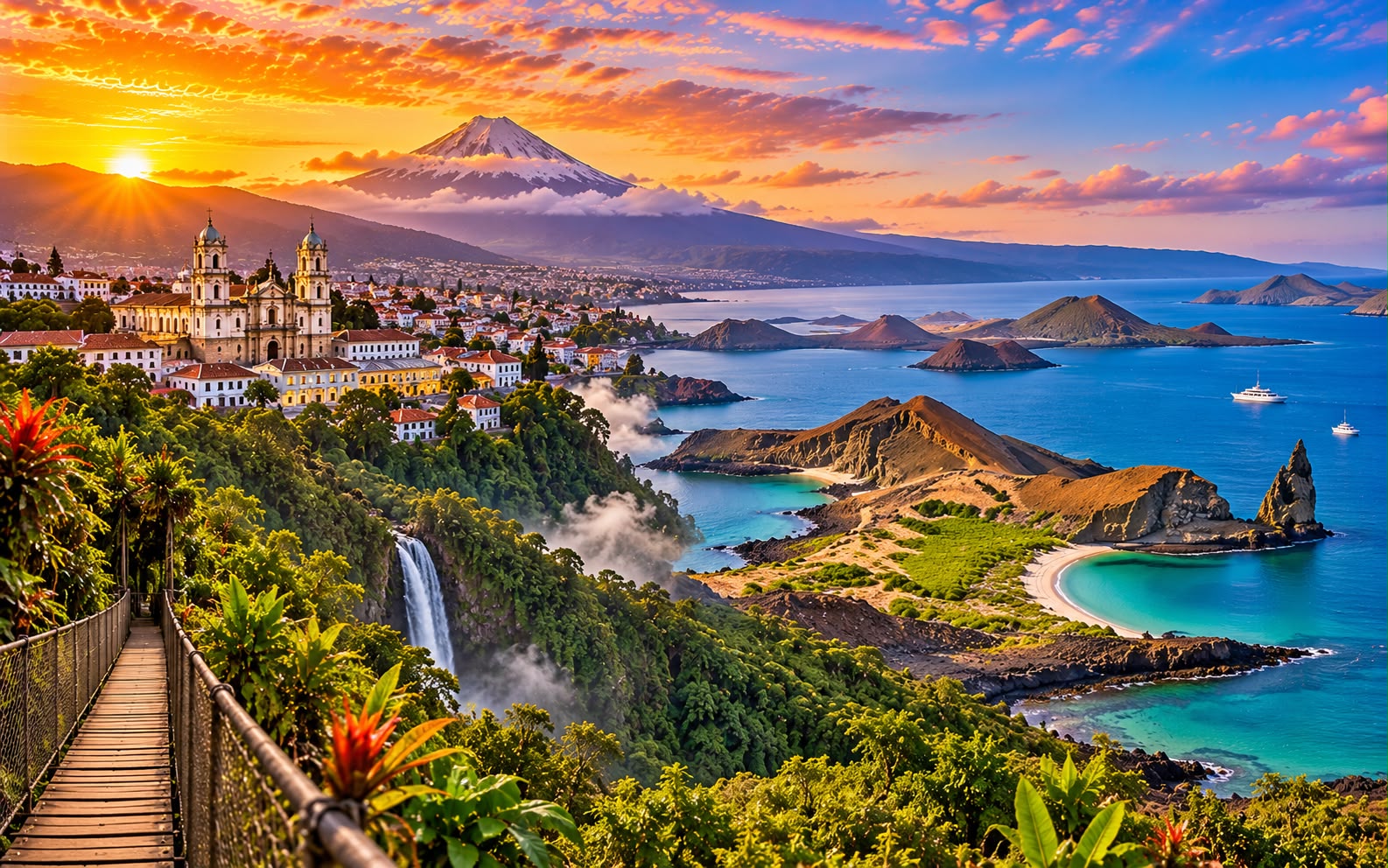
Ecuador in 11 days: Quito, the Galápagos and the cloud forest
Animals that have never learned to fear people, in a country small enough to reach them easily: sea lions on the town dock, marine iguanas on black lava, blue-footed boobies dancing on a clifftop, and a colonial capital at 2,850 metres — with the cruise-versus-island-hopping decision and the fees nobody mentions until you land.
- The Andes
- 11 days
- ≈ AED 13,500 / person
- Galápagos + Andes
Before you go
The Galápagos are the reason, and they deserve it. Six hundred miles off the mainland, the animals evolved without land predators and never developed a reason to run. A sea lion will share the dock with you. A marine iguana will not move off the path. Blue-footed boobies nest at the edge of a trail and continue nesting.
What makes Ecuador a good trip rather than a good excursion is that it is small. Quito’s colonial centre is one of the best preserved in the Americas and sits at 2,850 m, in a valley with volcanoes on both sides. Mindo’s cloud forest is two hours away and holds several hundred bird species. You can have all three in eleven days without a long internal flight beyond the islands.
Two decisions shape the cost and the trip: cruise or island-hop, and which islands you actually need.
Before you go: the fees, the two ways to do it, and altitude
Entry, and the fees nobody mentions
- Most nationalities enter Ecuador visa-free for 90 days — the EU, UK, US, Canada, Australia and most of Latin America.
- The Galápagos charge separately, twice. There is a transit control card bought at the mainland airport before you fly, and a national park entrance fee paid on arrival in the islands. The park fee was increased substantially in 2024 and is now USD 200 for most adult foreign visitors, payable in cash.
- Bring that in cash, in clean US dollars. Card facilities at the island airports are unreliable and the queue does not care.
- Your bags are inspected for organic material on the way in. Do not carry seeds, fruit or plants.
Cruise or island-hopping
This is the decision that shapes everything.
- A cruise sleeps aboard and sails overnight, which is the only way to reach the outer islands — Genovesa, Española, Fernandina — where the rarer species are. Four, five and eight night itineraries are standard, and they are expensive.
- Island-hopping bases you in towns on Santa Cruz, San Cristóbal and Isabela, with day boats to nearby sites. It costs a fraction of a cruise, you sleep on land, and you see a great deal — just not the outer islands.
- Day boats are limited by distance, and inter-island ferries are small, fast and rough. Take something if you are prone.
- This itinerary assumes island-hopping, because it is what most people can actually afford and it is genuinely good.
The altitude, and the order
- Quito sits at 2,850 m, which is higher than most European ski resorts and enough to feel on arrival.
- Give yourself the first day gently. This guide starts in Quito rather than rushing to the islands, partly for that reason.
- The Galápagos are at sea level, so the islands are a rest from the altitude rather than an addition to it.
Money and getting around
- Ecuador uses the US dollar as its own currency, which removes a whole category of problem. Bring small denominations; change for large notes is scarce.
- Cards work in Quito and larger island hotels; carry cash for boats, guides, fees and small restaurants.
- Flights to the Galápagos leave from Quito and Guayaquil and take around two hours. Book early.
- Spanish is essential outside tourism; English is common among island guides.
Day by day
Day 1 — Land in Quito
- 14:00 — Land at Mariscal Sucre (UIO), which is 40 km east of the city in the Tababela valley — an hour to the centre, more in traffic, and around USD 30 by taxi.
- 15:30 — Sleep in the Centro Histórico for the churches on your doorstep, or La Floresta for the restaurants. The airport sits at 2,400 m and the city at 2,850 m, so you arrive higher than you landed.
- 17:00 — Walk a few blocks, slowly. Quito is higher than most people have ever slept and the first evening is not the time to climb anything.
- 18:30 — Locro de papa — potato and cheese soup with avocado — and a canelazo, hot cane spirit with cinnamon, which is the correct drink at this altitude on a cold evening.
- 20:00 — Early night. Ecuador uses US dollars, so there is no money to change; get small notes, because nobody has change for a twenty.
Day 2 — Old Quito
- 09:00 — La Compañía de Jesús, gilded floor to ceiling in seven tonnes of gold leaf and the finest baroque interior in South America. Half an hour, and photography is not allowed.
- 10:30 — San Francisco, the oldest church in the city, begun in 1534 within weeks of the Spanish founding, and its cloister.
- 12:00 — Plaza Grande and the Basílica del Voto Nacional — climb the tower if the ladders and open walkways do not bother you, and note the gargoyles, which are Galápagos animals rather than monsters.
- 14:00 — Lunch on Calle La Ronda.
- 15:30 — The TelefériQo to 4,050 m on Pichincha’s flank. Go on a clear afternoon or not at all; the queue is long and the cloud wins often. The walk up toward Rucu Pichincha from the top station will wind you completely.
- 19:00 — La Ronda again after dark, when the restored colonial street fills up, for dinner and another canelazo.
Day 3 — The Equator, then fly
- 08:30 — Mitad del Mundo, the monument on the line the French Geodesic Mission calculated in 1736. They were about 240 m out, which is remarkable for the instruments they had.
- 10:00 — The neighbouring Intiñan museum sits on the GPS line and does the demonstrations — the water swirl is a trick, the egg-on-a-nail is skill, and it is all enjoyable if you hold it lightly.
- 12:00 — To the airport.
- 14:00 — Fly to Baltra or San Cristóbal, about two hours. At check-in your bags are inspected for organic material and you buy the INGALA transit card; on landing you pay the national park fee in cash, which rose sharply in 2024. Budget for both and carry dollars.
- 16:30 — Land. Cross to Santa Cruz by bus, ferry and bus — about 90 minutes to Puerto Ayora.
- 18:30 — Your first sea lions. They will be on the pavement, on the benches, and occasionally on the boat you wanted.
Day 4 — Santa Cruz
- 07:30 — Charles Darwin Research Station at opening, before the heat and the tour groups: the giant tortoise breeding programme, and the corral of Española tortoises whose species was brought back from fourteen individuals.
- 10:00 — Walk back through town and pick up snorkel gear if you did not bring your own.
- 11:30 — Tortuga Bay: a 45-minute walk on a paved path from town, and then two kilometres of white sand. The first beach has surf and marine iguanas; walk to the far end for Playa Mansa, the sheltered lagoon with turtles, rays and small sharks in water you can stand up in.
- 15:00 — Back, out of the midday sun.
- 17:30 — The fish market on the dock, where pelicans and a sea lion queue with the customers and the woman filleting does not look up. It is the best free show in the islands.
- 19:30 — Dinner on Charles Binford, the street that closes to become an open-air kitchen.
Day 5 — The highlands and a day boat
- 07:00 — The Santa Cruz highlands, 20 minutes up and several degrees cooler: giant tortoises grazing wild on farmland at El Chato, entirely unbothered by you, and the lava tunnels you walk through beneath them.
- 10:30 — Back down, or straight to the dock.
- 11:00 — A day boat. North Seymour for frigatebirds inflating their red throat pouches and blue-footed boobies doing the foot-lifting dance; or Santa Fé for snorkelling with sea lions, which is the single best in-water hour available here.
- 16:30 — Back into Puerto Ayora, sunburnt.
- 19:00 — Dinner, and book the Isabela speedboat for the morning — they sell out.
Day 6 — Ferry to Isabela
- 07:00 — The speedboat to Isabela, two hours. It is open ocean in a small boat: take the tablet if you are prone, sit at the back, and expect to be wet.
- 09:30 — Puerto Villamil, sand streets, no rush, and the least developed of the inhabited islands.
- 11:00 — Concha de Perla: a boardwalk through mangrove to a natural pool where you snorkel straight off the steps, with sea lions, turtles and penguins. Free, and twenty minutes from town.
- 14:00 — Lunch, then the Centro de Crianza tortoise centre on the edge of town.
- 16:30 — The flamingo lagoon behind the village — Ecuador’s largest population, and quiet at this hour.
- 18:30 — Sunset from the beach bar with the swing seats, which is exactly as good as it sounds.
Day 7 — Sierra Negra, and the tunnels
- 07:00 — Sierra Negra volcano: a 45-minute drive, then a 16 km round walk to a caldera 10 km across — one of the largest in the world. It is often in cloud and worth doing anyway; the Volcán Chico extension crosses fumaroles and lava fields from the 2018 eruption.
- 13:00 — Back to town, and lunch.
- 14:30 — Los Túneles, an hour by boat: collapsed lava arches in shallow clear water. You snorkel among white-tipped reef sharks sleeping under ledges, turtles, rays and seahorses, and walk over the arches between swims. The best excursion in the archipelago, and it does not run when the sea is up.
- 18:30 — Back. Last Isabela evening.
Day 8 — Back to Santa Cruz, or San Cristóbal
- 06:00 — The speedboat back, two hours. Mornings are calmer than afternoons.
- 09:00 — If you are routing out via San Cristóbal, a second boat; otherwise a slow day in Puerto Ayora.
- 11:00 — Kicker Rock (León Dormido) off San Cristóbal: an eroded tuff cone split by a channel you swim through, with Galápagos sharks, hammerheads in season, and rays beneath you in very deep water. Not a beginner’s snorkel.
- 15:00 — La Lobería or Playa Mann for the last sea lion colony.
- 18:30 — Last island night. Repack — your bags are inspected again on departure.
Day 9 — Fly to the mainland, on to Mindo
- 09:00 — Fly back to Quito, two hours, and gain an hour: the islands run one hour behind the mainland.
- 13:00 — Drive to Mindo, two hours north-west and 1,600 m lower — over the pass and down into the Chocó cloud forest, which is a different climate and a different set of birds.
- 15:30 — Arrive. It is warm, wet and loud.
- 17:00 — The hummingbird feeders at a lodge café: a dozen species at arm’s length, including the booted racket-tail, and they hold still for nobody.
- 19:30 — Dinner, then listen to the frogs. Rain on the roof is the normal soundtrack.
Day 10 — Birds, and the forest
- 05:30 — Birding with a guide, which is the whole reason to be here. The Mindo valley holds over 500 species; a good guide with a scope finds toucans, tanagers and — if you have booked it — a cock-of-the-rock lek at dawn, where the males display in scarlet.
- 09:30 — Breakfast back at the lodge.
- 11:00 — The tarabita, a hand-hauled cable car over the gorge, then the waterfall trails — six falls, and you can swim in the Nambillo.
- 14:30 — A chocolate tour at one of the small producers: bean to bar in two hours, on cacao grown in the valley, and genuinely good.
- 17:00 — Drive back toward Quito, or stay and drive in the morning.
Day 11 — Fly home
- Morning — Back to Quito if you stayed in Mindo — two hours, and add an hour for the airport on the far side of the city.
- Allow three hours at UIO. It is an hour from the centre in light traffic and considerably more at rush hour, and the road has one realistic alternative.
- Spend your coins. US currency is legal tender here, but the Ecuadorian centavo coins in your pocket are not, anywhere else.
Costs and practicalities
Best time to visit
The mainland and the Galápagos run on different calendars, which is the planning problem for any trip combining them.
- The Galápagos, December–May — warmer air and sea, calmer crossings, better snorkelling visibility, and the green turtle and land iguana nesting season. The warm-water months.
- The Galápagos, June–November — cooler, choppier, and the Humboldt current brings nutrients, so this is the best season for marine life, waved albatross (April–December) and penguins. Wetsuits are useful.
- The Andes (Quito, Cotopaxi, Quilotoa) — June–September is the dry season and the best for volcano views; the rest of the year has afternoon cloud and rain.
- The Amazon — wet year-round; December–March has higher water for canoeing.
Quito sits at 2,850m and the weather there changes hourly in any month.
Travel tips
- Altitude first. Quito is higher than most people realise. Take the first 24 hours gently before Cotopaxi or Quilotoa.
- The US dollar is the official currency. Bring small notes — nobody has change for a 50, and old US coins circulate alongside Ecuadorian ones.
- Galápagos entry costs are separate and substantial: the park fee on arrival and the transit control card, both in cash.
- Follow the Galápagos rules exactly — two metres from wildlife, stay on marked trails, no flash, nothing taken off the islands. Naturalist guides are compulsory on most sites.
- The equator monument at Mitad del Mundo is in the wrong place. The Intiñan museum next door is nearer the actual line, and both are tourist theatre.
- Watch your belongings in Quito’s Old Town and on the Trole, and use apps rather than street taxis after dark.
- Check current advice for the coast and the Colombian border. Security has deteriorated in Guayaquil and Esmeraldas in recent years.
What this trip actually costs
Two people, 10 nights, mid-range with island-hopping, excluding international flights:
| Item | Cost |
|---|---|
| Galápagos park fees and transit cards ×2 | USD 460 (≈ AED 1,689) |
| Quito–Galápagos flights ×2 return | USD 900 (≈ AED 3,305) |
| Island hotels and day boats, 6 nights | USD 3,400 (≈ AED 12,487) |
| Quito and Mindo hotels, 4 nights | USD 700 (≈ AED 2,571) |
| Guides, ferries, Mindo activities, transfers | USD 700 (≈ AED 2,571) |
| Food and drink, 11 days | USD 1,200 (≈ AED 4,407) |
| Total for two | USD 7,360 (≈ AED 27,030) |
- Roughly USD 3,680 (≈ AED 13,515) per person. The Galápagos are most of it — the mainland half of this trip is inexpensive.
- A cruise instead of island-hopping roughly doubles the total, and buys you the outer islands and a naturalist guide throughout.
- The park fee alone is USD 200 a head and is not negotiable.
What to pack
- Cash in US dollars for the park fee, in clean notes.
- Reef-safe sunscreen, a rash vest and your own snorkel mask if you have one.
- Motion sickness tablets for the inter-island ferries, which are genuinely rough.
- Layers for Quito, which is cool at 2,850 m, and light clothing for the islands.
- Waterproofs for Mindo, which is a cloud forest in every month.
- Type A/B plugs, 120V, as in the US.
FAQ
Cruise or island-hopping? Island-hop if budget matters — you will see sea lions, iguanas, tortoises, boobies, sharks and turtles, and sleep on land. Cruise if you want Genovesa, Española and Fernandina, which day boats cannot reach.
Is eleven days enough? Yes, for this shape. Adding days is best spent on more islands rather than more mainland — though Cotopaxi and Baños are both excellent if you want the Andes properly.
When should I go? Two seasons, both good. December to May is warmer with calmer seas and better snorkelling visibility. June to November is cooler and rougher, with more nutrients in the water and therefore more marine activity — and it is when the albatross are on Española.
Will the altitude in Quito be a problem? Mildly, for a day. Take the first afternoon slowly, drink water, and do not plan anything strenuous before day two.
Prices and entry rules change, and what you need depends on your passport; last checked 8 October 2026, so confirm with the embassy or your airline before booking.


