 The Itinerary
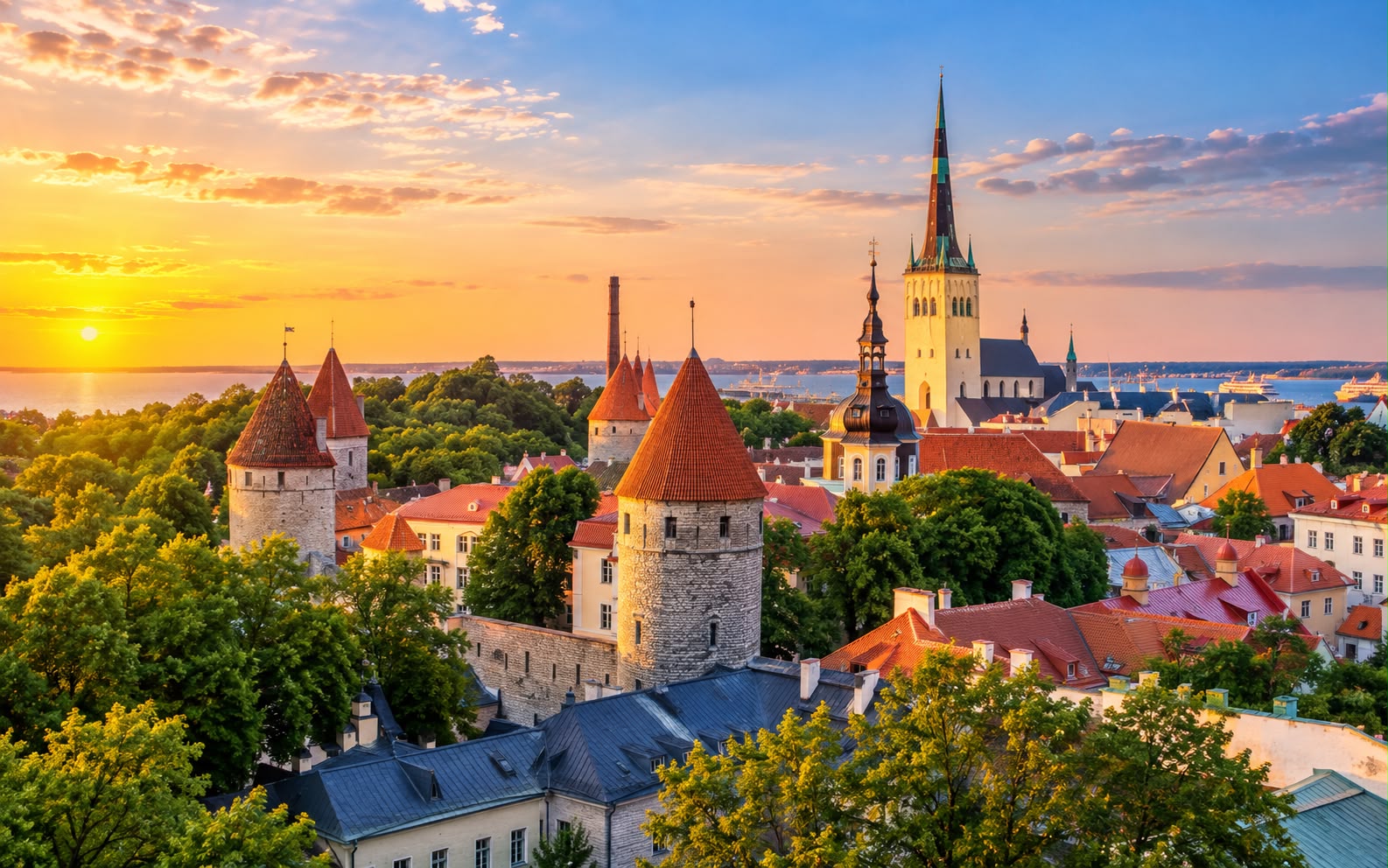
Estonia in 7 days: Tallinn, Lahemaa and Tartu
The most complete medieval old town in northern Europe, a national park of bogs and abandoned Soviet submarine bases an hour away, and a university town that reads like a smaller, cleverer Prague — in a country the size of Switzerland with the population of Birmingham.
- Northern Europe
- 7 days
- ≈ AED 4,050 / person
- Medieval old town + forest
Before you go
Estonia is the country that decided to become software. You can sign a contract, found a company or vote from a phone here, and the national ID card does things most passports cannot. Then you walk into Tallinn’s old town and the century falls off: city walls with twenty surviving towers, merchant houses with the hoist beams still bolted above the windows, and a Gothic town hall that has been standing since 1404.
What makes a week work rather than a long weekend is what sits outside the walls. Lahemaa National Park is an hour east — bog boardwalks, Baltic coastline, manor houses and a decommissioned Soviet submarine base you can walk around. Tartu is two and a half hours south: Estonia’s university town since 1632, a European Capital of Culture in 2024, and the place Estonians go when they want to argue about ideas.
The shape: Tallinn (3 nights) → Lahemaa (1) → Tartu (2), then back to Tallinn to fly. Figure EUR 1,150 (≈ AED 4,709) per person excluding flights. Go June–August for white nights that barely get dark; December for one of Europe’s oldest Christmas markets in a square that needs no decorating.
Before you go: the 15-minute admin
Visas
- Estonia is in Schengen. One Schengen visa covers it along with 28 other countries, and many nationalities enter visa-free — check yours against the current list before you book anything.
- Apply to Estonia if it is your main destination or first entry. If you are combining it with Latvia and Lithuania, see the Baltics route, where one visa covers all three.
Money
- Euro. Cards work everywhere, including bog boardwalk car parks and rural museums. Carrying cash is close to optional, which is unusual in this part of Europe.
- Tipping is not expected. Rounding up is plenty.
- Tallinn’s old town is the expensive part of the country. Tartu runs noticeably cheaper for the same standard.
SIM and data
- Free public wi-fi is near-universal and has been since the early 2000s — it is a point of national pride, and it reaches bus stops and beaches.
- An EU roaming plan works at home rates. From outside the EU, a prepaid Estonian SIM or an eSIM is a few euro for the week.
Getting around
- Tallinn airport to the old town is 10 minutes by tram 4 (€2 from the machine) — probably the shortest airport-to-centre run of any European capital.
- Public transport in Tallinn is free for residents, which is why locals look confused when you ask where to buy a ticket. Visitors pay; buy the QR ticket in the app.
- Intercity coaches (Lux Express, Tpilet) are modern, cheap and punctual. Tallinn–Tartu is about 2h30 for €11–15. Trains on the same route are similar.
- Lahemaa effectively needs a car for one day. Hire from €45–60/day. Without one, take a small-group day tour from Tallinn instead and skip the overnight.
Travelling with kids?
- The route works with small children: short drives, no altitude, and a rest day built into Tartu.
- The Seaplane Harbour submarine and AHHAA in Tartu are the two that reliably win an afternoon.
- The Viru bog boardwalk is flat, fenced and 3.5km — fine for anyone who can walk it, hard with a pushchair.
- Old-town cobbles are brutal on wheels. Carrier over stroller inside the walls.
Day by day
Day 1 — Land in Tallinn, first walk inside the walls
- Afternoon — Land, tram 4 into town, check in. The old town is small enough that almost anywhere inside the walls is walkable to everywhere else.
- 16:30 — Orientation loop on foot: Raekoja plats (the town hall square), the Town Hall Pharmacy — trading since 1422 and still a working chemist — then up through Lühike jalg, the short-leg lane that climbs to the upper town.
- 18:00 — Toompea for the view: the Kohtuotsa and Patkuli platforms look over the red roofs and the ferry port. Kohtuotsa is the postcard. Go now, before the cruise crowds, and again at sunset if the light is good.
- 19:30 — Dinner in the lower town. Modern Estonian mains run €18–28; black bread, smoked fish and anything involving juniper are the local arguments.
Where to stay in Tallinn (three nights — inside the walls for atmosphere, just outside it for space and price)
- Luxury: Hotel Telegraaf — the old telegraph exchange, inside the walls, spa underneath.
- Mid-range: Nordic Hotel Forum — a five-minute walk from the old town with a rooftop pool, and the reliable business-hotel choice.
- Value: the Rotermann quarter between the old town and the port — converted mill buildings, modern apartments, ten minutes on foot from the square.
Day 2 — Upper town, lower town, and the walls
- 09:30 — Start high. Alexander Nevsky Cathedral is the onion-domed Russian Orthodox one facing parliament — deliberately so, when it was built in 1900 under the Empire. Opposite, Toompea Castle flies the Estonian flag from Tall Hermann tower; the flag going up there in 1989 is the image of independence.
- 11:00 — St Mary’s Cathedral (the Dome Church), the oldest church on mainland Estonia, floor paved with the coats of arms of the Baltic German nobility.
- 13:00 — Down to the lower town for lunch, then the city walls: the Hellemann Tower walkway lets you walk a stretch of the rampart. Twenty towers survive of the original forty-six.
- 15:30 — St Olaf’s Church tower if you have the legs — 124 steps up a tight spiral for the best single view of the city. Briefly the tallest building in the world, and struck by lightning at least eight times.
- 18:00 — Kalamaja, the wooden-house district north of the walls, for dinner. Pastel timber houses, the Telliskivi Creative City complex in old railway workshops, and where Tallinn actually eats.
Day 3 — Kadriorg, the seaplanes, and a slow evening
- 10:00 — Kadriorg Park: a baroque palace Peter the Great built for Catherine, now a foreign-art museum, with KUMU — Estonia’s main art museum — at the top of the park. KUMU’s 20th-century floors, covering occupation and Soviet-era art, are the most interesting rooms in the country.
- 13:30 — Seaplane Harbour (Lennusadam): a 1917 seaplane hangar holding a genuine 1936 submarine you climb inside, an icebreaker at the quay outside, and the best museum in Tallinn for anyone travelling with children.
- 16:30 — Walk the waterfront back toward Rotermann, or take the ferry-port promenade for the Helsinki boats coming and going — Finland is 80km north, two hours by fast ferry, and a day trip if you want one.
- 19:30 — Last old-town dinner.
Day 4 — East into Lahemaa
- 09:00 — Collect the hire car and drive east. Lahemaa starts about an hour from Tallinn.
- 10:30 — Viru bog boardwalk: a 3.5km loop over raised bog on timber, with a viewing tower halfway. Flat, easy, and completely unlike anywhere else on this trip — stunted pines, black pools, and silence.
- 13:00 — Palmse Manor, the restored Baltic German estate that functions as the park’s visitor centre, for lunch and the grounds.
- 15:00 — The coast. Käsmu, the “captains’ village”, where nearly every house belonged to a sea captain and the shoreline is strewn with glacial boulders the size of cars.
- 17:00 — Check in locally — Võsu and Käsmu have small guesthouses — or carry on to Hara, the abandoned Soviet submarine degaussing base, concrete piers running out into the Baltic and rusting slowly. Bleak, photogenic, and open to walk around at your own risk.
Day 5 — South to Tartu
- 09:30 — Drive south-west toward Tartu, about 2h30 from Lahemaa.
- 12:30 — Arrive, drop the car (or return it in Tallinn on day 7 — check one-way fees first), check in.
- 14:00 — Raekoja plats again, a smaller one: Tartu’s town hall square tips downhill to the Kissing Students fountain, the image every Estonian associates with the city. The leaning house at number 18 — the Barclay House — leans because it was built on the old town wall.
- 15:30 — Toomemägi (Cathedral Hill): the ruined brick Tartu Cathedral, the old observatory used to measure the Struve Geodetic Arc, and students asleep on the grass in summer.
- 18:00 — Dinner around the square. Tartu is a university town and prices follow: mains €14–22.
Where to stay in Tartu (two nights)
- Mid-range: Hotel Lydia or Antonius Hotel, both central and a short walk from the square.
- Value: guesthouses in the Supilinn (“soup town”) district, wooden houses on streets named after vegetables.
Day 6 — The Estonian National Museum, then Supilinn
- 10:00 — Estonian National Museum, built on a former Soviet airbase runway, the building itself angled to lift off it. The permanent exhibition on everyday Estonian life is the best single explanation of the country you will find, and the Finno-Ugric gallery puts Estonian next to its distant relatives.
- 13:30 — AHHAA Science Centre if you have children, or the Upside Down House if you want the photograph.
- 15:00 — Walk Supilinn: Kartuli (potato), Herne (pea), Oa (bean) streets, wooden houses, and the Emajõgi river path back into town.
- 18:00 — Last dinner. Tartu brews its own beer and is mildly superior about it.
Day 7 — Back to Tallinn, fly home
- 09:00 — Coach or train back to Tallinn, about 2h30. Both run several times a day; book the day before in summer.
- 12:00 — If the flight is late, leave bags at the station and take a last loop of the old town, or the Balti jaam market by the station — three floors of produce, street food and secondhand everything.
- Afternoon — Tram 4 to the airport, 10 minutes.
Costs and practicalities
Best time to visit
June–August for warmth and light, and the difference between summer and winter here is extreme — nineteen hours of daylight in June against six in December.
- May–June — everything opens, the white nights peak around the solstice, and Jaanipäev on 23–24 June empties Tallinn into the countryside entirely.
- July–August — warmest, around 20–22°C, and the busiest. The islands of Saaremaa and Hiiumaa are in full use. The Song Festival, held every five years in early July, brings tens of thousands of singers to Tallinn.
- September–October — autumn colour in Lahemaa, prices down, and the Old Town quiet after the cruise season.
- November–March — cold, dark, and genuinely atmospheric. Tallinn’s Christmas market in the Town Hall Square runs from late November, and the bogs are walkable on snowshoes.
Travel tips
- Estonia is one of the most digital countries on earth and effectively cashless. Cards and phones work everywhere, including parking and public toilets.
- Check the cruise schedule before a Tallinn Old Town day. With ships in, Viru Gate and Raekoja plats are a procession; with none, it is a quiet medieval town.
- The Helsinki ferry is two hours and makes a Finland day trip genuinely practical.
- Bog walking is an Estonian institution. Boardwalks at Viru and Soomaa, and bog shoes in winter; it is the landscape that defines the country.
- Saunas are social and the rules vary by house. Ask whether swimwear is worn.
- Russian is widely spoken and politically sensitive. Open in English and let the other person choose.
- Mosquitoes in the forests and bogs from June are serious. Repellent is not optional for Lahemaa or Soomaa.
What this trip actually costs
Two people, 6 nights, mid-range comfort, flights excluded:
| Item | Cost |
|---|---|
| Hotels, 6 nights (3 Tallinn + 1 Lahemaa + 2 Tartu) | EUR 900 (≈ AED 3,685) |
| Car hire, 2 days + fuel | EUR 160 (≈ AED 655) |
| Coaches, trams and transfers | EUR 70 (≈ AED 287) |
| Food and drink, 7 days | EUR 700 (≈ AED 2,866) |
| Museums, towers and entries | EUR 160 (≈ AED 655) |
| Total for two | EUR 1,990 (≈ AED 8,148) |
- Roughly EUR 995 (≈ AED 4,074) per person, with room in both directions: guesthouses outside the walls and skipping the car pull it under EUR 700 (≈ AED 2,866); a hotel inside the walls and eating well pushes past EUR 1,500 (≈ AED 6,142).
- Skipping the car saves about EUR 160 (≈ AED 655) and costs you the submarine base at Hara and the evening in Käsmu. Lahemaa day tours from Tallinn run about EUR 70 (≈ AED 287) each.
- Book Tallinn first if you are travelling June–August or over the Christmas market — the old town fills, and everything else in this route has slack.
- Hotel picks here are chosen on location, not on commission — always check prices and recent reviews before booking.
What to pack
- Layers, in any month. July can be 25°C or 14°C and wet. The Baltic does not commit.
- Waterproof shoes with grip for the bog boardwalk — timber in the rain is a skating rink.
- An eye mask in June and July. It barely gets dark; “white nights” is not a figure of speech at this latitude.
- Proper cold-weather kit December–March. −15°C happens, and the wind comes off the sea.
FAQ
Is Tallinn worth more than two days? Two days covers the old town. The third is what gets you Kadriorg, the seaplane hangar and Kalamaja, which is where the city stops being a film set and starts being a place people live.
Can I do this without hiring a car? Yes, with one change: swap the Lahemaa overnight for a day tour out of Tallinn and give the night to Tartu. Tallinn–Tartu coaches are frequent and comfortable.
Is it worth adding Latvia and Lithuania? If you have ten days or more, yes — the three capitals are four-hour coach hops apart and one visa covers all of them. The Baltics route does exactly that.
When is the Christmas market? Raekoja plats runs one from late November to early January. It claims descent from the market of 1441 and the square needs no set dressing, which is most of the appeal.
Prices and entry rules change, and what you need depends on your passport; last checked 8 October 2026, so confirm with the embassy or your airline before booking.


