 The Itinerary
Ethiopia in 7 days: Lalibela, Gondar and the Simien Mountains
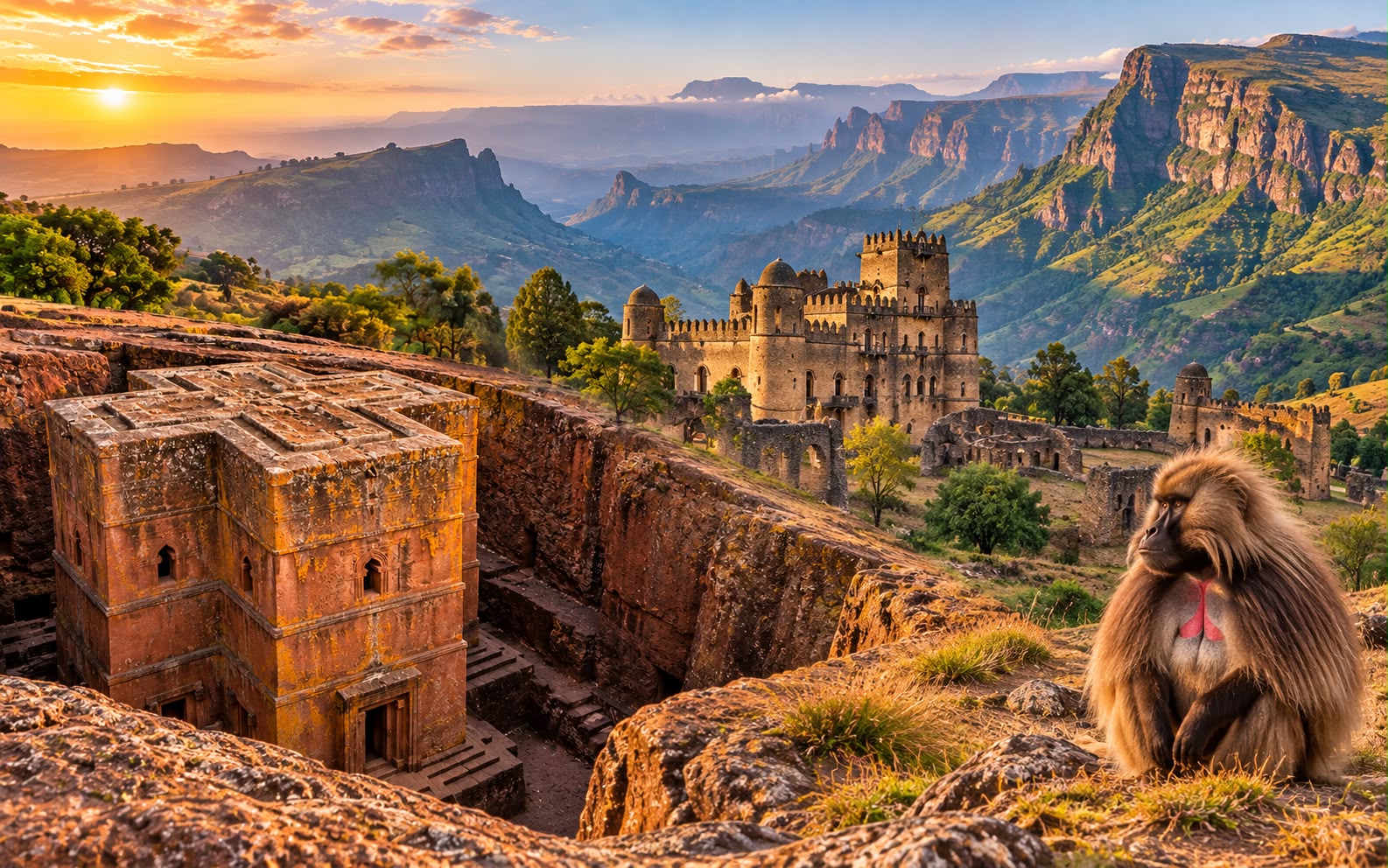
Eleven churches cut downwards into solid rock eight centuries ago, a castle compound built by emperors in the 1600s, an escarpment where troops of gelada baboons graze at 3,000 metres, and the lake the Blue Nile flows out of — on the one route through Africa that is about buildings rather than animals.
- East Africa
- 7 days
- ≈ AED 4,050 / person
- Rock churches and highland escarpments
Before you go
Ethiopia does not fit the continent’s brochure. There is no safari at the centre of this trip. It was never colonised, it kept its own church, its own alphabet, its own calendar and its own clock, and what it built over fifteen hundred years is the reason to come.
Lalibela is the headline. Eleven churches, carved in the twelfth and thirteenth centuries not up from the ground but downwards into solid volcanic rock — the builders began at what is now the roof and cut away everything that was not a church. Bete Giyorgis, a cross forty metres down in a pit, is the image you already know even if you did not know where it was. They are not ruins. Priests still serve in them, and pilgrims still fill them at Christmas.
North of that, Gondar has a walled compound of castles built by emperors from the 1630s, which looks more like Scotland than the Horn of Africa. Beyond it the Simien Mountains fall away in a 1,500-metre escarpment where gelada baboons — the last grass-eating primates on earth, found nowhere else — graze in troops of hundreds and largely ignore you. Then Lake Tana, where the Blue Nile begins, with monasteries on its islands.
The shape: Addis (1 night) → Lalibela (2) → Gondar (1) → Simien (1) → Bahir Dar (1), flying between them. Figure USD 1,100 (≈ AED 4,040) per person excluding international flights. Go October–March, after the rains and before the heat.
Before you go: the 15-minute admin
Visas and current conditions
- Most nationalities use the e-visa, applied for online before travel. Apply through the official Ethiopian immigration portal and not a reseller.
- Check your government’s current travel advice before booking anything. Conditions in northern Ethiopia have changed repeatedly in recent years and parts of the Amhara region, which this route crosses, have been affected. This is the one country on this site where that check should come before the flights, not after.
- A yellow-fever certificate is required if you arrive from a country where it is present.
Money
- Ethiopian birr, and it has moved a long way against the dollar in recent years — which is why the budget here is in dollars.
- Carry cash. Cards work in Addis hotels and almost nowhere else on this route. Bring clean, recent US dollar notes and change as you go.
- Church and park entries are fixed in dollars or their birr equivalent, and are the bulk of what you will spend beyond flights.
SIM and data
- Ethio Telecom sells tourist SIMs at Bole airport; bring your passport. Data is cheap and slow.
- Expect no coverage in the Simien and patchy coverage in Lalibela. Download maps and tickets in advance.
Getting around
- Domestic flights are the route. Ethiopian Airlines links Addis to Lalibela, Gondar and Bahir Dar daily; the roads between them are long and mountainous.
- The discount worth knowing: fly into Ethiopia on Ethiopian Airlines and domestic fares drop substantially. Book the domestic legs with the same booking reference — it can halve this trip’s biggest line item.
- A guide is close to essential at Lalibela. The churches are a warren and the meaning is not self-evident; hire a licensed one at the ticket office.
- The Simien requires a scout by law, and a vehicle from Debark. Both are arranged at the park office.
Travelling with kids?
- This is a demanding trip for small children: altitude, early flights and a lot of walking on uneven rock.
- Geladas are the exception — a troop of several hundred primates grazing a few metres away is as good as wildlife gets at any age.
- Lalibela’s trenches and tunnels involve steps, drops and dark passages. Hold hands and bring a torch.
- Altitude is real: Addis sits at 2,355m and the Simien camps above 3,200m. Build in a slow first day.
Day by day
Day 1 — Addis Ababa, and the oldest relative
- Morning — Land at Bole. Most long-haul arrivals land early. Check in, eat, and move slowly; you are at 2,355m before you have done anything.
- 11:00 — The National Museum for Lucy — Dinkinesh in Amharic, “you are marvellous” — the 3.2-million-year-old Australopithecus afarensis skeleton found in the Afar in 1974. What is displayed is a cast; the original is held in the back. The point stands.
- 14:00 — Holy Trinity Cathedral, where Emperor Haile Selassie is buried, and Merkato if you want one of Africa’s largest open-air markets. Go with a guide and keep your phone away.
- 17:00 — A coffee ceremony. Ethiopia is where coffee comes from and the ceremony is not a performance for tourists — green beans roasted in front of you, ground, brewed in a clay jebena, and poured three times. It takes an hour. That is the point.
Where to stay in Addis (one night, near the airport for an early domestic departure)
- Mid-range: the Bole district, walking distance to restaurants and 10 minutes from the terminal.
- Value: guesthouses around Kazanchis, central and cheaper, 20 minutes from Bole.
Day 2 — Fly to Lalibela, the northern churches
- 07:00 — Early flight north, about an hour. Lalibela’s airport is 25km from town on a spectacular road.
- 10:00 — Check in, then the northern group: Bete Medhane Alem, the largest monolithic rock-hewn church in the world, surrounded by 34 columns; Bete Maryam, the most decorated; and the trenches and tunnels connecting them, one of which is deliberately pitch dark and meant to be walked blind.
- 13:00 — Lunch. Then rest — you are at 2,500m and the afternoon light is harsh.
- 16:00 — Back for the golden hour at the churches. The rock turns red and the pilgrims in white come for evening prayers.
Where to stay in Lalibela (two nights — the escarpment hotels on the ridge above town have the views)
- Mid-range: lodges on the ridge road, most with terraces looking west over the valley.
- Value: guesthouses in town, five minutes from the church entrance and much cheaper.
Day 3 — Bete Giyorgis, and the monastery above
- 06:30 — Bete Giyorgis at dawn, before anyone else. A perfect Greek cross cut forty metres down into the rock, standing free in its pit, built — the story goes — after St George complained he had no church of his own. Walk the rim first, then the trench down into it.
- 09:00 — The southeastern group: Bete Gabriel-Rufael, Bete Amanuel, Bete Abba Libanos, reached by the tunnels.
- 12:00 — Lunch, then the climb or mule ride up to Asheton Maryam, a monastery at 3,150m above the town. Two hours up, and the view back over the Lasta mountains is the reason.
- 18:00 — Dinner. Wednesdays and Fridays are fasting days in the Orthodox calendar, which means the vegan platter — and it is the best food in the country.
Day 4 — Fly to Gondar, the castle compound
- 08:00 — Fly to Gondar, about an hour via Addis or direct depending on the day.
- 11:00 — Fasil Ghebbi, the royal enclosure: six castles and a complex of halls inside a walled compound, begun by Emperor Fasilides in the 1630s when Gondar became the capital. Stone battlements, round towers and Portuguese and Indian influence in the arches.
- 14:00 — Debre Berhan Selassie church. Modest from outside; inside, the ceiling is covered with eighty winged angel faces, each slightly different, and it is the single most photographed interior in Ethiopia.
- 16:00 — Fasilides’ Bath, a stone pool with a building in the middle, filled once a year for Timkat, the Epiphany celebration in January, when thousands enter the water. If you can travel in mid-January, do it here.
Day 5 — Into the Simien
- 06:30 — Drive north to Debark, about three hours, and the park headquarters. Pick up the mandatory scout and permits.
- 10:30 — Into the park. Sankaber and the escarpment viewpoints come first: a 1,500-metre drop, with pinnacles and mesas standing out of the haze below.
- 13:00 — Geladas. Troops of several hundred graze the grassland at the cliff edge — the males with manes and a bright red patch on the chest that gives them their other name, the bleeding-heart baboon. They are not fed, not habituated for tourists, and simply unbothered. Sit down and they carry on grazing around you.
- 16:00 — Chenek if time and road allow, higher and the best chance of walia ibex on the crags and the Ethiopian wolf, of which perhaps 500 remain.
- Evening — Lodge near Debark or inside the park. It gets properly cold above 3,000m.
Day 6 — Lake Tana and the Blue Nile
- 07:30 — Drive to Gondar and fly or drive south to Bahir Dar on Lake Tana, Ethiopia’s largest lake.
- 13:00 — Boat out to the island monasteries. Ura Kidane Mehret on the Zege peninsula is the one to pick: a round thatched church whose entire inner drum is painted with saints, battles and the devil, in registers from floor to roof. Several monasteries remain closed to women, which is worth knowing before you book the boat.
- 16:30 — The Blue Nile Falls (Tis Issat), 30km south. Honest warning: a hydro scheme upstream takes much of the flow and the falls are a fraction of their old size except in the rains. Go for the gorge walk and the suspension bridge as much as the water.
- 19:00 — Fish from the lake, grilled, by the water.
Day 7 — Fly to Addis, home
- Morning — Bahir Dar’s market for the baskets, or the lakeshore for pelicans and the papyrus boats.
- Midday — Fly to Addis, about an hour. Long-haul departures are mostly late evening, so there is usually time for a last meal and a shower at a day-rate hotel near Bole.
Costs and practicalities
Best time to visit
October–March, the dry season, and the window is sharpened by two things most itineraries are built around: the Simien roads and the Timkat festival.
- October–November — the best of the year. The highlands are green after the rains, the wildflowers are out, and the light is clear.
- December–February — dry, cool at altitude and cold at night in Lalibela and the Simiens. Timkat, 19 January, is the Orthodox Epiphany and the largest festival in the country — Gondar and Lalibela fill completely and accommodation is taken months ahead.
- March–May — the belg rains build; hot in the Danakil, which is only sensible from November to February in any case.
- June–September — the main kiremt rains. Roads wash out, the Simien treks are difficult, and many lodges close.
Meskel, 27 September, marks the end of the rains with bonfires and is the other date worth planning around.
Travel tips
- Check current advice carefully before committing. Parts of Ethiopia — Tigray, Amhara, Oromia — have carried severe warnings in recent years and the position changes.
- The calendar is different. Ethiopia runs on thirteen months and is seven to eight years behind the Gregorian calendar; the clock also starts at dawn, so “three o’clock” may mean nine in the morning. Confirm times carefully.
- Remove shoes at every rock-hewn church in Lalibela and cover shoulders and knees. Hiring a church guide is expected.
- Bring US dollars in cash. Cards work at a few Addis hotels; ATMs are unreliable and limits are low.
- A yellow fever certificate is required if arriving from an endemic country, and is often asked for regardless.
- Altitude is a factor — Addis is 2,350m and Lalibela 2,500m. Take the first day gently.
- The Danakil requires an armed escort and an organised group. It is not somewhere to improvise, and the heat is extreme.
What this trip actually costs
Two people, 6 nights, mid-range comfort, international flights excluded:
| Item | Cost |
|---|---|
| Hotels and lodges, 6 nights | USD 540 (≈ AED 1,983) |
| Domestic flights, four legs each | USD 640 (≈ AED 2,350) |
| Guides, drivers, scout and park fees | USD 460 (≈ AED 1,689) |
| Food and drink, 7 days | USD 300 (≈ AED 1,102) |
| Church and site entries | USD 260 (≈ AED 955) |
| Total for two | USD 2,200 (≈ AED 8,080) |
- Roughly USD 1,100 (≈ AED 4,040) per person. The domestic flights are the lever: arriving on Ethiopian Airlines and booking the internal legs on the same reference can cut that USD 640 (≈ AED 2,350) close to half.
- Lalibela’s entry ticket covers all eleven churches and is valid for several days — it is the single biggest site cost and worth two full days rather than one.
- The Simien needs a vehicle, a scout and park fees whether you are one person or four, so it is much cheaper shared.
- Hotel picks here are chosen on location, not on commission — always check prices and recent reviews before booking.
What to pack
- Layers and a proper warm jacket. The highlands are cold at night and the Simien is near freezing before dawn, whatever the map says about latitude.
- Shoes you can grip rock in. Lalibela is steps, slopes and polished stone, and shoes come off inside every church — socks you do not mind on dusty floors.
- Cash in clean US dollars, small denominations, more than you think.
- A torch. The tunnels between the churches are dark on purpose.
- Sun protection. At 2,500m the sun is fierce even when the air is cold.
FAQ
Is seven days enough? For this route, yes, because the flights do the distance. It is tight — adding Axum and its stelae field needs a ninth or tenth day.
Do I need a guide? At Lalibela, effectively yes. In the Simien a scout is required by law. Elsewhere it is optional and still useful.
What is the food like? Injera — a wide sour flatbread of teff — with stews spooned onto it, eaten with the right hand. The Orthodox fasting days on Wednesdays and Fridays mean entirely vegan menus, and they are consistently the best meals.
Why is the date wrong? Ethiopia keeps its own calendar, around seven to eight years behind the Gregorian one, with thirteen months. The clock runs differently too: six o’clock Ethiopian time is midday. Ask which system someone means when they tell you a departure time.
Prices and entry rules change, and what you need depends on your passport; last checked 8 October 2026, so confirm with the embassy or your airline before booking.


