 The Itinerary
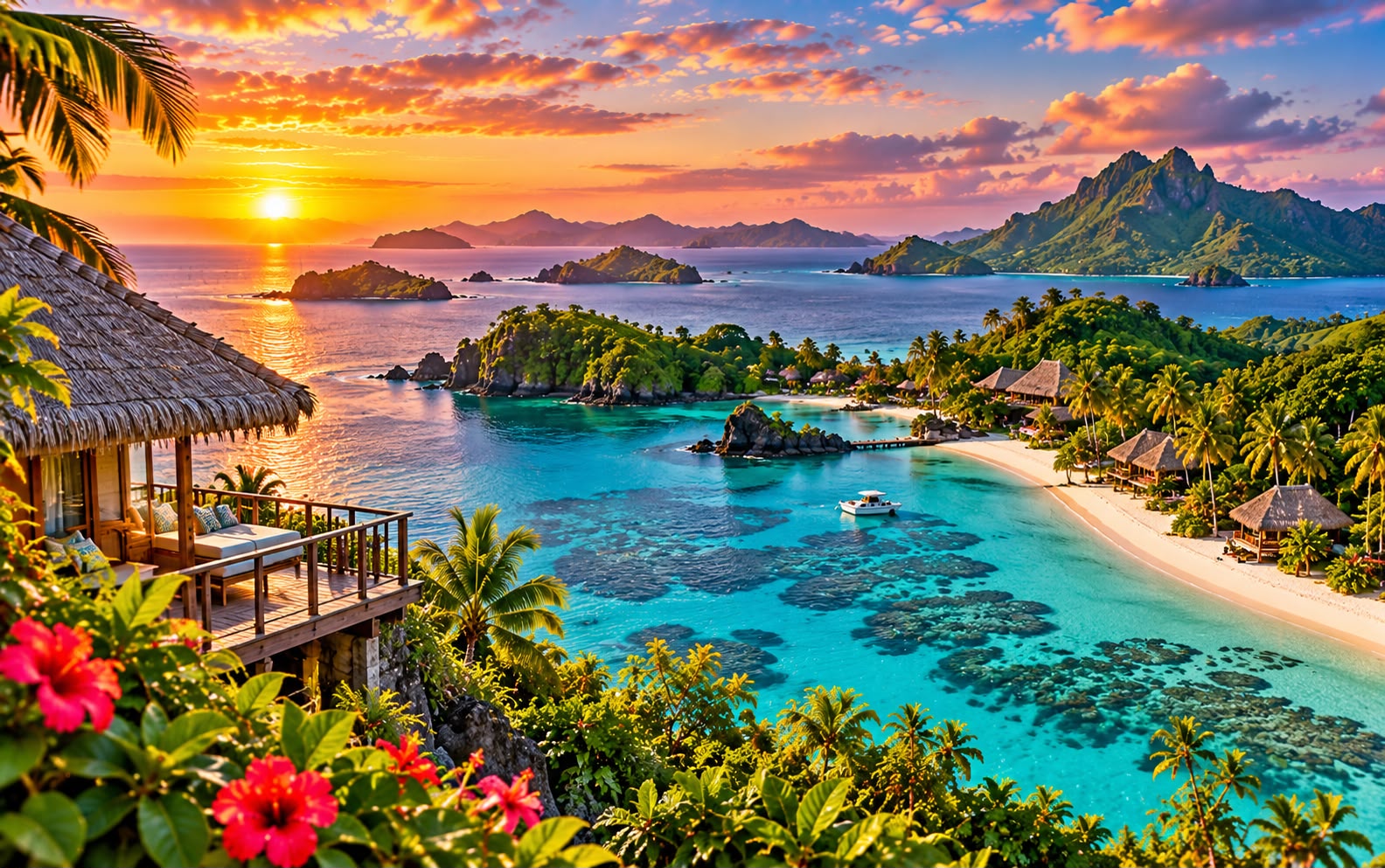
Fiji in 9 days: the Yasawas, Viti Levu and a village stay
Three hundred islands, one catamaran that links the best of them, and a welcome that is not manufactured: manta rays in a channel, limestone caves you swim into, a village kava ceremony done properly, and reefs straight off the beach — with the boat-pass maths and the two seasons that decide the price.
- Pacific Islands
- 9 days
- ≈ AED 10,550 / person
- Islands + reefs
Before you go
Fiji has 333 islands and a reputation built mostly on resort brochures, which undersells it. The country underneath is a Melanesian one with a strong village culture, where a visitor who does the right things is treated with a warmth that is not part of the room rate.
The trip splits in two. The Yasawa Islands — a chain running north-west, reached by one daily catamaran — give you the beaches, the reefs and the manta rays. Viti Levu, the main island, gives you the villages, the highlands and a coast road along the reef.
The thing that makes this simple is the Yasawa Flyer, a catamaran that runs up the chain each morning and back each afternoon, with a hop-on pass that lets you island-hop without chartering anything.
Before you go: boats, seasons and the village rules
Entry, and the season
- Most nationalities get a free four-month visitor permit on arrival — the EU, UK, US, Canada, Australia, New Zealand, India and many more. Bring proof of onward travel and accommodation.
- Passport valid six months, and a departure ticket.
- May to October is the dry season: less rain, lower humidity, and the reliable choice. November to April is wet and warm and carries cyclone risk, which peaks January to March.
- July and August are busiest with Australian and New Zealand school holidays; prices rise accordingly.
- The water is warm year-round. Manta rays in the Yasawas are most reliable May to October.
The boat pass is the itinerary
- The Yasawa Flyer leaves Denarau (near Nadi) each morning, runs up the chain dropping and collecting at each island, and returns in the afternoon. It is the only scheduled way through the islands.
- A hop-on pass priced by number of days is far better value than point-to-point tickets if you are visiting more than one island.
- Island transfers are by small boat from the catamaran, and in swell that is a wet transfer. Pack accordingly.
- Book accommodation and the boat together where you can; many island properties bundle them, and the boat sells out in season.
- Islands are small and have one or two places to stay. There is no walking to a different restaurant. Choose the property carefully, because for two days it is your whole world.
The village rules, which matter
- Villages are private communities, not attractions. You visit by invitation or with a guide, never by wandering in.
- Bring a gift of kava root (sevusevu) if you are visiting a village — your host or guide will arrange it — and present it to the chief. This is the correct, expected form.
- Cover shoulders and knees in villages, and wear a sulu (sarong) over swimwear. Both men and women.
- Remove hats and sunglasses in a village, and do not touch anyone’s head.
- Take your shoes off before entering a house or bure.
- Kava is mildly sedative, tastes of muddy pepper, and refusing it politely is fine — clap once, accept, drink in one, clap three times.
Money and getting around
- The Fijian dollar (FJD). Cards work at resorts and in Nadi; the islands are largely cash, and there are no ATMs on most of them.
- Withdraw enough cash in Nadi for the entire island leg. This is the most common practical mistake visitors make.
- Viti Levu’s coast road is served by cheap local buses and inexpensive taxis; agree the fare first.
- Tipping is not traditional; a “Christmas fund” box at resorts is the usual form.
- English is an official language and universally spoken.
Day by day
Day 1 — Land in Nadi
- 06:00 — Most long-haul flights land at Nadi (NAN) at dawn. You will be greeted by a guitar trio in the arrivals hall, which is not a put-on.
- 08:00 — Stay near Nadi town or Denarau — the Yasawa Flyer leaves Denarau marina around 08:45, so tonight’s bed needs to be close to it.
- 09:30 — Draw cash now. The Yasawa islands have no ATMs, patchy card acceptance and no bank, and your resort will charge a poor rate to change money. Take more Fijian dollars than you think for the whole island stretch.
- 11:00 — Sabeto mud pools and hot springs, 20 minutes out — you coat yourself in grey mud, let it dry, and rinse in a thermal pool. Cheap, daft, and exactly the right first morning.
- 14:00 — The Garden of the Sleeping Giant, orchids planted by Raymond Burr on the hillside, a quiet hour.
- 17:00 — Repack into one soft bag for the islands.
- 19:00 — Dinner, early night. Buy the Flyer ticket and your resort transfers as a package (a “Bula Pass”) before you go — booking each leg separately costs considerably more.
Day 2 — North into the Yasawas
- 08:45 — The Yasawa Flyer leaves Denarau. The catamaran runs the whole chain daily and drops you at your island by small boat — the big boat does not dock, it stops offshore and a tender comes out.
- 11:00 — Past the Mamanucas — the resort islands, and Monuriki, where Cast Away was filmed.
- 13:00 — Lunch on board, and watch the islands go from low and developed to high, green and almost empty.
- 15:00 — Arrive at your island. The Naviti and Waya groups are the usual middle of the chain and the sensible choice for a first stop.
- 16:00 — Settle. Accommodation runs from backpacker dorms in bure huts to small resorts, and the difference in the water in front of them is nil.
- 18:30 — Dinner at the property, which is where everyone eats — there is nowhere else — at long shared tables.
- 20:00 — A beach with no lights on it, and the whole sky.
Day 3 — Reef, and the first swim
- 07:30 — Breakfast, then snorkel straight off the beach. The coral comes close in here; you do not need a boat for the first look.
- 10:00 — Most properties run a boat to a better site mid- morning — ask at breakfast, because it goes when enough people want it.
- 12:30 — Lunch, then the heat of the day in a hammock.
- 15:00 — A village visit, if your hosts arrange one. You bring sevusevu — a bundle of waka, dried kava root, bought in Nadi market for a few dollars — and present it to the chief, who accepts it on the village’s behalf. Cover your shoulders and knees, and take your hat off: wearing one in a village is reserved for the chief.
- 18:00 — Kava, cross-legged on a mat. Clap once, take the bowl, drink it in one, clap three times. It tastes of muddy water and numbs your mouth, and the point is entirely the sitting around.
- 20:00 — Singing afterwards, in harmony, and it is not staged for you.
Day 4 — Further north
- 09:00 — The Flyer again, an hour or two further up the chain toward the Sawa-i-Lau area and the top of the Yasawas.
- 11:30 — Arrive, settle at the second island. Changing islands once is worth it; the chain is 80 km long and the north is noticeably quieter than the middle.
- 14:00 — Sawa-i-Lau caves: a limestone chamber you enter by boat and swim in, with light coming through a hole in the roof. Then the part people talk about afterwards — a short underwater passage you duck through, in the dark, with a guide’s hand, into a second enclosed chamber. It is about three metres and entirely safe, and it is still a decision.
- 16:30 — Back, and a swim off the beach.
- 19:00 — Dinner, different island, same rhythm.
Day 5 — Manta rays, in season
- 07:00 — Between May and October, mantas feed in the channel off Naviti on the tide. Boats go when the spotters on the headland see them, which means you wait with your fins on and then move quickly.
- 08:00 — In the water. Reef mantas up to three metres across, feeding in the current, passing underneath you close enough to see the markings. You swim alongside, you do not chase, and you do not touch.
- 10:30 — Back. This is the single best thing in the islands and it is weather and season dependent, which is why it is worth building two days of flexibility around it.
- 12:30 — Lunch, then beach, hammock, book — the correct programme.
- 16:00 — A sunset kayak or the headland walk for the view back down the chain.
- 19:00 — Last island night. Settle the bar bill in cash.
Day 6 — Back south, and across to the coast
- 09:00 — The Flyer south, most of the day — four to five hours from the top of the chain.
- 14:00 — Denarau marina. Collect the bag you left, and the hire car if you booked one.
- 15:30 — Drive the Coral Coast, about 90 minutes south-east on the Queens Road, with the sea on one side the whole way.
- 17:30 — A coast resort or guesthouse around Korotogo or Pacific Harbour.
- 19:00 — Dinner, and a shower with pressure, which after a week of islands is a genuine pleasure.
Day 7 — The highlands and the river
- 08:00 — The Sigatoka River by longboat — flat-bottomed craft up into the interior to highland villages that the road does not reach. Half a day, with sevusevu again, and a meke — the dance — if the village is expecting you.
- 13:00 — Lunch back on the coast.
- 15:00 — The Sigatoka Sand Dunes National Park: Fiji’s first national park, and an archaeological site as much as a landscape — 2,600-year-old Lapita pottery and human burials erode out of the dunes continuously. The two-hour loop goes over the dunes and down to a black-sand beach with serious surf.
- 18:00 — Back.
- 19:30 — Dinner — kokoda, the Fijian ceviche in coconut milk, which is on every menu and should be.
Day 8 — Reef, or the garden island
- Option A — the reef, 09:00. Snorkel or dive the Coral Coast reef, which you reach from the beach at low tide, or go out to the Beqa Lagoon for the serious diving — including the shark dive, which is baited, controversial, and extremely impressive.
- Option B — Navala, 08:00. A day inland to Navala, the last village in Fiji built entirely of traditional thatched bure, laid out in avenues under the hills. Go with a guide and with sevusevu; it is a working village and not a museum.
- Option C — Pacific Harbour. Ziplines, river tubing, or the Arts Village.
- 17:00 — Drive back toward Nadi, about two hours.
- 19:30 — Last dinner.
Day 9 — Fly home
- Morning — Nadi airport is small and straightforward — an hour is genuinely enough.
- Most long-haul departures are late evening or overnight, so you usually get the last day. Leave bags at the airport or your hotel and take it slowly.
- Last stop — Nadi market for kava root, which is the one thing worth carrying home, and check your own country’s rules on bringing it in before you buy.
Costs and practicalities
Best time to visit
May–October is the dry season and the better half of the year, with the cyclone season falling in the other.
- May–October — dry, 25–28°C, lower humidity, and the best diving visibility. July and August are busiest with Australian and New Zealand school holidays.
- November–April — hot, humid, wettest, and the official cyclone season. Rates drop sharply; most years pass without a direct hit but the risk is real.
- Diving visibility is best June–October; manta rays at the Yasawa channels are most reliable May–October.
- Surfing on the Mamanucas is best April–October, when the southern swell arrives.
Viti Levu’s two sides have different weather. The west — Nadi, Denarau, the islands — is dry; Suva on the east is wet in any month.
Travel tips
- Accept the kava. The sevusevu ceremony on arriving at a village is the protocol; clap once, drink in one, clap three times. Refusing is a genuine discomfort to your hosts.
- Cover shoulders and knees in villages, remove hats and sunglasses, and do not touch anyone’s head.
- Island transfers are the planning problem. The Yasawa Flyer runs daily up the chain and takes hours; seaplanes are quick and expensive. Build the route around the boat times.
- Cards work in Nadi, Denarau and the resorts and barely anywhere else. Carry Fijian dollars for villages and markets.
- Reef shoes matter. Coral cuts become infected quickly in the tropics; treat any graze immediately.
- “Fiji time” is real and applies to boats, buses and meals. Build margin around the one flight that matters.
- Tap water is safe in Nadi and Suva, less so on the outer islands where it is often rainwater.
What this trip actually costs
Two people, 8 nights, mid-range, excluding international flights:
| Item | Cost |
|---|---|
| Island properties and coast accommodation, 8 nights, most with meals | FJD 5,800 (≈ AED 9,432) |
| Yasawa Flyer passes ×2, transfers, coast transport | FJD 2,400 (≈ AED 3,903) |
| Manta snorkel, caves, village tours, reef trips | FJD 1,800 (≈ AED 2,927) |
| Food, drink and extras not included | FJD 2,600 (≈ AED 4,228) |
| eSIM, tips, sundries | FJD 400 (≈ AED 650) |
| Total for two | FJD 13,000 (≈ AED 21,141) |
- Roughly FJD 6,500 (≈ AED 10,570) per person. Island meal plans are effectively compulsory — there is nowhere else to eat — so compare properties on the all-in figure rather than the room rate.
- The boat pass is the saving. Point-to-point tickets for three islands cost meaningfully more than a pass.
- Budget dorms and family-run island places exist and cut the accommodation line by half; Fiji is not only a resort country.
What to pack
- Reef-safe sunscreen, and more of it than you think.
- Your own snorkel and mask if you have them — rental sets on small islands are well used.
- A sulu or sarong each, for villages and for everything else.
- Cash in Fijian dollars, drawn in Nadi, for the island leg.
- A dry bag. Every island transfer is a wet boat.
- Type I plugs (Australian style), 240V.
- Reef shoes for coral-strewn shallows.
FAQ
Do I need a resort, or can I do this cheaply? Both exist on the same islands. Backpacker and family-run places sit beside expensive resorts along the Yasawas, use the same boat and snorkel the same reefs.
Is the Yasawa Flyer really necessary? It is the practical way through the chain. Seaplanes and charters exist and cost many times more. The pass is what makes island hopping affordable here.
When will I see manta rays? May to October, in the Naviti channel, and it is never guaranteed — but in season the odds are good and the properties run boats daily when they are around.
Is it a good family trip? Very. Calm lagoons, short boat hops, and a culture that is genuinely fond of children. The wet transfers are the only thing to plan around with very young ones.
Prices and entry rules change, and what you need depends on your passport; last checked 8 October 2026, so confirm with the embassy or your airline before booking.


