 The Itinerary
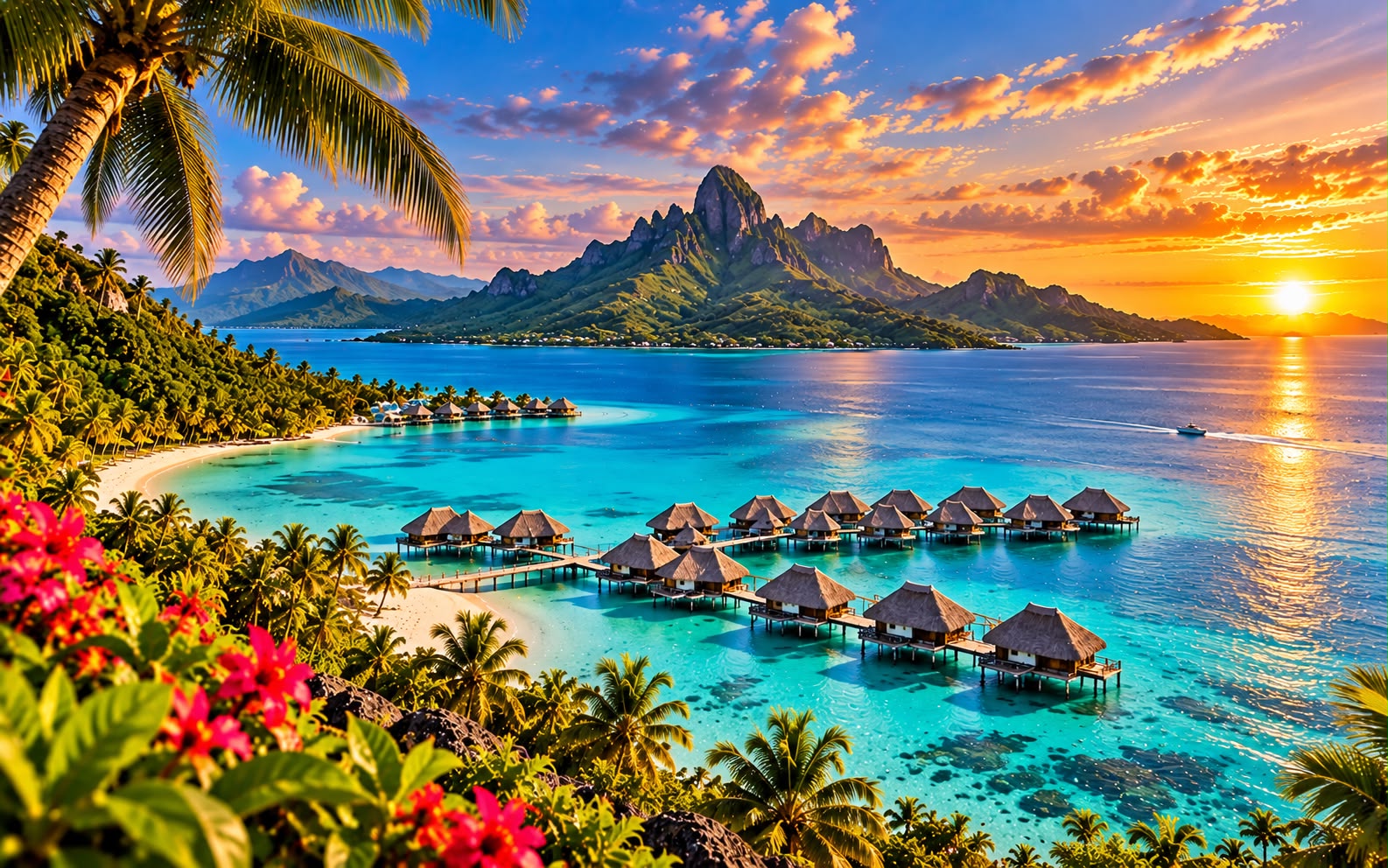
French Polynesia in 10 days: Tahiti, Moorea, Huahine and Bora Bora
The version of these islands that isn't an overwater bungalow: family pensions, a ferry, an island-hopping air pass, and four islands with different characters — Moorea's green spires, Huahine's quiet, Taha'a's vanilla, and Bora Bora's lagoon, which does deserve the reputation.
- Pacific Islands
- 10 days
- ≈ AED 7,800 / person
- Island-hopping, not one resort
Before you go
French Polynesia has a single image attached to it — an overwater bungalow with a ladder into turquoise water — and that image costs XPF 120,000 (≈ AED 4,117) a night and keeps people from coming at all.
There is another version. Pensions de famille are family-run guesthouses, usually with breakfast and dinner included, at a fraction of the resort price, and they are how the islands are actually travelled. With one of those and Air Tahiti’s island-hopping pass, ten days across four genuinely different islands becomes an expensive trip rather than an impossible one.
And they are different. Moorea is a green cathedral of volcanic spires thirty minutes by ferry from the capital. Huahine is slow, agricultural and largely undeveloped. Taha’a smells of vanilla. Bora Bora’s lagoon is the one thing here that is exactly as advertised.
Before you go: the pass, the pensions and the season
Entry and money
- French Polynesia is a French overseas collectivity but is outside the Schengen area — it has its own entry rules. Many nationalities enter visa-free for up to 90 days; a Schengen visa does not automatically cover you here, and some nationalities need a separate visa. Check your own case specifically rather than assuming French rules apply.
- The currency is the CFP franc (XPF), pegged to the euro at a fixed rate, so it does not swing.
- Cards work in Papeete, resorts and larger businesses. Pensions, roulottes, small boat operators and the outer islands often want cash. Draw money in Papeete — ATMs on the smaller islands are few and occasionally empty.
- Tipping is not expected.
The Air Tahiti pass is the whole trip
- Inter-island flights are the only practical way between the Society Islands other than Tahiti–Moorea. Booked one by one they are punishing.
- Air Tahiti sells multi-island passes — the Bora Bora pass covers Moorea, Huahine, Raiatea, Taha’a and Bora Bora — at far less than the sum of the legs, with the condition that you travel in one direction around the loop and book the whole thing before you start.
- Baggage allowance on inter-island flights is low. Pack for it, or pay.
- Tahiti to Moorea, take the ferry instead — 30–45 minutes, several times a day, cheap, and you can bring a car.
Pensions, and what they include
- Pensions de famille are family guesthouses, often with a half-board option (breakfast and dinner) which on the smaller islands is not optional in practice — there may be nowhere else to eat.
- Book them well ahead. Most have a handful of rooms.
- Roulottes are the food trucks that gather at Papeete’s waterfront and in most towns each evening. They are excellent and they are what keeps the food budget survivable.
Season
- May to October is the dry season: less humid, less rain, and the reason most people come.
- July to October brings humpback whales, and licensed operators run in-water encounters with them off Moorea and Rurutu. This is the single best reason to pick those months.
- July is Heiva, the month-long dance and sport festival in Papeete — extraordinary, and accommodation fills accordingly.
- November to April is hot, humid and the cyclone season. It is also cheaper and far quieter, and many days are simply fine.
Day by day
Day 1 — Land in Papeete
- 05:30 — Most long-haul flights land at Faa’a (PPT) in the early morning, which is a gift: you get the whole first day. Rooms are rarely ready, so leave bags and start.
- 08:00 — The Marché de Papeete, best before nine: vanilla pods by the bundle, monoi oil, pareos, tuna being broken down downstairs, and flower crowns everyone actually wears.
- 10:00 — Place Vaiete and the waterfront, then the cathedral and the pearl shops on rue Jeanne d’Arc — Tahitian black pearls are graded on lustre and surface, and a reputable dealer will show you why one is four times the other.
- 12:30 — Lunch, then check in and sleep for two hours. You have crossed a lot of time zones.
- 17:00 — Pointe Vénus, where Cook observed the transit of Venus in 1769 — black sand, a lighthouse, and locals swimming after work.
- 19:00 — The roulottes at Place Vaiete: food trucks that wheel in at dusk — grilled tuna, chow mein, poisson cru au lait de coco, steak frites — eaten at plastic tables on the quay. It is the cheapest good meal in French Polynesia and the most fun.
Day 2 — Tahiti’s other side, then Moorea
- 08:00 — Hire a car and drive the east coast. Tahiti is treated as an airport by most itineraries and deserves a day.
- 09:00 — The Arahoho blowhole, then the Faarumai waterfalls — a ten-minute walk to Vaimahuta, which drops into a pool you can swim in.
- 11:00 — The Taravao isthmus and up onto Tahiti Iti, the smaller peninsula, as far as the road goes at Teahupo’o — the wave that breaks over shallow reef here is among the heaviest in the world, and from shore you can see why.
- 13:30 — Lunch at Teahupo’o or Taravao.
- 15:30 — Back to Papeete, return the car.
- 17:00 — Ferry to Moorea — 30–45 minutes, runs several times daily, takes cars, and costs a fraction of the flight. Sit outside for the approach: Moorea rises out of the sea as a wall of green spires.
- 18:30 — Check in at Cook’s Bay or Opunohu Bay.
- 20:00 — Dinner at the pension.
Day 3 — Moorea’s lagoon
- 08:30 — The lagoon tour, and do not skip it. Stingrays come to waist-deep water and lean against your legs like cats; blacktip reef sharks circle a metre away and are entirely uninterested in you.
- 10:30 — The coral gardens off the north shore for snorkelling, then a motu stop — a sand islet on the reef — for grilled fish and green coconut.
- 14:00 — Back, out of the sun.
- 16:00 — Whale encounter if you are here July to October: humpbacks calve in this lagoon and licensed operators run in-water encounters. Book with an operator who carries a guide in the water and limits the group; the cheap ones put twenty people in at once, which helps nobody.
- 18:00 — Sunset from Ta’ahiamanu beach, public and free, looking back at Tahiti across the channel.
Day 4 — Moorea’s interior
- 07:30 — Up to the Belvedere lookout before the cloud builds: Cook’s Bay on one side, Opunohu Bay on the other, Mount Rotui between them, and the whole crater rim behind.
- 09:00 — The Opunohu valley marae — restored stone temple platforms in the trees, with almost nobody there.
- 10:30 — Magic Mountain, a steep track to a viewpoint over the lagoon. 4x4 tours run it; on a scooter you will be pushing.
- 13:00 — Lunch, and the pineapple fields — Moorea grows the Queen Tahiti variety and sells juice at the roadside.
- 15:00 — The Three Coconuts hike, three hours through forest to a pass between peaks, or a second snorkel if legs have had enough.
- 18:30 — Last Moorea night. Fly out tomorrow, so repack for the inter-island baggage limit.
Day 5 — To Huahine
- 09:00 — Ferry or short hop back to Papeete if you are flying out of PPT, or take the direct Moorea–Huahine flight where the schedule allows.
- 11:30 — Fly to Huahine, 35 minutes. The island appears as two joined by a bridge and almost no development on either.
- 13:00 — Fare, the one small town: a quay, a shop, and a pace that takes a day to adjust to.
- 15:00 — Swim off the town beach, or walk the coast road.
- 17:30 — Sunset over the pass in the reef, from the quay, with the supply ship in if you are lucky — the whole island turns out for it.
- 19:30 — Dinner at your pension, half-board, at a long table with whoever else is staying.
Day 6 — Huahine, slow
- 08:30 — The marae at Maeva: over 200 stone structures around Lake Fauna Nui, the densest concentration of pre-European temples in Polynesia, and the stone fish traps in the lagoon are still in use after 800 years.
- 10:30 — Circle the island by scooter or car — two hours of driving, four with stops. Vanilla, watermelon, and a coastline with no resorts on it.
- 12:00 — Faie, and the blue-eyed eels in the stream: sacred, up to two metres, and fed by anyone who stops. Tinned mackerel is the accepted offering.
- 13:00 — Lunch at a roadside snack.
- 15:00 — The Belvedere above Maroe Bay, and the vanilla plantation on the way back.
- 18:30 — Dinner, and the stars. There is very little light here.
Day 7 — Raiatea and Taha’a
- 09:00 — Fly to Raiatea, 20 minutes — the sacred island, and the departure point from which the great voyaging canoes settled Hawai’i and New Zealand.
- 10:30 — Taputapuatea marae, a UNESCO site and the most important religious centre in eastern Polynesia. The scale is modest and the significance is not; take the guide.
- 13:00 — Lunch in Uturoa.
- 15:00 — Boat across to Taha’a, 30 minutes inside the same lagoon — the two islands share one reef, which is why the water between them is flat.
- 16:30 — Check in at a pension or on a motu. Taha’a produces most of French Polynesia’s vanilla and the whole island smells faintly of it.
- 19:30 — Dinner, and an early night.
Day 8 — The coral garden
- 09:00 — The coral garden between Taha’a and Motu Tautau: you are dropped at one end of a shallow channel and the current carries you over the coral to the other, face down, doing nothing. Twenty minutes, repeated as often as you like, and the best snorkel of the trip for effort expended.
- 11:30 — A vanilla plantation: Tahitian vanilla is hand-pollinated, one flower at a time, on a single morning when it opens. Understanding that explains the price.
- 13:00 — Lunch on a motu.
- 15:00 — A pearl farm — grafting, the three-year wait, and how the grades are decided. Buy here if you are buying.
- 17:30 — Back to the pension. Quiet.
Day 9 — Bora Bora
- 09:30 — Fly to Bora Bora, 20 minutes. The airport is on a motu, so you arrive by boat across the lagoon — the approach is the point, and it earns the reputation.
- 11:00 — Check in at Matira, the one stretch with affordable rooms and the best beach.
- 13:00 — The lagoon tour: manta rays at the cleaning stations, the coral gardens, blacktips and lemon sharks in the shallows, and lunch on a motu with Mount Otemanu above everything.
- 17:00 — Matira Beach — public, free, shallow a long way out, and the best beach on the island regardless of what the resorts charge.
- 19:00 — Dinner in Vaitape, or a roulotte by the quay.
Day 10 — Fly home
- Morning — Bora Bora to Papeete, 50 minutes, and a long day before the night flight out.
- If you have the hours — Leave bags at the airport and take the ferry to Moorea and back, or drive round Tahiti’s west coast to the Grotte de Maraa and the Jardins d’Eau de Vaipahi.
- Evening — Most international departures leave between 22:00 and midnight, so the last day is genuinely usable. Eat at the roulottes one more time before you go.
Costs and practicalities
Best time to visit
May–October is the dry season and by a clear margin the better half of the year.
- May–October — dry, 24–28°C, lower humidity, calmer lagoons and the best underwater visibility. July is Heiva i Tahiti, the month-long dance and sport festival, which is the single best cultural event in the Pacific.
- November–April — hot, humid, wettest, with cyclone risk from November to March. Rates fall and the islands are green.
- Humpback whales are present from July to October, and Rurutu in the Australs is one of the few places you can legally swim with them.
- Tiger and lemon sharks at Fakarava and Rangiroa are year-round; the grouper spawning and associated shark concentration at Fakarava’s south pass is in June and July.
Travel tips
- This is one of the most expensive destinations on earth. Inter-island flights, resort rates and imported food all compound. Pensions de famille are a fraction of the resort price and are how most locals host.
- The Air Tahiti multi-island passes are far cheaper than individual flights if you are hopping between archipelagos. Buy before you arrive.
- The CFP franc is pegged to the euro. Cards work at resorts and in Papeete; carry cash for pensions, markets and the outer atolls.
- Reef-safe sunscreen matters here, and several lagoons request it. Oxybenzone damages coral.
- Do not stand on coral, and wear reef shoes in the lagoon — stonefish are present.
- Tipping is not customary and can sit awkwardly; it is not part of the culture.
- Sunday is for church and family. Services are open to visitors and the singing is extraordinary; dress modestly.
What this trip actually costs
Two people, 9 nights, pensions rather than resorts, excluding international flights:
| Item | Cost |
|---|---|
| Pensions, 9 nights, mostly half-board | XPF 190,000 (≈ AED 6,519) |
| Air Tahiti multi-island pass, two people | XPF 100,000 (≈ AED 3,431) |
| Papeete–Moorea ferry, return | XPF 6,000 (≈ AED 206) |
| Lagoon tours, whale encounter, coral garden | XPF 70,000 (≈ AED 2,402) |
| Car and scooter hire | XPF 30,000 (≈ AED 1,029) |
| Food outside half-board, roulottes | XPF 60,000 (≈ AED 2,059) |
| Total for two | XPF 456,000 (≈ AED 15,646) |
- Roughly XPF 228,000 (≈ AED 7,823) per person. French Polynesia is expensive and this is the honest floor for doing it properly across four islands.
- An overwater bungalow would add XPF 120,000 (≈ AED 4,117) a night on top. One night of that as a finale is a common compromise.
- Half-board is what keeps it down. Restaurant dinners on the small islands run XPF 6,000 (≈ AED 206) a head.
- The pass is non-negotiable value — the same flights bought separately cost roughly double.
What to pack
- Reef-safe sunscreen, and more than you think. The sun here is severe.
- Your own snorkel and mask. You will use it every single day and rental gear is poor.
- Reef shoes for coral and stonefish.
- Light long sleeves for sun on boats.
- Mosquito repellent — dengue circulates.
- European Type C/E plugs, 220V.
- Cash from Papeete for the outer islands.
- Pack light — inter-island baggage limits are strict.
FAQ
Do I have to stay in an overwater bungalow? No, and most people who go for ten days do not. Family pensions cost a fraction of the price, include meals, and put you with people who live there. One resort night at the end is the usual compromise if you want the photograph.
Is Bora Bora worth it, or is it overhyped? The lagoon is genuinely the best of the group and the mountain above it is extraordinary. The island itself is the most developed and least interesting of the four here — which is exactly why it belongs at the end of an island-hop rather than being the whole trip.
When should I go? May to October for dry weather. July to October if you want to swim with humpback whales, which is the strongest single reason to pick a month.
How many islands in ten days? Four is right. Three is calmer. Five means you spend the trip in airports — inter-island flights are short but the check-in and transfer time is not.
Is the Air Tahiti pass really necessary? If you are visiting more than two islands, yes. It costs roughly half what the individual legs do, and the condition — travel in one direction, book it all upfront — is easy to plan around.
Prices and entry rules change, and what you need depends on your passport; last checked 8 October 2026, so confirm with the embassy or your airline before booking.


