 The Itinerary
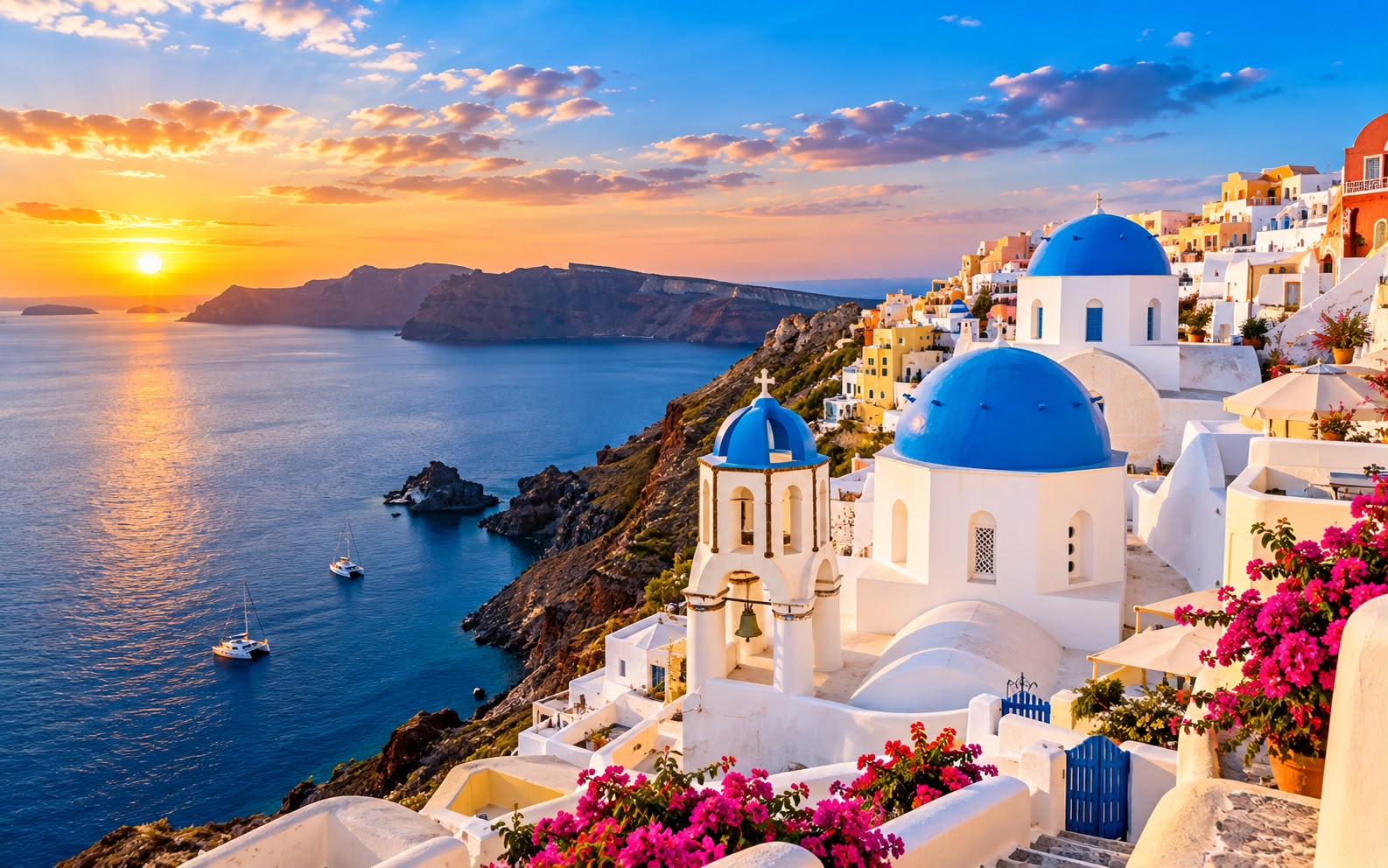
Greece in 10 days: Athens, Mykonos and Santorini
The Aegean classic with its eyes open: the Acropolis at the 8am slot (the combo ticket is gone — new rules inside), Mykonos decoded sunbed-by-sunbed, then four Santorini days built around the caldera hike, the wine, and the truth about the Oia sunset scrum — plus the Naxos swap that halves the bill for those who'd rather have Greece than the queue.
- Southern Europe
- 10 days
- ≈ AED 8,200 / person
- Couples + first-timers
Before you go
Greece invented half the ideas this site runs on — journeys, hospitality, writing things down — and the classic first trip still earns its fame: marble gods above Athens, an island of windmills and expensive sunbeds, and then Santorini, where a drowned volcano’s rim wears white villages like snow.
This guide does the famous triangle honestly: the Acropolis under its new ticket rules, Mykonos without the bill shock, Santorini built around what’s actually best (the caldera-rim hike, the Bronze-Age city, the wine) rather than just the sunset queue — and, running through it, the Naxos swap box for readers who’d trade the scene for space at half the price.
Go May–June or September–early October — swimming-warm, sane prices, soft light. July–August brings peak crowds, peak caldera rates and the meltemi wind (see the ferry box). April and late October are lovely and cheap with a some-things-shut asterisk. All costs are in euros (EUR).
Before you go: the admin
Visa and the Acropolis rules
- Visa: Greece is Schengen — the full process (VFS Global, €90, EES biometrics live, 4–8 weeks of appointment lead) is in our Schengen visa guide.
- The Acropolis rules changed — current version: entry is €30 year-round (the winter half-price is gone), on mandatory hourly timed slots booked at the official hhticket.gr — and the beloved €30 multi-site combo ticket was discontinued in 2025: the Agora, Olympieion and friends are now separate tickets. Free-entry days still exist (first Sundays Nov–Mar, a handful of national dates) and are gloriously crowded.
The ferry box
- The ferry box (read before booking): conventional ships (Blue Star, ~€43–53 Piraeus→Mykonos, 4h40) are steadier, cheaper, deck-access lovely; high-speed cats (SeaJets et al., ~€80–90, 2h40) are faster and bumpier — and in July–August’s meltemi wind, it’s the fast cats that cancel first. Book on Ferryhopper, arrive 45 min early, take the seasickness tablet before sailing, and never book a ferry-to-flight connection under 6 hours.
Money and pickpockets
- Cards everywhere; carry €50 in small notes for kiosks, buses and chapel candles. Tipping: round up, ~5–10% for table service. Tap water: fine in Athens, bottled on the islands (Santorini’s is desalinated — short showers are island courtesy).
- Athens pickpocket honesty: metro line 3 (airport–Monastiraki) and Monastiraki square are the classic zones — zips forward, phones off café tables.
Day by day
Day 1 — Land in Athens, Plaka at dusk
- Afternoon — Land ATH, a hub with non-stops from most of Europe, the Gulf and beyond. Metro line 3 into town (€9), check in around Plaka/Syntagma/Monastiraki.
- 18:00 — First walk: Plaka’s lanes into Anafiotika — a whitewashed Cycladic mini-village smuggled under the Acropolis cliff — then Monastiraki square’s happy chaos.
- 20:00 — Rooftop dinner with the lit Parthenon floating above the city (Monastiraki’s rooftops make this easy; ~€20–35 pp) — Greece begins properly.
Where to stay in Athens (three nights)
- Luxury: Hotel Grande Bretagne — 4.7/5 on TripAdvisor (~4,700 reviews), the 1874 Syntagma grande dame; the roof garden’s Acropolis view is a landmark itself. ~€400+.
- The value king: The Athens Gate Hotel — 4.5/5 (~5,300 reviews), TripAdvisor’s #1 value: rooftop breakfast facing the Acropolis. ~€180–250.
- Plaka charm: Plaka Hotel — 4.4/5 (~4,400 reviews), in the heart of the old quarter. ~€140–190.
Day 2 — The Acropolis, done right
- 07:45 — At the gate for the 8:00 slot (€30, timed, hhticket.gr — first two slots beat both heat and cruise groups): up past the Propylaia to the Parthenon, the Erechtheion’s caryatids, and the city-to-sea view that explains 2,500 years of real-estate obsession. Two hours; marble is slippery — grippy soles.
- 10:30 — The Acropolis Museum (~€15–20): the originals — caryatids, frieze — over the glass-floor excavation; the top-floor Parthenon hall aligns with the temple through the window.
- 13:00 — Plaka taverna lunch (~€12–18 — gemista, moussaka, the works).
- 15:00 — Ancient Agora (€10 — now a separate ticket, see above): Socrates’ actual workplace, the Temple of Hephaestus (the best-preserved of them all), the rebuilt Stoa’s museum.
- 18:30 — Sunset option A: Lycabettus Hill (funicular or 20-min path) — all Athens pinking below. Option B (book ahead): the coast run to Cape Sounion — Poseidon’s temple over the sea at sundown (~€40–60 tours).
- 21:00 — Souvlaki counter dinner (~€4–6 a stick — the budget’s best friend; chicken versions everywhere).
Day 3 — Athens at street level
- 09:30 — Central Market’s theatre (fish-hall hollering, olive pyramids), coffee in Psyrri’s street-art lanes.
- 12:00 — The National Archaeological Museum (€12): the Mask of Agamemnon, the Antikythera mechanism — the ancient world’s greatest hits under one roof.
- 15:00 — Choose: Athens Riviera tram to a swim (Edem/Vouliagmeni), or Kolonaki café-and-boutique hours, or the Panathenaic Stadium photo (€10 — the 1896 Olympics’ marble horseshoe).
- 19:30 — Last-mainland dinner in Psyrri (live rebetiko music if you’re lucky, ~€18–30). Pack for the boats; big luggage rolls fine on ferries.
Day 4 — Sail to Mykonos
- 07:30 — Metro to Piraeus; Blue Star to Mykonos (~€48, 4h40 of deck coffee and island-spotting — or the 2h40 SeaJets at ~€88 if time beats romance).
- 13:00 — Check in near Mykonos Town (Chora); the maze of white lanes was literally designed to confuse pirates — getting lost is the attraction.
- 17:00 — The circuit: Little Venice’s wave-splashed balconies → the windmills ridge → Paraportiani church’s melted-sugar geometry.
- 19:45 — Sunset with the windmills, then dinner — the Mykonos price honesty: this is Greece’s most expensive table (mains €20–40; the €5 gyros counters two lanes inland are the local counterweight).
Where to stay in Mykonos (two nights)
- Luxury: Myconian Ambassador — 4.7/5 (~2,100 reviews), Relais & Châteaux polish over Platys Gialos. ~€350+.
- The value star: Nissaki Boutique Hotel — 4.9/5 (~2,100 reviews), TripAdvisor’s #1 value: infinity pool, beach-strip location. ~€200–300.
- Sunset-boutique: Aeolos Resort — 4.9/5 (~2,100 reviews), three pools and an evening saxophonist, because Mykonos. ~€220–320.
Day 5 — Delos in the morning, a beach for the afternoon
- 09:00 — Boat to Delos (~€22 return + €12 entry, 30 min): the sacred island where Apollo was born — an entire ancient city open to the sky: the Terrace of the Lions, mosaic-floored villas, the amphitheatre. Three shadeless hours — hat, water, awe. One of Greece’s great sites, criminally underexplained by its neighbour’s nightlife.
- 13:30 — Beach afternoon, decoded: Platys Gialos/Psarou are the scene (sunbeds €40–100+ a pair at the famous clubs — that’s the fee for the postcard); Paraga/Paradise are younger and looser; Agios Sostis (north) is the free, taverna-backed local’s answer. Pick your Mykonos.
- 19:30 — Golden-hour lanes, dinner inland where the prices calm down; pack for the caldera.
Day 6 — Ferry to Santorini, first gasp
- 10:00 — Fast ferry Mykonos → Santorini (~€70–90, 2–3 h; meltemi rules apply).
- 13:00 — Athinios port honesty: the arrival is a cliff-switchback scrum — pre-book the hotel transfer or grab the €2.50 bus; taxis (~€35) vanish fast.
- 14:30 — Check in, walk to the caldera rail — and there it is: a 300-metre cliff of villages hanging over a drowned volcano. The photo does not prepare you; nothing does.
- 17:30 — Fira by golden hour: the cathedral terrace, cliff-lane cafés — and the cable car (€6) down-up to the old port if you want the view from the water. (The donkey rides: skip them — animal-welfare groups have documented the problem for years; the cable car exists.)
- 20:00 — First caldera dinner (~€25–45 pp with the view; €12–18 two lanes back).
Where to stay in Santorini (four nights — the honest maths)
- The caldera splurge: Astra Suites, Imerovigli — long the connoisseurs’ benchmark: Skaros Rock views without Oia’s crush. €400–700 in season.
- Caldera view on a budget: Keti Hotel, Fira — the famous little cliff-ledge cheat code. ~€180–280.
- The value base: Kamari or Perissa black-sand beach hotels (€90–150) — sleep by the sea, visit the caldera daily by €1.80 bus.
- The hack: two caldera nights + two beach nights = the photos and the budget.
Day 7 — The caldera hike, Oia, and the sunset truth
- 08:00 — The Fira → Oia caldera-rim hike: 10 km, 3–4 hours, the entire volcano at your left shoulder through Firostefani, Imerovigli and the empty middle miles. Start early (no shade), carry water — this is the single best thing on the island, and it’s free.
- 12:30 — Oia: blue domes, marble lanes, bookshop-and-gallery browsing before the coaches peak.
- 14:00 — Descend the 300 steps to Ammoudi Bay: fried tomato balls and grilled octopus at the water’s edge (~€20–30); the brave swim off the rocks to the islet.
- 17:30 — The sunset truth: Oia’s castle viewpoint at sunset is a stadium crush (claim a spot 90+ minutes early, then defend it). The connoisseur alternatives: watch from Ammoudi below, from Imerovigli’s Skaros Rock, or from your own hotel rail — same sun, no scrum. Choose once, without FOMO.
- 20:30 — Bus/taxi back; late gyros counts as self-care.
Day 8 — The Bronze Age and the vineyards
- 09:00 — Akrotiri (€12): the “Pompeii of the Aegean” — a 3,600-year-old city preserved by the very eruption that made the caldera, with three-storey houses and frescoed rooms under a cool roof. Add the Red Beach viewpoint next door (look, don’t linger under the cliff — landslides are real).
- 13:00 — Lunch in Pyrgos village (the locals’ hilltop favourite; castle-top view free).
- 15:00 — Wine afternoon: Santorini’s vines grow in ground-hugging baskets against the wind — taste assyrtiko and sweet vinsanto at Santo Wines or Venetsanos (~€25–40 pp, caldera terrace included).
- 18:30 — Skaros Rock, Imerovigli for the free sunset the Oia crowd never finds.
- 20:30 — The dinner you dressed for (~€35–60 pp on the rim) — or tomato fritters and fava at a Pyrgos taverna for a third of it.
Day 9 — Black sand, blue water (or the catamaran)
- Option A — the beach day: Perissa/Perivolos black sand (loungers ~€10–20 — island-normal prices return), lunch barefoot, Kamari promenade stroll.
- Option B — the splurge that earns it: a caldera catamaran half-day (~€120–150 pp, small-group: hot springs, Red/White beach swims, BBQ and drinks aboard, sunset from the water) — consistently the trip’s five-star memory for couples.
- 19:30 — Farewell dinner on the rim; the lights of Fira spill down the cliff like the lava never quite did.
Day 10 — Home from JTR
- Morning — Santorini’s little airport flies to Athens (45 min, €60–120) and, in season, direct to Europe’s hubs — connect home from either. Last look from the plane window: the caldera draws its own map applause.
Costs and practicalities
Best time to visit
May–June and September–early October. July and August are hot, expensive and crowded, and the meltemi wind can cancel ferries in the Cyclades for days at a time.
- May–June — the islands open, the sea is swimmable from late May, the archaeology is comfortable to walk, and the wildflowers are out.
- July–August — peak. Athens passes 38°C, Santorini and Mykonos are at capacity, and the meltemi blows hardest in July and August, which is the reason ferries get cancelled.
- September–early October — the best of the year. The sea is at its warmest, the crowds thin after the first week of September, and the prices fall.
- November–April — most island tourism closes entirely, ferries drop to winter schedules, and Athens becomes a normal and very pleasant European city. The Acropolis in February with nobody on it is a real experience.
Travel tips
- The Acropolis has a daily visitor cap and timed entry. Book online, and go at opening or in the last two hours — the midday heat on that rock is serious and there is no shade.
- Ferries are cancelled by wind, not by rain. Build a buffer day before any flight home; the meltemi does not care about your schedule.
- Book ferries ahead in summer, especially for cars. The fast catamarans sell out and are far more weather-sensitive than the big ships.
- Cards are widely accepted since the tax reforms, but carry cash for small tavernas, kiosks and island bakeries.
- Paper goes in the bin, not the toilet, on most islands. The plumbing is narrow and this is not optional.
- Lunch is late and dinner is later — 9pm onwards is normal. A taverna at 7 will be empty.
- Tipping is modest — round up or 5–10% in cash.
What this trip actually costs
Two people, 9 nights (3+2+4), shoulder-season mid-range, international flights excluded:
| Item | Cost |
|---|---|
| Hotels, 9 nights (incl. two caldera-view nights) | EUR 1,900 (≈ AED 7,780) |
| Ferries: Piraeus→Mykonos + Mykonos→Santorini | EUR 260 (≈ AED 1,065) |
| Local transport: metro, island buses, cable car, port transfers | EUR 110 (≈ AED 450) |
| Sights: Acropolis + museum, Agora, Delos boat + entry, Akrotiri, wine tasting | EUR 270 (≈ AED 1,106) |
| Food, 10 days (taverna-to-rim mix) | EUR 1,100 (≈ AED 4,504) |
| eSIM, extras | EUR 40 (≈ AED 164) |
| Buffer: the catamaran, a Mykonos sunbed, Sounion sunset | EUR 320 (≈ AED 1,310) |
| Total for two | EUR 4,000 (≈ AED 16,378) |
- Roughly EUR 2,000 (≈ AED 8,189) per person — Aegean-tier pricing sits between Italy and Switzerland, and the two famous islands are why. The Naxos swap, priced honestly: replace Mykonos with Naxos (same ferry line, hotels at half, Greece’s best island beaches, hill villages with no queue) and the trip drops toward EUR 1,600 (≈ AED 6,551) pp — the version Greeks themselves book. July–August caldera rooms alone can add €800 to the total.
- Book in this order: Schengen visa (VFS, 4–8 weeks) → flights (ATH in / JTR or ATH out) → Santorini caldera hotel (the season’s true sellout — months ahead for May–Sept) → Athens and Mykonos hotels free-cancel → Acropolis 8am slot at hhticket.gr → ferries on Ferryhopper (weeks ahead in season) → catamaran and wine tasting a few days out → the caldera hike is free and never full at 8am.
- Hotel and restaurant picks here are unsponsored — no affiliate links in this article. Chosen on location and current ratings; always check prices and recent reviews before booking.
What to pack
- Grippy sandals/trainers — marble (Acropolis) and caldera cobbles both polish slick.
- Sun kit at Aegean strength: hat, SPF50, refillable bottle; there is no shade on Delos or the rim hike.
- A light layer for ferry decks and meltemi evenings — the wind is real even in August.
- Swimwear ×2, snorkel mask for Ammoudi’s rocks, reef-safe sunscreen.
- Modest cover for monasteries and churches (shoulders/knees; a scarf solves it).
- The seasickness tablets — before boarding, not after; motion-sensitive travellers pick Blue Star over the cats.
FAQ
Two islands in 10 days — not three? Two, firmly. Every island change costs half a day of port logistics, and Santorini rewards the four nights this plan gives it. Three islands in ten days is a ferry timetable with occasional Greece attached.
Mykonos or the Naxos swap — really? Mykonos is a scene: gorgeous town, glamour, prices to match — and Delos next door is a genuine wonder. Naxos is an island: mountains, Venetian lanes, kilometre beaches, half the bill. First-timers chasing the classic go Mykonos (this guide); returners and families take the swap and rarely look back. There’s no wrong answer, only an honest menu.
Is a caldera-view room worth €400? For one or two nights, almost everyone says yes — coffee on your own rail over the volcano is the island’s core memory. For four nights, the two-plus-two hack (rim + beach base) buys the same photos and a €500 saving. Imerovigli gives Oia’s view without Oia’s crush; that’s the quiet pro move.
When exactly — and how bad is August? Late May–June and September are the answer: 28–30°C, swimmable seas, bookable tables. August works if you’ve booked by March and enjoy company: peak prices, the meltemi’s ferry roulette, and sunset crowds at football-match density.
Halal and vegetarian food? Vegetarians eat like philosophers: gemista, fava, briam, greek salad, spanakopita, tomato fritters — half the taverna menu is meat-free by tradition. Halal is thinner: Athens has a proper halal scene (around Omonia/Metaxourgeio), the islands very little — the working strategy is seafood (everywhere, excellent) plus the veg canon, and chicken gyros where the counter confirms sourcing.
What’s Greece guide #2? Crete (Knossos, Chania, the beach trinity) and the mainland icons (Delphi + Meteora’s sky monasteries) are neck and neck — with the Naxos–Paros slow loop as the wildcard the comments keep requesting.
Prices and entry rules change, and what you need depends on your passport; last checked 8 October 2026, so confirm with the embassy or your airline before booking.


