 The Itinerary
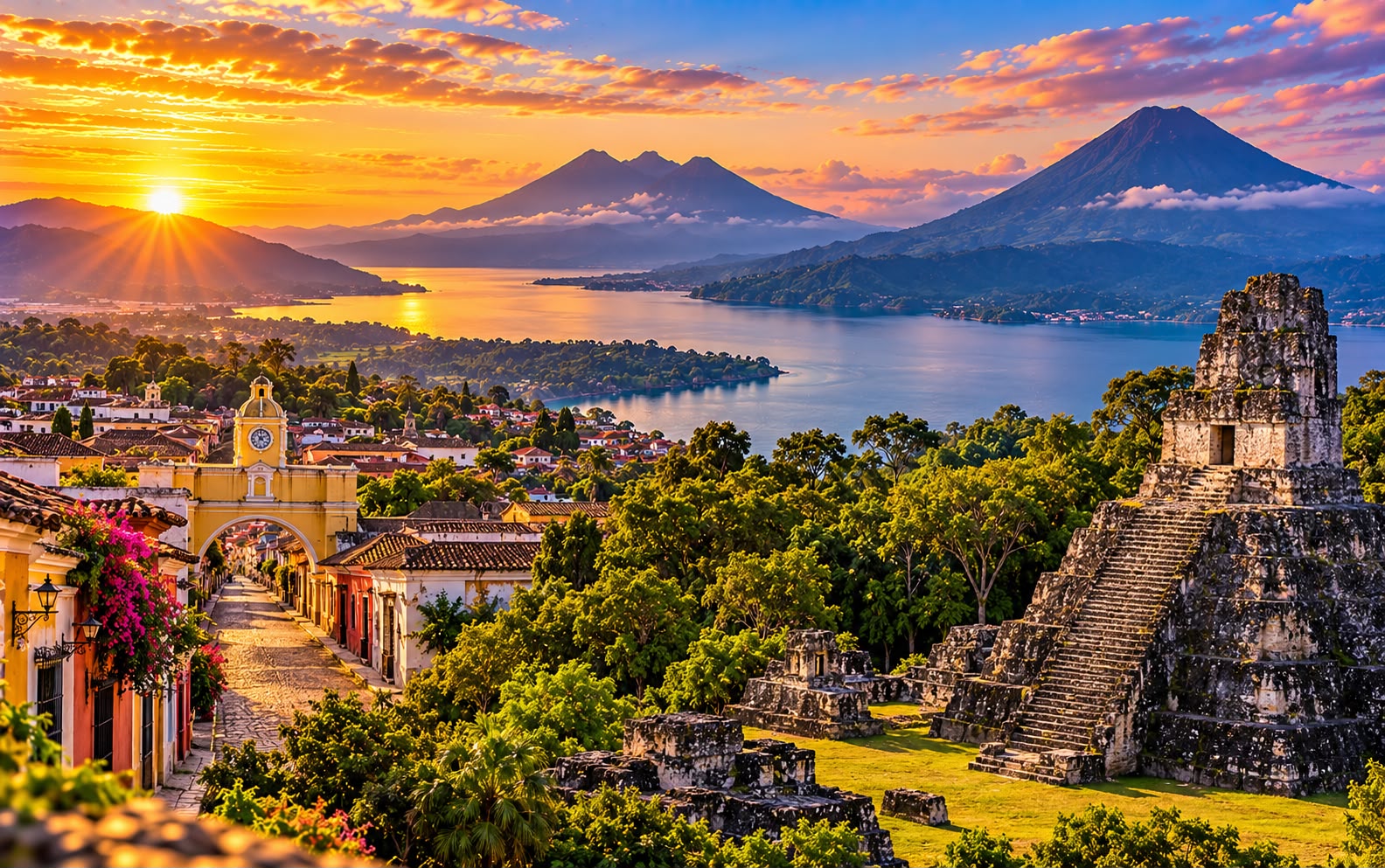
Guatemala in 10 days: Antigua, Lake Atitlán and Tikal
The cultural heart of Central America: a colonial city under three volcanoes, a lake ringed by Maya villages where the language changes shore to shore, and temples rising out of jungle canopy at dawn — with the honest brief on shuttles, the volcano hike worth doing, and the safety advice that is neither alarmist nor naive.
- Mexico and Central America
- 10 days
- ≈ AED 5,300 / person
- Maya sites + volcanoes
Before you go
Guatemala has the Maya heartland, thirty-odd volcanoes, and the best textiles in the Americas, and it sits next to two countries most people visit instead. That is changing, but slowly enough that Tikal at dawn is still a quiet place.
Antigua is a colonial capital flattened by earthquakes and left half-ruined, cobbled, low and beautiful, with Volcán de Fuego erupting on the horizon most evenings. Lake Atitlán fills a collapsed caldera ringed by volcanoes, with a dozen Maya villages around the shore, each with its own dress and sometimes its own language. Tikal is the great Classic Maya city, where temples push up through a rainforest canopy full of howler monkeys.
Ten days does all three, with one internal flight that saves the best part of two days.
Before you go: shuttles, altitude and the honest safety brief
Entry
- Most nationalities enter visa-free for 90 days — the EU, UK, US, Canada, Australia and many others.
- The CA-4 agreement means that 90 days is shared across Guatemala, Honduras, El Salvador and Nicaragua — crossing between them does not reset it.
- Passport valid six months.
Getting around: shuttles, not buses
- Tourist shuttles are how this route is done: shared minibuses between Antigua, Atitlán, Flores and the rest, booked a day ahead through any hostel or agency. They are cheap, direct and comfortable enough.
- Chicken buses — repainted US school buses — are the local network. They are cheap, an experience, and not the sensible way to move luggage across the country.
- Fly Guatemala City to Flores for Tikal. The road is 8–10 hours; the flight is an hour. The overnight bus exists and is the false economy on this trip.
- Roads are winding and slow. Antigua to Atitlán is 3 hours for a distance that looks like one.
Altitude, and the volcano
- Antigua sits at 1,500 m and Atitlán at 1,560 m — enough to feel on the first day, not enough to cause trouble.
- Acatenango is the hike people come for: an overnight climb to around 3,970 m, camping on the ridge opposite Fuego, which erupts through the night. It is hard — six hours up, cold at the top, and the altitude is real. It is also the single most memorable thing in the country.
- Pacaya is the gentle alternative: two to three hours return, lava fields, and you can toast marshmallows on the vents.
The safety brief, plainly
- On this route, in these places, visitors are generally fine. Antigua, Atitlán’s main villages and Flores are well used to tourism and calm.
- Guatemala City is the exception and this itinerary avoids spending time there beyond the airport.
- Do not travel intercity at night, including the overnight buses. This is the single most repeated piece of local advice.
- Use shuttles or registered taxis, not street hails.
- Take what you need and leave the rest — the risk is opportunistic theft, not anything worse.
- Some volcano trails have a history of robberies; go with a registered guide, which you would want anyway.
Money and the small print
- The quetzal (GTQ). Cards work in Antigua, larger hotels and some restaurants; everywhere else is cash.
- ATMs are in the towns and absent in villages. Draw in Antigua or Panajachel.
- Spanish is essential outside hotels — and in the highland villages, Spanish is often a second language after Kaqchikel or Tz’utujil.
- Tap water is not drinkable. Refill from filtered dispensers, which every guesthouse has.
Day by day
Day 1 — Land, and straight to Antigua
- 14:00 — Land at La Aurora (GUA) in Guatemala City and transfer straight out — about an hour to Antigua, and there is no reason to spend a night in the capital.
- 15:30 — Antigua is a grid of cobbled streets under three volcanoes, founded 1543, flattened by earthquake in 1773 and left half-ruined ever since — which is exactly why it looks the way it does.
- 17:00 — The Santa Catalina arch on 5a Avenida, with Agua framed behind it, and the market end of the street.
- 18:30 — Parque Central as the light goes.
- 20:00 — Dinner in a courtyard. Antigua eats well and is considerably more expensive than the rest of the country.
- Note — It is cold at night. Antigua sits at 1,530 m and the volcano days go far higher; bring more warm clothing than “Central America” suggests.
Day 2 — Antigua
- 09:00 — The ruins, and they are the point: Las Capuchinas with its circular tower of nuns’ cells, Santa Clara, and the cathedral — a working façade with the collapsed nave open to the sky behind it.
- 11:30 — Iglesia de La Merced, yellow and intact, with the largest fountain in Central America in its cloister.
- 13:00 — Lunch, then the Jade Museum or a chocolate workshop — bean to bar in two hours, and genuinely about cacao’s role in Maya society rather than a tasting.
- 16:00 — Cerro de la Cruz, 20 minutes’ climb, for the grid laid out below with Agua behind it. Go with others or with the tourist police, who escort walkers up on a schedule.
- 18:30 — If Fuego is active you will see it from the rooftops after dark — it erupts every 15 to 20 minutes, and from Antigua it is a glow and a distant thud.
- 20:00 — Dinner.
Day 3 — Acatenango, or a gentler day
- Option A — Acatenango, 08:00. The overnight hike, and the best thing in Guatemala. Six hours up through farmland, cloud forest and then volcanic scree to a ridge camp at 3,600 m, with Fuego erupting across the valley all night — a kilometre away, at eye level, every twenty minutes, throwing lava into the dark. It is brutally cold, the altitude is real, and almost nobody regrets it. This uses days 3 and 4.
- What it takes — Go with an operator that provides a proper sleeping bag and tent, hire a porter if you are unsure, and do not attempt it on your first day at altitude.
- Option B — Pacaya, 06:00. A half-day instead: a much easier climb on an active volcano where you toast marshmallows on vents. Back by lunch.
- Option B afternoon — A backstrap weaving workshop or the coffee fincas on the slopes above town.
Day 4 — Down from the volcano, or to the lake
- After Acatenango — Down by late morning, then rest in Antigua. You will want to, and your legs will insist.
- Otherwise, 08:00 — Shuttle to Lake Atitlán, about three hours over the highlands.
- 11:30 — Arrive Panajachel, the lakeside town where the road ends, then take a lancha — the public boat — to your village. San Pedro, San Marcos and Santa Cruz are the usual bases; Panajachel itself is the least appealing of them.
- 13:30 — First sight of the lake properly: a flooded caldera 340 m deep, ringed by three volcanoes, with villages at the water’s edge connected mostly by boat.
- 18:00 — Sunset from the dock.
- 20:00 — Dinner.
Day 5 — The lake villages
- 08:30 — Lancha to San Juan La Laguna, and this is the village to spend the morning in: women’s weaving cooperatives using backstrap looms and natural dyes — the plants are grown in the courtyard and they show you the process from leaf to thread. It is the most honest place on the lake to buy textiles, and the money stays in the co-op.
- 11:00 — San Juan’s painted streets and the Rupalaj K’istalin community guides.
- 13:00 — Lunch, then on by boat.
- 14:30 — Santiago Atitlán, the largest and most traditional village, and the shrine of Maximón — a cigar- smoking folk saint, part Maya deity and part Spanish, who moves house every year to a different cofradía member. A small payment and a guide gets you in; take the offering seriously.
- 16:30 — Or San Marcos for the swimming platform at Cerro Tzankujil and the yoga end of the lake.
- 18:00 — Sunset over the volcanoes from the water. The afternoon wind — the Xocomil — gets up around three, so the late boats are rougher; the last ones run around six.
Day 6 — Atitlán, active or slow
- Option A — Indian Nose, 04:00. A 90-minute climb in the dark to the ridge above San Juan for sunrise over the whole caldera, with the three volcanoes catching the first light. Go with a village guide; the trail has had robberies and the co-ops run it properly.
- Option B — the water, 08:00. Kayak the shore from Santa Cruz, which is flat and clear before the wind, or the San Juan–San Pedro path along the hillside.
- Option C — nothing. Entirely defensible.
- 16:00 — Book tomorrow’s shuttle and confirm the Flores flight. This is the day the logistics need attention.
- 19:00 — Last lake dinner.
Day 7 — Chichicastenango, then north
- 06:30 — If it is Thursday or Sunday, go to Chichicastenango — the largest indigenous market in Central America, filling the whole town. Textiles, masks, produce, livestock, and Santo Tomás church, where Maya and Catholic ritual run simultaneously on the same steps, with copal smoke and flower offerings. It is worth reorganising the week around.
- 11:00 — Back, or straight on.
- 13:00 — Shuttle to Guatemala City.
- 16:00 — Fly to Flores, one hour. The alternative is a nine-hour overnight bus, which is cheap and costs you a day.
- 17:30 — Flores: a small island town on Lake Petén Itzá, joined by a causeway, with red roofs and one road round the edge. A genuinely pleasant surprise after the journey.
- 19:30 — Dinner over the water.
Day 8 — Tikal
- 03:30 — The sunrise tour. Into the park in the dark, and up Temple IV before first light.
- 05:30 — Whether the sun actually appears through the mist is a gamble. The sound is not: howler monkeys start in the dark and the noise they make is genuinely unnerving — a deep roar that carries kilometres and sounds nothing like a monkey.
- 07:30 — Temple IV, at 70 m the tallest pre-Columbian structure in the Americas, climbed by a wooden stair to look out over unbroken canopy with the roof combs of other temples pushing through it.
- 09:00 — The Great Plaza — Temples I and II facing each other — the North Acropolis, and the Lost World pyramid. Tikal was a city of perhaps 60,000 at its peak and what is cleared is a fraction of it; mounds in the forest are buildings.
- 12:00 — Out before the heat, or stay in the park hotels and go back in at four when the day tours have gone and you have the plaza to yourself.
- 19:00 — Back in Flores.
Day 9 — Yaxhá, or the lake
- Option A — Yaxhá, 13:00. A smaller site on a lake an hour away, far quieter than Tikal, where you climb Structure 216 for sunset over two lakes and the forest. Howler monkeys again, and perhaps a dozen other people.
- Option B — slow, 09:00. Flores itself: swim off the causeway, take a lancha to San Miguel across the water for the viewpoint, and do very little.
- 18:00 — Fly back to Guatemala City.
- 20:00 — Sleep near the airport, not in Antigua — the morning transfer back is an hour you will not want.
Day 10 — Fly home
- Morning — Most international departures leave La Aurora in the morning, and the airport is small and straightforward.
- Note — Keep some quetzales for the departure formalities and a last coffee, but not many; they are hard to change elsewhere.
Costs and practicalities
Best time to visit
November–April is the dry season and the practical window, with the caveat that the highlands are cool and the Petén is hot in every month.
- November–April — dry, clear, and the best for volcano climbs and for Tikal. December to February has the clearest views of the Atitlán volcanoes and cold nights in the highlands.
- Semana Santa, the week before Easter, is the biggest event in Guatemala — Antigua’s processions and sawdust carpets are extraordinary and the town is booked out a year ahead.
- May–October — the rains, arriving as heavy afternoon storms. Mornings are usually clear, the country is green, and this is the best time for the Acatenango climb to see Fuego erupting against cloud.
- September–October — the wettest, and the months when landslides close highland roads.
Tikal is hot and humid year-round; go at opening for the wildlife and the light.
Travel tips
- Altitude and cold catch people out. Antigua is 1,500m, Atitlán 1,560m, Quetzaltenango 2,330m, and highland nights are genuinely cold. Pack warm layers for a tropical country.
- The Acatenango overnight is hard — 1,500m of ascent to 3,900m, in cold. It is worth it for Fuego, but it is not a casual walk.
- Shuttles, not chicken buses, between tourist towns. The chicken buses are an experience and are also where most robberies of travellers happen.
- Do not photograph children or Maya ceremonies without asking. This is taken seriously, and in rural highland communities it has caused real trouble.
- Cards work in Antigua, Guatemala City and Panajachel; carry quetzales elsewhere, in small notes.
- Lake Atitlán’s boats stop in the early evening and the afternoon wind — the Xocomil — makes the crossing rough from about midday.
- Volcanic activity changes access. Fuego, Pacaya and Santiaguito are all active; follow INSIVUMEH guidance and your guide’s.
What this trip actually costs
Two people, 9 nights, mid-range, excluding international flights:
| Item | Cost |
|---|---|
| Hotels and guesthouses, 9 nights | GTQ 7,000 (≈ AED 3,363) |
| Guatemala City–Flores flights ×2 return | GTQ 4,400 (≈ AED 2,114) |
| Shuttles, boats and transfers | GTQ 2,200 (≈ AED 1,057) |
| Tikal, Yaxhá, Acatenango or Pacaya, guides, workshops | GTQ 4,000 (≈ AED 1,922) |
| Food and drink, 10 days | GTQ 4,000 (≈ AED 1,922) |
| eSIM, extras | GTQ 400 (≈ AED 192) |
| Total for two | GTQ 22,000 (≈ AED 10,569) |
- Roughly GTQ 11,000 (≈ AED 5,284) per person — inexpensive by Central American standards and considerably cheaper than Costa Rica.
- The Flores flight is the biggest single line and the best money on the trip; the alternative is two days on a bus.
- Acatenango is the other significant extra, and worth it.
What to pack
- Warm layers for Acatenango, which is near freezing on the ridge at night even though you started the day in shorts.
- A rain layer — the wet season runs May to October and rains most afternoons.
- Walking shoes with grip for volcanic scree.
- Cash in quetzales for villages and markets.
- Insect repellent for Tikal and the Petén lowlands.
- Type A/B plugs, 120V.
FAQ
Is Guatemala safe? On this route, with the habits above, yes — and it is a far calmer country to travel than its reputation suggests. Avoid intercity travel after dark, skip Guatemala City, and use registered guides on volcano trails.
Is Acatenango worth it? If you are reasonably fit, it is the best thing in the country — an active volcano erupting across a valley all night, from a camp you walked to. If you are not, Pacaya gives you lava for a fraction of the effort.
Should I fly to Flores or take the bus? Fly. The road is eight to ten hours each way and the flight is one. On a ten-day trip the bus costs you two days to save a modest sum.
When should I go? November to April is the dry season and the reliable choice. May to October is green and wet, usually with clear mornings and afternoon rain, and noticeably cheaper.
Prices and entry rules change, and what you need depends on your passport; last checked 8 October 2026, so confirm with the embassy or your airline before booking.


