 The Itinerary
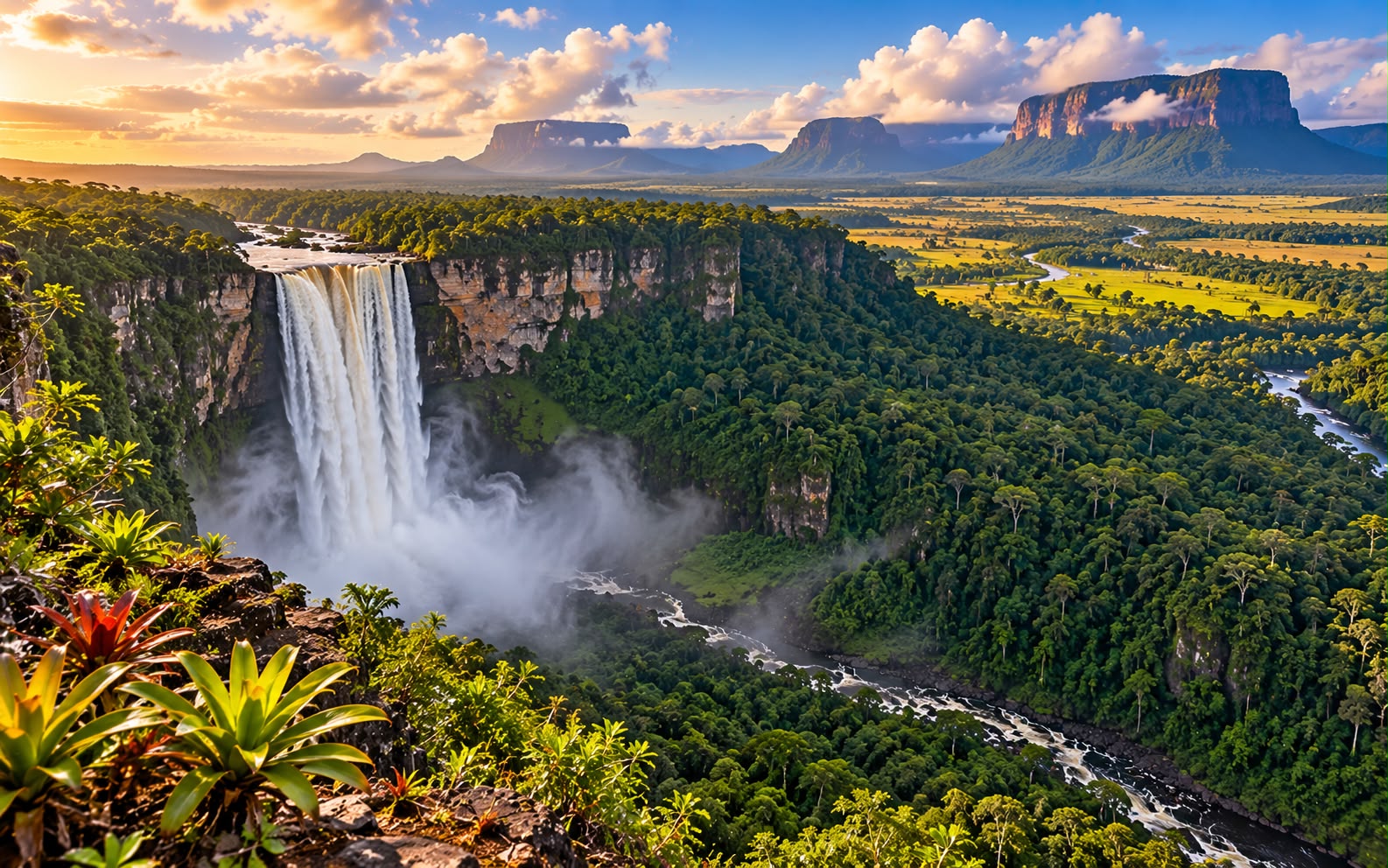
Guyana in 9 days: Kaieteur Falls, Iwokrama and the Rupununi
A single-drop waterfall almost five times the height of Niagara, reached by light aircraft and approached on foot to an unfenced lip where you stand alone — then a rainforest canopy walkway, a river where giant otters and black caiman live, and savannah ranches where the vaqueros still work cattle on horseback.
- The Guianas
- 9 days
- ≈ AED 10,600 / person
- Rainforest with nobody in it
Before you go
Kaieteur Falls drops 226 metres in a single uninterrupted plunge — about five times the height of Niagara — carrying an enormous volume of water off a sandstone plateau into a gorge. It is the largest single-drop waterfall in the world by the combination of height and flow.
What makes it extraordinary is not the statistic. It is that you arrive by light aircraft on a grass strip, walk twenty minutes through forest with a guide, and stand at an unfenced edge with perhaps a dozen other people on the entire plateau. There is no railing, no visitor centre, no queue. Compare that with Iguazú or Victoria Falls and the difference is the whole point of Guyana.
The rest follows: Iwokrama, a million acres of rainforest run as a research reserve with a canopy walkway in it; the Rupununi savannah with ranches you stay on and giant anteaters in the grass; and Georgetown, a Dutch-planned, British-built capital of enormous wooden buildings below sea level.
This is South America’s least-visited mainland country, and it is not a cheap or easy one.
Before you go: cost, logistics and the honest caveats
Entry and health
- Many nationalities enter visa-free, including the UK, EU, US and Canada. Check your own case — the list is narrower than for neighbouring countries.
- Yellow fever vaccination is required and the certificate is checked.
- Malaria is present in the interior, particularly the Rupununi and the forest. Take prophylaxis.
This is an expensive country to travel
- Everything in the interior is reached by light aircraft or by a very long road. The Georgetown–Lethem road is 14–16 hours in the dry season and impassable in the wet.
- Kaieteur is almost always a day flight from Georgetown — weather-dependent, and it is cancelled regularly. Build a spare day.
- Lodges are all-inclusive because there is no alternative within a hundred miles.
- Budget accordingly: this costs more than Brazil or Colombia for the same number of days, and the reason is aviation fuel.
Georgetown, straight
- Georgetown has a genuine crime problem and the standard advice is to be careful. Stay in a reputable hotel, use arranged transport rather than hailing taxis, and do not walk around after dark or in the market areas with valuables.
- The city is worth a day for the architecture and the market. It is not a place to wander aimlessly.
- The interior — the lodges, the river and the savannah — is an entirely different matter and is very safe.
When to go
- Two dry seasons: mid-September to mid-November, and mid-February to late April. These are the times to come.
- Kaieteur is at its most spectacular in the wet (May–August, December–January) when the volume is enormous — but flights are cancelled far more often and the roads close.
- The Rupununi floods in the wet season and becomes a different landscape reached by boat.
- Late September to October is probably the best compromise.
Money and language
- Guyanese dollar (GYD), and the notes carry large numbers. US dollars are widely accepted and often preferred for tours.
- Cash for the interior — there is nothing to draw it from once you leave Georgetown.
- English is the official language, the only South American country where it is — a British colonial inheritance, along with cricket, which matters enormously here.
Day by day
Day 1 — Land in Georgetown
- Most international flights land late at night at Cheddi Jagan (GEO), which is 40 km south of the city — about an hour, and arrange the transfer with your hotel rather than finding one at arrivals.
- 09:00 — Having slept: Stabroek Market, a cast-iron Victorian hall of 1881 under a clock tower, selling everything, and chaotic in a way that is worth seeing. Leave valuables at the hotel and go with a guide or driver.
- 11:00 — St George’s Cathedral, which at 43 m is among the tallest wooden buildings in the world, built in 1892 entirely of greenheart timber.
- 12:30 — Lunch, then the seawall — Georgetown sits below sea level and is held back by a Dutch-built defence that runs for kilometres, with the whole city walking along it at dusk.
- 15:00 — The Botanical Gardens and the manatees in the ponds there, which are tame enough to hand-feed grass.
- 17:00 — The Promenade Gardens and the wooden colonial houses on Main Street, built on stilts with Demerara shutters.
- 19:00 — Dinner. Guyanese food is the mix the country is: pepperpot (an Amerindian dish of cassareep-stewed meat), curry and roti from the Indian majority, Chinese, and Creole.
- 20:30 — Confirm the Kaieteur flight and the interior legs.
Day 2 — Kaieteur Falls
- 07:00 — To the domestic terminal at Ogle. The day’s flights go when the weather allows, so there may be a wait.
- 08:30 — The flight in is an hour over unbroken rainforest in a small aircraft — the canopy runs to the horizon in every direction with no road, no clearing and no smoke, and that view alone justifies the ticket.
- 09:30 — Land on a grass strip at the top of the plateau. A ranger meets the plane.
- 10:00 — Walk twenty minutes through forest to the first viewpoint, then a second, then a third — each closer to the lip, each unfenced. At the last you stand at the edge of a 226 m drop with the Potaro River going over beside you and spray coming back up.
- 10:30 — Look for the golden rock frog, which lives its entire life in the water held by giant tank bromeliads on the plateau and is found nowhere else, and the Guianan cock-of- the-rock, orange and absurd, in the forest on the walk.
- 11:30 — Swifts nest behind the water and fly through the falls at dusk to roost, which you will probably not see on a day trip and is worth knowing about.
- 12:30 — Fly back, often with a stop at Orinduik Falls on the Brazilian border — a series of wide stepped cascades over jasper where you can swim.
- 16:00 — Georgetown.
- If it was cancelled — this is why you keep a spare day.
Day 3 — South to Iwokrama
- 07:00 — Fly to Fair View or Annai, about an hour, or take the road if you have a full day and a strong constitution.
- 08:30 — Iwokrama: 371,000 hectares of rainforest given by Guyana to the international community in 1989 as a living experiment in whether a forest can be used sustainably and still function. It is run jointly with the Amerindian communities who live in it.
- 10:00 — Settle at Iwokrama River Lodge on the Essequibo — Guyana’s great river, a kilometre wide here.
- 12:00 — Lunch, then the heat.
- 15:30 — A river trip: black caiman — the largest predator in the Amazon basin, up to five metres — are studied here and seen regularly, plus river otters and dozens of bird species on the banks.
- 18:30 — Spotlighting on the water after dark for caiman eyeshine, which is unnerving in a small boat.
- 20:00 — Dinner at the lodge, and the forest at night is extremely loud.
Day 4 — The canopy walkway
- 05:30 — Out early for the Iwokrama Canopy Walkway: a series of suspension bridges and platforms 30 m up in the canopy, 154 m long, and you are at the level where the birds and monkeys actually live.
- 06:00 — Dawn from the platforms is the point — toucans, macaws, spider monkeys and howlers, and the forest waking up underneath you.
- 08:30 — Breakfast at Atta Lodge.
- 10:30 — A forest walk with an Amerindian guide, which is where you learn what every plant is for. Iwokrama has the highest recorded density of jaguar in the world and sightings on the forest road are a genuine possibility — rare, but people do see them here.
- 13:00 — Lunch, rest.
- 16:00 — Turtle Mountain if you have the legs: a 90-minute climb through forest to a bare summit with the canopy stretching unbroken to the horizon on all sides.
- 19:00 — Dinner.
Day 5 — To the Rupununi
- 07:30 — South out of the forest, and within an hour the landscape changes completely: the trees stop and the Rupununi savannah begins — open grassland with termite mounds, scattered palms and mountains on the horizon.
- 10:00 — Annai and the Makushi villages at the forest edge.
- 12:00 — Arrive at a ranch — Karanambu, Rock View or Caiman House, depending on your route.
- 13:00 — Lunch, then the afternoon off.
- 16:00 — Karanambu was Diane McTurk’s ranch, where she rehabilitated giant river otters for decades — they are up to 1.8 m long and the work continues.
- 17:30 — Out on the river or the savannah at dusk for giant anteaters, which are most active in the cool and are one of the most reliable sightings here.
- 19:30 — Dinner at the ranch table with whoever else is staying, which will be four people.
Day 6 — The savannah and the lily
- 05:30 — Out at first light. The Rupununi holds giant anteater, capybara, black caiman, and over 400 bird species in open country where you can actually see them.
- 08:00 — Breakfast.
- 10:00 — A Makushi or Wapishana village visit, arranged through the ranch — cassava processing, the bitter kind that must be pressed to remove the cyanide, which is the staple here.
- 13:00 — Lunch, rest.
- 16:00 — By boat on the Rupununi River to a pond of Victoria amazonica — the giant water lily, with pads up to three metres across that will hold a child’s weight. The flowers open white at dusk, are pollinated by a beetle they trap overnight, and reopen pink the next evening. Timing the boat for that is the evening’s point.
- 18:30 — Arapaima — the largest freshwater scaled fish in the world, up to three metres — surface to breathe air in the ponds here, and the local communities run the conservation programme that brought them back.
- 20:00 — Dinner.
Day 7 — Deeper south, or back north
- Option A — south, 08:00. Dadanawa or the deep Rupununi, where the ranches are vast and the vaqueros still work cattle on horseback. This is as remote as the country gets without a serious expedition.
- Option B — Surama, 08:00. A Makushi village that owns and runs its own eco-lodge — you stay in the community, climb Surama Mountain before dawn for the view over the savannah, and the money goes to the village directly. It is the best community tourism in the country.
- 13:00 — Lunch.
- 16:00 — A final savannah drive, or the river.
- 19:00 — Dinner under a sky with no settlement for a hundred kilometres in any direction.
Day 8 — Back to Georgetown
- 09:00 — Fly back from Annai or Lethem, about an hour and a half, over the forest again.
- 11:30 — Georgetown. A shower and a change.
- 13:00 — Lunch, then the Guyana National Museum or the Walter Roth Museum of Anthropology, which is small and good on the nine Amerindian nations.
- 16:00 — The Demerara name on your rum bottle at home comes from the river here — a distillery tour or at least a tasting of El Dorado, which is made at Diamond on the Demerara and is among the best rum in the world.
- 19:30 — Last dinner.
Day 9 — Fly home
- Morning — Cheddi Jagan is 40 km out, about an hour, and most international departures are very late at night — so the last day is usually free and the night is not. Arrange transport through the hotel.
- If you have the day — the Demerara Harbour Bridge and a trip up the Essequibo to Fort Island, with its 1743 Dutch fort and church.
- Last buy — El Dorado 15-year, and Amerindian basketry from the Hibiscus craft centre.
Costs and practicalities
Best time to visit
Guyana has two dry seasons, which gives more flexibility than most of the region — but Kaieteur’s volume and the savanna roads pull in opposite directions.
- Mid-September–mid-November — the long dry season. Best for the Rupununi savanna roads and for wildlife at Karanambu and Caiman House.
- Mid-February–April — the short dry season, and generally the best overall compromise.
- May–August and December–January — the two rainy seasons. Kaieteur is at its most thunderous after rain, and the flight in is more likely to be cancelled for cloud.
- Giant river otters, black caiman and arapaima in the Rupununi are easiest in the dry, when the water drops and concentrates them.
- Leatherback turtles nest at Shell Beach from March to August.
Kaieteur is a single-drop fall of 226m — nearly five times Niagara — and runs in every season.
Travel tips
- This is the only English-speaking country in South America, which makes it far easier to travel than its neighbours.
- Internal flights are small and weight-limited, and Kaieteur day flights are cancelled for cloud without much notice. Build a spare day.
- The Rupununi is reached by a long unpaved road or by air. In the wet, the road is not an option.
- Bring US dollars in cash to change; the Guyanese dollar comes in large numbers and cards work in Georgetown hotels only.
- Georgetown has real street-crime risk after dark. Use arranged transport and do not walk at night.
- A yellow fever certificate is required and checked. Malaria prophylaxis for the interior.
- Interior lodges are community-owned in several cases — Surama, Rewa — and staying there is how tourism money reaches the villages.
What this trip actually costs
Two people, 8 nights, lodges and ranches all-inclusive, excluding international flights:
| Item | Cost |
|---|---|
| Georgetown hotel, 3 nights | GYD 120,000 (≈ AED 2,101) |
| Iwokrama and Rupununi lodges, 5 nights, all-inclusive, two people | GYD 460,000 (≈ AED 8,055) |
| Kaieteur day flight, two people | GYD 230,000 (≈ AED 4,027) |
| Interior flights, two people | GYD 290,000 (≈ AED 5,078) |
| Transfers, guides, village and park fees | GYD 60,000 (≈ AED 1,051) |
| Food and drink in Georgetown, extras | GYD 50,000 (≈ AED 875) |
| Total for two | GYD 1,210,000 (≈ AED 21,187) |
- Roughly GYD 605,000 (≈ AED 10,593) per person — about USD 2,900, and Guyana is expensive: more than Brazil, Colombia or Peru for the same days.
- Aviation is why. Roughly 40% of this is flying, and there is no realistic alternative on a nine-day trip.
- The road to Lethem takes 14–16 hours in the dry season and saves a great deal of money if you have the time and the stamina.
- Lodges are all-inclusive because there is nowhere else to eat.
What to pack
- Long sleeves and trousers, light coloured, for the forest and the savannah — this is both sun and insect protection.
- Serious repellent and malaria prophylaxis.
- Binoculars. This is a birding country of the first rank and the trip is half-wasted without them.
- A head torch, and a spare. The lodges run generators for a few hours.
- Dry bags for every boat, and rain gear — it is a rainforest and the dry season is only relatively dry.
- Cash in USD and GYD for the interior.
- UK-style Type G and US Type A plugs both occur, 240V.
FAQ
Is Kaieteur really better than Iguazú or Victoria Falls? Different, and the case for it is solitude. It is the largest single-drop waterfall in the world by height and volume combined — 226 m in one plunge — and you stand at an unfenced edge with perhaps a dozen people on the whole plateau. Iguazú and Victoria are bigger spectacles with thousands of visitors and walkways. If being alone with it matters, nothing compares.
What if the flight is cancelled? It happens regularly, and weather is the reason. Build a spare day in Georgetown, and book Kaieteur early in your trip rather than on the last day so there is a second chance.
Is Georgetown safe? It has a real crime problem and warrants genuine care — arranged transport, a reputable hotel, nothing on display, and no walking after dark. The interior is completely different and is very safe. Treat them as two separate places, because they are.
Will I see a jaguar? Possibly, which is more than most places can say — Iwokrama has the highest recorded jaguar density in the world and the forest road produces sightings. It is still luck. Giant anteater, giant otter, black caiman and arapaima are all far more likely.
When should I go? Mid-September to mid-November or mid-February to late April, the two dry seasons. The falls are at their most powerful in the wet, when flights are cancelled most often.
Prices and entry rules change, and what you need depends on your passport; last checked 8 October 2026, so confirm with the embassy or your airline before booking.


