 The Itinerary
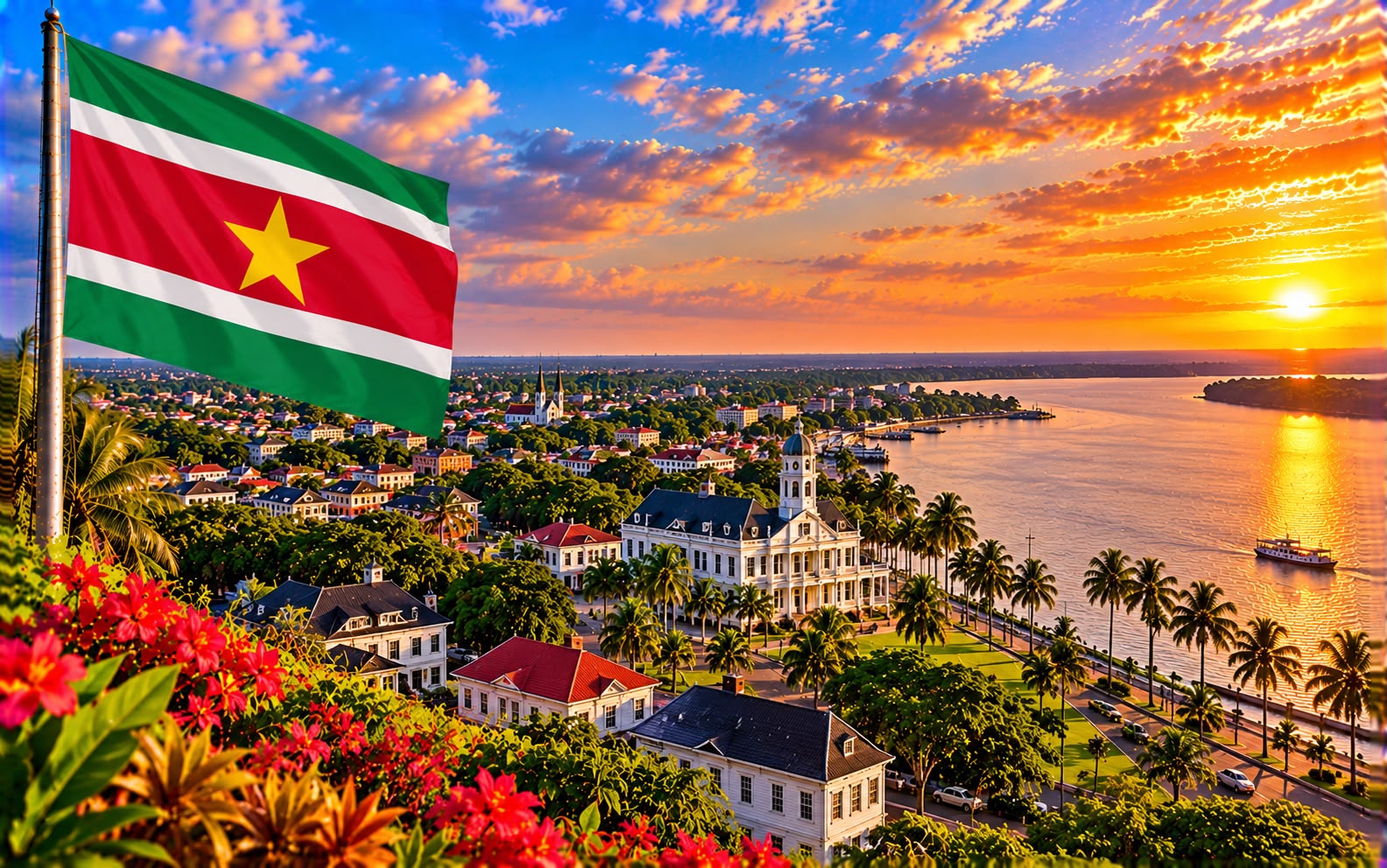
Suriname in 8 days: Paramaribo's wooden city, the Upper Suriname river and Galibi
The only Dutch-speaking country in South America — ninety per cent rainforest, a UNESCO capital built entirely of white timber, and river villages founded by people who escaped slavery and were never recaptured.
- The Guianas
- 8 days
- ≈ AED 2,350 / person
- A Dutch wooden capital in the Amazon, and Maroon villages up a jungle river
Before you go
Suriname is the smallest sovereign state in South America and one of the strangest. It is Dutch-speaking, it is over ninety per cent rainforest, and its population — fewer than two-thirds of a million — is a mixture of Indian, Javanese, Creole, Maroon, Chinese, Indigenous and Dutch descent that has produced a country where a mosque and a synagogue stand next door to each other in the capital and share a car park.
Paramaribo’s historic inner city is on the UNESCO list and is unlike any other colonial centre in the Americas: white-painted timber buildings, Dutch in proportion and tropical in construction, with Fort Zeelandia on the riverfront and Saint Peter and Paul Cathedral — one of the largest wooden buildings in the hemisphere — in the middle of it.
The Maroons are what makes the interior remarkable. Enslaved people who escaped the Dutch plantations from the seventeenth century onwards fled upriver, fought the colonial authorities to a standstill, and signed treaties in the 1760s recognising their freedom and their territory — a century before abolition. Their descendants still live in villages along the Upper Suriname river, with their own languages, and several run the lodges you stay in.
And Galibi, on the Marowijne at the Guianese border, is one of the most important leatherback turtle nesting beaches in the world.
Eight days. Figure SRD 24,000 (≈ AED 2,342) per person excluding flights. Go February–April or August–November, the drier windows.
Before you go: the 15-minute admin
Money, which has been volatile
- The Surinamese dollar (SRD), which has been devalued heavily and repeatedly in recent years. Any figure in an older guide is wrong — check the rate close to travel.
- Bring US dollars or euros in cash to change. Cards work in a few Paramaribo hotels and almost nowhere else.
- There is an official rate and a street rate; use your hotel or a cambio rather than an individual.
- Costs on the ground are low; the interior lodges and the domestic flights are what you pay for.
Visas and health
- A tourist card or e-visa is required by most nationalities and is applied for online before travel. Check the official portal.
- Yellow fever vaccination is required if arriving from an endemic country, and is sensible regardless given the interior.
- Malaria risk exists in the interior, not in Paramaribo. Take advice.
- Dengue is present. Repellent matters more than anything.
Getting around
- Paramaribo is walkable; the rest of the country is not.
- The interior is reached by bus-then-boat or by light aircraft. The Upper Suriname river lodges arrange a road transfer to Atjoni and a dugout canoe upriver from there — three to six hours total.
- Domestic flights (Gum Air, Blue Wing) reach the deep interior airstrips.
- Hire a car for the coastal strip and Commewijne if you want independence; driving is on the left, which surprises people.
- There is essentially no road network into the interior. The rivers are the roads.
Language
- Dutch is official and is the language of government and education.
- Sranan Tongo is the lingua franca that everyone actually uses across communities, an English-based creole you will half-follow.
- English is reasonably widely spoken in Paramaribo. Some Dutch helps a great deal.
Travelling with kids?
- The river trips are long and open; the canoes are stable but basic.
- Turtle watching at Galibi is after dark and involves a long boat journey.
- Malaria and dengue precautions matter in the interior.
Day by day
Day 1 — Paramaribo
- Afternoon — Arrive at Johan Adolf Pengel, about 45 minutes from town.
- 16:00 — The historic inner city: Fort Zeelandia on the river, the Presidential Palace, and the white timber streets around Waterkant.
- 17:30 — The Saint Peter and Paul Cathedral — twin-towered, entirely of wood inside and out, and one of the largest wooden structures in the Americas — and then the mosque and the synagogue standing side by side on Keizerstraat, which is the image the country uses of itself and is simply true.
- 19:30 — Dinner. Surinamese food is the real draw: Javanese bami and saoto, Indian roti, Chinese, Creole pom, all on the same street.
Where to stay in Paramaribo (three nights across the trip)
- Mid-range: the centre near Waterkant, walkable to everything.
Day 2 — Commewijne and the plantations
- 09:00 — Across the Suriname river to Commewijne, by ferry or over the Jules Wijdenbosch bridge.
- The old plantations — Frederiksdorp, Peperpot, Mariënburg — are the sugar and coffee estates the colony ran on, some restored and some left to the forest. Mariënburg’s rusting sugar factory is extraordinary and grim.
- The best way to do it is by bicycle, which several operators arrange — flat roads along the river dykes past the estates.
- 16:00 — Fort Nieuw Amsterdam, an open-air museum at the confluence, and the dolphin-watching boats that go out at dusk for the Guiana dolphins in the estuary.
Day 3 — Upriver
- 06:00 — The road south to Atjoni, about three hours, then a dugout canoe up the Upper Suriname river for one to three hours depending on the lodge.
- The river is the road. You pass villages, people washing, boats of goods going up and timber coming down.
- Afternoon — Arrive at a Maroon-run lodge. Several are owned and staffed by the villages themselves, which is the kind to choose.
- Evening — The river at dusk. There is no road, no phone signal, and the generator goes off.
Where to stay upriver (three nights)
- Simple: the river lodges between Atjoni and Djumu — thatch, hammocks or basic rooms, full board because there is nowhere else.
Day 4 — The Maroon villages
- Morning — A village visit with someone from it. The Saamaka and Matawai peoples here descend from those who escaped the plantations and fought the Dutch to the 1760s treaties that recognised their autonomy — a century before slavery was abolished in the colony.
- The woodcarving is the visible tradition: doors, stools and paddles cut in interlocking geometric patterns, each with meaning.
- Ask before photographing, always, and expect a village fee, which is right.
- Afternoon — Swim in the river where they tell you it is safe, or walk into the forest with a guide.
Day 5 — The river, and the rapids
- A day on the water. The Gran Dan and Awarradam rapids, granite shelves the river pours over, with pools between them you can sit in.
- Or the forest — the walks from the lodges are good for howler monkeys, toucans, and the sheer scale of what is essentially undisturbed Amazon.
- Suriname is over ninety per cent forested, the highest proportion of any country on earth, and most of it has never been logged.
Day 6 — Back down, and Brownsberg
- Morning — Downriver and back towards the coast.
- Afternoon — Brownsberg Nature Park, on a plateau above the Brokopondo reservoir — a lake created by a dam in the 1960s which flooded 1,500 square kilometres and displaced several thousand Maroons, whose drowned forest still stands out of the water as dead trunks.
- The park has waterfalls, eight monkey species and a view over the reservoir that explains the whole thing.
Day 7 — Galibi and the turtles
- Morning — East to Albina on the Marowijne, then by boat to Galibi Nature Reserve, near the French Guianese border.
- Galibi is one of the world’s most important nesting beaches for leatherback turtles — animals up to two metres long and several hundred kilos, hauling up the sand at night to dig.
- Season runs roughly February to August, peaking around April to June. Green and olive ridley turtles also nest here.
- It is run with the Kalina and Lokono communities who live alongside it, and they guide the beach walks.
- The rules: no white light, no flash, stay behind the animal, and do what the guide says.
- Stay the night in the village; the beach is a night activity.
Day 8 — Back, and fly out
- Morning — Boat and road back to Paramaribo, most of the day.
- If your flight is the same evening, leave very generous margin. Better to come back the day before.
Costs and practicalities
Best time to visit
February–April and August–November are the two dry seasons, which gives more flexibility than the single-season tropics.
- February–April — the short dry season. Good for the interior rivers and for Paramaribo.
- August–November — the long dry season and generally the best: lower water on the rivers, better access to the Central Suriname Nature Reserve, and the most reliable flying weather for the interior strips.
- May–July and December–January — the two rainy seasons, heavy and humid. The interior becomes harder and some lodges close.
- Leatherback and green turtles nest at Galibi from February to August, peaking around April and May — which straddles the wet season and is the reason some trips go then.
Paramaribo is hot and humid year-round, around 30°C with little variation.
Travel tips
- Dutch is the official language — a surprise in South America — with Sranan Tongo as the lingua franca. English is widely understood in Paramaribo.
- The historic inner city of Paramaribo is UNESCO-listed for its Dutch colonial timber architecture, and it is genuinely one of the most distinctive cityscapes in the Americas.
- The interior is reached by small plane or by long riverboat. Lodges arrange both; neither is a casual day trip.
- Bring US dollars or euros to change. The Surinamese dollar has been volatile; cards work in Paramaribo hotels and almost nowhere else.
- A yellow fever certificate is required and malaria prophylaxis is essential for the interior.
- Maroon and Indigenous villages are visited by arrangement with the community, and photography requires permission.
- Suriname is one of the most forested countries on earth — over 90% — and the interior lodges are the point of coming.
What this trip actually costs
Two people, 7 nights, mid-range comfort, flights excluded:
| Item | Cost |
|---|---|
| Paramaribo hotels, 3 nights | SRD 9,000 (≈ AED 878) |
| River lodges, 4 nights, full board | SRD 21,000 (≈ AED 2,050) |
| Transfers, canoes, domestic transport | SRD 12,000 (≈ AED 1,171) |
| Guides, park and village fees | SRD 3,000 (≈ AED 293) |
| Food and drink in Paramaribo | SRD 3,000 (≈ AED 293) |
| Total for two | SRD 48,000 (≈ AED 4,685) |
- Roughly SRD 24,000 (≈ AED 2,342) per person. Check the exchange rate close to travel — the Surinamese dollar has moved a very long way and any conversion here will age.
- The interior is the cost. Paramaribo itself is cheap.
- Maroon-owned lodges cost much the same as the operator-owned ones and the money stays in the village. Ask who owns it.
- Galibi is a two-day commitment by the time you have travelled both ways. Worth it in season, pointless outside it.
- Hotel picks here are chosen on location, not on commission — always check prices and recent reviews before booking.
What to pack
- Strong repellent and long sleeves — dengue in the city, mosquitoes in the interior.
- Malaria prophylaxis if your advice says so for the interior.
- A dry bag, because every interior journey is by open canoe.
- A head torch with a red filter for the turtle beach.
- Cash in US dollars or euros to change.
- Quick-dry clothing. It is humid in every month.
FAQ
Why is it Dutch-speaking? The Dutch took it from the English in 1667 in exchange for New Amsterdam — which became New York. Suriname stayed Dutch until independence in 1975.
Who are the Maroons? Descendants of enslaved people who escaped the plantations and established independent communities upriver. They fought the colonial authorities to treaties in the 1760s recognising their freedom and territory, a century before abolition, and their villages are still there.
When can I see leatherbacks at Galibi? Roughly February to August, peaking April to June. Outside that the journey is not worth making.
Can I combine it with Guyana or French Guiana? Yes — both borders are river crossings and the three Guianas are frequently done together. French Guiana requires a Schengen visa for some nationalities, which catches people out.
How much of the country is forest? Over ninety per cent, the highest proportion of any country, and most of it undisturbed.
Prices and entry rules change, and what you need depends on your passport; last checked 8 October 2026, so confirm with the embassy or your airline before booking.


