 The Itinerary
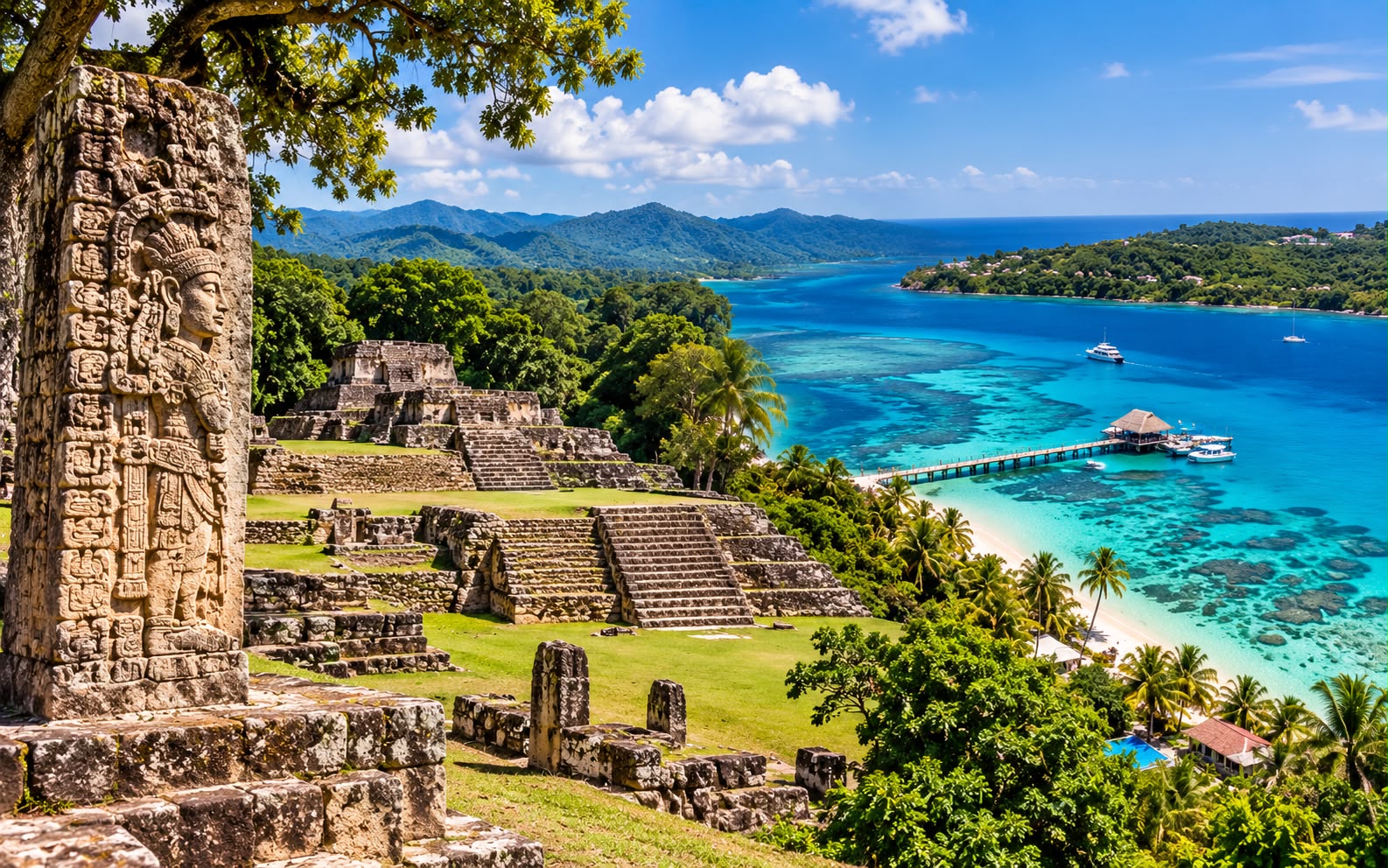
Honduras in 7 days: Copán's Maya city and Roatán's reef
The most finely carved city the Maya ever built, with a stairway of 2,200 glyphs that is the longest Maya text in existence — and, two hours away by air, an island sitting on the second-largest barrier reef on earth.
- Mexico and Central America
- 7 days
- ≈ AED 4,900 / person
- Maya carving, then the world's second-largest reef
Before you go
Honduras has two things that are genuinely world-class and they are at opposite ends of the country.
Copán is the first. Other Maya cities are bigger — Tikal is taller, Chichén Itzá more famous — but none carved like Copán. The stelae in the Great Plaza are cut almost free of the stone in a depth of relief nobody else attempted, and the Hieroglyphic Stairway carries around 2,200 glyphs up sixty-three steps: the longest Maya text that survives anywhere. It is UNESCO-listed, it sits in a small, pleasant town, and it is reachable in an afternoon.
Roatán is the second. The Mesoamerican Barrier Reef is the largest in the hemisphere and the second largest on earth after Australia’s, and Roatán sits directly on it. The wall dives drop off a few hundred metres from shore, and learning to dive here costs a fraction of almost anywhere else.
The shape: Copán Ruinas (2 nights) → Roatán (4). Figure HNL 36,000 (≈ AED 4,916) per person excluding flights. Go February–April — dry, and good visibility on the reef.
Before you go: the 15-minute admin
Current conditions — read this first
- Check your own government’s current travel advice before booking. Advice on Honduras is strongly regional. San Pedro Sula and Tegucigalpa carry serious warnings about violent crime, and most advisories tell visitors to avoid parts of both.
- Copán Ruinas and the Bay Islands are treated very differently and are where effectively all visitors go. This route is built around that: it uses San Pedro Sula as an airport and a road, and does not stay there.
- Conditions change and this site cannot keep current with them. Read your own government’s page before you book.
Visas
- Many nationalities enter visa-free for 90 days.
- The CA-4 agreement shares that 90 days across Honduras, Guatemala, El Salvador and Nicaragua combined — crossing between them does not reset it.
Money
- Honduran lempira, though Roatán runs largely on US dollars and quotes dive packages in them.
- Cards work on Roatán and in Copán town; carry lempiras for buses, markets and tips.
SIM and data
- Tigo and Claro SIMs at San Pedro Sula airport. Coverage is fine in both destinations.
Getting around
- San Pedro Sula (SAP) is the mainland gateway. Copán is about three hours west by road; use a pre-arranged shuttle or private transfer, not public buses, and travel in daylight.
- Roatán has its own airport (RTB) with direct flights from San Pedro Sula, and internationally from several US cities — worth checking, because flying straight in avoids the mainland entirely.
- On Roatán, taxis are shared by default. Agree whether yours is colectivo or private before setting off.
Travelling with kids?
- Roatán is straightforward with children: calm water on the West End side, snorkelling straight off the beach.
- Copán’s ruins involve a lot of open ground and sun — go early.
- The macaw sanctuary at Copán and the island’s dolphin and sloth encounters are the obvious draws.
- Dengue is present. Repellent, morning and evening.
Day by day
Day 1 — Into Copán
- Morning — Fly into San Pedro Sula, meet the pre-booked transfer and drive west, about three hours through tobacco country.
- 14:00 — Arrive Copán Ruinas, a small town of cobbled streets and a single plaza, entirely geared to the ruins and none the worse for it.
- 16:00 — Macaw Mountain, a rescue centre for scarlet macaws — the bird is on Copán’s carvings and was nearly lost from the valley; the released population flies over the ruins now.
- 19:00 — Dinner on the plaza.
Where to stay in Copán Ruinas (two nights)
- Mid-range: hotels around the plaza, most in colonial buildings, all within ten minutes of the site.
- Value: guesthouses a few streets out, very cheap.
Day 2 — The ruins, properly
- 08:00 — Copán Archaeological Park at opening, before the heat and the coaches. The Great Plaza first: stelae of the ruler Waxaklajuun Ub’aah K’awiil — 18 Rabbit — carved so deeply they are nearly sculptures in the round.
- 09:30 — The Hieroglyphic Stairway, sixty-three steps and about 2,200 glyphs, the longest Maya inscription anywhere. It is under a tarpaulin for protection, which is a disappointment until you understand that a 19th-century reconstruction put many blocks back in the wrong order and the text is still being reassembled.
- 11:00 — The Acropolis and the tunnels beneath it, where earlier temples lie buried under later ones — the Rosalila temple survives almost intact inside the pyramid. The tunnel ticket is separate and worth it.
- 13:00 — Lunch, then the Sculpture Museum, which holds the originals from the plaza and a full-size colour reconstruction of Rosalila.
- 16:00 — Las Sepulturas, the residential site a kilometre away, where the nobility actually lived, and usually empty.
Day 3 — To the island
- 08:00 — Transfer back to San Pedro Sula, about three hours.
- 13:00 — Short flight to Roatán, under an hour.
- 15:00 — Check in at West End or West Bay and do nothing else. The reef is a hundred metres offshore.
- 17:30 — Snorkel straight off the beach at Half Moon Bay, then sunset. The island faces west and makes the most of it.
Where to stay on Roatán (four nights)
- Luxury: West Bay, the best beach, resorts directly on the sand.
- Mid-range: West End, the village — dive shops, restaurants, and walkable at night.
- Value: guesthouses behind West End, or Sandy Bay between the two.
Day 4 — Learning to dive, or diving
- 08:00 — If you are not certified, this is the place to become it: Roatán is among the cheapest places in the world to do a PADI Open Water course, usually three days, with wall dives straight after.
- Certified instead? Head for Mary’s Place, a fissure in the reef wall you swim down through, or El Aguila, a wreck in 30 metres.
- 14:00 — Afternoon dive or surface interval on the beach. Decompression rules mean no flying for 24 hours after your last dive — which is why the island comes before the flight home, not after.
- 19:00 — West End for dinner.
Day 5 — The reef, and the rest of the island
- 08:00 — Second day of the course, or two more dives.
- 13:00 — East along the island: Punta Gorda, the oldest Garifuna community on Roatán — an Afro-Indigenous people deported here by the British in 1797, with their own language, drumming and food, all UNESCO-recognised.
- 16:00 — Camp Bay or Little French Key at the quieter east end, where the development stops.
Day 6 — Last dives, or the mangroves
- 08:00 — Final dives and certification, or a mangrove tunnel kayak trip through the channels between Roatán and the smaller cays.
- 13:00 — West Bay beach for the afternoon. The snorkelling off the right-hand end is as good as the diving for anyone who would rather not go under.
- Evening — Last dinner on the water.
Day 7 — Fly home
- Morning — If you dived yesterday, remember the 24-hour no-fly rule and plan the last day as surface time only.
- Midday — Fly out of Roatán directly if you can, or back via San Pedro Sula.
Costs and practicalities
Best time to visit
February–April is the driest and clearest window on the mainland, though the Bay Islands run on a slightly different and more forgiving calendar.
- February–April — dry, clear, and the best for Copán and the western highlands.
- December–January — dry and cooler, and busy with North American visitors. Nortes — cold fronts — can bring choppy water and rain to the north coast and the Bay Islands.
- May–November — the rains on the mainland, arriving as afternoon storms. Green, cheap, and workable.
- September–October — the wettest and the peak of hurricane season.
- Diving on Roatán and Utila is year-round; whale shark season at Utila is most reliable March–April and August–October.
Copán sits in a dry pocket and is comfortable in most months.
Travel tips
- Check current advice for the mainland cities. San Pedro Sula and Tegucigalpa carry significant crime warnings; Copán, the Bay Islands and the Lago de Yojoa corridor are a different proposition.
- The lempira is the currency and US dollars circulate, especially on the Bay Islands where prices are often quoted in dollars.
- Utila is the cheapest place in the world to get a dive certification and the quality varies enormously. Pick the school on safety record, not price.
- Sandflies on the Bay Islands are worse than mosquitoes. Coconut oil is the local remedy and it works better than DEET.
- The ferry from La Ceiba to Roatán and Utila is notoriously rough in the afternoon and during nortes. Take the morning crossing and take something for it.
- Use arranged transport between cities, not public buses, and avoid night travel.
- Copán’s hieroglyphic stairway is covered for conservation; the museum holds the original stelae and is worth the extra ticket.
What this trip actually costs
Two people, 6 nights, mid-range comfort, international flights excluded:
| Item | Cost |
|---|---|
| Hotels, 6 nights | HNL 21,000 (≈ AED 2,867) |
| Diving: Open Water course or ten dives, two people | HNL 20,000 (≈ AED 2,731) |
| Transfers, domestic flights, taxis | HNL 13,000 (≈ AED 1,775) |
| Food and drink, 7 days | HNL 13,000 (≈ AED 1,775) |
| Copán park, tunnels and museum | HNL 5,000 (≈ AED 683) |
| Total for two | HNL 72,000 (≈ AED 9,831) |
- Roughly HNL 36,000 (≈ AED 4,916) per person. Diving is the variable: skip it and this trip drops by about a third.
- Copán’s tunnel ticket is separate from the main entry and is the best money you will spend on the site.
- Roatán is dollar-priced and noticeably more expensive than the mainland. Budget the two halves separately.
- Hotel picks here are chosen on location, not on commission — always check prices and recent reviews before booking.
What to pack
- Reef-safe sunscreen. Standard sunscreen is damaging on a living reef and some operators will refuse it.
- Insect repellent, for Copán in particular — dengue is present across the region.
- A hat and real sun protection for the ruins, which have almost no shade.
- Your dive certification card if you have one, and your logbook.
FAQ
Is it safe? It depends entirely where. Advisories warn seriously about San Pedro Sula and Tegucigalpa, and treat Copán and the Bay Islands quite differently — this route uses the mainland as an airport and a road, in daylight, with pre-arranged transport. Read your own government’s current advice first.
Can I fly straight to Roatán? Often yes, from several US cities and from San Pedro Sula. If you only want the reef, you need not touch the mainland at all.
Is Copán worth it if I have seen Tikal or Chichén Itzá? Yes, and for the opposite reason — it is not about scale. Copán is the finest Maya carving that survives, and the Hieroglyphic Stairway has no equivalent anywhere.
Roatán or Utila? Roatán is more developed with better beaches; Utila is cheaper, scruffier, and known for whale sharks. Divers on a budget pick Utila; most other people pick Roatán.
Prices and entry rules change, and what you need depends on your passport; last checked 8 October 2026, so confirm with the embassy or your airline before booking.


