 The Itinerary
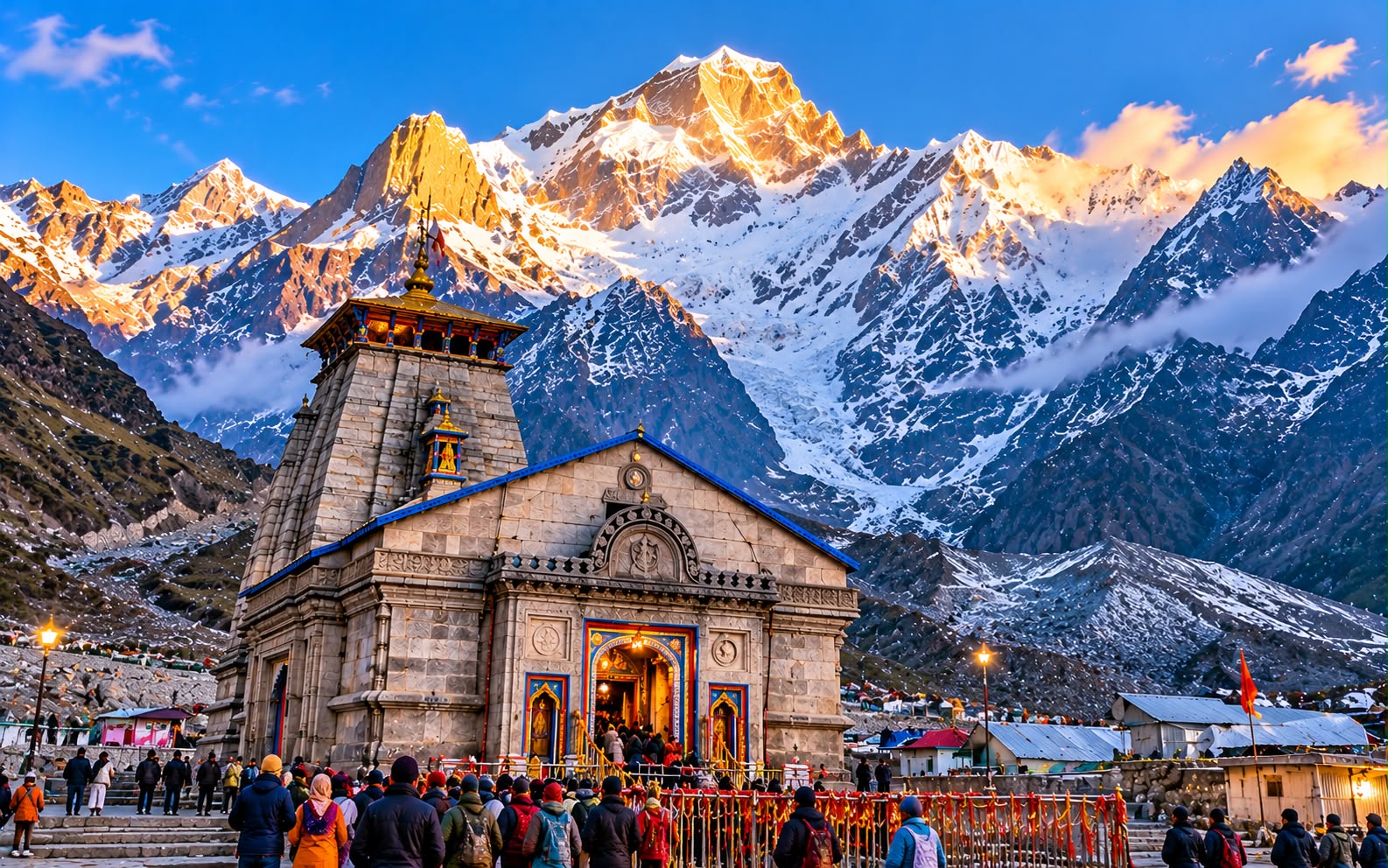
Char Dham Yatra in 10 days: Yamunotri, Gangotri, Kedarnath and Badrinath
Ten days for the four Himalayan shrines in their traditional west-to-east order — a 6km climb to Yamunotri, road access at Gangotri, the 16km ascent to Kedarnath at 3,583m, and Badrinath below the Tibet border. Registration is mandatory, the season is short, and the physical demands are higher than most accounts admit.
- South Asia
- 10 days
- ≈ AED 2,250 / person
- The four Garhwal shrines in the traditional order, with the trekking stated honestly
Before you go
The Char Dham is four Himalayan shrines in Garhwal, visited in a traditional west-to-east order: Yamunotri, Gangotri, Kedarnath, Badrinath. Two are sources of rivers, two are among the holiest sites in Hinduism, and all four sit between 3,000m and 3,600m in mountains that close for half the year.
Three things this page will not soften.
It is physically demanding. Yamunotri is a 6km climb. Kedarnath is 16km on foot from Gaurikund with about 1,500m of ascent, finishing at 3,583m. Ponies, palki and helicopters exist and are heavily used, and even then the days are long, cold and high. Cardiac deaths among pilgrims are reported every season.
The monsoon is genuinely dangerous here. In June 2013, flash floods and landslides killed thousands of people across Garhwal and destroyed much of Kedarnath town. The temple survived; almost nothing around it did. Build the trip for May–June or September–October, and treat July and August as closed.
Registration is mandatory. Nobody travels this route without it.
Figure INR 58,000 (≈ AED 2,265) per person. The shrines open around Akshaya Tritiya (late April or May) and close around Diwali (October or November).
Before you go: registration, which is compulsory
- Every yatri must register through the Uttarakhand government portal before travelling. You will be asked for it at checkposts and at each shrine.
- Register with photo ID for every member of the party, and carry printed copies as well as the digital pass.
- Daily caps apply at each shrine in busy years, and slots can run out at peak season.
- A health declaration is part of it. Take it seriously rather than ticking it.
- Helicopter tickets to Kedarnath are sold separately through the official IRCTC Heliyatra portal, open months ahead, and they sell out within hours. Unofficial resellers are a known problem — book through the official site only.
Before you go: the rest of the admin
Visas
- e-Visa at the official indianvisaonline.gov.in/evisa and nowhere else. You will arrive through Delhi.
- Non-Hindus are not permitted inside some of these temples. Practice varies by shrine and is enforced locally; the settings and the walks are open to everyone.
Health, honestly
- Kedarnath at 3,583m and Badrinath at 3,133m are real altitudes, reached quickly from the plains.
- Get a medical check before you travel if you are over 55, or have cardiac, respiratory or blood-pressure conditions. The Uttarakhand authorities recommend this and the reason is the annual death toll.
- Acclimatise: this itinerary spends nights at increasing heights rather than driving straight up, which is deliberate.
- Symptoms of altitude sickness — headache, nausea, breathlessness at rest — mean stop, not push on.
- Carry your regular medication in hand luggage, with a list.
- Medical posts exist along the Kedarnath path and are busy.
Getting there from the Gulf
- Fly to Delhi, then Haridwar or Dehradun — about 5–6 hours by road, or the train.
- Dehradun (DED) has domestic flights from Delhi and elsewhere.
- Helicopters from Dehradun do same-day Char Dham circuits for a great deal of money; that is a different trip from this one.
Money
- Carry cash — ₹15,000–20,000. ATMs thin out past Rishikesh and the mountain towns run on cash.
- Signal is patchy throughout and absent on the trek sections.
Day by day
Day 1 — Haridwar
- Arrive and settle. Haridwar is where the Ganges leaves the mountains, and one of the seven holiest cities in Hinduism.
- 17:00 — Walk down to Har Ki Pauri and find a place early; it fills.
- 18:30 — Ganga Aarti at Har Ki Pauri: hundreds of lamps set on the current, bells, and a crowd of thousands. The traditional start of the yatra.
- 21:00 — An early night. Tomorrow is seven to eight hours.
Day 2 — To Barkot
- 06:00 — Leave early. Seven to eight hours up through Mussoorie and down into the Yamuna valley, and the mountain roads get slower as the day goes on.
- 10:00 — Kempty Falls if you want to stop, though it is crowded.
- 15:00 — Barkot at 1,220m, a small town and the base for Yamunotri.
- Confirm tomorrow’s pony or palki tonight, with the price and the route agreed.
Day 3 — Yamunotri
- 05:30 — Drive to Janki Chatti, then 6km on foot, climbing about 700m. Start early: the path is busiest and hottest from mid-morning.
- Ponies and palki (carried chairs) are available at the trailhead with rates posted. Agree the price and the route before setting off, including the return.
- 09:30 — Yamunotri temple at 3,293m, the source shrine of the Yamuna. The actual glacier source is higher and not accessible.
- 10:00 — Surya Kund, a hot spring beside the temple, hot enough to cook rice in. Pilgrims lower cloth bundles into it and eat the result as prasad.
- 14:00 — Back down to Barkot, or push on towards Uttarkashi, which makes tomorrow shorter.
Day 4 — To Uttarkashi and Harsil
- 08:00 — To Uttarkashi, about four hours, then on towards Harsil.
- Harsil, below Gangotri, is a beautiful deodar valley and a better place to stay than Gangotri town — quieter, lower, and warmer at night.
- 16:00 — Arrive and rest. You are gaining height steadily now.
Day 5 — Gangotri
- 07:00 — Gangotri at 3,100m, and the good news: the temple is on the road. No trek required, which makes this the gentlest of the four.
- The Bhagirathi river here is the main headstream of the Ganges, and the temple was built in the eighteenth century at the spot where Ganga is said to have descended to earth.
- Gaumukh, the actual glacier snout, is 18km further on foot, needs a separate forest permit and two days, and is a serious trek rather than an add-on.
- 14:00 — Back to Uttarkashi for the night.
Day 6 — The long transfer to Guptkashi
- 05:30 — Leave very early. Eight to ten hours east across the Garhwal ridges, and the hardest driving day of the trip.
- 16:00 — Guptkashi at 1,319m, the staging town for Kedarnath.
- 19:00 — Confirm your helicopter booking or your pony, and repack: you want a daypack only for tomorrow.
Day 7 — Kedarnath
- 05:00 — The big day. 16km on foot from Gaurikund, climbing from 1,980m to 3,583m — six to eight hours up for a fit walker, longer for most. Start in the dark so you are not finishing the climb in the afternoon.
- The alternatives: pony or palki the whole way, or a helicopter from Phata, Sersi or Guptkashi — seven minutes each way, booked months ahead through the official portal only.
- 13:00 — Kedarnath temple, one of the twelve Jyotirlingas, below the Kedarnath peak and the Chorabari glacier. Attributed to Adi Shankara in the eighth century, on an older site.
- The 2013 floods destroyed the town around it. A large boulder diverted the debris flow around the temple and is still there behind it, known locally as Bhim Shila. Much of what you see is rebuilt.
- Stay overnight at Kedarnath if you can get accommodation. The temple at dawn, before the day’s walkers arrive, is the reason people do this. It is freezing at night even in June and the accommodation is very basic.
Day 8 — Down, and on to Badrinath
- 06:00 — The temple at dawn, if you slept up here.
- 08:00 — Descend to Gaurikund. Faster than the climb and much harder on the knees — poles halve the damage.
- 12:00 — Drive towards Joshimath, six to seven hours, passing Rudraprayag and Karnaprayag, two of the five sacred confluences where the Alaknanda meets its tributaries.
- 19:00 — Joshimath, the usual night stop. Parts of the town have suffered serious subsidence since 2023 and some buildings and hotels have been closed; your operator will know the current position.
Day 9 — Badrinath and Mana
- 07:00 — Badrinath at 3,133m, the most accessible of the four — the temple is on the road — and the most visited, so early matters. The brightly painted facade sits against the Neelkanth peak, with the Tapt Kund hot spring below it where pilgrims bathe before entering. One of the four national Char Dham of India as well as the Garhwal four, and the most important of them.
- 10:00 — Mana village, 3km on: the last village before the Tibet border, with Bhotia houses, a cave where the Mahabharata is said to have been dictated, and Bharat’s last tea shop.
- 11:00 — Vasudhara Falls, a 5km walk from Mana, if your legs are still working after Kedarnath.
- 15:00 — Back down towards Rudraprayag or Rishikesh.
Day 10 — Rishikesh, and out
- 09:00 — Rishikesh, where most yatras end.
- 10:00 — Lakshman Jhula and Ram Jhula, the suspension bridges.
- 12:00 — The Beatles Ashram (Chaurasi Kutia): abandoned, covered in murals, and oddly moving.
- 18:30 — Triveni Ghat for the evening aarti, if you are staying the night.
- Dehradun or Haridwar for the train or flight, then Delhi. Leave a buffer before an international connection — this road is long and weather closes it.
Costs and practicalities
Best time to visit
- May to mid-June — the main season. The shrines have just opened, the weather is clear, and it is very busy. Kedarnath is still cold and there may be snow on the path in early May.
- September to October — the better half of the year, honestly: the monsoon has gone, the air is clear, crowds are thinner, and the mountains are visible. The shrines close around Diwali.
- July and August — do not. This is the monsoon, Garhwal’s roads are landslide-prone, and the 2013 disaster happened in mid-June as the monsoon arrived early. The yatra is frequently suspended in these months.
- November to April — the shrines are closed and the deities are moved to winter seats at Ukhimath and Joshimath, where they can be visited.
The season is short and the weather decides it. Check whether the yatra is running before you travel; it is suspended in bad conditions, sometimes for days.
Travel tips
- Register before you go, and carry printed copies.
- Book Kedarnath helicopter tickets on the official portal only, months ahead.
- Get a medical check if you are older or have any cardiac or respiratory history.
- Agree pony and palki rates in advance, with the route and the return.
- Go west to east, in the traditional order. It also happens to build altitude sensibly.
- Stay overnight at Kedarnath if you can — dawn at the temple is the whole point.
- Carry cash.
- Pack for freezing nights even in June.
- Walk slowly. Everyone overtaking you on day one is resting on day two.
- Respect that this is a pilgrimage, not a trek with temples on it. Photography inside the shrines is generally forbidden.
What this trip actually costs
Two people, 9 nights, mid-range comfort, international flights excluded:
| Item | Cost |
|---|---|
| Hotels, 9 nights, incl. one night at Kedarnath | INR 44,000 (≈ AED 1,718) |
| Car and driver, 10 days, including Haridwar and Dehradun runs | INR 42,000 (≈ AED 1,640) |
| Registration, temple entries, ponies or palki, Kedarnath helicopter | INR 16,000 (≈ AED 625) |
| Food and drink, 10 days | INR 10,000 (≈ AED 390) |
| SIM, cash buffer, tips, extras | INR 4,000 (≈ AED 156) |
| Total for two | INR 116,000 (≈ AED 4,530) |
- Roughly INR 58,000 (≈ AED 2,265) per person.
- The helicopter is the swing item. Kedarnath return flights run several thousand rupees per person and the figure above assumes one leg flown and one walked. Walking both ways removes most of that line; flying both ways for two people adds considerably.
- Ponies and palki are priced per person per leg and are the other negotiated cost. Palki for Yamunotri and Kedarnath together can exceed the helicopter.
- Accommodation is simple throughout — this is a pilgrimage circuit, not a resort one, and dharamshalas and guesthouses are the norm. Kedarnath’s accommodation is very basic and limited.
- Food is cheap and overwhelmingly vegetarian. Several of these towns are strictly vegetarian and alcohol-free.
- Hotel picks here are chosen on location, not on commission — always check prices and recent reviews before booking.
What to pack
- Proper warm layers and a windproof. Kedarnath is below freezing at night in June.
- Broken-in walking boots — 16km up and 16km down is not the place for new footwear.
- A walking pole or two, which halve the knee damage on the descent.
- A rain layer, always.
- Your medication, in hand luggage, with a written list.
- Cash.
- A torch for pre-dawn starts and power cuts.
- Modest clothing — covered shoulders and legs at every shrine.
- A light daypack only; porters are available but travel light anyway.
FAQ
How hard is the Kedarnath trek? 16km each way with about 1,500m of ascent, finishing at 3,583m. Six to eight hours up for a fit walker. It is the hardest thing on this site that is not technical mountaineering, and ponies, palki and helicopters exist because most pilgrims use them.
Can I do the Char Dham without trekking? Gangotri and Badrinath are on the road. Yamunotri needs 6km on foot or a pony. Kedarnath needs 16km on foot, a pony, a palki or a helicopter — there is no road.
Is it safe? In season, with registration and sensible health precautions, yes. In the monsoon it is genuinely hazardous — the 2013 disaster killed thousands. Check whether the yatra is running before you travel.
Can non-Hindus visit? The valleys, the walks and the towns, yes. Entry inside some of these temples is restricted to Hindus and is enforced locally.
When do the shrines open and close? Around Akshaya Tritiya in late April or May, and around Diwali in October or November. Exact dates are announced each year.
Is ten days enough? It is the practical minimum for all four at a safe pace. Shorter itineraries exist and they rely on helicopters.
Prices and entry rules change, and what you need depends on your passport; last checked 26 October 2026, so confirm with the embassy or your airline before booking.


