 The Itinerary
Goa in 4 days: north beaches, Old Goa and the Latin Quarter
Four days is North Goa done properly — one base, the beaches between Sinquerim and Arambol, the cathedrals at Old Goa and an evening in Panjim's Latin Quarter. South Goa and Dudhsagar are deliberately left out; at this length the drive would cost you a day.
- South Asia
- 4 days
- ≈ AED 850 / person
- A long weekend in the north, without the drive south
Before you go
Four days in Goa is one base in the north and no long drives. The beaches from Sinquerim up to Arambol, the Portuguese cathedrals at Old Goa, and an evening in Panjim’s Latin Quarter. That is a full and unhurried long weekend.
South Goa and Dudhsagar are left out on purpose. Palolem is ninety minutes each way and a different holiday — quieter, emptier, and worth going to rather than visiting. Dudhsagar needs most of a day and a jeep permit. Seven days does both Goas, the spice farms and the waterfall properly.
Pick one base and stay in it. Goa’s distances are short and its roads are slow; people lose half a short trip moving between beaches they could have driven to in twenty minutes.
Figure INR 22,000 (≈ AED 859) per person. November to February is the season; December into early January is the peak, and priced like it.
Before you go: the short version of the admin
Visas
- e-Visa at the official indianvisaonline.gov.in/evisa — around five working days, 171 nationalities, and only that domain. Print it.
- Indian passport and OCI holders pay domestic rates at the churches and museums, where they charge at all.
- Six months’ validity, two blank pages.
Flying in from the Gulf
- Goa has two airports. Mopa (GOX) in the north is the one you want for this trip — about 40 minutes to the Calangute–Anjuna belt. Dabolim (GOI) is an hour and a bit from the same beaches and closer to the south.
- Direct from Dubai, Abu Dhabi, Sharjah, Doha, Kuwait and Muscat, around three and a half hours.
- Check which airport your ticket says before booking the hotel. Arriving at Dabolim for a Morjim villa is a real and common mistake, and it costs an hour each way.
Money and getting around
- Rent a scooter. ₹400–600 a day, and it is genuinely the way to do Goa. You need an international driving permit plus your home licence; police checks happen and the fine is real.
- Helmets are compulsory and enforced.
- If you would rather not ride: the GoaMiles app is the local taxi service and avoids the famously organised taxi syndicate. Ubers and Olas do not operate freely here.
- UPI QR everywhere, cards at the bigger places, ₹3,000 in small notes for shacks and parking.
Where to base yourself
- Candolim or Sinquerim — calmest of the central beaches, good restaurants, walkable, and the best compromise for a short trip.
- Assagao or Siolim — inland, leafy, converted Portuguese houses, ten minutes from the sand. The best food in Goa is here.
- Anjuna or Vagator — younger, louder, better sunsets.
- Not Baga or Calangute themselves unless the point of the trip is the strip at night.
Day by day
Day 1 — Land, and get your bearings on the sand
- 13:00 — Collect a scooter at the hotel. Most will arrange it and it saves a trip; helmets are compulsory and enforced, and you need your licence plus an international driving permit.
- 15:00 — Sinquerim and Candolim beach, the quieter end of the long northern strand, for the first swim.
- 16:30 — Fort Aguada on the headland above it: a 1612 Portuguese fort, the lighthouse, and a view down the whole coast. Half an hour, and late afternoon is the right light for it.
- 17:30 — Up to Chapora Fort above Vagator, an hour before sunset. It is the view everyone has seen and still worth the short climb.
- 19:30 — Dinner in a beach shack. The whole point of Goa’s shacks is that you eat ten metres from the water. Kingfish, prawn balchão, Goan sausage. Pick the busy one.
Day 2 — Old Goa, and Panjim after dark
- 09:00 — Old Goa, before the heat. This was once a city the size of Lisbon; cholera emptied it and left the churches standing in the grass.
- 09:15 — The Basilica of Bom Jesus, which holds the body of St Francis Xavier in a silver casket, lowered for public viewing roughly once a decade. The laterite facade is deliberately unplastered. Sunday mornings are for mass, not for visitors.
- 10:15 — Sé Cathedral opposite, the largest church in Asia, and the Golden Bell that tolled for the Inquisition.
- 11:00 — St Augustine’s Tower, a belfry ruin standing alone in the grass. The most atmospheric thing in Old Goa and the least visited.
- 12:30 — Back north for lunch and the hot hours. There is no shade in Old Goa and nothing gained by staying.
- 17:00 — A Mandovi river cruise if you want one: touristy, an hour, and quite fun. Skip it for a quiet drink if not.
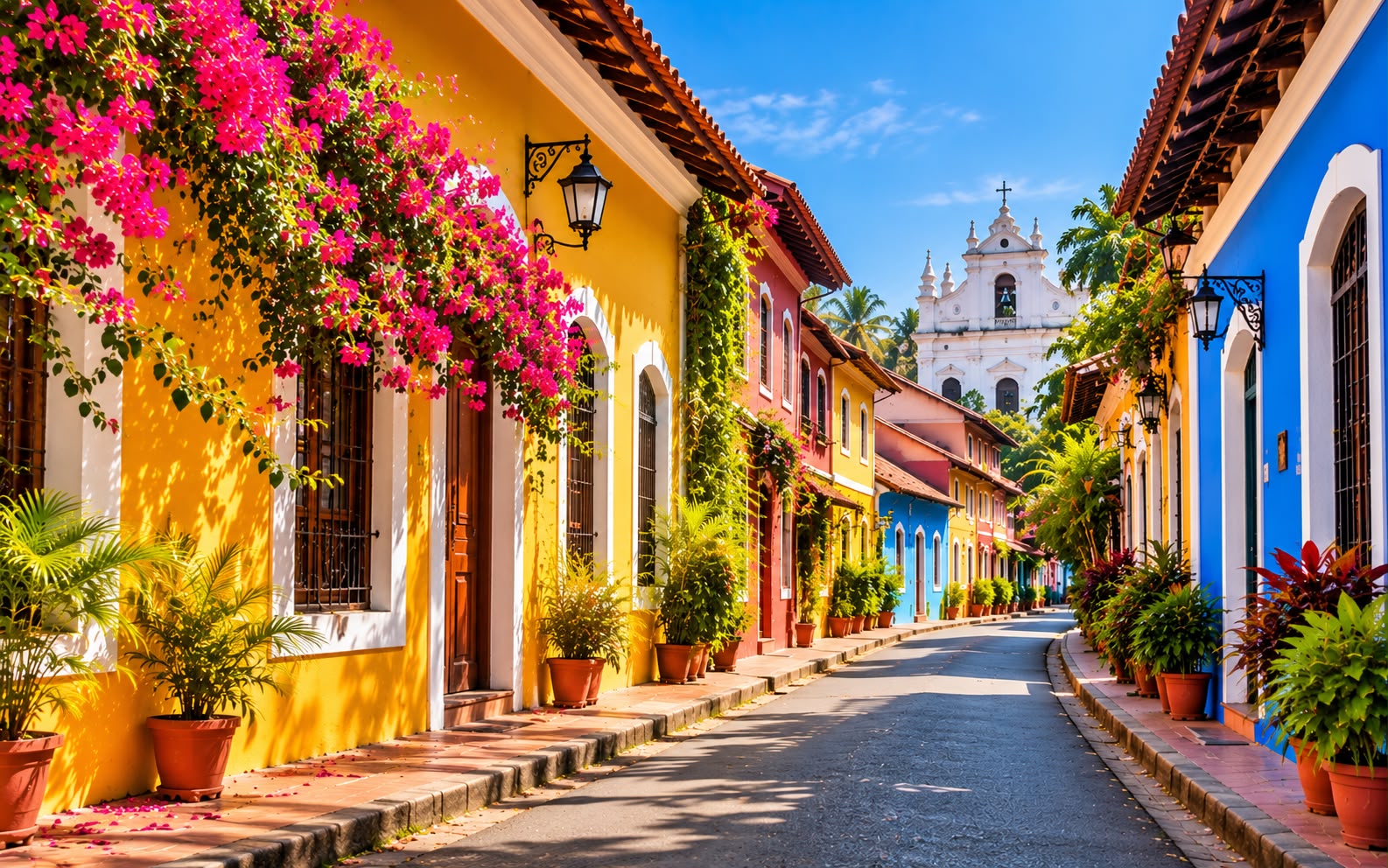
- 18:30 — Panjim’s Fontainhas after dark. The Latin Quarter is a grid of narrow lanes in ochre, blue and green, with Portuguese-tiled house numbers, bougainvillea, and the Chapel of St Sebastian at the end of one of them. Walk it slowly — there is no sight here, the place is the sight.
- 20:00 — Eat in Panjim. This is the best food town in the state and worth the ride back.
Day 3 — The north coast, properly
- 09:00 — Anjuna, the rocky end of the beach. The flea market runs on Wednesdays in season; if your days do not line up, the Saturday night market at Arpora is the better one anyway.
- 11:00 — Assagao and Siolim inland: Portuguese houses, bakeries, and the shops that have made this the fashionable half of Goa.
- 13:00 — Lunch inland, out of the sun.
- 15:00 — Morjim or Ashwem, across the Chapora river — wider, emptier and cleaner sand than anything south of it. Morjim is an olive ridley turtle nesting beach and the roped-off sections in season are not decorative.
- 17:00 — Arambol if you want the far north and the drum circle that builds through the afternoon.
- 18:15 — Sunset with your back to the crowd. Ashwem and Mandrem both deliver.
Day 4 — One last swim
- 07:30 — The beach closest to you, early, before it fills and while the sand is still cool.
- 10:00 — The Saturday market, or a last hour in Panjim, or simply nothing.
- Check your airport once more. Mopa is 40 minutes from the north beaches; Dabolim is 70–90 — and arriving at the wrong one is a real and common mistake.
Costs and practicalities
Best time to visit
- November to February — the season. Dry, 30–32°C, sea warm, and every shack open. Mid-December to the first week of January is the peak: prices triple and the beaches are full.
- Late October and early March — the shoulders, and the best value. The shacks are going up or coming down, but the weather is largely the same.
- March to May — hot and increasingly humid. Still swimmable, much cheaper, noticeably emptier.
- June to September — the monsoon. Most beach shacks are dismantled by law and the sea is genuinely dangerous. Goa is beautiful and green in the rain, but it is not a beach holiday.
The shacks are seasonal structures. They go up around late October and come down in May, which is why the same beach is a different place in July.
Travel tips
- Confirm your airport. Mopa north, Dabolim south.
- Scooter plus an international driving permit, and wear the helmet.
- Use GoaMiles rather than negotiating with the taxi stand.
- Never swim where the flags say not to. Goa’s rip currents drown people every season, and the drowning is almost always a tourist who ignored a flag.
- Beach shacks are fine to eat in and are inspected; pick the busy one.
- Alcohol is cheap here because Goa taxes it differently from the rest of India. Carrying it across the state line is an offence.
- Sunday is not a quiet day in north Goa, and December is not a quiet month.
- Churches want shoulders and knees covered, including at Old Goa.
What this trip actually costs
Two people, 3 nights, mid-range comfort, international flights excluded:
| Item | Cost |
|---|---|
| Hotel, 3 nights, north Goa, mid-range | INR 15,000 (≈ AED 586) |
| Scooter hire, fuel, airport transfers both ways | INR 8,000 (≈ AED 312) |
| Entries, river cruise, markets | INR 3,000 (≈ AED 117) |
| Food and drink, 4 days | INR 14,000 (≈ AED 547) |
| SIM, tips, extras | INR 4,000 (≈ AED 156) |
| Total for two | INR 44,000 (≈ AED 1,718) |
- Roughly INR 22,000 (≈ AED 859) per person — and Goa has the widest spread of any destination on this site. The same four days are genuinely doable on half this in a guesthouse, and genuinely quadruple it at a Vagator villa over New Year.
- The food line is high on purpose. Eating well is most of what people do here, and shack dinners with drinks add up faster than the room.
- Christmas and New Year are a different market. Hotels take minimum stays of five to seven nights and charge two to three times these figures.
- Hotel picks here are chosen on location, not on commission — always check prices and recent reviews before booking.
What to pack
- An international driving permit if you intend to ride. Without it the scooter is technically illegal and the fine is routine.
- Reef-safe sun cream and more of it than you think.
- One set of modest clothes for Old Goa’s churches.
- Mosquito repellent for evenings inland.
- A dry bag if you are riding with a phone in the rain season.
FAQ
Is four days enough for Goa? For the north, yes — comfortably. It is not enough to add the south, and splitting a four-day trip between both ends wastes most of a day on the drive.
North Goa or South Goa? North for beaches with life on them, restaurants and markets. South for quiet, space and better sand. On four days, pick north; it is closer to Mopa and there is more to do when you are not swimming.
Do I need to rent a scooter? Not strictly, but Goa is built around it and taxis here are expensive and syndicated. If you will not ride, base yourself somewhere walkable like Candolim.
Is Goa good in the monsoon? Beautiful, and cheap, and not a beach holiday. The shacks come down and the sea is dangerous.
Is it safe to swim? Where the flags allow, yes. Goa’s rip currents are serious and the lifeguards are good; the people who get into trouble are almost always those who went in at an unflagged beach.
Prices and entry rules change, and what you need depends on your passport; last checked 26 October 2026, so confirm with the embassy or your airline before booking.


