 The Itinerary
Gujarat in 7 days: Ahmedabad, the white Rann, Gir's lions and Somnath
Seven days across Gujarat — Ahmedabad's old pols, the white salt desert of the Rann at full moon, the only wild Asiatic lions left on earth at Gir, and the temple at Somnath. It is a dry state with the best vegetarian food in India and almost no foreign tourists.
- South Asia
- 7 days
- ≈ AED 1,550 / person
- A salt desert, the last wild Asiatic lions, and India's first UNESCO heritage city
Before you go
Seven days in Gujarat is a salt desert, a lion and a heritage city, and almost nobody from outside India does it.
Three things here exist nowhere else. The Great Rann of Kutch is a salt marsh the size of a small country that dries to a blinding white crust every winter. Gir holds the last wild Asiatic lions on earth — a population that fell to a few dozen a century ago and now numbers around 900, all of them in this one forest. And Ahmedabad was India’s first UNESCO World Heritage City, for a dense old quarter of pols that most visitors to India have never heard of.
Two things to know before you commit. Gujarat is a dry state — alcohol is prohibited, with a permit system for visitors. And Gir closes from mid-June to mid-October, which makes this a winter trip twice over.
Figure INR 40,000 (≈ AED 1,562) per person. November to February, with the Rann Utsav running across that window.
Before you go: the short version of the admin
Visas and permits
- e-Visa at the official indianvisaonline.gov.in/evisa and nowhere else. Ahmedabad (AMD) is an e-Visa port of entry.
- The Great Rann is a border area and needs a permit for the white desert at Dhordo. It is issued quickly at the checkpost near Bhirandiyara or in Bhuj — carry passport and visa copies and passport photographs.
- Gir safari permits must be booked online in advance through the Gujarat Forest Department. They release in batches and the good slots go; weekends and holidays sell out weeks ahead.
Alcohol — Gujarat is a dry state
- Prohibition has been in force since 1960. Buying, selling and drinking are all offences for residents.
- Visitors can obtain a liquor permit — foreign tourists and out-of-state visitors apply through authorised hotels or online, with passport and travel proof. Licensed hotel shops then sell limited quantities.
- Do not carry alcohol across the state line. It is taken seriously, and the checkposts are real.
- Honestly, most people simply go without for a week and find the food more than compensates.
Flying in from the Gulf
- Ahmedabad (AMD) takes directs from Dubai, Sharjah, Abu Dhabi, Doha, Muscat and Kuwait — around three hours, and one of the shortest Gulf–India hops.
- Fly into Ahmedabad and out of Rajkot or Diu, or loop back. Bhuj (BHJ) and Rajkot (RAJ) both have domestic connections.
- This route is long on road. Ahmedabad–Bhuj is 7 hours, Bhuj–Gir is 8. Consider the Bhuj flight or an overnight train to take the sting out of the first leg.
Money
- UPI QR payments everywhere; Gujarat adopted them early and thoroughly.
- ₹5,000 in small notes for permits, craft villages and tips.
Day by day
Day 1 — Ahmedabad’s old city
- 08:00 — The morning heritage walk, which starts at the Swaminarayan temple. Run by the municipal corporation, it costs very little and is the only sensible way to understand the pols. Two hours on foot.
- Ahmedabad became India’s first UNESCO World Heritage City in 2017, for a six-hundred-year-old walled quarter organised into pols — self-contained neighbourhoods of carved wooden houses around shared courtyards, with secret passages between them and bird feeders on poles.
- 10:30 — Sidi Saiyyed Mosque for its stone jali screen: a tree carved in latticework that became the symbol of the city.
- 11:15 — Jama Masjid, 1424, with 260 columns and no two alike.
- 13:00 — A Gujarati thali. Unlimited, sweet-savoury, and the best vegetarian food in India.
- 17:00 — The riverfront, or the pols again as the light goes.
Day 2 — Gandhi, and the stepwells
- 09:00 — Sabarmati Ashram, where Gandhi lived from 1917 to 1930 and from which he began the Salt March. Spare, well presented and genuinely moving. An hour.
- 11:00 — Adalaj Stepwell, 18km north: five storeys down, carved on every level, built in 1498, and about ten degrees cooler at the bottom — which is what it was for.
- Or give the whole day to Patan, two hours out: Rani ki Vav, a UNESCO stepwell with over 500 major sculptures and the one on the ₹100 note, paired with the Modhera Sun Temple, built in 1026 and aligned so the equinox sun strikes the sanctum. Leave by 08:00 if you do.
- 19:00 — An early night. Tomorrow is seven hours, or a dawn flight.
Day 3 — West to Bhuj, and the craft villages
- 07:00 — Get to Bhuj: a 7-hour drive, a short flight, or the overnight train. The flight saves most of a day and is worth it if the schedule works.
- 14:00 — The craft villages, which are the real reason to be here. Kutch has one of the densest concentrations of surviving handicraft in India: Ajrakhpur for block printing with natural dyes, Nirona for rogan art — paint drawn into threads from castor oil and laid on cloth, practised now by a single family — Bhujodi for weaving, and embroidery across dozens of villages. Buy directly from the artisans: cheaper, better, and the money goes where it should.
- 17:30 — Aina Mahal and Prag Mahal in Bhuj, which survive in part and are worth an hour. Bhuj was devastated by the 2001 earthquake, which killed around 20,000 people across Kutch.
Day 4 — The White Rann
- 15:00 — North towards Dhordo, 80km. Collect the permit at Bhirandiyara on the way — passport and visa copies, and passport photographs.
- 16:30 — Kalo Dungar (Black Hill), the highest point in Kutch, for the view over the whole white expanse before you walk on it.
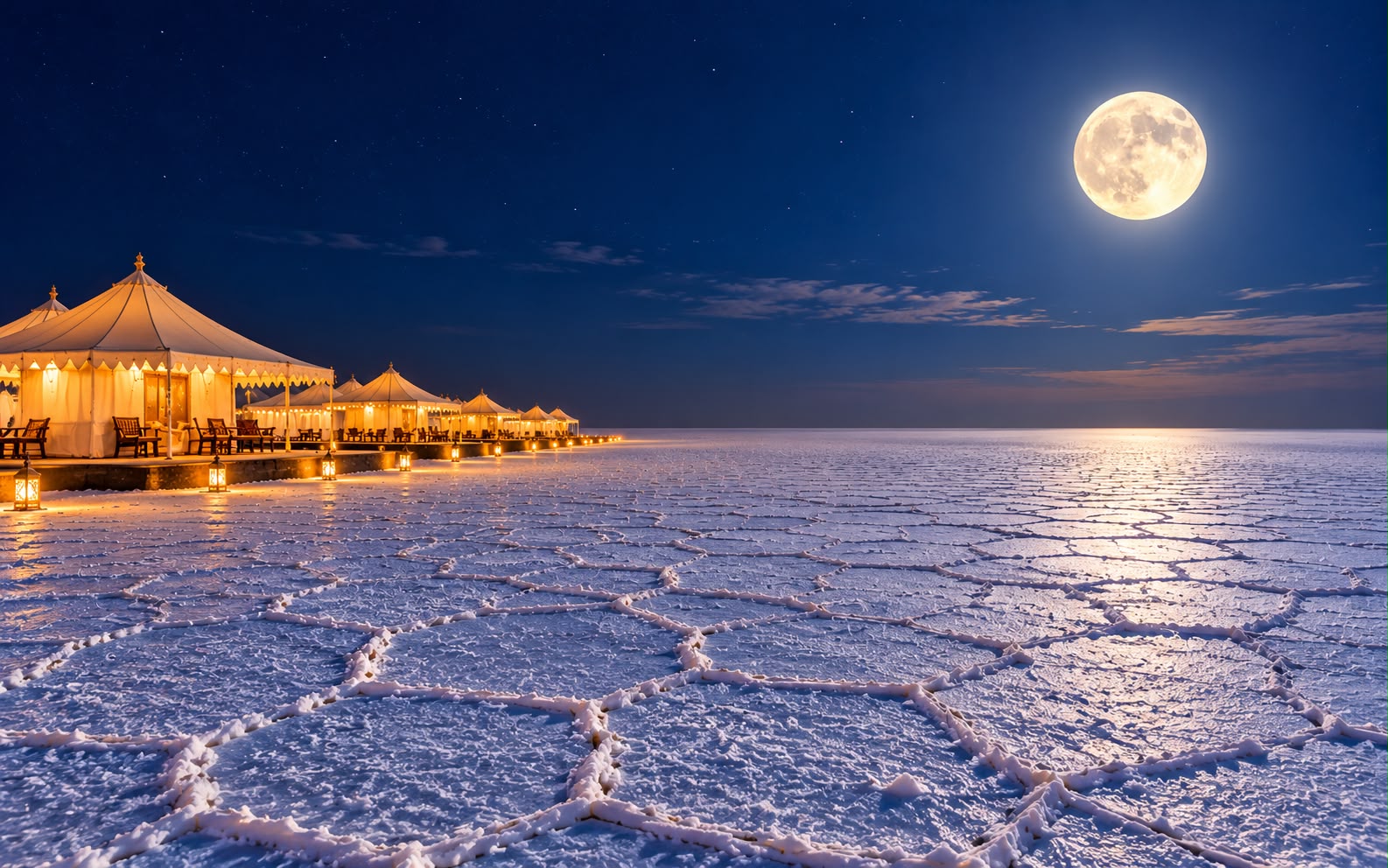
- 18:00 — The White Rann at sunset. The Great Rann floods every monsoon and dries to a salt crust every winter: a flat white plain running to the horizon, with Pakistan somewhere beyond it. Go at full moon if you possibly can — the white ground under a full moon is the single image people come for.
- The Rann Utsav runs roughly November to February: a tent city at Dhordo with craft markets, folk music and organised everything. Comfortable, and not quiet — book it directly if you want it, or take a village homestay nearby if you do not.
Day 5 — The long drive south to Gir
- 07:00 — South, around 8 hours, or break it at Rajkot. Flying Bhuj–Rajkot saves most of a day if the schedule works.
- 16:00 — Into Sasan Gir. Confirm tomorrow’s permit, route and time slot tonight — entry is by assigned slot and there is no flexibility on the morning.
Day 6 — Gir, and the lions
- 06:00 — The morning safari. Gir holds the only wild Asiatic lions in the world. They were hunted to perhaps 20 animals by the early 1900s and survived because the Nawab of Junagadh protected them; the population is now roughly 900 and slowly expanding beyond the park. Asiatic lions are smaller than African ones, with a fold of skin along the belly and sparser manes that leave the ears visible.
- Sightings are good by Indian standards — considerably better than tiger reserves — but not guaranteed. Leopard, nilgai, chital, sambar, crocodile and a great deal of birdlife are near-certain.
- 15:00 — The afternoon safari, on a different route if your permit allows.
- If both drives draw a blank, the Devalia Interpretation Zone is a fenced enclosure with near-guaranteed sightings. It is not the same thing and it is honest about that.
- The park is closed from mid-June to mid-October.
Day 7 — Somnath, and out
- 08:00 — An hour and a half south-west to the coast.
- 10:00 — The Somnath temple, on the shore of the Arabian Sea and the first of the twelve Jyotirlingas. Destroyed and rebuilt repeatedly over a thousand years — most famously sacked by Mahmud of Ghazni in 1026 — and the present building dates from 1951. Security is tight: phones and bags are not allowed inside and there are lockers at the gate.
- There is no land between here and Antarctica, which an arrow pillar on the seafront announces, and it is approximately true.
- 19:00 — The sound and light show on the temple, which is well done, if you are staying the night.
- Fly out of Rajkot or Diu, or drive back to Ahmedabad — around 7 hours, so leave early or add a night.
Costs and practicalities
Best time to visit
- November to February — the only sensible window, and the one everything is built around. Days 22–28°C, cool nights, the Rann dry and white, Gir open.
- Full moon nights between November and February are the best the Rann ever looks.
- The Rann Utsav runs across this window; Kite Festival in Ahmedabad is 14 January and genuinely spectacular.
- March to May — 40–44°C in Kutch and the Rann becomes punishing. Gir’s lion sightings improve as water sources shrink, which is the one argument for coming.
- June to September — monsoon. The Rann floods and is not visitable; Gir closes mid-June to mid-October. There is effectively no trip here in these months.
Travel tips
- Book Gir permits online, weeks ahead. Nothing else here is as time-critical.
- Carry passport copies and photographs for the Rann permit.
- Aim for a full moon at Dhordo.
- Take the Ahmedabad heritage walk rather than wandering the pols alone.
- Buy crafts directly in the Kutch villages.
- Fly or train the Ahmedabad–Bhuj and Bhuj–Rajkot legs if you can. The driving on this route is the hardest part of it.
- The white salt is blinding — sunglasses are not optional, and it reflects enough to burn.
- Gujarat is dry. Arrange a permit through your hotel if it matters, or go without.
- Gujarati food is overwhelmingly vegetarian and much of it is slightly sweet. The thalis are among the best meals in India.
What this trip actually costs
Two people, 6 nights, mid-range comfort, international flights excluded:
| Item | Cost |
|---|---|
| Hotels, 6 nights (2 Ahmedabad + 2 Bhuj or Rann + 1 Gir + 1 Somnath) | INR 32,000 (≈ AED 1,250) |
| Car and driver, 7 days, including airport runs | INR 26,000 (≈ AED 1,015) |
| Gir safari permits and jeep, Rann permit, entries, heritage walk | INR 9,000 (≈ AED 351) |
| Food and drink, 7 days | INR 9,000 (≈ AED 351) |
| SIM, tips, extras | INR 4,000 (≈ AED 156) |
| Total for two | INR 80,000 (≈ AED 3,124) |
- Roughly INR 40,000 (≈ AED 1,562) per person. The food line is the lowest on this site — Gujarat is cheap to eat in, vegetarian, and excellent.
- The car is the biggest line because the distances are genuinely large. Substituting a Bhuj or Rajkot flight for a driving day costs about the same and buys back most of a day.
- The Rann Utsav tent city is a separate market. Packages there run well above these figures and include meals and activities; village homestays nearby are a fraction of it.
- Gir’s safari line is fixed by the Forest Department and is modest; premium lodges are where the cost sits.
- Hotel picks here are chosen on location, not on commission — always check prices and recent reviews before booking.
What to pack
- Sunglasses, and good ones. The salt flat reflects brutally.
- A warm layer — Kutch nights in December and January drop to 8–10°C and the Rann is exposed.
- Neutral colours for the Gir safaris, and a hat.
- Passport copies and spare photographs for the Rann permit.
- Closed shoes for the salt, which is sharp underfoot.
- Shoulders and knees covered for Somnath and the temples, and expect to leave your phone at the gate.
FAQ
Will I see a lion at Gir? Probably — sighting rates are good, considerably better than most Indian tiger reserves, and two safaris make it likely. Devalia’s enclosure is the fallback if not.
Is the Rann worth the drive? At full moon between November and February, yes, without qualification. Outside that window it is a long way to see a flat white plain in ordinary light.
Is Gujarat really dry? Yes. Visitors can get a permit through authorised hotels, but it is a formality worth deciding about before you arrive rather than after.
Is this a good first trip to India? Not really — the distances are long and the tourist infrastructure is thinner than Rajasthan’s. It is an excellent second or third trip, and you will meet very few other foreign visitors.
Can I do it in five days? You can do Ahmedabad and the Rann in five. Adding Gir and Somnath is what needs the full week, because of the eight-hour drive south.
Prices and entry rules change, and what you need depends on your passport; last checked 26 October 2026, so confirm with the embassy or your airline before booking.


