 The Itinerary
Hampi in 4 days: the Vijayanagara ruins, Badami and Pattadakal
Four days for the capital of an empire and the architecture that preceded it — two days among Hampi's ruins and granite boulders, then the Chalukyan cave temples at Badami and the UNESCO cluster at Pattadakal and Aihole, where south Indian temple architecture was effectively invented.
- South Asia
- 4 days
- ≈ AED 800 / person
- Ruins in a boulder landscape, and the temples that came 800 years before them
Before you go
Four days here is two sites, 800 years apart, three hours of road between them.
Hampi was the capital of the Vijayanagara empire — at its height in the 1500s one of the largest cities on earth, perhaps half a million people, and razed over six months in 1565 after the battle of Talikota. What is left is 25 square kilometres of temples, palaces and bazaars scattered through a landscape of enormous granite boulders that looks like nowhere else in India.
Badami, Pattadakal and Aihole are 140km north-west, and they are where the architecture Hampi inherited was worked out in the sixth to eighth centuries. Aihole is reasonably called the cradle of Indian temple architecture, and at Pattadakal you can watch northern and southern styles being tried side by side.
Six days in southern Karnataka — Mysore, safari, coffee — is the other half of the state and a completely different trip.
Figure INR 20,000 (≈ AED 781) per person, which makes this the cheapest itinerary on this site. October to February; March to June regularly passes 40°C and there is no shade among the boulders.
Before you go: the short version of the admin
Visas
- e-Visa at the official indianvisaonline.gov.in/evisa and nowhere else.
- Six months’ validity, two blank pages.
Getting there — the real constraint
- Hampi has no airport. The options, in order of usefulness:
- Hubli (HBX), about 160km / 3 hours, with domestic connections from Bangalore, Mumbai and Hyderabad.
- Ballari / Vidyanagar (VDY), about 60km, with very limited flights.
- Bangalore (BLR), 340km / 6–7 hours, and the best international connection.
- The overnight train or bus from Bangalore to Hosapete (Hospet) is the local answer and a good one — Hosapete is 13km from Hampi.
- From the Gulf, fly to Bangalore (directs from Dubai, Abu Dhabi, Sharjah, Doha, Muscat, Kuwait), then the night train or a morning domestic hop to Hubli.
- Leaving from Badami, carry on to Belagavi (IXG) or Hubli, both about two hours, rather than driving all the way back.
Where to stay in Hampi
- Hampi Bazaar village is the sacred centre: closest to everything, strictly vegetarian and alcohol-free, and very simple.
- Virupapur Gaddi (“Hippie Island”) across the river: guesthouses, rice paddies, and a coracle or the bridge to cross. Relaxed, and a longer trip to the monuments.
- Hosapete, 13km away, for proper hotels and air conditioning.
- Much of the old bazaar area was cleared by demolition in the 2010s to protect the monuments, so expect less of a village than older guidebooks describe.
Money
- Carry cash. ATMs are in Hosapete, not at the monuments, and the village runs on small notes.
- UPI QR works in most guesthouses and cafés.
- ₹3,000 in small notes for coracles, guides and entries.
Day by day
Day 1 — The sacred centre
- 15:00 — Start at the river end, which is the oldest part, once the afternoon heat is off the granite.
- 15:30 — The Virupaksha Temple, and this is not a ruin: it has been in continuous worship since the seventh century, which makes it older than the empire that grew around it and the only thing in Hampi that survived 1565 intact. The eastern gopuram is 50 metres. The temple elephant, Lakshmi, appears at the morning blessing rather than now — come back for it.
- 16:30 — Hampi Bazaar, the colonnaded street running east from the temple, where a market once traded horses and gemstones. The monolithic Nandi sits at the far end.
- 17:45 — Hemakuta Hill for sunset: a cluster of small pre-Vijayanagara shrines on a granite slope right above the temple, ten minutes’ walk, and the easiest sunset in Hampi. The boulders go gold.
Day 2 — Vittala, the royal enclosure, and the river
- 05:30 — Matanga Hill for sunrise, if you do one early start. It is the highest point in the ruins and the reason most photographs of Hampi exist. Thirty minutes up in the dark — take a torch and go with someone, as it is steep and empty.
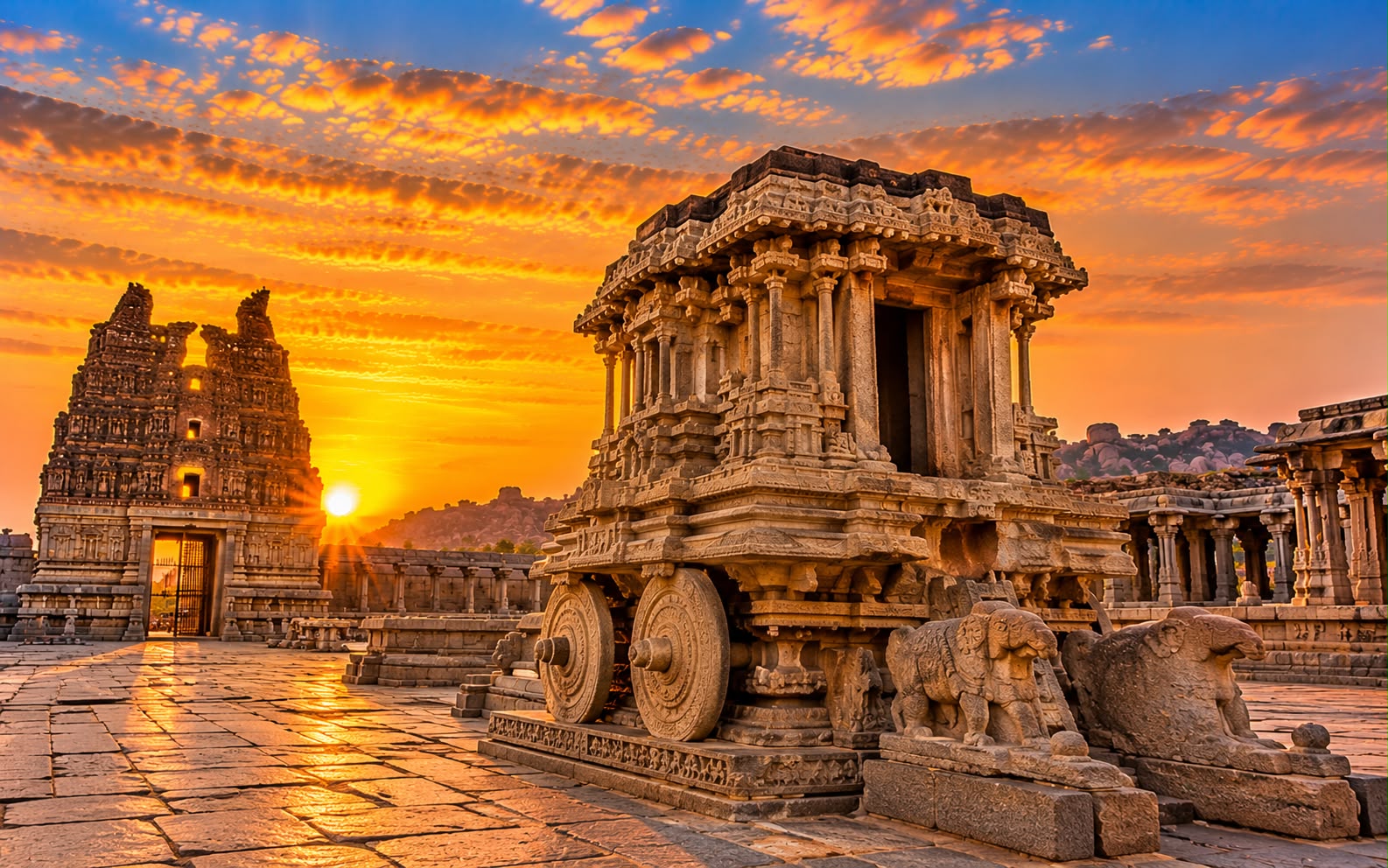
- 08:30 — The Vittala Temple, the masterpiece, and early because there is no shade in the compound. The stone chariot in the courtyard — a shrine carved as a processional cart, with wheels that once turned — is on the ₹50 note.
- 09:30 — The musical pillars: 56 slender columns that ring at different pitches when struck. Striking them is forbidden now, and rightly; visitors doing exactly that were destroying them.
- An electric shuttle runs the last kilometre from the car park. The walk along the river is better and takes fifteen minutes.
- 11:00 — Back before the heat. Between 11:00 and 15:00 the boulders radiate and the ruins are genuinely unpleasant.
- 15:30 — The royal enclosure: the stepped tank, the Mahanavami Dibba platform, and the Hazara Rama Temple, whose outer walls carry the Ramayana in continuous relief.
- 16:30 — The Zenana enclosure: the Lotus Mahal, an Indo-Islamic pavilion that survived the sack, and the Elephant Stables — eleven domed chambers for the state elephants, and the most photographed building here after the chariot.
- 17:45 — A coracle on the Tungabhadra. The round basket boats are unchanged in centuries and cost very little. Or cross to Anegundi, older than Hampi itself and named in the Ramayana as Kishkindha, the monkey kingdom.
Day 3 — Badami and the cave temples
- 08:00 — Leave Hampi. Three hours north-west, and an early start puts you at the caves before the worst of the afternoon.
- 11:30 — Badami’s four cave temples, cut into a red sandstone cliff above a tank in the late sixth century. Cave 3 is the great one — 578 AD, an 18-armed dancing Shiva, and ceiling carving that still holds traces of paint. Three are Hindu, one is Jain, and the sequence of them up the cliff is the point.
- 13:30 — Lunch in Badami town, out of the sun.
- 16:00 — The north fort above the tank, for the view back over the caves. Watch for monkeys — they are confident here and will take anything visible.
- 17:30 — Agastya Lake, with the Bhutanatha temples standing at the water’s edge. The best photograph in Badami, and late afternoon is when it works.
- Stay in Badami.
Day 4 — Pattadakal, Aihole, and out
- 08:30 — Pattadakal, 22km away and UNESCO-listed: ten temples in one compound, built in the seventh and eighth centuries, deliberately mixing northern nagara and southern dravida styles. The Virupaksha Temple here — not the Hampi one — was the model for Ellora’s Kailasa. This is the clearest place in India to see the two great temple traditions side by side, which is why it matters more than its size suggests.
- 10:30 — Aihole, 14km further: over 120 temples scattered through and around a village, the earliest experiments of the lot. Find the Durga Temple, with its apsidal plan, and the Lad Khan Temple.
- 12:30 — Out via Belagavi or Hubli, about two hours, or the long drive back to Bangalore.
Costs and practicalities
Best time to visit
- November to February — the only comfortable window. Days 26–30°C, cool mornings, and the light on the boulders is at its best.
- October — the tail of the monsoon, the Tungabhadra full, and the landscape greener than you expect.
- The Hampi Utsav festival usually falls in January — spectacular, and the town fills completely.
- March to June — 40–44°C, with no shade anywhere in the ruins. The granite radiates heat into the evening. Genuinely unpleasant, and the reason this is a winter trip.
- July to September — moderate rain, green, humid, and the river high enough that coracles sometimes stop.
There is no shade at Hampi. The season is not a preference here; it decides whether the trip works.
Travel tips
- Two days minimum at Hampi. The site is 25 square kilometres and people routinely under-plan it.
- Mornings and late afternoons only for walking the ruins. Between 11 and 3 the boulders are unbearable even in December.
- Hire a bicycle or a scooter, or an auto for the day at an agreed rate. The monuments are kilometres apart.
- One ticket covers Vittala, the Lotus Mahal and the Elephant Stables on the same day — keep it.
- Hire a licensed guide for a half-day at Vittala. Hampi is very hard to read without one.
- Carry water, far more than you think, and a hat.
- The sacred centre is vegetarian and alcohol-free. Respect it; it is a living temple town.
- Do not strike the musical pillars, climb on carvings, or take stone. The site is actively eroding from visitor pressure.
- Watch for monkeys at Badami’s fort and Hampi’s hilltops — do not carry visible food.
What this trip actually costs
Two people, 3 nights, mid-range comfort, international flights excluded:
| Item | Cost |
|---|---|
| Hotels, 3 nights (2 Hampi or Hosapete + 1 Badami) | INR 12,000 (≈ AED 469) |
| Car and driver, 4 days, including the airport or station runs | INR 14,000 (≈ AED 547) |
| Entries, licensed guide, coracle, bicycle hire | INR 5,000 (≈ AED 195) |
| Food and drink, 4 days | INR 6,000 (≈ AED 234) |
| SIM, cash buffer, tips, extras | INR 3,000 (≈ AED 117) |
| Total for two | INR 40,000 (≈ AED 1,562) |
- Roughly INR 20,000 (≈ AED 781) per person — the cheapest itinerary on this site. Entry fees are nominal, the food is inexpensive and the accommodation is simple almost everywhere.
- The car is more than a third of it, and it is unavoidable: Badami, Pattadakal and Aihole are not practically reachable otherwise.
- Hosapete costs more than Hampi village and gives you air conditioning and a proper hotel, which in October or March is worth it.
- Hotel picks here are chosen on location, not on commission — always check prices and recent reviews before booking.
What to pack
- A hat, sunglasses and high-factor sun cream. There is no shade in 25 square kilometres of granite.
- Far more water than you think, and a refillable bottle.
- Proper walking shoes. The ruins are uneven rock, not paths.
- A torch for a pre-dawn climb up Matanga.
- Shoulders and knees covered — Virupaksha is a working temple.
- Cash, since the ATMs are in Hosapete.
FAQ
Is four days enough for Hampi? Two days covers Hampi itself properly. The other two take in Badami, Pattadakal and Aihole, which most visitors skip and should not.
Could I do Hampi as a day trip? No. People try it from Bangalore and spend thirteen hours in a car to see a fraction of a site that needs two days.
Is Hampi or Badami the better half? Hampi for scale and landscape; Badami and Pattadakal for the architecture that made everything after them possible. Hampi is the spectacle, Pattadakal is the explanation.
Is it safe to walk the ruins alone? In daylight, yes, and it is a relaxed place. For a pre-dawn climb up Matanga Hill, go with someone — it is dark, steep and empty.
How do I actually get there? Fly to Bangalore, then the overnight train to Hosapete, or a domestic flight to Hubli and three hours by road. There is no shortcut, and it is the main reason Hampi stays as quiet as it does.
Prices and entry rules change, and what you need depends on your passport; last checked 26 October 2026, so confirm with the embassy or your airline before booking.


