 The Itinerary
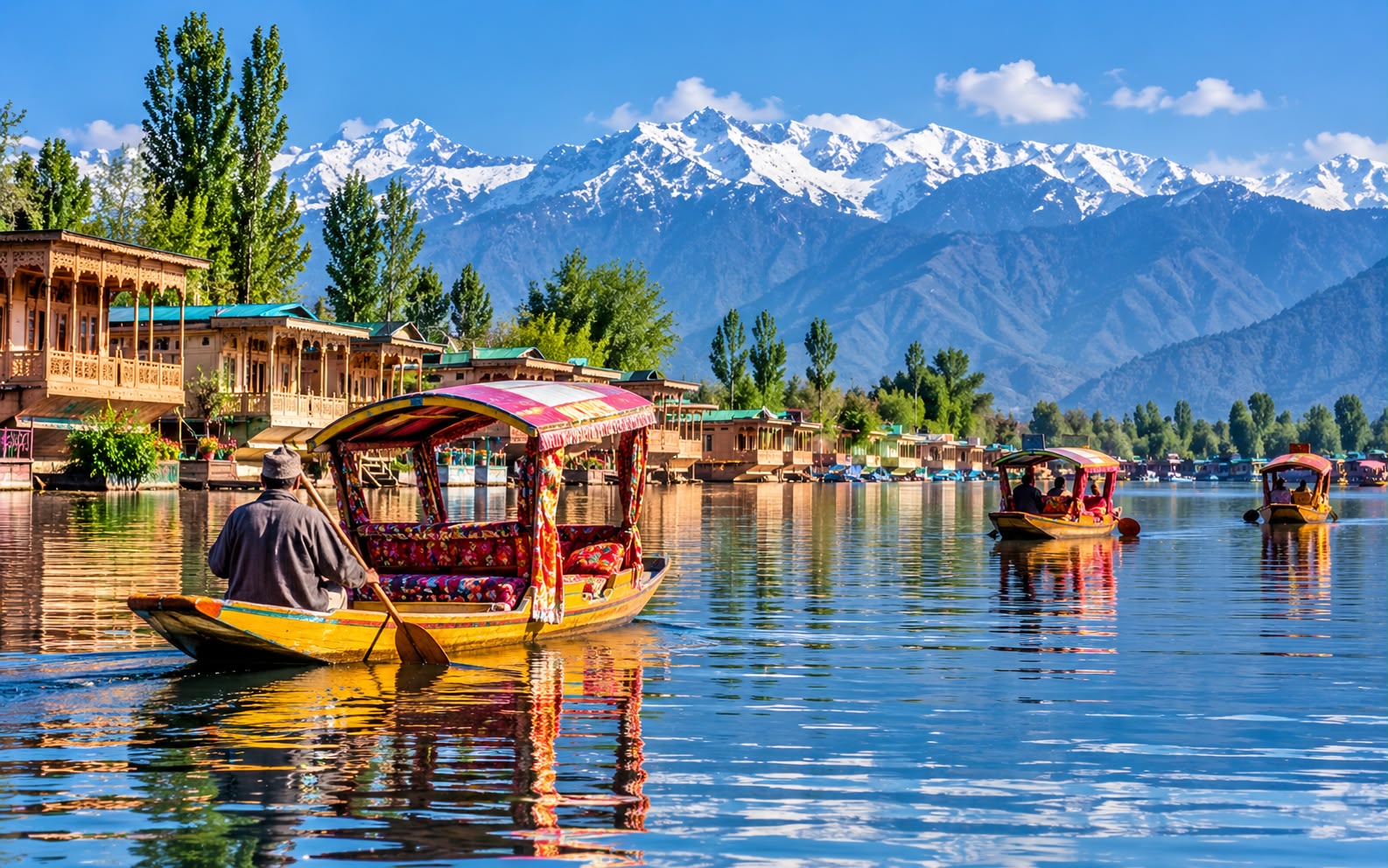
Kashmir in 5 days: Srinagar, Gulmarg and Pahalgam
Five days in the Kashmir valley — a houseboat on Dal Lake, the Mughal gardens, the Gulmarg gondola to nearly 4,000m, and the Lidder valley at Pahalgam. Several governments maintain travel advisories for Jammu and Kashmir, and this guide opens with that rather than burying it.
- South Asia
- 5 days
- ≈ AED 1,250 / person
- The Dal Lake houseboats and two valleys — behind a live travel advisory
Before you go
Read this first
Several governments advise against all, or all but essential, travel to parts of Jammu and Kashmir, including the Kashmir valley. The exact wording differs between countries and changes with conditions, so check your own government’s current advice before you book anything — not a blog, and not this page.
What sits behind those advisories:
- A long-running security situation. The valley has seen insurgency, heavy security deployment and periodic unrest for over three decades. Armed forces are highly visible and checkpoints are routine.
- Attacks have targeted tourists. In April 2025, gunmen killed civilians at Baisaran meadow above Pahalgam, a site on most visitor itineraries including this one. It was followed by a serious military exchange between India and Pakistan.
- Communications have been cut before. The region has experienced extended internet and mobile shutdowns, most notably through 2019–2020. Assume connectivity can be withdrawn.
- Border proximity. The Line of Control is close, and areas near it carry separate and stronger warnings everywhere.
- Conditions change quickly. A quiet season can end abruptly, and roads, flights and permits close with it.
Travel insurance will usually not cover you for a region your government advises against travelling to. Check the policy wording specifically; this catches people out and it is expensive.
This guide is not an encouragement to go. It exists because Kashmir is one of the most beautiful places in Asia, because millions of Indian travellers visit every year, and because a page that states the position honestly is more use than one that pretends it does not exist. Read your own government’s advice, take it seriously, and make your own decision.
Five days is Srinagar and two valleys: a night on a Dal Lake houseboat, the gondola at Gulmarg, and the Lidder at Pahalgam.
Seven days adds Sonmarg and Doodhpathri and gives each valley a proper day instead of a visit.
Figure INR 32,000 (≈ AED 1,250) per person. April to October, with April for tulips, June to August for the meadows, and October for the chinars.
Before you go: the admin
Visas and registration
- e-Visa at the official indianvisaonline.gov.in/evisa and nowhere else. Srinagar (SXR) is not an e-Visa port of entry — you will arrive through Delhi.
- Foreign nationals should expect to be registered at hotels and at checkpoints, and to have passport details taken repeatedly.
- Six months’ validity, two blank pages.
The SIM card problem, which catches everyone
- Prepaid SIM cards issued outside Jammu and Kashmir do not work in the valley. This is a long-standing security rule and it applies to Indian prepaid numbers from other states as well as to most tourist SIMs.
- Postpaid Indian connections work. So do J&K-issued prepaid numbers, which need local documentation.
- International roaming works for foreign numbers.
- Plan for being offline. Download maps and bookings, and tell people at home you may be out of contact.
Flying in from the Gulf
- Srinagar (SXR) via Delhi, about 90 minutes in the air. There are no direct Gulf flights.
- Flights are weather-dependent and cancellations in winter and during poor visibility are common. Leave a buffer day before any international connection.
- The Jammu–Srinagar highway is the land route and closes for landslides and snow; it is not a reliable alternative.
Money
- Carry cash. ATMs exist in Srinagar and are unreliable elsewhere, and the connectivity that card machines depend on is not guaranteed.
- UPI works when the network does, which is not always.
- ₹8,000–10,000 in cash for five days is sensible here, which is more than anywhere else on this site.
Day by day
Day 1 — Srinagar and the lake
- 13:00 — Onto a houseboat. The Dal and Nigeen houseboats date from the British period, when the Maharaja forbade outsiders from owning land and visitors built on the water instead. Carved cedar, heavily furnished, and unlike anything else in India. Nigeen is quieter than Dal and generally the better choice.
- 15:00 — The Mughal gardens: Shalimar Bagh, built by Jahangir for Nur Jahan in 1619, and Nishat Bagh on the lakeshore with twelve terraces for the zodiac. Chashme Shahi is the smallest and the nicest. Chinar trees are the signature here, planted by the Mughals and enormous now.
- 18:00 — A shikara at sunset: the long painted boats, paddled, across open water and through the lotus channels. Agree the price and the length of the ride first.
- Ask the houseboat to arrange tomorrow’s 05:00 boat tonight.
Day 2 — The old city, and the floating market
- 05:00 — The floating vegetable market on Dal Lake: growers trading from boats on the water, an hour’s business and then gone. The best thing in Srinagar, and almost nobody who sleeps on land sees it.
- 09:00 — Hazratbal Shrine on the northern shore, white marble, holding a relic of the Prophet. Women cover their heads; the inner chamber is restricted.
- 10:30 — Jamia Masjid in the old city: 1394, with 378 deodar columns each a single trunk. Closed to visitors around Friday prayers.
- 12:00 — The old city lanes for papier-mâché, walnut carving, pashmina and carpets. Buy from a shop with a fixed price and a bill, and treat anything described as “shahtoosh” as illegal, because it is.
- 16:00 — Shankaracharya Temple on the hill above the city, up 240 steps, for the view over the whole valley. Phones are not allowed at the top.
- In late October and November, add Pampore’s saffron fields, 15km out, when the crocuses flower.
Day 3 — Gulmarg
- 08:00 — Two hours west, climbing to 2,650m.
- 10:00 — The Gulmarg Gondola, one of the highest cable cars in the world. Phase 1 reaches Kongdoori at 3,080m; Phase 2 continues to Apharwat at 3,979m, where there is snow most of the year. Book online in advance — Phase 2 has limited capacity, sells out, and closes in bad weather without notice, so go up early while the day is still clear.
- Dress for the top. It can be 25°C in the meadow and below freezing at Apharwat within the same hour.
- 13:00 — The meadow. In summer it is wildflowers with the world’s highest golf course on it; in winter this is one of Asia’s serious ski resorts, with lift-served off-piste that draws experienced skiers from everywhere.
- 16:00 — Back to Srinagar, or stay in Gulmarg if you want the mountain in the morning.
Day 4 — Pahalgam and the Lidder
- 08:00 — Two and a half hours east, through Pampore’s saffron and Anantnag.
- Pahalgam sits at 2,200m where two rivers meet, and is the valley’s prettiest base.
- 11:00 — Betaab Valley, named after a film shot there, which is as Bollywood as it sounds and genuinely lovely.
- 13:00 — Chandanwari, where the Amarnath pilgrimage begins.
- 15:00 — Aru Valley, 12km up, quieter, and the trailhead for the Kolahoi glacier. Walk along the Lidder rather than taking a pony everywhere. Pony rates are a known friction point — agree the price and the route in writing before mounting, and expect to be asked for more at the top.
- Baisaran meadow above Pahalgam was the site of the April 2025 attack. Local advice on where it is sensible to go changes — ask your hotel in the morning rather than assuming.
Day 5 — Back, and out
- 09:00 — Two hours to Srinagar.
- 11:30 — A last shikara, or the handicraft shops if you are buying.
- Fly to Delhi and connect. Build the buffer in — Srinagar departures are weather-dependent and the valley is not a place to cut a connection fine.
Costs and practicalities
Best time to visit
- April — the tulip garden below Shankaracharya hill opens for about three weeks and is the largest in Asia. Blossom everywhere. Cold at night.
- May to August — the meadows at their best, Gulmarg green, everything open. July and August bring the Amarnath Yatra, which fills Pahalgam and Sonmarg with pilgrims and tightens security considerably.
- September to early November — the quietest and arguably the loveliest: clear air, chinar trees turning, saffron in flower at Pampore from late October.
- December to March — deep winter. Gulmarg’s skiing is world-class; Srinagar is cold and beautiful, Dal Lake sometimes freezes, and roads to Pahalgam and Sonmarg close with snow.
- Avoid planning around the Amarnath Yatra dates unless you are going for it.
Travel tips
- Check your government’s advice, and your insurance wording, before booking.
- Your prepaid SIM will not work. Arrange a postpaid number, rely on roaming, or plan to be offline.
- Carry more cash than you think.
- Book Gondola Phase 2 online in advance.
- Agree pony and shikara prices in advance, including the return.
- Stay on a houseboat for one night, not all five. They are wonderful and the plumbing is period.
- Buy pashmina from an established shop with a bill. The market is full of mill-made imitation, and shahtoosh is illegal everywhere.
- Expect checkpoints, identity checks and a visible military presence. Be patient, be polite, and do not photograph security installations or personnel.
- Ask locally each morning about road conditions and where it is sensible to go. Your hotel knows far more than any website.
What this trip actually costs
Two people, 4 nights, mid-range comfort, international flights excluded:
| Item | Cost |
|---|---|
| 1 night on a houseboat + 3 nights hotels (Srinagar, Gulmarg, Pahalgam) | INR 26,000 (≈ AED 1,015) |
| Car and driver, 5 days, including airport runs | INR 18,000 (≈ AED 703) |
| Gondola both phases, shikara, ponies, garden entries | INR 10,000 (≈ AED 390) |
| Food and drink, 5 days | INR 7,000 (≈ AED 273) |
| SIM, cash buffer, tips, extras | INR 3,000 (≈ AED 117) |
| Total for two | INR 64,000 (≈ AED 2,499) |
- Roughly INR 32,000 (≈ AED 1,250) per person, excluding the Delhi connection.
- Kashmir is cheaper than its reputation — this is a domestic holiday market, and the hotels and food are priced for it.
- The gondola and the ponies are where costs are negotiated rather than fixed, and where most disputes happen. Agree everything in advance.
- Houseboats vary enormously. The grand old ones on Nigeen are worth paying for; the cheapest on Dal can be damp and tired.
- Hotel picks here are chosen on location, not on commission — always check prices and recent reviews before booking.
What to pack
- Layers, and a proper warm one. Apharwat is below freezing most of the year whatever the valley is doing.
- Waterproofs. The valley gets rain and snow outside summer.
- Walking shoes with grip for the Lidder and the glacier paths.
- Cash, and a backup card.
- Downloaded maps and bookings, because your phone may not work.
- Sun cream — at altitude and on snow it burns hard.
- Modest clothing. Kashmir is conservative and predominantly Muslim; covered shoulders and knees are appreciated, and a scarf for women at shrines.
FAQ
Is it safe to travel to Kashmir? That is not a question this page can answer for you. Several governments maintain advisories, a 2025 attack targeted tourists at a site on this route, and conditions change quickly. Read your own government’s current advice, check whether your insurance covers you, and decide.
Why does the guide exist if there is an advisory? Because Kashmir is extraordinarily beautiful, millions of people visit each year, and someone researching the trip is better served by an honest page than by one that omits the risk.
Will my phone work? Only on international roaming or an Indian postpaid connection. Prepaid SIMs from outside J&K are blocked, and this surprises almost everyone.
Is five days enough? For Srinagar and two valleys, yes. Seven days adds Sonmarg and Doodhpathri and is the better trip if you have the time.
When is the tulip garden open? Usually late March into mid-April, for about three weeks, and the exact dates are announced each year.
Prices and entry rules change, and what you need depends on your passport; last checked 26 October 2026, so confirm with the embassy or your airline before booking.


