 The Itinerary
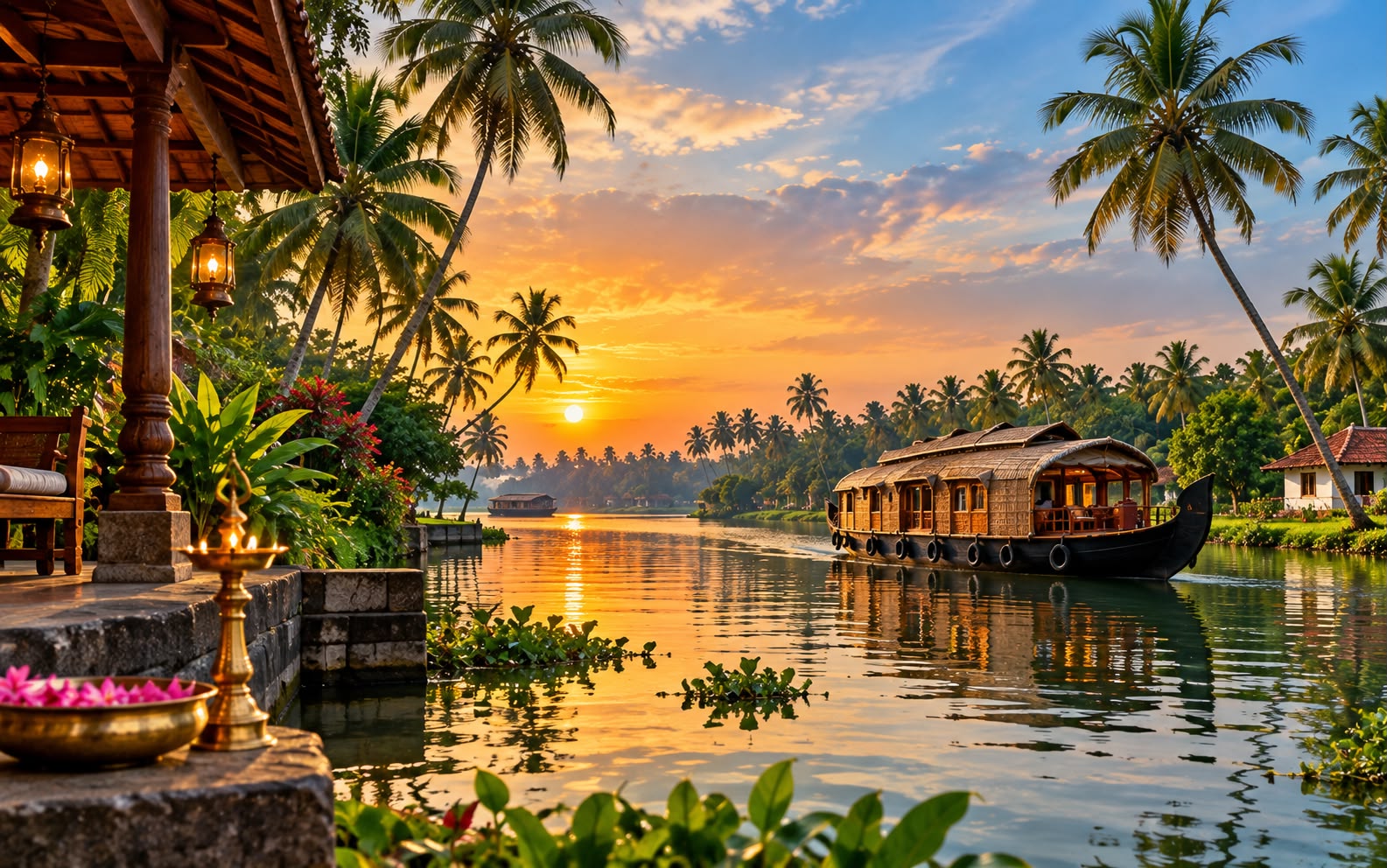
Kerala in 9 days: Kochi, Munnar, the backwaters and the beach
The gentle India — colonial Fort Kochi, tea hills above the clouds, a night on a private houseboat through the backwaters, and a quiet palm-lined beach to end on. One arc, one driver, no rush.
- South Asia
- 9 days
- ≈ AED 2,350 / person
- Slow-paced travellers
Before you go
If the Golden Triangle is India at full volume, Kerala is the same country with the dial turned to evening: spice-trade lanes and antique synagogues in Kochi, tea estates stacked to the clouds in Munnar, a night drifting through palm-canal villages on your own houseboat, and a beach where the loudest thing is a fishing boat coming in. It’s India’s easiest introduction and its best recovery — many travellers do our Golden Triangle guide first and this one as the exhale.
Go October–March — dry, green, 28–32°C on the coast and a cool 20°C in Munnar. The monsoon (June–September) is its own product: everything intensely green, hotel prices halved, and the traditional Ayurveda season (the humidity is considered ideal for treatment) — a fair trade if you accept daily rain. One calendar trap: Eravikulam National Park closes for roughly February–March (Nilgiri tahr calving season) — if the wildlife stop matters to you, travel outside those weeks.
All costs are in Indian rupees (INR), with conversions calculated at today’s exchange rate. Foreigner ticket prices are quoted; Indian passport and OCI holders pay domestic rates at the ticketed sights — which trims the entries line modestly here rather than transforming the budget, unlike the monument-heavy Golden Triangle.
Before you go: the short version of the admin
Visas, UPI, SIMs and the scam list are identical to our Golden Triangle guide, where they’re covered in depth (short form: e-visa for 171 nationalities at the official site only; the UPI One World wallet lets G20-nationality visitors pay by QR like locals; Airtel/Jio SIM at the airport). Kerala-specific notes:
Flying in, and the car
- Fly into Kochi (COK) — direct flights from across the Gulf (this is the UAE’s most-connected Indian state) and every Indian hub. The airport is ~40 km from Fort Kochi.
- Hire a car with driver for the whole arc (~₹3,000–4,000/day including fuel; arranged by any hotel or Kerala operator) — it’s the standard way Kerala is done, costs less than two Gulf taxi days, and turns every transfer into sightseeing. Self-drive is possible but the hill hairpins and Indian traffic argue otherwise.
Book the houseboat first
- Book the houseboat before anything else — the good boats and the Dec 20–Jan 5 peak (when rates double) go first. Book direct with operators rather than aggregator markups.
The gentler India
- Kerala is calmer than north India — the tout pressure of Delhi and Agra largely doesn’t exist here — but the same app-taxi and official-counter habits still serve.
Travelling with kids?
- Kerala may be India’s best family destination: short drives, pools everywhere, a houseboat that doubles as the world’s slowest theme-park ride, and beaches with gentle shelves (respect rip warnings and swim where locals do).
- Munnar’s altitude means mosquito relief; the coast needs repellent at dusk.
- Kathakali’s demon faces delight or terrify by temperament — the pre-show makeup session usually wins them over.
Day by day
Day 1 — Land in Kochi, evening among the fishing nets
- 13:00 — Land at Kochi, meet your driver, ~1 h to Fort Kochi. Check in, late lunch at a heritage café (Kashi Art Café is the institution).
- 16:30 — Walk the seafront to the Chinese fishing nets — the giant cantilevered structures the city has raised and lowered for six centuries; sunset behind them is Kochi’s signature image. A small tip gets you onto a platform to help work one.
- 18:00 — St Francis Church (free) — India’s oldest European church, where Vasco da Gama was first buried.
- 19:30 — Dinner: fresh seafood grilled at the net-side stalls (pick, pay, they cook) or a proper Keralan fish molee in a heritage restaurant.
Where to stay in Kochi (two nights, Fort Kochi side)
- Heritage splurge: Brunton Boatyard (CGH Earth) — a shipyard reborn as the city’s grandest waterfront address.
- Mid-range: Forte Kochi — superbly rated colonial charmer on Princess Street, pool included.
- Budget: Tissa’s Inn — the homestay-style boutique that outscores hotels twice its price.
Day 2 — Spice lanes, a synagogue and painted demons
- 9:00 — Mattancherry / Jew Town by tuk-tuk or cycle: the Dutch Palace (small fee; closed Fridays) with its Ramayana murals, the antique warehouses, and the ginger-and-cardamom scent of the working spice godowns.
- 11:00 — Paradesi Synagogue (Sun–Thu ~10:00–12:00 and 15:00–17:00; small fee; modest dress) — 1568, Belgian chandeliers, hand-painted Chinese floor tiles; the queue moves fast, the closing hours don’t bend.
- 13:00 — Lunch in Jew Town or back in Fort Kochi; try a banana-leaf sadya thali somewhere busy.
- 15:00 — Slow afternoon: the Indo-Portuguese Museum, gallery hopping, or the ferry across to Ernakulam’s markets (pennies, and the skyline view back).
- 17:00 — Kerala Kathakali Centre: arrive for the make-up session (~17:00) — watching the dancers paint the green hero-faces and demon reds is half the show — then the performance itself (~18:00; ~₹400–500). Loud, strange, unforgettable.
- 20:00 — Dinner and pack: the hills tomorrow.
Day 3 — Climb to Munnar, tea to the horizon
- 8:30 — Drive to Munnar (~4 h, climbing 1,500 m) — the road itself is the attraction: rubber plantations, waterfalls (Cheeyappara mid-route), then suddenly the first tea slopes.
- 13:00 — Lunch in Munnar town, check in.
- 15:00 — Tea Museum (closed Mondays typically; small fee) — the colonial-era machinery still rolling leaf, with a tasting — then walk into the estate paths behind town: the manicured green corduroy in every direction is why you came.
- 17:30 — Sunset viewpoint chai; early dinner — Munnar sleeps early and so should you, if you take tomorrow’s sunrise option.
Where to stay in Munnar (two nights)
- Upscale: Eden Woods Resorts & Spa — superbly rated, stream-side calm outside town.
- Mid-range: Sterling Munnar — big, comfortable, valley views, family-easy.
- Budget: KTDC Tea County — the state-run classic in town; reliable and well kept.
Day 4 — Above the clouds: tahr, peaks and the highest tea
- Option A, the big one — 4:30 — Jeep to Kolukkumalai (~₹3,000–4,000 per jeep, ~3 h round trip on a spectacularly bad road): the world’s highest organic tea estate at 2,400 m for a sunrise above a sea of clouds, then a tour of the 1930s factory. The road is the price of the view; both are extreme.
- Option B, the gentle one — 7:30 — Eravikulam National Park (7:30–16:00; foreigners ₹500, Indians ₹200; forest-bus shuttle only; closed ~Feb–Mar for calving; book online in peak season) — near-guaranteed sightings of the endangered Nilgiri tahr on the high grasslands under Anamudi, south India’s highest peak.
- 13:00 — Lunch back toward town.
- 15:00 — The eastern loop drive: Mattupetty Dam and its lake, Echo Point, and up to Top Station on the Tamil Nadu border — the grandest viewpoint in the Western Ghats when the clouds allow.
- 19:00 — Dinner; try Kerala’s beef fry with parotta — the hill-country classic.
Day 5 — Down to the backwaters, aboard your houseboat
- 8:00 — Drive down the ghats to Alleppey (~5 h through spice and rubber country).
- 12:00 — Board your houseboat (noon check-in; deluxe 1-bedroom from ~₹10,500/night all-inclusive — meals, crew, fuel; premium and luxury tiers above; rates roughly double Dec 20–Jan 5). Your crew of two-three cooks and pilots; you do nothing, which is the entire point.
- 12:30–18:00 — Cruise: out across Vembanad Lake, then into the narrow canals — paddy fields below water level, kids waving from school boats, kingfishers on every wire. Lunch on board is Keralan home cooking; the karimeen (pearl spot fish) is the order.
- 17:30 — Boats moor by village banks before dusk (rule, not choice): walk the towpath, watch the light die over the paddies, dinner on deck under the stars.
Day 6 — Backwater morning, then the beach
- 6:30 — The best hour of the trip: mist on the water, fishermen setting nets, chai on deck. Optional village shikara or kayak detour into the smallest canals (~₹750–1,000/person) — the houseboat can’t fit where the real life is.
- 9:30 — Disembark at Alleppey; 30 minutes north to Marari Beach — a fishing-village coast of palms and sand with none of Goa’s noise.
- 11:00 — Check in, and downshift: this is the trip’s do-nothing chapter, by design.
- 16:00 — Walk the beach as the fishing fleet comes in; fresh-catch dinner at a beach shack or your resort.
Where to stay at Marari (three nights)
- Marari runs from barefoot-luxury eco resorts (the famous beachfront ones with Ayurveda centres, ~₹12,000–25,000) down to family homestays a lane back from the sand (~₹3,000–6,000). Book by current reviews and beach proximity; December–January needs weeks of notice.
Day 7 — Beach and Ayurveda
- Morning — Nothing, professionally. Swim early (calmest water), breakfast late.
- 14:00 — First Ayurveda session — Kerala is the home of the practice, and even sceptics surrender to an abhyanga massage (~₹2,000–3,500 at reputable centres; multi-day treatment courses need a doctor consult first — real Ayurveda is medical, not spa fluff, and good centres behave accordingly).
- 17:00 — Village walk or cycle: the church, the fish market, the toddy shop if you’re curious (palm wine, an acquired taste, acquired quickly).
Day 8 — The spare day — three ways to spend it
- Option A — More nothing. The correct answer for most.
- Option B — Alleppey by land: the beach and lighthouse, a second shikara ride at sunset, chai by the canals.
- Option C — Culture finale: a village cooking class (fish curry, appam — the souvenir skill) or a temple-festival hunt if the season obliges (November–April is festival country; ask your hosts what’s on — elephants and drums may be an evening away).
- Evening — Last seafood feast; pack for the morning drive.
Day 9 — Fly home from Kochi
- Morning — Drive to Kochi airport (~1.5 h; leave buffer for Kerala traffic), fly out — Gulf travellers are home by afternoon on the direct flights.
Costs and practicalities
Best time to visit
October–March is the dry season and the obvious window, though Kerala’s monsoon is part of its appeal rather than purely an obstacle.
- October–March — dry, 25–32°C, and the best for the backwaters, the beaches and the hill stations. December–January is peak and Varkala and Fort Kochi fill.
- April–May — hot and humid before the rains.
- June–September — the southwest monsoon, which arrives in Kerala first and hardest. This is the traditional Ayurveda season — the humidity is considered ideal for treatment, and the serious clinics are busiest now.
- October–November — the lighter northeast monsoon.
Onam, in August or September, is the biggest festival of the Malayali year, and the snake boat races at Alappuzha and Aranmula fall in July and August — spectacular, and squarely in the monsoon.
Travel tips
- Book a houseboat with a certified operator and check it has a working sewage system. The backwaters have a real pollution problem and the cheap boats are part of it.
- Kerala is India’s most literate state and English is widely spoken, which makes it far easier to travel than most of the country.
- Alcohol is restricted — state-run outlets, limited hours, and many restaurants serve none. Hotel bars are the exception.
- Ayurveda ranges from serious medicine to spa theatre. A genuine course is two weeks minimum with a doctor’s consultation; a 60-minute massage at a beach hut is not the same thing.
- Kathakali makeup takes hours and is part of the performance. Arrive early to watch it rather than just the play.
- Remove footwear at temples, and note that several Kerala temples admit Hindus only — this is stated at the gate.
- Munnar and Wayanad are cold at night. Pack a layer for the hills even in March.
What this trip actually costs
Two people, 8 nights (incl. one aboard the houseboat), mid-range comfort, international flights excluded:
| Item | Cost |
|---|---|
| Hotels + houseboat, 8 nights | INR 63,500 (≈ AED 2,480) |
| Car with driver, all transfers and sightseeing days | INR 22,000 (≈ AED 859) |
| Entries and activities: Eravikulam, Kolukkumalai jeep, Kathakali, kayak, Ayurveda | INR 13,000 (≈ AED 508) |
| Food and drink outside inclusive meals, 9 days | INR 16,000 (≈ AED 625) |
| SIM, tips, extras | INR 5,500 (≈ AED 215) |
| Total for two | INR 120,000 (≈ AED 4,686) |
- Roughly INR 60,000 (≈ AED 2,343) per person (~USD 700) — homestays and a shared shikara instead of the houseboat night pull it near INR 40,000 (≈ AED 1,562); the famous beach eco-resorts and a proper multi-day Ayurveda course push it well past INR 100,000 (≈ AED 3,905). Monsoon season cuts the lodging line nearly in half.
- Book in this order: flights → e-visa → the houseboat (direct with the operator; peak dates first) → Marari resort for Dec–Jan dates → car and driver → the rest is walk-up easy.
- Hotel and restaurant picks here are unsponsored — no affiliate links in this article. Chosen on location and current ratings; always check prices and recent reviews before booking.
What to pack
- Light cottons + one warm layer: Munnar evenings hit 12–15°C while the coast stays at 30°C.
- Mosquito repellent for the coast and backwaters at dusk; Munnar’s altitude is the break from it.
- Modest cover for churches, the synagogue and temples; a scarf as ever.
- Reef-safe sunscreen, a hat, and shoes you can wet.
- Motion-sickness tablets for the ghat hairpins if you’re prone.
- Old clothes for the Ayurveda oil sessions — the oil wins.
- Space for tea from Munnar, spices from Mattancherry, and banana chips you’ll ration badly.
FAQ
Golden Triangle or Kerala first? Either works; they’re opposite Indias. Triangle first if you want icons and intensity, Kerala first if you want a soft landing. The classic combination is Triangle then Kerala — chaos, then cure — and 16 days covers both of our guides back to back.
Is one night on the houseboat enough? For most, yes — it’s a magical 22 hours and the novelty arc is complete by the second morning. Two nights suit the truly unhurried (the Alleppey–Kumarakom route earns it); day-cruises miss the moonlit mooring, which is the best part.
Is Kerala safe / good for families and older travellers? Among India’s most relaxed states for all three: high literacy, low hassle, strong healthcare, short drives. The usual sun, traffic and sea-swimming cautions are the honest list.
What about vegetarians and halal food? Both easy. Kerala’s vegetarian repertoire (sadya feasts, thoran, avial, appam with stew) is a cuisine in itself, and the state’s large Muslim community means halal kitchens are common — Malabar biryani is reason alone.
Monsoon — really an option? Genuinely, with eyes open: June–September means daily rain (usually in bursts, not all day), the greenest landscapes of the year, half-price hotels and prime Ayurveda. Houseboats still run; beaches are for walking not swimming. Wrong for a first-time photo trip; right for a slow, cheap, restorative one.
What’s the natural extension? South to Varkala’s cliff beaches (2.5 h), east to Thekkady/ Periyar for spice gardens and wildlife between Munnar and Alleppey (+1–2 days), or the overnight train north to Goa. Our Golden Triangle guide covers the other India entirely.
Prices and entry rules change, and what you need depends on your passport; last checked 8 October 2026, so confirm with the embassy or your airline before booking.


