 The Itinerary
Spiritual north India: Varanasi and Amritsar in 7 days
India's two great sacred cities in one week — dawn boats and fire ceremonies on the Ganges, then the Golden Temple's 24-hour calm, the world's largest free kitchen and the border theatre at Wagah.
- South Asia
- 7 days
- ≈ AED 1,500 / person
- Culture and spiritual travellers
Before you go
This is the India trip about meaning rather than monuments. Varanasi is one of the oldest living cities on earth — Hindus come to its ghats to pray, to bathe, and to die, and the visitor’s job is to witness it respectfully from a rowing boat at dawn. Amritsar is its counterweight: the Golden Temple’s white marble and gold at the centre of a pool of stillness, a free kitchen that feeds a hundred thousand people a day, and — twenty minutes away — the foot-stamping theatre of the Wagah border ceremony. One week, two cities, and more of India understood than most month-long trips manage.
Fair warning, given honestly: Varanasi confronts. The old city is intense — narrow, crowded, sacred and profane shoulder to shoulder — and the burning ghats mean you will see cremation. Most travellers leave calling it the most powerful place they’ve ever been; a few just want to leave. Read Day 2’s etiquette notes and decide with open eyes.
Go October–March. Summer is brutal in both cities; winter dawns on the Ganges are misty and cold (5–10°C) — part of the magic, pack for it.
All costs are in Indian rupees (INR), with conversions calculated at today’s exchange rate. Indian and OCI passports pay domestic rates at ticketed sites.
Before you go: the short version of the admin
Visas, UPI One World, SIMs and the general scam list live in our Golden Triangle guide. Route specifics:
Flights, and getting about
- Flights: into Varanasi (VNS) via Delhi from most origins; between the cities, Varanasi → Amritsar usually connects via Delhi (~4–5 h door to door; occasional seasonal directs exist — check). Amritsar (ATQ) has direct Gulf connections (Dubai/Sharjah), so Gulf-based readers should fly home from there rather than backtracking.
- Both cities are walking-and-rickshaw places — the old quarters are vehicle-free or close to it. Autos and cycle rickshaws by agreed fare; Ola/Uber work outside the old cores.
Dressing for sacred spaces
- Dress for sacred spaces all week: shoulders and knees covered everywhere, head covering mandatory at the Golden Temple (free scarves at the gates) and useful at every Varanasi temple.
The Varanasi hustle
- The Varanasi hustle: boat touts, “priests” offering blessings that become invoices, and karma-donation collectors at the burning ghats. The Golden Triangle guide’s rules apply doubled — agree every price first, and a firm, smiling no is a complete sentence.
Travelling with kids?
- Doable but think twice: Varanasi’s lanes are intense, edges are unfenced, and cremation is public — parents of teens report profound trips; parents of toddlers report stress.
- Amritsar, by contrast, is wonderful with children — the temple community adores them, langar is an adventure, and Wagah is pure pantomime.
- If bringing young kids: boat mornings (life jackets are mandatory now), calmer Assi Ghat as your base, and skip the burning-ghat lanes.
Day by day
Day 1 — Arrive Varanasi, first fire ceremony
- Afternoon — Land (via Delhi), taxi to the ghats-side hotel; the last stretch is on foot or cycle-rickshaw — the old city excludes cars, which is why it still exists.
- 17:00 — First walk south along the ghats — 80+ stone stairways to the river, each with its own life: laundry, cricket, yoga, buffalo.
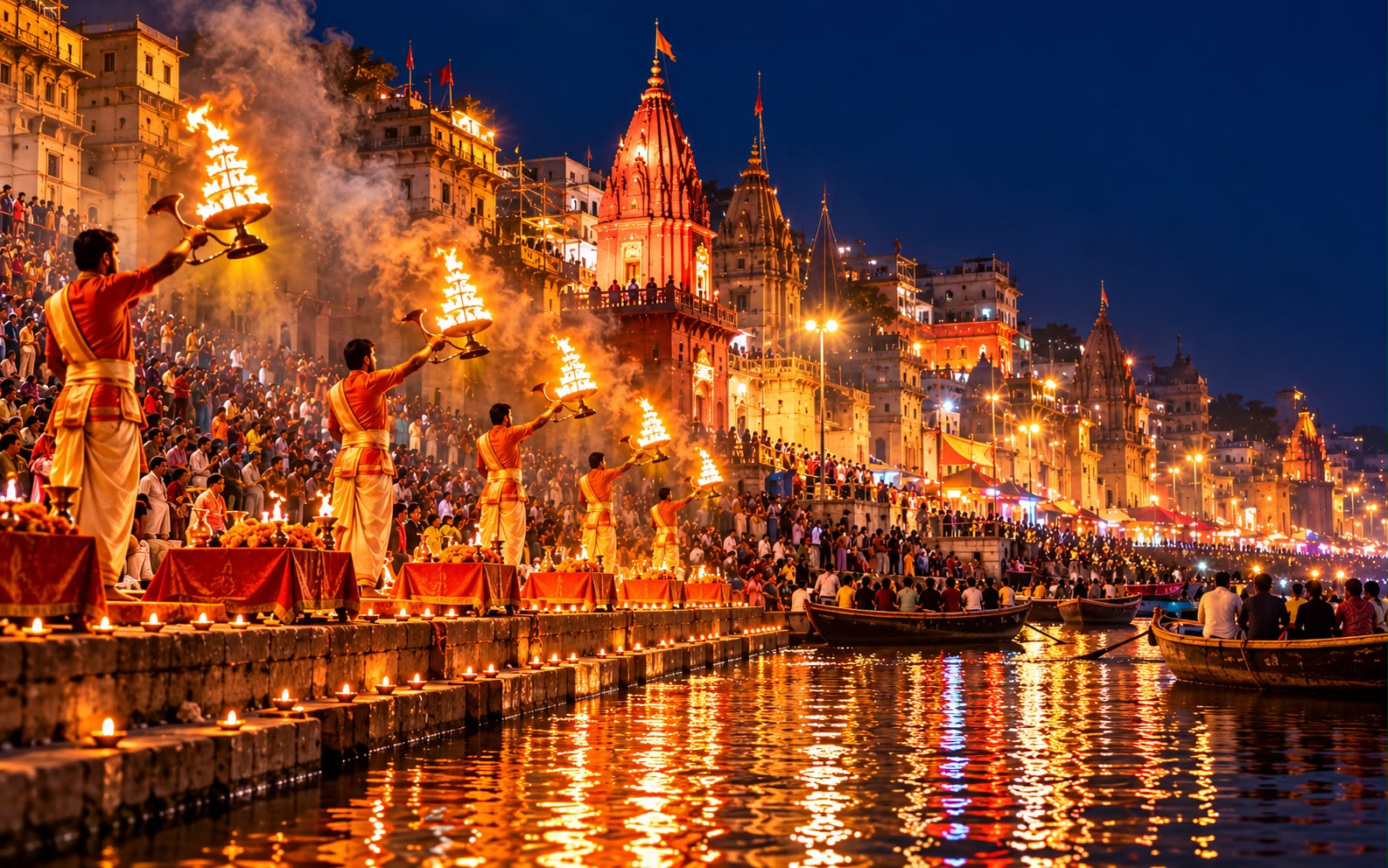
- 18:00 winter / 18:45 summer-ish — Ganga aarti at Dashashwamedh Ghat (free from the steps; arrive 45–60 min early for a spot) — seven priests, fire lamps, bells and 20,000 voices. Tonight watch from the steps, inside the sound; tomorrow you’ll see it from the water.
- 20:00 — Dinner at your hotel rooftop — the lanes at night are for day three’s confidence, not day one’s.
Where to stay in Varanasi (three nights, on or above the ghats)
- Heritage splurge: BrijRama Palace — the 18th-century palace on Darbhanga Ghat, arrival by boat; Varanasi’s one great luxury address.
- Mid-range: Amritara Suryauday Haveli — riverside haveli, courtyard calm, rooftop Ganges views.
- Budget: Ganpati Guest House — the long-running travellers’ favourite with river-view rooms and rooftop café.
Day 2 — Dawn on the river, the old city, the corridor
- 5:45 — Sunrise boat ride (book the evening before, ~20:00, for fair rates: shared rowboat ₹150–250/person, private ₹1,500–2,500 — sunrise carries a premium; life jackets are mandatory). Drift from Assi toward Manikarnika as the sun lifts out of the far bank and the ghats fill with bathers and yoga — the single greatest hour in Indian travel.
- 7:30 — Passing Manikarnika, the burning ghat, from the water: fires burn around the clock and have for centuries. The etiquette is absolute — no photographs of the pyres, ever, no pointing, and on land later, politely refuse anyone offering “closer views” for donations.
- 8:30 — Kachori-and-jalebi breakfast in the lanes; the famous hole-in-the-wall lassi shops (served in clay cups) open mid-morning.
- 10:00 — Kashi Vishwanath temple and corridor — the rebuilt riverfront complex around Shiva’s great shrine. Entry is free; queues are long, phones/bags go into lockers, and non-Hindu visitors should check current inner-sanctum rules at the counter (the corridor and outer complex welcome all).
- 13:00 — Lunch, then the wise Varanasi move: retreat, rest, process.
- 17:30 — Evening round two, your choice: the aarti from a boat (stationary on the water facing Dashashwamedh — spectacular, book ahead) or the smaller, more intimate Assi Ghat aarti among locals.
- 20:00 — Dinner; try Banarasi specialities — baati chokha, malaiyyo in winter, and paan to finish, because Banaras invented the art.
Day 3 — Sarnath, silk and the slow goodbye
- 6:00 — Optional: Subah-e-Banaras at Assi Ghat — the dawn programme of Vedic chants, ragas and open-air yoga (~5:00–5:30 start by season; free) — gentler than another boat, and locals outnumber tourists.
- 9:30 — Sarnath (~30–40 min): where the Buddha preached his first sermon. The great Dhamek Stupa and monastery ruins (foreigners ~₹300), the excellent Archaeological Museum (small fee; closed Fridays) holding the Ashoka lion capital — India’s national emblem — in the flesh. Two–three calm hours; the contrast with the old city is the point.
- 13:00 — Lunch back in town.
- 15:00 — Banarasi silk: the weaving quarter’s looms and a reputable showroom (your hotel knows the honest ones) — a real Banarasi sari or stole is the souvenir of the trip. Watch the handloom work before buying; that’s what you’re paying for.
- 18:00 — Last ghat walk at golden hour; sit on the steps and let the city do its thing.
- 20:00 — Pack for an early flight; rooftop farewell dinner.
Day 4 — Fly to Amritsar, first sight of gold
- Morning — Fly Varanasi → Amritsar via Delhi (~4–5 h door to door). Land, check in on the pedestrianised Heritage Street.
- 16:00 — Walk the heritage corridor to the temple complex. Shoes into the free cloakroom, feet through the wash, head covered (free scarves at the gate) — and then through the gateway: the Golden Temple floating on its pool, gold on water, kirtan hymns on loudspeakers that somehow soothe rather than blare. All faiths welcome, 24 hours, free, forever.
- 17:30 — First slow parikrama (clockwise circuit) of the pool; join the queue for the inner sanctum if it’s short, or save it for dawn.
- 19:30 — Langar — the world’s largest free kitchen: sit in rows on the floor with everyone from beggars to billionaires, eat dal-roti-kheer served by volunteers. Then do the thing that makes the visit: volunteer 30 minutes rolling chapatis or washing plates — walk-ins welcome, no signup.
- 21:30 — The temple at night is, many say, more beautiful still — stay for the illuminated reflection, or return for the Palki ceremony (the scripture’s nightly procession, ~21:45 winter).
Where to stay in Amritsar (three nights)
- Luxury: Taj Swarna — the city’s five-star benchmark, superb Punjabi kitchen.
- Mid-range: Fortune Inn Heritage Walk — superbly rated, walking distance to the temple.
- Budget: SureStay Heritage Walk — three minutes from the gates, excellent value; the SGPC’s own pilgrim guesthouses are the free/nominal alternative.
Day 5 — Dawn gold, hard history, border theatre
- 5:30 — (Or 3:30, for the brave: the amrit vela hours are transcendent.) The temple at dawn — mist on the pool, the first hymns, short sanctum queue. This is the visit you’ll remember.
- 8:30 — Breakfast on Heritage Street.
- 9:30 — Jallianwala Bagh (nominal entry; grounds all day) — the walled garden of the 1919 massacre: the preserved bullet holes, the martyrs’ well. Fifteen minutes’ walk and a century of weight.
- 11:00 — The Partition Museum, Town Hall (foreigners ~₹200; ~2 h; typically closed Mondays) — the world’s first museum of the 1947 Partition, told through survivors’ objects and voices. In this city, on this border, it lands hard and it should.
- 13:00 — Lunch: Amritsari kulcha, properly — Kulwant Singh Kulchian Wala or the Lawrence Road institutions (₹80–120 of butter-blistered perfection).
- 14:30 — Drive to Wagah-Attari border (30 km; shared transport ~₹150/seat, private car ~₹1,800 round trip). Arrive ~2 h before the ceremony — seating is first-come and free; guards wave foreigners, women and children toward better blocks (carry passports). Big bags stay in the car.
- 16:15 winter / 17:15 summer — The Beating Retreat ceremony: high-kicking soldiers, roaring grandstands on both sides of the gate, the synchronized flag-lowering — one hour of nationalist opera that ends, disarmingly, with a handshake.
- 19:30 — Back in town; dinner at Kesar Da Dhaba (since 1916 — the dal makhani that launched a thousand imitations).
Day 6 — The food city, the fort, the last hour of gold
- 9:00 — Breakfast like Amritsar means it: puri-chole or another kulcha round, then Gurdas Ram Jalebi Wala (est. 1884) while they’re hot.
- 11:00 — The old-city bazaars: phulkari embroidery, juttis, papad-warian lanes; or the Gobindgarh Fort complex (ticketed, part theme-park these days — go for the walls and skip the add-ons).
- 13:30 — Clay-pot lassi at the century-old akharas — spoon-thick, ₹50–70, lunch replaced.
- 16:00 — Rest, shop, or one more museum (the Sikh Museum inside the temple complex, free, moving).
- 19:00 — Farewell dinner — Amritsari fish or the vegetarian thali blowout.
- 21:00 — Last visit to the Golden Temple at night. Sit by the water until they sing the day closed. No better ending exists in India.
Day 7 — Fly home
- Morning — Amritsar airport: direct to the Gulf, or connect via Delhi. If the flight is late, one more dawn at the temple costs nothing — literally.
Costs and practicalities
Best time to visit
October–March, and in both cities the cold months are the atmospheric ones.
- October–November — the best of the year. Dev Deepawali at Varanasi, fifteen days after Diwali, lights every ghat with lamps and is the most extraordinary night of the city’s calendar.
- December–January — cold, with heavy morning fog on the Ganges that makes the dawn boat ride either sublime or blank. Amritsar is genuinely cold, close to freezing at night, and the Golden Temple in winter mist is remarkable.
- February–March — comfortable and clear, and Holi in Varanasi is as intense as anywhere in India.
- April–June — 45°C on the Gangetic plain. Avoid.
- July–September — the monsoon. The Ganges rises and the lower ghats flood; boats are restricted and the steps disappear.
Kumbh and Magh Mela years transform Varanasi and Prayagraj entirely — check whether your dates fall in one.
Travel tips
- Photography at the burning ghats is prohibited — Manikarnika and Harishchandra. People will offer to let you, for money; it is a scam and it is also a cremation. Put the camera away.
- Take the dawn boat. Sunrise from the water is the single best hour in Varanasi, and the evening Ganga Aarti at Dashashwamedh is the other.
- The Golden Temple requires covered head, bare feet and no tobacco. Head scarves are provided free at the entrance.
- Eat at the Golden Temple’s langar. It serves 50,000–100,000 people a day free, regardless of faith, and volunteering in the kitchen is welcomed.
- The Wagah border ceremony is late afternoon, fills early, and foreigners have a separate and better enclosure. Carry your passport; no bags.
- Varanasi’s old lanes are a maze and guides will attach themselves. Agree a price or decline clearly.
- Drink bottled water only, and do not swim in the Ganges however compelling the scene.
What this trip actually costs
Two people, 6 nights, mid-range comfort, arrival flights excluded:
| Item | Cost |
|---|---|
| Hotels, 6 nights (3 Varanasi ghat-side + 3 Amritsar heritage street) | INR 33,000 (≈ AED 1,289) |
| Flight Varanasi → Amritsar (via Delhi), 2 pax | INR 12,000 (≈ AED 469) |
| Local transport: airports, autos, Sarnath, Wagah car | INR 8,000 (≈ AED 312) |
| Boats, entries and museums, 2 pax | INR 6,000 (≈ AED 234) |
| Food and drink, 7 days (langar lowers this beautifully) | INR 14,000 (≈ AED 547) |
| SIM, tips, extras | INR 5,000 (≈ AED 195) |
| Total for two | INR 78,000 (≈ AED 3,046) |
- Roughly INR 39,000 (≈ AED 1,523) per person (~USD 455) — the great sights of this trip (the aarti, the temple, langar, Wagah, Jallianwala) are free or nearly so; guesthouses pull the total near INR 26,000 (≈ AED 1,015), and BrijRama’s palace rooms are the one place to spend up.
- Book in this order: flights (the via-Delhi connector sells out around festivals) → ghat-side rooms in Varanasi (few and beloved — weeks ahead in season, months for Dev Deepawali) → Amritsar heritage-street hotels → boats the evening before → everything else walks up.
- Festival intelligence: Dev Deepawali (Nov full moon) — a million lamps on the ghats, Varanasi’s most spectacular and most booked night; Diwali and Guru Nanak Jayanti transform Amritsar. Aim at them deliberately or route around them.
- Hotel and restaurant picks here are unsponsored — no affiliate links in this article. Chosen on location and current ratings; always check prices and recent reviews before booking.
What to pack
- A scarf/head-cover per person — used daily in both cities.
- Modest layers throughout; winter dawn on the river is 5–10°C — real jacket, hat for the boat.
- Slip-on shoes (removed constantly) + socks for cold marble parikramas.
- Hand sanitiser and the standard India stomach kit; the street food is half the trip — ease in, choose busy stalls.
- Small notes for boats, rickshaws and shoe-minders; UPI covers the rest.
- Emotional bandwidth. Sincerely — this route uses it.
FAQ
Is Varanasi too intense for a first India trip? It’s the deep end. If this is your first India, do our Golden Triangle first and add this route second — you’ll navigate the lanes with far more ease. Hardy first-timers do land straight here and thrive; know your travel temperament.
Can I photograph the cremation ghats? No. From the river at a respectful distance, wide shots of the ghat are tolerated by most boatmen’s guidance; on land, cameras stay down entirely near the pyres. When unsure, don’t — no photograph is worth the intrusion, and touts “authorising” photos for money have no authority to sell.
Is the Golden Temple really open to everyone? Completely — every faith, no ticket, 24 hours, and the langar feeds all comers as a founding principle. Cover your head, go sober and shoeless, and you are a guest of honour like everyone else.
Is Wagah worth the hype? As spectacle, absolutely — it’s the world’s most choreographed border. Go once, cheer along, and read the Partition Museum the same day; the pairing turns pantomime into perspective.
Vegetarian and halal food? Varanasi’s old city is heavily vegetarian (and largely alcohol-free near the ghats) — a vegetarian paradise. Amritsar’s langar is vegetarian by rule; the city’s Muslim quarter and many dhabas serve halal — though the iconic dhabas are veg — so both diets travel well here.
What pairs with this route? Amritsar sits 4–5 h by road from Dharamshala/McLeod Ganj (the Tibetan world — a natural +3 days), and Varanasi connects onward to Bodh Gaya for the Buddhist circuit. Within our guides, the Golden Triangle bolts on via Delhi at either end.
Prices and entry rules change, and what you need depends on your passport; last checked 8 October 2026, so confirm with the embassy or your airline before booking.


