 The Itinerary
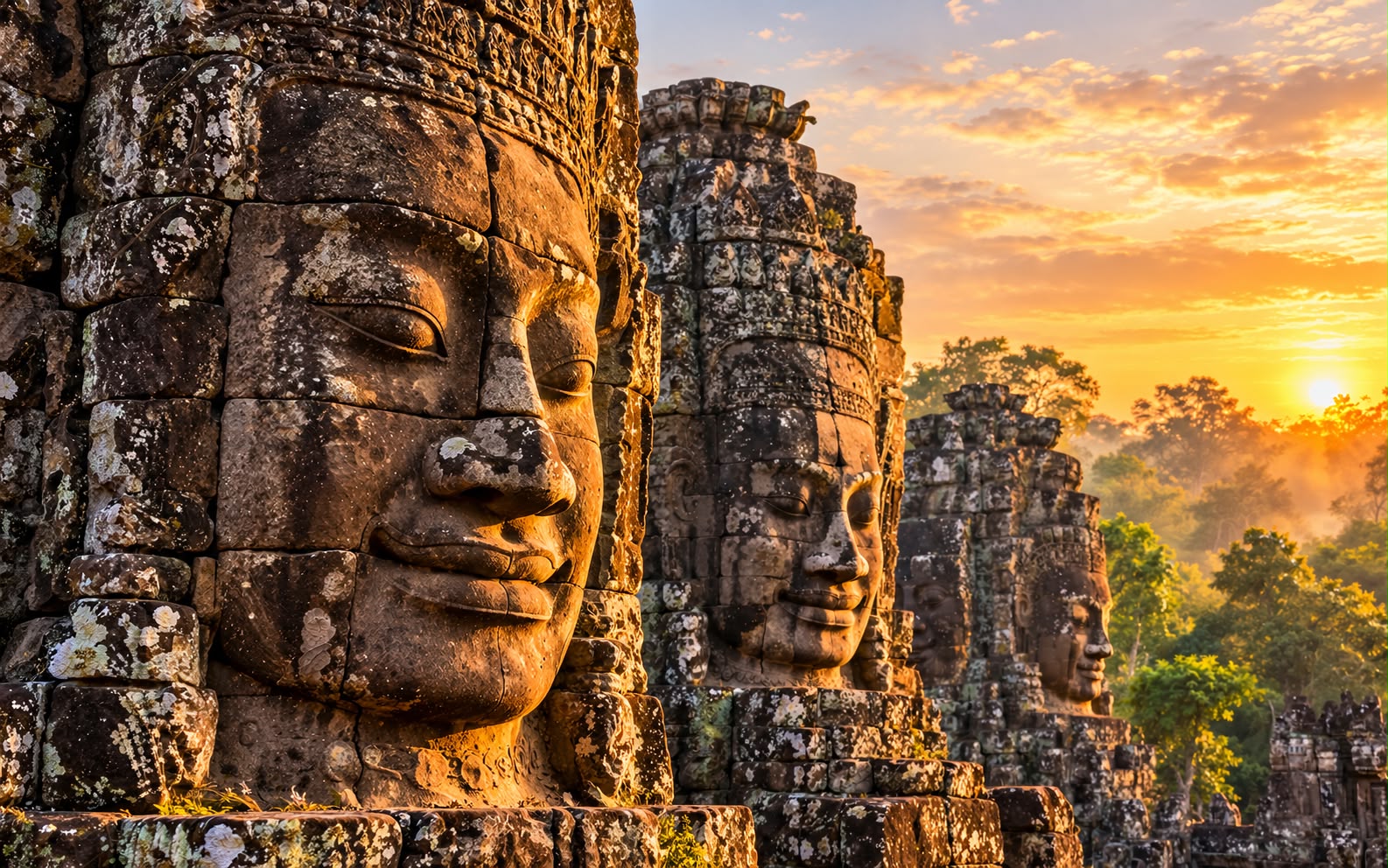
Indochina in 16 days: Bangkok, Angkor, Hoi An and Ha Long Bay
The grand tour of mainland Southeast Asia: Bangkok's temples and traffic, a thousand square kilometres of Khmer ruins at Angkor, the Mekong delta, a lantern-lit trading port, and a bay of two thousand limestone islands at the end. Four internal flights, three currencies, one of the great trips.
- Southeast Asia
- 16 days
- ≈ AED 7,000 / person
- Three countries, the largest religious monument on earth, and a bay full of limestone
Before you go
This is the route most people mean when they say Southeast Asia, and it is three countries rather than two because leaving any of them out makes the trip worse.
Bangkok is the arrival — a city of gilded temples, seven-lane traffic and the best street food in the world, all at once. Angkor is the reason the trip exists: the largest religious monument ever built, at the centre of a Khmer capital that held something like a million people when London held fifty thousand.
Vietnam is the long half. Ho Chi Minh City is loud and commercial with the war museums that explain the last century. Hoi An is a preserved trading port of tailors and lanterns where the Japanese, Chinese and Europeans all left their architecture. Hanoi is the oldest and most northern, with a thousand-year-old quarter laid out by guild. And Ha Long Bay is nearly two thousand limestone karsts rising out of the Gulf of Tonkin.
Sixteen days, three countries, four internal flights. Figure USD 1,900 (≈ AED 6,978) per person. November–February is the window that works for all three.
One honest note before you plan: this overlaps the Thailand and Laos and Vietnam and Cambodia routes on this site. Those are better if you have ten or twelve days. This is the version for people who have a fortnight and want the whole thing.
Before you go: the admin
Three countries, three systems
- Thailand admits most nationalities visa-free for 30 to 60 days. Check your own; the list changed recently and is generous.
- Cambodia issues an e-visa online and a visa on arrival at Siem Reap and Phnom Penh. The e-visa is worth the small extra fee to skip the arrival queue.
- Vietnam runs an e-visa for most nationalities, valid 90 days, applied for online about a week ahead. Print it. Airlines have refused boarding over an unprintable phone copy.
- Six months’ passport validity for all three, and blank pages — Cambodia’s visa takes a full one.
- Check requirements at booking, not at packing. These three change their rules more often than most.
Flights, and why four of them
- Fly into Bangkok, out of Hanoi. The open-jaw is the whole trip; doing it as a return wastes two days.
- The four internal legs are Bangkok–Siem Reap, Siem Reap–Ho Chi Minh City, Ho Chi Minh City–Da Nang (for Hoi An) and Da Nang–Hanoi. All are an hour to ninety minutes on AirAsia, Vietjet or Vietnam Airlines.
- Book them as you book the trip. They are cheap in advance and not cheap late.
- The overland alternatives exist and cost days. The bus from Bangkok to Siem Reap is a long, hot, scam-prone institution. Take the flight.
- Vietnam’s domestic flights run late routinely. Leave a buffer before the international departure.
Money
- Thai baht, Cambodian riel and Vietnamese dong, and Cambodia effectively runs on US dollars. Prices are quoted in dollars and ATMs dispense them; riel comes back as small change under a dollar.
- Carry clean, untorn US dollar notes for Cambodia. Worn or marked notes get refused.
- Vietnamese dong has a lot of zeroes — 100,000 dong is about four dollars. Check the note count, because 10,000 and 100,000 look similar and that mistake is made daily.
- Cards work in hotels and better restaurants in all three; everything else is cash.
- Tipping is not traditional but is now expected in tourism, particularly for guides and drivers.
Health and one piece of road advice
- See a travel clinic six weeks ahead — hepatitis A and typhoid are standard; Japanese encephalitis and rabies depend on your plans.
- Dengue is present in all three and there is no preventive drug. Repellent, day and night, is the whole answer; the mosquito that carries it bites in daylight.
- Drink bottled or filtered water everywhere, including for teeth.
- Crossing the road in Hanoi and Ho Chi Minh City: walk slowly and predictably into the traffic and do not stop. The scooters flow around you. Hesitating is what causes accidents, and this is genuinely the technique everyone uses.
Day by day
Day 1 — Bangkok, the river
- Arrive, and go to the river, which is where the city makes sense.
- 15:00 — The Chao Phraya express boat is the city’s best transport and its best sightseeing simultaneously. The orange flag is the cheap local one.
- 17:00 — Wat Arun across the river, best at sunset from the Bangkok side, and the ferry across costs almost nothing.
- 19:30 — Street food: Chinatown’s Yaowarat Road after dark, which is the single best eating street in the country. It starts at seven and not before.
Day 2 — The old city
- 08:30 — The Grand Palace and Wat Phra Kaew, which holds the Emerald Buddha — jade, 66cm tall, and the king changes its robes three times a year. Strict dress code: shoulders and knees covered, no see-through fabric, and they enforce it at the gate.
- 11:00 — Wat Pho next door for the 46-metre reclining Buddha and the massage school, which is where Thai massage is taught from. An hour there costs a fraction of a hotel spa.
- 14:00 — The Museum of Siam, which explains the history well and is air-conditioned.
- 18:00 — A rooftop bar for the scale of it. There is a dress code at most and sandals will not get you in.
Day 3 — Markets
- 08:00 — Chatuchak Market at the weekend — 15,000 stalls — or Wang Lang and Or Tor Kor for food markets a tenth as crowded.
- 13:00 — Jim Thompson House, the teak compound of the silk trader who vanished in 1967.
- 16:00 — Lumpini Park late, when the monitor lizards come out and the city exercises.
- Skip the floating markets unless you have a spare day; Damnoen Saduak is two hours out and almost entirely staged.
- 19:00 — Pack. The Siem Reap flight is short but the visa queue is not.
Day 4 — Siem Reap, and the first temples
- 09:00 — An hour’s flight, and three days is right — one day leaves you resentful of the queues, three lets you see it properly.
- 13:00 — The three-day pass is the right buy and is sold at the official ticket office only, with a photograph taken on the spot.
- 15:30 — Angkor Thom and the Bayon, with 216 enormous serene faces on fifty-four towers, and the Terrace of the Elephants. Go at opening or late afternoon; the middle of the day is 35°C with no shade.
- 18:30 — Pub Street or the night market for the first evening, which is unapologetically what it is.
Day 5 — Angkor Wat at sunrise
- 05:00 — Angkor Wat at sunrise, from the left-hand reflecting pool. It is crowded and it is still worth doing once.
- Angkor Wat is the largest religious monument in the world and was built in about thirty years in the twelfth century.
- Dress code applies — shoulders and knees, and they turn people away at Angkor Wat’s upper level.
- 08:00 — Inside, once the sunrise crowd has gone for breakfast — the bas-relief galleries run 600 metres and are the best hour here.
- 10:30 — Ta Prohm, where the silk-cotton and strangler fig roots have grown through the stone and were deliberately left there.
- 15:00 — Preah Khan and Neak Pean, both quiet, on the grand circuit.
Day 6 — Banteay Srei, and the other history
- 07:30 — Banteay Srei, forty minutes out — small, pink sandstone and the finest carving at Angkor by a distance. Go first; it is tiny and fills.
- 10:30 — Beng Mealea further out if you want a temple largely unrestored, or back for the roluos group.
- 14:00 — The Landmine Museum or APOPO, where the mine-detection rats are trained, for the other half of the country’s recent history.
- 17:00 — The floating villages on the Tonlé Sap, which are worth doing only with a reputable operator — several of these trips are exploitative and your hotel will know which.
- 19:30 — An Apsara dance dinner, which is touristic and pleasant.
Day 7 — Ho Chi Minh City
- 09:00 — An hour’s flight, and the country changes completely.
- 13:00 — The War Remnants Museum. It is presented from the Vietnamese side, which is the point, and it is harrowing — particularly the Agent Orange rooms. Go early in the day, so this is the first stop off the plane rather than the last.
- 16:00 — The Reunification Palace, left exactly as it was on 30 April 1975, with the tanks outside.
- 18:00 — Notre-Dame Cathedral and the Central Post Office, both French colonial, the post office by Gustave Eiffel’s firm.
- 20:00 — Ben Thanh Market at night, when the street stalls set up around it.
Day 8 — Cu Chi, and the delta
- 07:30 — The Cu Chi Tunnels, ninety minutes out: 250 kilometres of hand-dug tunnels on three levels, a section widened for visitors, and it is a genuinely tight squeeze.
- 12:00 — Back, or straight on to the delta.
- 14:00 — The Mekong Delta as a day trip — Ben Tre or Cai Be rather than My Tho, which is the coach-party one. Sampans through the coconut channels, paddled rather than motored.
- And a floating market if you go early enough — which on a day trip means leaving at six, not two, so choose which half of this day matters.
- 19:00 — Back in the city, and a bowl of pho for breakfast tomorrow, which is a breakfast food here and not a dinner.
Day 9 — To Hoi An
- 09:00 — Fly to Da Nang, then forty minutes by road.
- 14:00 — Order anything you want made, first thing you arrive. Tailoring is the local industry — several hundred shops, and a suit or dress takes about 24 hours with a fitting. Allow two nights if you want anything made.
- 16:00 — The Ancient Town is UNESCO-listed and closed to cars — a trading port that silted up and was therefore never modernised. The Japanese Covered Bridge dates from the 1590s.
- 19:00 — The lanterns. The old town is lit by them nightly, and on the full moon the electric lights go off and it is candles and paper on the river.
Day 10 — My Son, and the beach
- 06:30 — My Son, an hour inland — Cham temples in a jungle valley, Hindu rather than Buddhist, bombed in the war and atmospheric for it. Go at opening; by ten it is hot and full.
- 11:00 — Back for the fitting.
- 14:00 — An Bang beach, fifteen minutes by bicycle, and the bicycles are usually free from the hotel.
- 17:00 — A cooking class with the market shop first, which is the best one of these anywhere on the route.
- 20:00 — Cao lau, which is made with water from one well in town and exists nowhere else.
Day 11 — The Hai Van Pass
- 08:00 — The Hai Van Pass north towards Hue, by car or motorbike, with the coast on one side the entire way. It is the pass from the Top Gear episode and it earns the reputation.
- 11:00 — Hue — the Citadel and the Imperial City, and the royal tombs along the Perfume River.
- 15:00 — Back over the pass, or the tunnel if the weather has closed in, which it does often.
- 18:00 — A last Hoi An evening, and collect everything you ordered.
Day 12 — Hanoi
- 10:00 — Ninety minutes by air from Da Nang.
- 14:00 — The Old Quarter, where the thirty-six streets are still named for the guild that worked each one — silk, tin, bamboo, votive paper.
- 17:00 — Water puppetry at Thang Long — an eleventh-century art form performed in a waist-deep pool, and it is forty-five minutes and genuinely charming.
- 19:00 — Bun cha for dinner and egg coffee afterwards, which is a Hanoi invention and far better than it sounds.
- Train Street is photogenic and the cafés have been repeatedly closed by the authorities on safety grounds. Check the current position and do not take liberties with a live railway.
Day 13 — The lake, and the history
- 06:00 — Hoan Kiem Lake at six in the morning, when several hundred people are doing tai chi, badminton and aerobics around it.
- 08:00 — Ho Chi Minh’s Mausoleum — he is in it, and he asked to be cremated. Strict rules, no bags, no photographs, and it closes for maintenance for two months most autumns.
- 10:30 — The Temple of Literature, Vietnam’s first university, founded 1070, with the doctors’ names on stone tortoises.
- 14:00 — The Hoa Lo Prison, the “Hanoi Hilton”, French-built and later American-occupied.
- 17:00 — The Museum of Ethnology, which is the best museum in the country and which most visitors miss.
Day 14 — Hanoi, or Ninh Binh
- 06:30 — Ninh Binh as a long day trip, two hours south — Trang An by sampan, three hours rowed by a woman using her feet, through nine caves between limestone towers.
- Or a slower Hanoi day: the Fine Arts Museum, West Lake and the Tran Quoc pagoda, and a bia hoi corner in the afternoon.
- 16:00 — Shopping in the Old Quarter, which is where the lacquerware and the silk are.
- 19:00 — A last Hanoi dinner, and pack for the boat — you need an overnight bag only.
Day 15 — Ha Long Bay, overnight
- 08:00 — Two and a half hours by road from Hanoi on the expressway.
- An overnight cruise is the right way — the day trips spend four hours on a bus for four hours on the water.
- 12:00 — Board. Nearly 2,000 limestone karsts rising out of the gulf, UNESCO-listed, with caves, floating villages and kayaking between the islands.
- Consider Lan Ha Bay or Bai Tu Long instead. Same geology, a fraction of the boats, and most good operators now run there — ask before booking.
- 15:00 — Sung Sot Cave is the big one, and busy; the kayaking and the swimming off the back of the boat are what people remember.
- 18:30 — Sunset from the top deck.
Day 16 — Back to Hanoi, and home
- 06:30 — Sunrise over the karsts, and tai chi on deck that almost nobody attends.
- 11:00 — Brunch as the boat comes back in, docking around noon.
- 15:00 — Back to Hanoi and fly home, or build a buffer night in Hanoi if your flight is early — the road in is two and a half hours and the traffic at the city end is unpredictable.
Costs and practicalities
Best time to visit
November to February is the only window that suits all three countries at once, which is why the whole region sells in those months.
- November–February — the dry season in Thailand and Cambodia, and the most comfortable in southern Vietnam. Hanoi and Ha Long are cool and often grey: 15–20°C, with drizzle and mist in January and February that can hide the bay entirely. That is the trade for sunshine everywhere else.
- March–April — hot and getting hotter. Angkor reaches 38°C and central Vietnam is pleasant. Songkran in Thailand in mid-April is a nationwide water fight and either the highlight or an obstacle.
- May–August — the wet season. Rain is usually a heavy afternoon hour rather than all day, prices drop and Angkor is green with full moats. Central Vietnam is at its best in May and June.
- September–October — the wettest in Vietnam, and typhoon season on the central coast, which can close Hoi An and Da Nang for days. The weakest window of the year for this particular routing.
Tet, the Vietnamese new year, falls in late January or February. The country effectively closes for a week, transport sells out months ahead and prices rise. Check the date before booking anything.
Travel tips
- Book the four internal flights when you book the trip. They are cheap early and expensive late, and they are what makes sixteen days enough.
- Print your Vietnam e-visa. Airlines have denied boarding over a phone copy that would not display.
- Carry clean US dollar notes for Cambodia — torn or marked ones get refused outright.
- Count the zeroes on Vietnamese dong. 10,000 and 100,000 look alike and the mistake is made constantly.
- Dress code at Angkor and the Grand Palace is enforced at the gate: shoulders and knees covered. Carry a scarf.
- Cross the road by walking slowly and not stopping. The scooters flow around you; hesitating is what causes accidents.
- Use the metered taxis or Grab, not the drivers who approach you. Grab works in all three countries and settles the price in advance.
- Choose Lan Ha or Bai Tu Long over the main Ha Long channel if your operator offers it. Same scenery, far fewer boats.
- Repellent in daylight, because dengue’s mosquito is a day biter.
What this trip actually costs
Two people, 15 nights, mid-range comfort, international flights excluded:
| Item | Cost |
|---|---|
| Hotels, 15 nights | USD 1,350 (≈ AED 4,958) |
| Four internal flights, two people | USD 1,000 (≈ AED 3,673) |
| Food and drink, 16 days | USD 700 (≈ AED 2,571) |
| Angkor pass, Ha Long cruise, guides and entries | USD 600 (≈ AED 2,204) |
| Local transport, taxis and transfers | USD 150 (≈ AED 551) |
| Total for two | USD 3,800 (≈ AED 13,956) |
- Roughly USD 1,900 (≈ AED 6,978) per person for sixteen days across three countries, which is the best value-per-day on this site outside Nepal.
- The flights are the biggest single line and the thing that makes the itinerary possible. Overland would save most of it and cost four days.
- The Angkor three-day pass and a good Ha Long cruise are about half the entries figure between them, and both are worth it.
- Daily costs are low and unevenly so: street food is a dollar or two a plate, while a decent overnight cruise is a hundred a head.
- Hotel picks here are chosen on location, not on commission — always check prices and recent reviews before booking.
What to pack
- Light, loose, covering clothes. Shoulders and knees for temples, and cotton or linen rather than synthetics in the heat.
- A scarf or sarong, which solves every dress code instantly.
- Proper walking shoes for Angkor — the stone is uneven and the steps are steep.
- Strong repellent, and apply it in daylight.
- A light rain layer in any month.
- Clean US dollars for Cambodia, and small notes.
- A power bank for the long temple days, and a universal adapter — the three countries use overlapping but not identical plugs.
- Sun protection. Angkor and the Mekong have no shade.
FAQ
Is sixteen days enough for three countries? Yes, because the internal flights are short and you are visiting six places rather than touring whole countries. It is not enough to add Laos or the Thai islands — that is a different trip.
How does this differ from your Vietnam and Cambodia route? That one is twelve days and two countries, with more time in each. This adds Bangkok and a third country for four extra days. If you have twelve days, take the shorter route; this is the fortnight version.
Do I need three separate visas? Effectively yes, though Thailand is visa-free for most nationalities. Cambodia is an e-visa or visa on arrival, and Vietnam is an e-visa applied for online about a week ahead.
Can I do it overland instead of flying? You can, and plenty of backpackers do. It costs about four days of the sixteen, and the Bangkok–Siem Reap bus in particular is a long and scam-prone journey. Flying is what makes this itinerary fit.
Is Ha Long Bay too touristy now? The main channel is extremely busy. Lan Ha Bay and Bai Tu Long have the same limestone scenery with a fraction of the boats, and most reputable operators now run there. Ask before booking.
Prices and entry rules change, and what you need depends on your passport; last checked 29 October 2026, so confirm with the embassy or your airline before booking.


