 The Itinerary
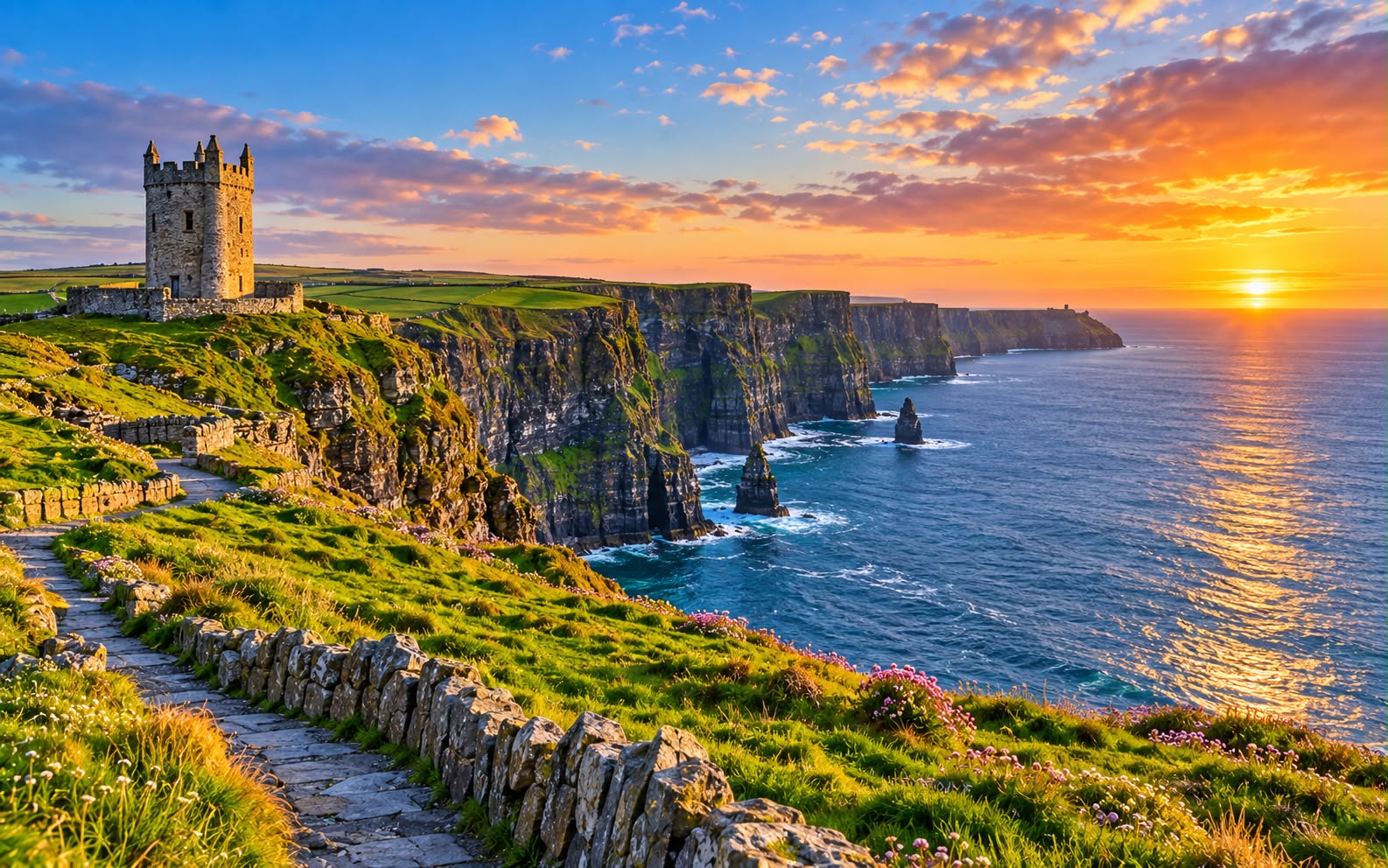
Ireland in 7 days: Dublin, Galway and the wild west
The friendliest country in Europe and its wildest coastline: a 1,200-year-old book in a Harry Potter library, cliffs that drop 214 metres into the Atlantic, fiddle sessions in painted pubs — and the visa trick nobody tells Indians: a UK visit visa can cover Ireland too.
- Northern Europe
- 7 days
- ≈ AED 5,550 / person
- Coast + culture
Before you go
Ireland runs on two renewable resources: rain and charm. The rain keeps the island forty shades of green; the charm means a request for directions ends fifteen minutes later with a family history and a restaurant recommendation. Add a coast that shatters into 214-metre cliffs, a capital that gave the world half its great writers, and pubs where the music is live, unamplified and started by whoever brought a fiddle — and you have Europe’s easiest country to love.
For this site’s readers there’s a headline the brochures skip: Ireland is not in Schengen, but a UK visit visa can cover it. Under the British-Irish Visa Scheme (BIVS), Indian nationals holding a UK short-stay visa (endorsed BIVS — most are) can visit Ireland without any Irish visa, provided they enter via the UK first. If you took our UK guide’s trip, Ireland is already half-unlocked.
The route: Dublin (3 nights) → Galway (2 nights) + the Cliffs of Moher → Dingle (1 night) on the Slea Head drive, then home. Figure EUR 1,350 (≈ AED 5,528) per person including a standalone visa, excluding flights. Go May–September for long light (October is moody-lovely; every month is rain-possible — that’s the deal).
Before you go: the admin
The BIVS trick, decoded
- The BIVS trick, decoded: UK short-stay visit visas issued to Indian nationals normally carry the “BIVS” endorsement — check the sticker. With it, you may visit Ireland for up to 90 days with NO Irish visa, on one condition: you must enter the UK first on that visa (even a London stopover counts), then continue to Ireland; you can fly home from either island. Mention BIVS in your UK cover letter to be safe. It works in reverse too (Irish visa endorsed BIVS → the UK).
- The standalone route: no UK visa? The Irish short-stay ‘C’ visa costs €60 + VFS service fee at your nearest visa centre — the usual file (proof of residence, bank statements, employment letter, bookings, insurance) — and Irish processing runs slower than Schengen: apply 6–8 weeks out.
Flights and money
- Flights: Etihad flies Abu Dhabi–Dublin non-stop and Emirates flies Dubai–Dublin daily (~8 h; commonly US$710–1,150 return).
- Money: euros (NOT in the North — that’s sterling and a different visa question); cards tap everywhere; tipping is ~10% at table-service restaurants only, nothing at pubs.
The car-hire honesty
- The car-hire honesty (Ireland’s famous gotcha): basic rentals carry a €2,000–3,000 damage excess, and — uniquely — most credit-card rental insurance EXCLUDES Ireland. Budget the super-damage-waiver (€15–30/day) or a standalone excess policy, book a SMALL car (the west’s boreens are hedge-width), and remember: left side, like home-away-from-UAE.
Day by day
Day 1 — Land in Dublin, first stroll
- Afternoon — Land, AirCoach/bus into the centre (~€8), check in.
- 16:30 — Orientation loop: Grafton Street’s buskers (Dublin’s future stars audition here daily), St Stephen’s Green, Molly Malone, and a first look at Temple Bar — with the honest note attached: it’s the postcard, and it charges like one (€10 pints, tourist menus). Look, photograph, then eat one street over.
- 19:30 — Dinner around South William/Camden streets (modern Irish, €22–35 mains) — and Irish brown bread with everything, immediately a habit.
Where to stay in Dublin (three nights — the honest warning: Dublin beds are among Europe’s priciest; book early, midweek beats weekends)
- Luxury: The Merrion — 4.8/5 on TripAdvisor (~5,300 reviews, 2026 Best of the Best), Georgian townhouses opposite government buildings. €450+.
- Mid-range: The Alex — 4.8/5 (~2,300 reviews), sharp and central by Trinity. ~€190–260.
- Value: Travelodge Plus City Centre — 4.8/5 (~1,600 reviews, the city’s #1 Best Value) at ~€120–160. (Marlin Stephen’s Green, 4.5/2,800, is the backup.)
Day 2 — The Book of Kells, a castle, the emigrants
- 09:00 — Trinity College: the Book of Kells Experience (~€25, timed — book online): the 1,200-year-old illuminated gospels, then the Long Room — the barrel-vaulted library of 200,000 ancient books that every fantasy film borrowed. Go at opening; by noon it’s a procession.
- 11:30 — Dublin Castle grounds and the Chester Beatty (free — one of Europe’s great small museums: Qur’ans, Mughal miniatures, Japanese scrolls; this site’s readers will find half their heritage beautifully kept).
- 14:00 — Lunch, then the EPIC Irish Emigration Museum (~€21) in the docklands vaults — the story of the 70-million-strong diaspora, told brilliantly (and a resonant mirror for any NRI family). Ha’penny Bridge photo on the walk back.
- 19:00 — The evening institution, framed for everyone: a trad session — live jigs and reels around a pub table (The Cobblestone and O’Donoghue’s are shrines). Non-drinkers are fully welcome: order a lemonade or a Guinness 0.0, take a stool, stay hours. The music, not the pint, is the point.
Day 3 — Howth’s cliffs, then choose your Dublin icon
- 09:30 — DART train to Howth (25 min, ~€7 return): the fishing-village peninsula — walk the cliff path loop (2 h, gorse, lighthouses, Dublin Bay glittering), watch seals mug the fish market, lunch on seafood chowder + brown bread (€9–12, the west’s national starter arrives early).
- 15:30 — Back in town, one big ticket:
- Guinness Storehouse (from ~€26 online, time-tiered): honestly framed — it’s a seven-storey brand museum done superbly, ending at the 360° Gravity Bar city view; soft drinks pour as happily as stout, so non-drinkers lose only the sample; or
- Kilmainham Gaol (~€8, books out days ahead): the prison where the 1916 leaders were executed — Ireland’s most moving hour and the pick for history-first travellers.
- 19:30 — Last Dublin dinner; collect the rental car in the morning.
Day 4 — West to Galway
- 09:00 — Collect the car and cross the island (2.5 h motorway; optional detour: Clonmacnoise, the monastic ruins on the Shannon, ~€8).
- 13:30 — Galway: lunch in the Latin Quarter’s painted lanes, then the Spanish Arch, the Claddagh (yes, of the ring), and street musicians who’d headline elsewhere.
- 17:30 — Salthill promenade stroll — Galway Bay sunset with the Burren’s grey hills across the water; locals kick the wall at the end for luck. Kick it.
- 20:00 — Dinner (Galway is Ireland’s food-town: €20–35 mains, oysters if September’s festival mood strikes), then the famous Tig Cóilí trad session — two a night, no cover, arrive early for a stool.
Where to stay in Galway (two nights)
- Luxury: Glenlo Abbey — 4.5/5 (~2,800 reviews), the estate-with-golf outside town — dinner is served in two Orient Express carriages. ~€280+.
- Mid-range: Park House Hotel — 4.5/5 (~3,700 reviews), old-school comfort off Eyre Square. ~€160–210.
- Value: The Nest Boutique Hostel — 4.6/5 (~460 reviews), privates near Salthill from ~€90. (Leonardo Galway, 4.2/3,800, is the mid-budget chain answer.)
Day 5 — The Burren and the Cliffs of Moher
- 09:00 — Loop south through the Burren — a grey limestone moonscape where Arctic and Mediterranean flowers somehow share cracks — stopping at Poulnabrone dolmen (a 5,800- year-old portal tomb, free, older than the pyramids and standing in a field).
- 12:00 — Lunch in Doolin, the trad-music village (chowder standards are set here).
- 13:30 — The Cliffs of Moher (€15 at the gate — book online for tiered discounts; under-12s free, parking + O’Brien’s Tower included): 214 metres of vertical Atlantic theatre, 8 km of paths, puffins in early summer. Stay behind the walls — the edge wind is not a metaphor; people ignore this yearly and make the news. Off-peak PM slots (after 4) get golden light AND smaller crowds.
- 17:30 — The coastal R478 back via Kinvara’s harbour castle; Galway evening, round two of everything.
Day 6 — Dingle and the Slea Head Drive
- 09:00 — South to Dingle (3 h — take the Killimer–Tarbert car ferry shortcut across the Shannon, €28/car, and coffee in literary Listowel).
- 13:00 — Fish and chips or chowder on Dingle’s harbour; say hello to the harbour town Nat Geo once called “the most beautiful place on earth.”
- 14:30 — The Slea Head Drive (30 km loop, clockwise, 2–3 h with stops): beehive huts from the first millennium, Coumeenoole beach wedged in the cliffs, Dunquin pier’s zigzag down to the Blasket Islands view, Gaelic road signs only — mainland Europe’s westernmost edge, and this trip’s scenery champion.
- 18:30 — Dingle evening: Murphy’s ice cream (sea-salt flavour, made with local milk — mandatory), dinner, and pubs that double as hardware shops (Foxy John’s sells pints and hammers; Dick Mack’s, boots) with trad sessions in the back.
Dingle night: the B&B belt is the point here — Pax House’s harbour views or the guesthouses along the Mall (~€110–160, Irish breakfasts included and enormous) — book by current reviews; it’s a small town that fills.
Day 7 — Conor Pass, then home
- 08:30 — Weather permitting, leave over the Conor Pass — Ireland’s highest road, Dingle shrinking behind, lakes in the corrie below (fog = take the N86 and lose nothing but the photo).
- 10:00 — The cross-country run back to Dublin (3.5 h; Adare’s thatched village makes the fairest coffee stop), drop the car at the airport by mid-afternoon for an evening Emirates/Etihad departure — or add an airport-hotel night for a morning flight.
Costs and practicalities
Best time to visit
May–September, though Ireland’s weather is unreliable in every month and the real variable is daylight and crowds rather than sunshine.
- May–June — the best of the year. Long days, the hedgerows in flower, and the Wild Atlantic Way before the summer traffic.
- July–August — warmest, busiest, and the Ring of Kerry and the Cliffs of Moher are at capacity. Accommodation in Dingle and Killarney needs booking months ahead.
- September–October — mild, quiet, and the light on the west coast is at its best.
- November–April — short days, wet and windy, and many west-coast attractions and ferries run reduced or not at all. St Patrick’s Day, 17 March, fills Dublin.
It will rain. Average rainfall on the west coast exceeds 200 days a year — plan around it rather than for it.
Travel tips
- Driving is on the left and the rural roads are single-track with stone walls and no verge. Take the extra insurance; the excess on Irish hire cars is notoriously high.
- Many hire companies require proof of your own insurance to waive the collision damage charge, and a credit card in the driver’s name. Sort this before you arrive.
- The Cliffs of Moher and the Ring of Kerry are coach routes. Drive the Ring anti-clockwise against the coaches, or do the Dingle peninsula instead — it is better and quieter.
- Book the Skellig Michael boat months ahead if it matters. It runs May to September only and is cancelled for swell constantly.
- Pub music sessions are not performances. Sit, listen, do not talk over the playing, and buy a round.
- Cards work everywhere; contactless is universal.
- Tipping is 10–15% in restaurants and not expected in pubs for drinks at the bar.
What this trip actually costs
Two people, 6 nights, mid-range, including standalone visas, excluding flights (AUH/DXB–Dublin ~US$710–1,150 return):
| Item | Cost |
|---|---|
| Irish C visas ×2 (€0 via BIVS if you hold a UK visit visa) | EUR 200 (≈ AED 819) |
| Dublin hotel, 3 nights | EUR 570 (≈ AED 2,334) |
| Galway hotel, 2 nights | EUR 280 (≈ AED 1,146) |
| Dingle B&B, 1 night | EUR 130 (≈ AED 532) |
| Car hire 4 days incl. excess cover + fuel + Shannon ferry | EUR 310 (≈ AED 1,269) |
| Dublin transit + Howth DART + airport buses | EUR 70 (≈ AED 287) |
| Book of Kells Experience ×2 | EUR 50 (≈ AED 205) |
| Guinness Storehouse (or Kilmainham) ×2 | EUR 55 (≈ AED 225) |
| EPIC museum ×2 | EUR 40 (≈ AED 164) |
| Cliffs of Moher (online) ×2 | EUR 25 (≈ AED 102) |
| Castle/Clonmacnoise/odds | EUR 40 (≈ AED 164) |
| Food, 7 days (chowder economy → seafood nights) | EUR 820 (≈ AED 3,358) |
| eSIM | EUR 15 (≈ AED 61.42) |
| Buffer: Murphy’s cones, wool jumpers, session lemonades | EUR 95 (≈ AED 389) |
| Total for two | EUR 2,700 (≈ AED 11,055) |
- EUR 1,350 (≈ AED 5,528) per person — and BIVS holders subtract the visa line AND the waiting: with a UK visit visa already in the passport, Ireland becomes a book-flights-and-go country. The other levers: Dublin midweek dates, B&Bs over hotels in the west (breakfast does lunch’s job), and lunch as the day’s big meal.
- Book in this order: visa decision (BIVS check first — look for the sticker endorsement) → flights → Dublin hotel (the scarce item) → car with proper excess cover → Book of Kells + Kilmainham timed slots → Cliffs online ticket → the west coast takes walk-ins and rewards spontaneity.
- Hotel and restaurant picks are unsponsored — no affiliate links in this article. Chosen on location and current TripAdvisor ratings; check recent reviews and prices before booking.
What to pack
- Rain shell always, umbrella never (the wind eats them) — Irish rain is soft, sideways and brief; locals call a wet day “grand” and mean it.
- Layers: 12–19°C summer norms; one warm jumper (or buy the Aran wool one there — the west’s best souvenir).
- Waterproof-ish walking shoes: Howth’s path, cliff grass, cobbles.
- Sunglasses regardless — Atlantic light strobes between showers.
- UK-style Type G plugs — UAE chargers work as-is (the BIVS of electricity).
- Motion-comfort for the Slea Head and Conor Pass bends; small car, small bags.
FAQ
How exactly does the BIVS visa trick work — can we fly UAE→Dublin directly on a UK visa? No — that’s the one rule: the first entry must be through the UK on the UK visa; after that, hop to Ireland (45-minute flights from £30, or the ferry) visa-free for up to 90 days, and fly home from Dublin if you like. So the classic combined trip is London first, Ireland second. Flying UAE→Dublin nonstop needs the Irish visa proper. Check your UK sticker says “BIVS” — nearly all Indian visit visas do.
Halal and vegetarian food? Dublin is genuinely strong — a large Pakistani/Bangladeshi/Malaysian scene with certified restaurants across the centre (the South Circular Road corridor has history here), plus kebab reliability everywhere. Galway has a handful; Dingle, assume seafood/veg. Vegetarians do better than the meat-and-potatoes myth: every menu carries real options, the brown-bread-and- soup lunch is accidentally veg-friendly (check the chowder isn’t the soup), and Indian restaurants appear in every town that has two streets.
Is the pub culture awkward for non-drinkers? Not remotely — the pub is Ireland’s living room, not its bar. Trad sessions, sport on the telly, toasties and tea, kids until early evening, and Guinness 0.0 poured with the same ceremony. Nobody clocks what’s in your glass; they clock whether you stayed for the third reel.
Self-drive or bus tours for the west? Self-drive wins the west (Slea Head and the Burren are stop-anywhere roads), IF you accept the small-car-narrow-road deal and price the excess cover honestly. The no-car version works too: Citylink buses Dublin–Galway (~€18), day tours to the Cliffs (~€45) and Kerry — you lose only the spontaneity, which is admittedly half of Ireland.
Cliffs of Moher or Slea Head — if weather kills one day? The Cliffs are the postcard; Slea Head is the love affair — most returners vote Dingle. If the forecast gives you one clear day, spend it on whichever you’d regret more in fog, and know the Cliffs’ visitor centre half-saves a wet visit while Slea Head in mist is just wet.
What’s Ireland guide #2? Belfast and the Giant’s Causeway — Titanic, the Dark Hedges, the basalt columns (with the UK-visa logistics that make it a natural BIVS add-on) — or the full Wild Atlantic Way for returners. Votes welcome; both on the list.
Prices and entry rules change, and what you need depends on your passport; last checked 8 October 2026, so confirm with the embassy or your airline before booking.


