 The Itinerary
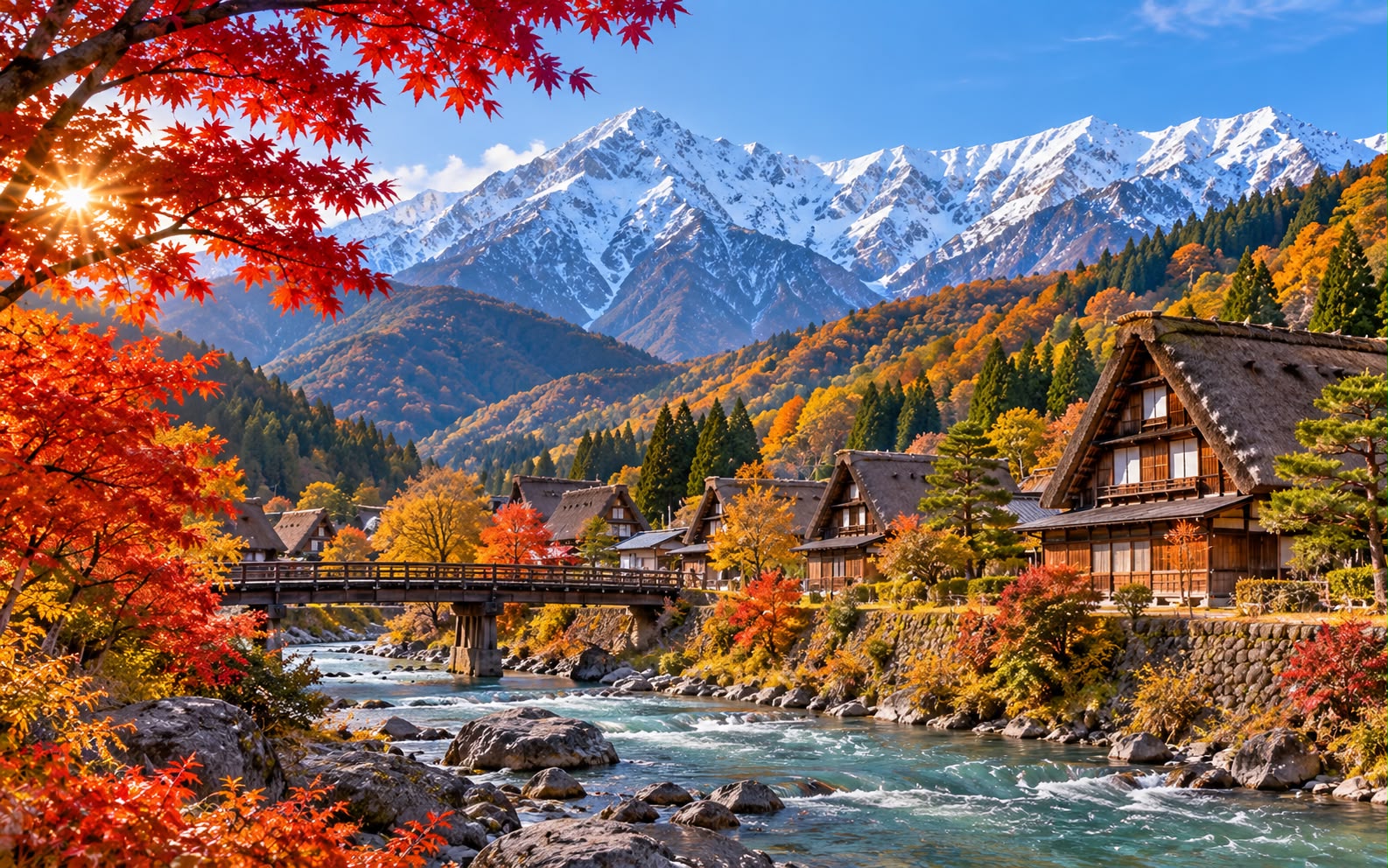
Japan beyond the Golden Route: Kanazawa, Shirakawa-go and the Alps
The Japan most visitors miss — samurai Kanazawa, the thatched village of Shirakawa-go, Takayama's old town and morning markets, and Japan's finest original castle at Matsumoto — in one clean loop from Tokyo.
- East Asia
- 9 days
- ≈ AED 3,650 / person
- Second-time visitors
Before you go
Tokyo–Kyoto–Osaka is Japan’s front door. This trip is the country behind it: Kanazawa, the samurai city the bombs never reached; Shirakawa-go’s steep-roofed farmhouses under the mountains; Takayama, an Edo merchant town that still smells of cedar and sake; and Matsumoto, home to Japan’s most beautiful surviving original castle. It runs as one clean loop from Tokyo — shinkansen out, mountain buses across, an alpine express back — with no flights and no backtracking.
If Japan is new to you, do our 10-day Golden Route first. This is the second helping — slower, cheaper, and with a fraction of the crowds.
All costs are in Japanese yen (JPY), with conversions calculated at today’s exchange rate. Opening hours are approximate — treat anything marked ~ as a guide, not a contract.
Before you go: the short version of the admin
Visas, money, Suica and eSIMs are identical to our first Japan guide, where they’re covered in depth. The route-specific essentials:
Visas, and no JR Pass needed
- Visas: ~70 passports visa-free (EU, UK, USA, UAE and more); Japan’s eVISA covers all nationalities resident in the UAE and everyone resident in India, via accredited agencies. Fees rose in July 2026 (~¥15,000 single-entry); start 3–4 weeks out.
- No JR Pass needed — this loop’s transport bought point-to-point totals ~¥35,000 per person, far under the ¥50,000 pass.
Reserve the mountain buses
- Reserve the mountain buses. The Kanazawa → Shirakawa-go → Takayama highway buses are all-reserved seating and sell out on autumn-foliage and winter weekends — book on Japan Bus Online / Nohi Bus as soon as dates are fixed.
- Suica note: IC cards cover the cities, but the mountain buses and some rural lines are ticket- or cash-based — keep ¥15,000+ in cash on this route, more than you’d need in Tokyo.
Luggage
- Luggage: the takkyubin trick again — forward big bags Tokyo → Takayama (or straight to your last Tokyo hotel) and travel the loop with an overnight bag. Buses have small holds; everyone on them is grateful they packed light.
Travelling with kids?
- An easy route with children: short legs, castle to climb, markets to graze, deer-free.
- The one long sit is the Takayama–Matsumoto bus (~2.5 h) — time it with naps.
- Matsumoto Castle’s steep ladder-stairs are a genuine six-storey climb: fine for school-age kids, a carrier job for toddlers.
Day by day
Day 1 — Land in Tokyo
- 15:00 — Check in near a Yamanote line station (Shinjuku or Tokyo Station side is ideal for tomorrow’s Shinkansen). Set up mobile Suica if you haven’t.
- 17:00 — Keep it light: an evening in Shinjuku or wherever your first trip left gaps — this loop returns you here for two nights at the end.
- 19:00 — Dinner and early night; tomorrow the trip actually starts.
Where to stay in Tokyo (bookends: 1 night now, 2 at the end)
- Mid-range: Hotel Gracery Shinjuku — central, reliable, under the Godzilla head.
- Budget: APA Hotel Shinjuku and siblings — small, spotless, cheap.
Day 2 — Hokuriku Shinkansen to Kanazawa
- 9:00 — Hokuriku Shinkansen from Tokyo Station (~2.5 h, ~¥14,000 reserved) — through the mountains of Nagano and along the Sea of Japan.
- 12:00 — Arrive under Kanazawa Station’s great wooden Tsuzumi-mon drum gate; check in, lunch near the station.
- 14:00 — Higashi Chaya district — the largest of Kanazawa’s preserved geisha teahouse quarters: latticed wooden facades, craft shops, and the city’s signature gold-leaf ice cream (Kanazawa makes 99% of Japan’s gold leaf; a whole sheet goes on the cone, ~¥1,000).
- 16:30 — Walk the Asano River bank to Kazue-machi, the quieter riverside teahouse row.
- 19:00 — Dinner in Katamachi, the local nightlife grid — Kanazawa izakaya run on Sea of Japan seafood and jibuni duck stew.
Where to stay in Kanazawa (two nights)
- Upscale: Hyatt Centric Kanazawa — modern, by the station, rooftop bar.
- Mid-range: Hotel Nikko Kanazawa — the classic tower at the station; top-floor bar, big breakfasts.
- Budget: Via Inn Kanazawa — clean and soundproofed, inside the station complex.
Day 3 — Kanazawa: garden, castle and samurai lanes
- 7:30 — Kenroku-en (~7:00–18:00 Mar–mid-Oct, from 8:00 in winter; ~¥320) — one of Japan’s three great gardens, and at opening hour you share it with herons and gardeners, not tour groups. The two-legged Kotoji lantern is the postcard.
- 9:30 — Kanazawa Castle Park next door (grounds free; restored halls ~¥320) — the rebuilt turrets show off the castle’s odd, beautiful lead-white roof tiles.
- 11:30 — Omicho Market (~9:00–17:00ish, many stalls closed Sun/Wed) — 300 years old and still the city’s kitchen: the move is a kaisen-don seafood bowl lunch (~¥2,000–3,500).
- 13:30 — 21st Century Museum of Contemporary Art (closed Mon; ~10:00–18:00; grounds free, exhibitions ~¥450+) — home of the famous “swimming pool” you can stand inside.
- 15:30 — Nagamachi samurai district: earthen walls, canals, and the Nomura-ke samurai house (~¥550) with its tiny perfect garden.
- 18:30 — Dinner: Kanazawa’s conveyor sushi is famously the country’s best of the genre — the station-building branches of the local chains (Morimori, Kurothe) run ¥2,000–3,500 and queue fast; put your name in early.
Day 4 — Shirakawa-go’s thatched village, sleep in Takayama
- 8:00 — Breakfast at Omicho, bags collected.
- 9:30 — Reserved highway bus Kanazawa → Shirakawa-go (~75 min, ¥2,800 — book ahead).
- 11:00 — Ogimachi village, Shirakawa-go (UNESCO): 100+ gassho-zukuri farmhouses, their steep thatched roofs built like praying hands against the snow. Shuttle or 15-min walk up to the Shiroyama observation deck (shuttle ¥200 cash) for the postcard over the whole valley, then inside Wada House (~9:00–17:00, ¥400) to see the silk-attic engineering.
- 13:00 — Lunch in the village — hoba miso (miso grilled on a magnolia leaf) with mountain vegetables.
- 15:30 — Reserved bus onward Shirakawa-go → Takayama (~50 min, ¥2,800).
- 17:00 — Check into your Takayama ryokan; soak first, then dinner in — Ryokan Tanabe’s Hida-beef kaiseki is the reason to book it.
Where to stay in Takayama (two nights)
- Splurge: Ryokan Tanabe — central, warmly run, famed for its Hida beef dinners and afternoon sake.
- Mid-range: Mercure Hida Takayama — onsen baths, big breakfast, mountain views.
- Budget: Tokyu Stay Hida-Takayama Musubi no Yu — by the station, with public baths and in-room laundry.
Day 5 — Takayama: markets, sake and old-town wandering
- 7:30 — Miyagawa Morning Market (~7:00–12:00, from 8:00 in winter) along the river: pickles, miso, apples, crafts, and breakfast on a stick.
- 9:00 — Sanmachi Suji — three lanes of dark-timber Edo merchant houses. Do the sake brewery crawl (six breweries, cedar-ball signs over the doors; tastings ¥200–500) and the Hida beef sushi stands — seared wagyu nigiri on a rice cracker plate, ¥900–1,500, worth every queue minute.
- 12:00 — Takayama Jinya (~8:45–17:00, ~¥440) — the last surviving Edo-era provincial government house, tatami rooms and a rice-tax storehouse.
- 14:00 — Pick one: Hida no Sato open-air village (~8:30–17:00, ¥700) — more gassho houses in a hillside setting, quieter than Shirakawa-go — or the Higashiyama walking course through temple-lined lanes.
- 18:30 — Hida beef, round two: teppan or sukiyaki in town (~¥4,000–7,000/person) — or your ryokan’s second-night menu.
Day 6 — Over the mountains to Matsumoto
- 9:40 — Highway bus Takayama → Matsumoto (~2.5 h, ~¥3,500, reservation advised) — up through the Hida mountains past Kamikochi’s peaks; in clear weather this is the most scenic public-transport ride in central Japan.
- 12:30 — Arrive Matsumoto; check in, soba lunch (Nagano’s signature — the station area alleys do it well, ~¥1,000).
- 14:00 — Matsumoto Castle (~8:30–17:00, last entry 16:30; ¥700) — the “Crow Castle”: black, moated, and one of only twelve original-keep castles left in Japan. Climb the six storeys of ship-steep stairs; the top floor’s mountain view is the reward.
- 16:30 — Nakamachi Street’s white-walled storehouses and Nawate “Frog” Street’s riverside stalls.
- 19:00 — Dinner in Nakamachi — sansai (mountain vegetable) izakaya food and local Shinshu sake.
Where to stay in Matsumoto (one night)
- Traditional: Marumo Ryokan — creaking, atmospheric, riverside by Nakamachi.
- Modern: Dormy Inn Matsumoto — rooftop onsen and the chain’s famous free late-night ramen.
Day 7 — A post town on the Nakasendo, then back to Tokyo
- 9:00 — Local JR Chuo line to Narai-juku (~35 min) — the best-preserved post town on the old Nakasendo highway: a kilometre of Edo-period wooden inns between forested mountains, and a fraction of Magome/Tsumago’s visitors. Coffee in a 200-year-old house; walk toward the Torii Pass trailhead if legs ask for more.
- 13:00 — Local train back to Shiojiri, board the Azusa limited express to Shinjuku (~2.5 h, ~¥6,000).
- 16:30 — Back in Tokyo; check in.
- 19:00 — Dinner wherever your first trip’s list left off — you’ve earned the neon again after a week of wooden lanes.
Day 8 — Tokyo flex day
- Use it for whatever the Golden Route trip missed: a Nikko or Kamakura day trip, the Ghibli Museum if you won the ticket race, a teamLab rematch, or shopping with the foldable extra bag. Structured suggestion if you want one: Nikko’s Toshogu shrine complex (~2 h by train each way) is the natural finale to a trip themed on old Japan.
Day 9 — Fly home
- Morning — Airport (Narita Express / Skyliner ~¥1,500–3,000), konbini breakfast, done. Departure tax (¥3,000) is already in your ticket.
Costs and practicalities
Tickets and day trips
Bus passes, Shirakawa-go transfers and castle tickets are bookable ahead. Coverage of the smaller Alps operators differs between the two, so check both.
Getting there
Fares swing hard by season and by day of the week — moving a trip by a few days is often the biggest single saving on the whole budget.
Best time to visit
October–November is the loop at its best, with the foliage descending the mountains through those weeks — but the Alpine Route’s own calendar is the real constraint.
- Mid-April–mid-June — the Tateyama Kurobe Alpine Route opens around 15 April and the snow corridor at Murodo — walls up to 20m high — is at its most dramatic in late April and May.
- July–August — the high route is clear and cool while the lowlands swelter. Kamikōchi is at its best and busiest.
- Late September–early November — the foliage, starting at Murodo in late September and reaching the valleys by early November. The best weeks of the year.
- Late November–mid-April — the Alpine Route closes entirely, usually at the end of November. Shirakawa-gō under snow is the winter draw, with light-ups on set January and February evenings.
Check the Alpine Route’s published opening dates before booking anything — they move each year and the whole loop depends on them.
Travel tips
- The Alpine Route is a chain of cable cars, buses and a trolleybus, and it only runs one way efficiently. Decide Toyama-to-Ōmachi or the reverse and send your luggage ahead — large bags cannot go on some sections.
- Book Shirakawa-gō’s winter light-up far ahead. It is on specific evenings only and requires a reservation to attend at all.
- Kamikōchi has no private cars. Park at Sawando or Hirayu and take the bus; the road closes entirely from mid-November to mid-April.
- Mountain weather changes fast and Murodo is at 2,450m. Take a warm layer and a waterproof even in August.
- Cash for the mountain huts and smaller buses. The route’s ticket offices take cards; the ramen at the top may not.
- Trains to Takayama and Matsumoto are limited express and reserved. Book seats in foliage season weeks ahead.
- Bears are present in the Alps. Carry a bell on quieter trails and make noise on blind corners.
What this trip actually costs
Two people, 8 nights (with two ryokan-with-dinner nights in Takayama), international flights excluded:
| Item | Cost |
|---|---|
| Hotels, 8 nights (3 Tokyo + 2 Kanazawa + 2 Takayama ryokan + 1 Matsumoto) | JPY 150,000 (≈ AED 3,479) |
| Trains and buses: Shinkansen, mountain buses, Azusa express, city transit | JPY 70,000 (≈ AED 1,624) |
| Gardens, castles and museums, 2 pax | JPY 12,000 (≈ AED 278) |
| Food and drink, 9 days (2 dinners in the ryokan rate) | JPY 75,000 (≈ AED 1,740) |
| eSIM, takkyubin, lockers, extras | JPY 9,000 (≈ AED 209) |
| Total for two | JPY 316,000 (≈ AED 7,330) |
- Roughly JPY 158,000 (≈ AED 3,665) per person — slightly under the Golden Route, because provincial Japan is where prices soften: business hotels throughout pull it near JPY 115,000 (≈ AED 2,668); two nights of top-end ryokan push past JPY 220,000 (≈ AED 5,103).
- Book in this order: flights → visa if needed → Takayama ryokan and the Shirakawa-go buses (both are the scarce items, especially October–November foliage and winter weekends) → Kanazawa hotel → the rest a week out is fine.
- Season note: this loop works year-round — spring blossoms at Matsumoto Castle, green summer valleys, October–November foliage (peak demand), and snow-buried Shirakawa-go in winter. The January winter light-up evenings are reservation-only with an October lottery — plan that version months ahead.
- Hotel and restaurant picks here are unsponsored — no affiliate links in this article. Chosen on location and current ratings; always check prices and recent reviews before booking.
What to pack
- Everything from the Golden Route list (slip-on shoes, coin purse, foldable bag), plus:
- A warmer layer than the season suggests — Takayama and Shirakawa-go sit high, and evenings run 5–10°C below Tokyo.
- Real winter kit December–March: the valley snow is metres-deep and pavements ice over; boots with grip.
- More cash than city Japan needs — rural sights, buses and market stalls.
- An onsen-ready attitude: two ryokan nights means yukata, shared baths and dinner at a set hour. It’s the point of the trip.
FAQ
Is this doable as a first Japan trip? Yes mechanically, but you’d be skipping Kyoto to see old streets — odd sequencing. Do the Golden Route first; this loop is the reward trip, and the contrast is what makes it land.
Which direction should I run the loop? As written (Kanazawa first) puts the Shinkansen’s fixed timetable at the start and the flexible Azusa at the end — better for jet-lagged day one. Reversed works identically if hotel prices favour it.
When is the best time? October–November foliage is the loop at its finest and its fullest — book two months ahead. April–May and September are the easy sweet spots. Winter is magical in Shirakawa-go and quiet everywhere else, but carry proper boots and watch bus timetables.
Can I add the Alpine Route or Kamikochi? In season, yes: the Tateyama-Kurobe Alpine Route (mid-April– November) slots between Kanazawa/Toyama and Nagano, and Kamikochi (mid-April–mid-November) is a bus detour from the Takayama–Matsumoto leg. Both add a day each; both are weather-dependent. They’re the natural upgrades to this exact loop.
Is Shirakawa-go worth it if I’ve seen Hida no Sato, or vice versa? They’re different pleasures: Shirakawa-go is a living village in a dramatic valley (with crowds to match, 10:00–15:00); Hida no Sato is a curated, quiet museum. This itinerary does both a day apart — if cutting one, keep Shirakawa-go and go before 10am.
Halal / vegetarian food on this route? Thinner than Tokyo: ryokan kitchens can adapt with advance notice (tell them at booking, not check-in), soba and sansai dishes carry vegetarians far, and Kanazawa has a handful of halal-listed restaurants. Rural Japan runs on dashi — strict diets should brief every accommodation ahead.
Prices and entry rules change, and what you need depends on your passport; last checked 23 October 2026, so confirm with the embassy or your airline before booking.


