 The Itinerary
Japan and South Korea in 14 days: Tokyo, Kyoto, Busan and Seoul
Shinkansen to Kyoto's temples and Osaka's food streets, a ferry or a short hop across the strait, and then Korea's own answer to all of it — a Silla capital with tombs in the middle of town, and a capital that rebuilt itself twice in a century.
- East Asia
- 14 days
- ≈ AED 10,300 / person
- Two countries people assume are similar, which is the reason to do them together
Before you go
Before you go: the admin
Two entries, both quick
- Japan admits most nationalities visa-free for 90 days, and Visit Japan Web lets you pre-register immigration and customs for a QR code that saves twenty minutes at the airport. Do it.
- South Korea requires a K-ETA from some nationalities and has waived it for others — the list has changed repeatedly, so check yours specifically rather than assuming.
- Passports need six months for both.
Trains, a ferry and one flight
- Japan’s shinkansen does the internal work — Tokyo to Kyoto is 2h15, Kyoto to Osaka 15 minutes.
- Do the JR Pass maths before buying. Since the 2023 price rise it only pays off on long multi-city routes, and Tokyo– Kyoto–Osaka point-to-point is usually cheaper.
- Osaka to Busan has two options. The overnight ferry from Osaka or the fast hydrofoil from Fukuoka make a continuous land-and-sea journey; the flight from Osaka takes 90 minutes and costs about the same. The ferry is the better story and costs a day.
- Korea’s KTX does Busan to Seoul in 2h40 via Gyeongju’s Singyeongju station.
- Fly into Tokyo and out of Seoul, open-jaw.
Money
- Japanese yen and Korean won. Neither is usable in the other and both are easy to draw.
- Japan is more cash-dependent than its reputation — small restaurants, shrines and rural buses are cash-only, and 7-Eleven ATMs take foreign cards.
- Korea is nearly cashless and foreign cards work widely.
- Get an IC card in Japan (Suica, Pasmo, ICOCA) and a T-money card in Korea on arrival. They cover trains, buses and convenience stores in each.
One gentle brief
- The two countries are not variations of each other, and the assumption that they are is the most common thing visitors arrive with. The food, the social register, the volume and the attitude to strangers are all different.
- The history between them is live. Japanese colonial rule from 1910 to 1945 is not settled history in Korea and comes up in museums, statues and conversation. Listen rather than mediate.
- Download the right maps. Google Maps is crippled in Korea by mapping-export law — Naver Map or KakaoMap are what work there.
Day by day
Day 1 — Land in Tokyo
- 15:00 — Arrive, get a Suica, and go to a konbini — the convenience stores are genuinely good food and the first thing to understand about Japan.
- 17:30 — Shibuya crossing and the Hachiko statue at dusk, then up to the Shibuya Sky deck or the free Shibuya Scramble view.
- 20:00 — An izakaya in Ebisu or Shimokitazawa rather than the tourist streets.
- The JR Pass must be considered before you fly — it is worth it only if you are doing Tokyo–Kyoto–Osaka and back, and the price rise in 2023 changed that maths.
Day 2 — Tokyo: the old city
- 07:00 — Senso-ji at Asakusa at seven in the morning, before the Nakamise stalls open and the crowds arrive.
- 09:30 — The Tokyo National Museum at Ueno for the swords, the screens and the Jomon pottery.
- 12:30 — Tsukiji outer market for lunch — the inner market moved to Toyosu, the outer one is still here and is still the better visit.
- 15:00 — Yanaka in the afternoon — the low-rise neighbourhood that survived both the earthquake and the firebombing, with the cemetery and the shotengai.
- 19:00 — A standing bar under the Yurakucho tracks.
Day 3 — Tokyo: your own version
- 09:00 — Meiji Jingu and Harajuku together, which is the contrast the city is famous for — a forest shrine and Takeshita Street, four minutes apart.
- 13:00 — TeamLab Borderless or Planets if that appeals, booked ahead — they sell out a week out.
- Or a day trip to Nikko or Kamakura, both about an hour — Nikko for the Toshogu shrine, Kamakura for the Great Buddha and the coast.
- 19:00 — Shinjuku’s Omoide Yokocho and Golden Gai in the evening — tiny bars, several seats each, some with a cover charge and some that do not want tourists. The ones that do are clearly marked.
Day 4 — Shinkansen to Kyoto
- 10:00 — Two hours and a quarter, with Fuji on the right about 40 minutes out if the air is clear. Reserve a seat on the E side.
- 13:00 — Drop bags and take the subway — Kyoto’s buses are slow and crowded, and the two subway lines cover more than people expect.
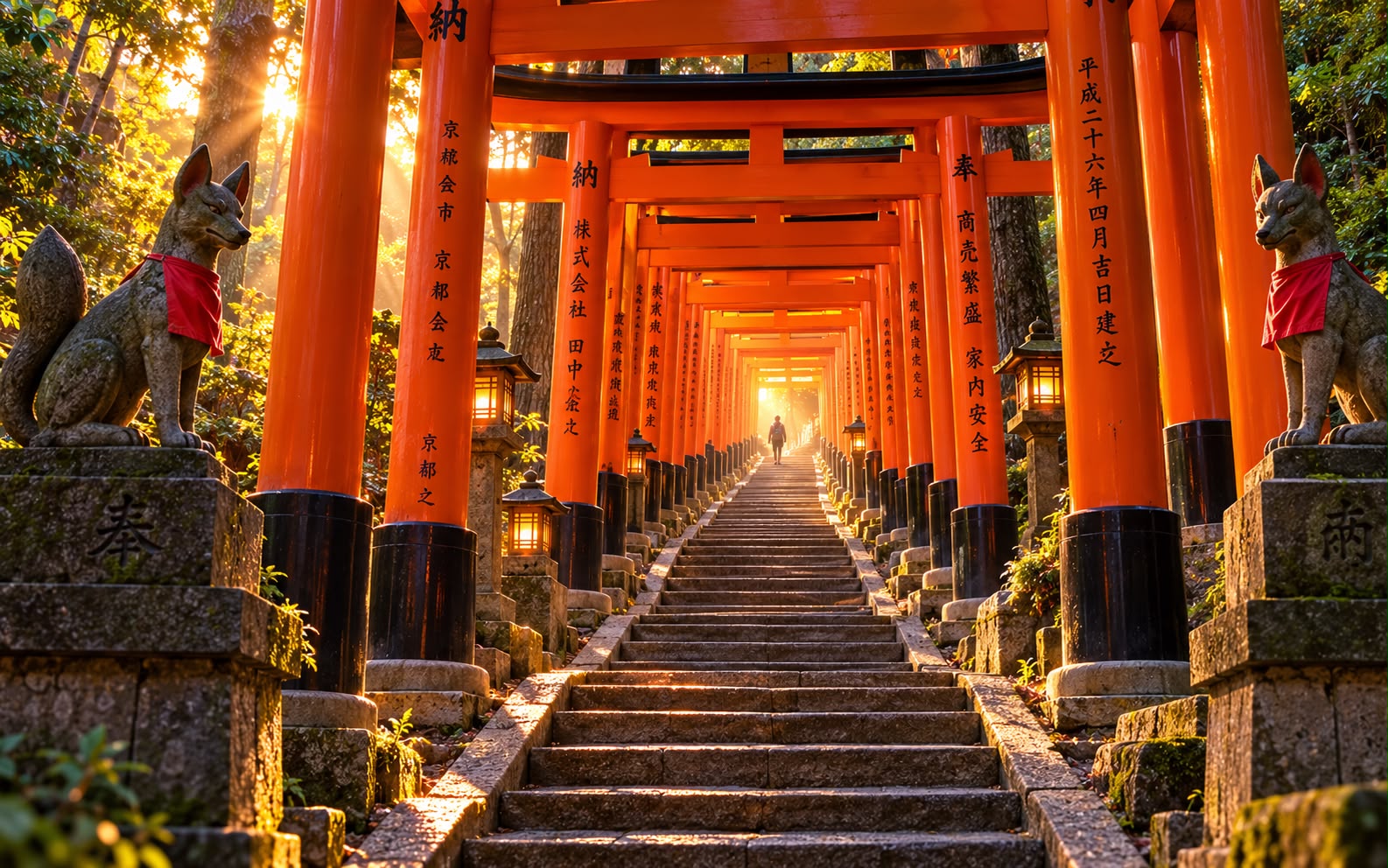
- 16:30 — Fushimi Inari in the late afternoon — the thousands of vermilion torii up the mountain. It is open 24 hours and is empty after about six, which is the only way to see it properly.
- 19:30 — Gion in the evening, walking Hanamikoji — do not photograph geiko and maiko, which is now prohibited in parts of Gion with fines, after years of harassment.
Day 5 — Kyoto: the east
- 07:00 — Kiyomizu-dera at opening, on its wooden stage over the hillside — the stage is built without nails.
- 10:00 — The Philosopher’s Path north to Ginkaku-ji, the silver pavilion, which is not silver and is better for it.
- 12:00 — Nanzen-ji and its aqueduct on the way, which is a brick Roman-looking thing in a Zen temple and entirely Meiji.
- 13:30 — Nishiki market for lunch, and the knife shops at the western end.
- 19:00 — Kyoto’s kaiseki for dinner if the budget stretches — this is where it was invented. Book through the hotel; many will not take a direct reservation.
Day 6 — Kyoto: the west, and Arashiyama
- 07:00 — Arashiyama’s bamboo grove at seven — by nine it is a queue and the photograph is impossible.
- 08:30 — Tenryu-ji’s garden, which is the real reason to be in Arashiyama, and the pond is fourteenth century and unaltered.
- 10:00 — The Iwatayama monkey park above it, which is a 20-minute climb and the macaques are outside the cage while you are inside it.
- 13:30 — Kinkaku-ji, the golden pavilion, which takes twenty minutes and a lot of other people.
- 15:00 — Ryoan-ji’s rock garden nearby, which takes as long as you let it — fifteen stones, and you can never see all of them at once.
Day 7 — Nara, then to Osaka
- 08:30 — Nara is 45 minutes — Todai-ji’s Great Buddha in the largest wooden building in the world, and the deer, which bow for crackers and will also head-butt you for them.
- 12:00 — Kasuga Taisha’s lanterns through the cedar forest — 3,000 of them, lit twice a year.
- 15:00 — Isuien garden or Naramachi, the old merchant quarter, which almost nobody walks.
- 17:00 — On to Osaka in the evening, which is 15 minutes further.
- 20:00 — Dotonbori after dark, which is loud, neon and the point.
Day 8 — Osaka, and across the strait
- 08:00 — Kuromon market for breakfast.
- 09:30 — Osaka Castle in the morning, and the park around it is better than the reconstructed interior.
- 12:00 — Osaka is a food city — takoyaki, okonomiyaki, kushikatsu, and the rule about not double-dipping the kushikatsu sauce, which is taken seriously.
- 16:00 — Then the crossing. The overnight ferry from Osaka to Busan sails in the evening and arrives next morning; the Fukuoka hydrofoil is faster but means getting to Fukuoka. Or fly, in 90 minutes.
- The ferry is the better story and costs you an evening; the flight costs you nothing and gives you the afternoon in Busan.
Day 9 — Busan
- 08:00 — Jagalchi fish market, the largest in Korea, where you buy downstairs and they cook it upstairs.
- 11:00 — Gamcheon Culture Village — a hillside of painted houses that was a refugee settlement and is now the city’s photograph. People live there; the quiet signs are not decorative.
- 15:00 — Haedong Yonggungsa, a temple on the rocks above the sea, which is unusual in Korea where temples are inland.
- 18:30 — Haeundae or Gwangalli beach in the evening, and the bridge lit up — Gwangalli faces it and is the better of the two for that.
Day 10 — Gyeongju
- 08:30 — An hour from Busan — the Silla capital for a thousand years and the most important historical site in Korea.
- 10:00 — The royal tomb mounds at Daereungwon sit in the middle of town like grass hills, and you can go inside Cheonmachong.
- 12:00 — Cheomseongdae, the seventh-century observatory, which is the oldest surviving in East Asia.
- 14:00 — Bulguksa and the Seokguram grotto, both UNESCO-listed — the grotto’s granite Buddha faces the sunrise over the East Sea and is behind glass for conservation.
- 18:00 — Stay the night or take the KTX on to Seoul, which is two hours from Singyeongju station.
Day 11 — Seoul: palaces and a hanok village
- 09:00 — Gyeongbokgung at opening, with the changing of the guard, and free entry if you wear hanbok, which half the visitors do and which is a genuine discount rather than a gimmick.
- 11:30 — Changdeokgung and its Secret Garden, which needs a timed guided tour and is the better palace. Book the garden slot online; it caps numbers.
- 14:30 — Bukchon Hanok Village between the palaces — residents live there and the signs asking for quiet are serious; there are now time restrictions and fines.
- 16:30 — Insadong for tea and paper.
- 19:00 — Gwangjang market for bindaetteok and mayak gimbap.
Day 12 — The DMZ
- 07:00 — Half a day, booked in advance, passport required. Tours run from Seoul and the JSA portion is frequently suspended — check what your tour actually includes.
- The Third Infiltration Tunnel, Dora Observatory and Imjingak are the standard elements.
- It is not a theme park and the dress code and the behaviour rules are real.
- 14:00 — The afternoon for the War Memorial of Korea, which is the context the DMZ needs.
- 19:00 — Itaewon or Yongsan for dinner, which is beside the memorial.
Day 13 — Seoul: your own version
- 10:00 — Leeum or the National Museum of Korea, the latter being one of the largest in Asia and free.
- 14:00 — Hongdae or Seongsu for the shops and the coffee, which is a serious Korean art form.
- 17:00 — A jjimjilbang — the bathhouse, which is naked in the bathing areas, segregated, and the clothed common rooms are where Koreans actually hang out. It is the single most Korean thing you can do.
- 20:00 — Korean barbecue for the last dinner, with someone older pouring for you and you pouring for them — and you never pour your own.
Day 14 — Fly out of Seoul
- 09:00 — The AREX train from Seoul Station to Incheon takes 45 minutes to an hour.
- Incheon is consistently rated the best airport in the world and has a transit hotel, a garden and a museum. Leave time rather than cutting it — it is the rare airport where arriving early is a pleasure.
Costs and practicalities
Best time to visit
Both countries have the same two short, precise seasons and they are the reason to plan carefully.
- Late March–April — the cherry blossom, which moves north through both countries over about six weeks: Kyushu and Busan first, Tokyo and Seoul around the first week of April, and a week in any one place. Forecasts are published from January and the dates shift by a fortnight year to year.
- Golden Week, 29 April–5 May in Japan, is the busiest domestic travel period of the year. Avoid it or book months ahead.
- June–mid-July — the rainy season in both, humid rather than torrential, and far fewer people.
- July–August — hot and very humid, 35°C with it, and typhoon season from August. Festival season in Japan and Obon in mid-August moves the whole country.
- Late October–early December — the autumn foliage, which is as good as the blossom, lasts longer and is less frantically booked. Seoraksan turns in mid-October, Kyoto in late November.
- December–February — cold, clear and cheap, with excellent skiing in both.
Chuseok and Seollal in Korea and New Year in Japan all close businesses and fill transport.
Travel tips
- Download Naver Map or KakaoMap before Korea. Google Maps does not give walking or driving directions there because of mapping-export restrictions, and this surprises almost everyone.
- Do the JR Pass maths. Since 2023 it rarely pays off for a Tokyo–Kyoto–Osaka route; buy point-to-point.
- Tattoos may bar you from Japanese onsen and some pools. Cover small ones; look for tattoo-friendly baths otherwise. Korean jjimjilbang are generally more relaxed but not universally.
- Do not tip in either country. In Japan it causes genuine confusion; in Korea it is simply not done.
- Pour for others, not yourself, in Korea, and receive a drink with two hands from anyone older. This matters more than any other etiquette rule there.
- Do not photograph geiko and maiko in Gion. Parts of it now carry fines, and the restriction exists because of years of people chasing women down a street.
- Luggage forwarding is cheap and excellent in Japan — takkyūbin sends the big bag to your next hotel overnight.
What this trip actually costs
Two people, 13 nights, mid-range comfort, international flights excluded:
| Item | Cost |
|---|---|
| Hotels, 13 nights | USD 2,340 (≈ AED 8,594) |
| Food and drink, 14 days | USD 1,400 (≈ AED 5,142) |
| Shinkansen and KTX, two people | USD 800 (≈ AED 2,938) |
| City transport, IC and T-money cards | USD 400 (≈ AED 1,469) |
| Temples, palaces, museums and the DMZ tour | USD 360 (≈ AED 1,322) |
| Osaka–Busan ferry or flight, two people | USD 300 (≈ AED 1,102) |
| Total for two | USD 5,600 (≈ AED 20,566) |
- Roughly USD 2,800 (≈ AED 10,283) per person. Korea is noticeably cheaper than Japan across accommodation, food and transport — roughly a third less for the same standard.
- Accommodation in Kyoto in blossom or foliage season can double, and it books out six months ahead in both.
- A JR Pass would add rather than save on this routing. Check before buying.
- Hotel picks here are chosen on location, not on commission — always check prices and recent reviews before booking.
What to pack
- Shoes that come off easily, in both countries, constantly.
- Socks without holes. You will be in them on tatami and temple floors more than you expect.
- A small towel. Japanese public toilets often have no dryer, and the jjimjilbang expects you to bring one.
- A light layer for summer — the air conditioning indoors is aggressive in both.
- A coin purse. Japan’s 500-yen coins accumulate fast and are real money.
- A portable charger and the right plug — Japan is 100V with two flat pins, Korea 220V with two round pins, so you need both.
FAQ
Are the two countries similar? Less than people expect, which is the argument for doing them together. The food, the social register, the volume and the attitude to strangers are all different, and the contrast is the most interesting thing about the trip.
Should I take the ferry or fly to Busan? The ferry is the better journey and costs a day. The flight is 90 minutes and about the same money. Take the ferry if the continuity appeals and fly if the days are tight.
Is the JR Pass worth it? Probably not on this route. Since the 2023 price rise it pays off on long multi-city itineraries, and Tokyo–Kyoto–Osaka point-to-point is usually cheaper. Do the sum.
Which should I give more days to? Japan, on a first visit — Tokyo and Kyoto each need three. Korea’s highlights are more concentrated and Seoul does a lot in three days.
Can I visit the DMZ? Yes, on a booked tour with your passport. The JSA portion is frequently suspended, so check what your tour actually includes before paying for it.
Prices and entry rules change, and what you need depends on your passport; last checked 29 October 2026, so confirm with the embassy or your airline before booking.


