 The Itinerary
Kosovo in 5 days: Pristina, Prizren and the Rugova canyon
Europe's newest country: an Ottoman town under a hilltop fortress, four medieval monasteries on the UNESCO list, a canyon with via ferrata routes above it, and the least visited capital on the continent — plus the border rule that catches people out.
- Southern Europe
- 5 days
- ≈ AED 1,700 / person
- Europe's youngest country, and its cheapest
Before you go
Kosovo declared independence in 2008 and is the youngest country in Europe. It is also among the cheapest, the least visited, and — by a distance — the most misunderstood by people who have not been.
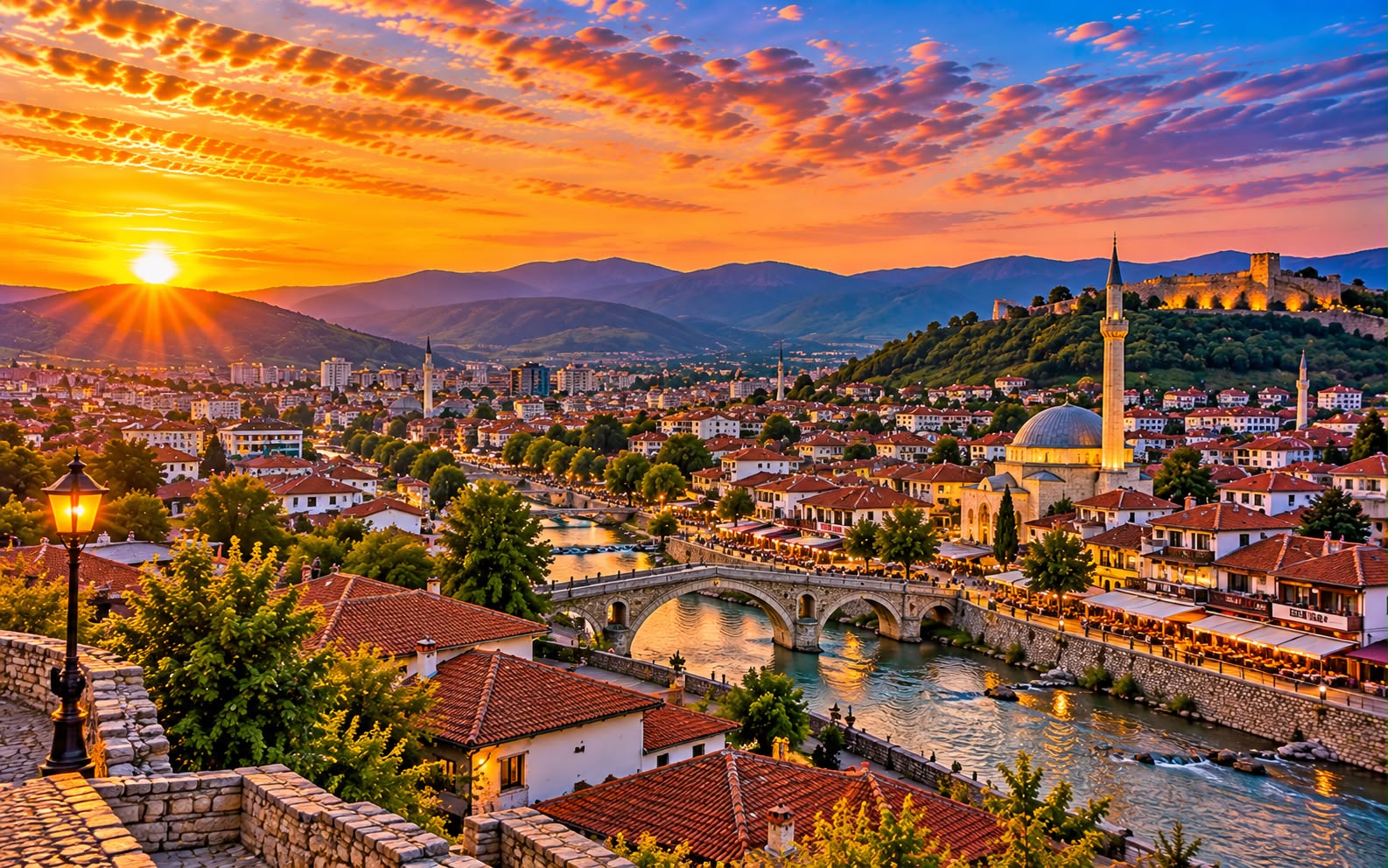
Prizren is the reason to come. An Ottoman town of mosques, a stone bridge and steep lanes under a hilltop fortress, with a river running through the middle and more cafés per street than seems possible. Peja sits under the Rugova canyon, which has via ferrata routes and the start of the Peaks of the Balkans trail. And the country holds four medieval Serbian Orthodox monasteries on the UNESCO list, including Visoki Dečani, the largest medieval church in the Balkans, with fourteenth-century frescoes almost completely intact.
Pristina is not pretty, and is interesting anyway: a capital of brutalist concrete, a famously strange national library, and the Newborn monument, unveiled on independence day in 2008 and repainted every year since.
Five days does it. Figure EUR 420 (≈ AED 1,720) per person excluding flights. Go May–June or September–October; Prizren’s Dokufest in August is excellent and books the town out.
Before you go: the 15-minute admin
The border rule, which matters more than the visa
- Serbia does not recognise Kosovo’s independence, and treats Kosovo’s crossings with Albania, North Macedonia and Montenegro as not being valid entry points into what it considers its own territory.
- In practice: if you enter Kosovo from a third country and then try to cross into Serbia, you can be refused, on the grounds that you entered Serbian territory without a valid Serbian stamp.
- Three patterns that work. Enter Kosovo from Serbia and return to Serbia. Or enter from a third country and leave to a third country. Or fly into Pristina and fly out, which sidesteps it entirely.
- Enforcement has eased in recent years and varies by crossing and by officer. Check the current position with your own foreign ministry before you book, and do not rely on a forum post from a few years ago.
Visas
- Many nationalities enter visa-free, and a valid multiple- entry Schengen visa is generally accepted for entry even where a national visa would otherwise be needed. Check your own case on the official government site.
Money
- The euro, adopted unilaterally. Kosovo is not in the eurozone and has no say in it, but euros are what you spend.
- Very cheap even by Balkan standards: a good dinner for two with wine under €35, a macchiato under €1.
- Cards are accepted in Pristina and Prizren; carry cash for monasteries, villages and the canyon.
SIM and data
- Tourist SIMs from IPKO or Vala at the airport. Roaming from the EU is not free here. Coverage is good except deep in Rugova.
Getting around
- Pristina airport is 20 minutes from the city.
- A car is the practical choice. Hire from €30–40/day. Buses link the main towns cheaply but the monasteries and the canyon are not served.
- Distances are short — nowhere on this itinerary is more than 90 minutes from anywhere else.
- Visoki Dečani and the Peć Patriarchate are protected sites with a security presence at the gate. Bring passports, expect a check, and photography inside the churches is generally not allowed.
Travelling with kids?
- Short drives and a very walkable Prizren make this easy.
- The Rugova canyon has a zipline and via ferrata with minimum ages — check before promising anything.
- The Bear Sanctuary near Pristina rehouses bears kept illegally in restaurant cages, and is a genuinely good hour.
- Monasteries want covered shoulders, knees and quiet.
Day by day
Day 1 — Pristina
- Afternoon — Land, taxi in, check in.
- 16:00 — Newborn, the typographic monument unveiled the day independence was declared and repainted every year with a new theme. Then the National Library behind it — ninety-nine domes and a metal lattice over the whole building, routinely voted one of the world’s ugliest and much better in person.
- 17:30 — Mother Teresa Boulevard, the pedestrian spine, the Cathedral of Blessed Mother Teresa, and the Imperial Mosque of 1460 in the old quarter behind it.
- 19:30 — Dinner. Kosovo eats late, grills well, and charges almost nothing.
Where to stay in Pristina (two nights across the trip)
- Mid-range: the centre around Mother Teresa Boulevard, walkable to everything.
- Value: guesthouses a few streets out, which in Pristina still means five minutes from the middle.
Day 2 — Gracanica, and the city’s other half
- 09:30 — Gracanica Monastery, 15 minutes from the capital. Built in 1321, five domes, and the frescoes inside are among the finest of the Serbian medieval period. It is a working monastery in a Serb-majority village and one of the four UNESCO sites here.
- 11:30 — Ulpiana, the Roman city next to it, still being excavated.
- 14:00 — Back to Pristina: the Kosovo Museum, the Ethnographic Museum in an Ottoman family compound — the best thing in the city — and the brutalist Palace of Youth and Sports if you like that sort of thing.
- 17:00 — Germia Park on the edge of town, where Pristina walks.
Day 3 — Prizren
- 09:00 — Drive south to Prizren, about an hour and a half. Check in; this is where you want the night.
- 11:00 — The old town: the Stone Bridge, the Sinan Pasha Mosque of 1615 with its painted interior, the hamam, and the lanes climbing away from the river.
- 13:00 — Lunch by the water, then Our Lady of Ljeviš, a 14th-century Orthodox church on the UNESCO list, converted to a mosque under the Ottomans and back again, with frescoes still visible under the whitewash.
- 16:00 — Climb to Prizren Fortress (Kaljaja) — 25 minutes up, and the view over the roofs, the minarets and the river is the best in the country.
- 19:30 — Dinner in the old town. In August, Dokufest turns the fortress, the river and an open-air cinema into one of the better documentary festivals in Europe.
Day 4 — Dečani, Peja and the canyon
- 09:00 — Drive north-west to Visoki Dečani, about an hour. The largest medieval church in the Balkans, finished in 1335, with around a thousand frescoes — the most complete surviving cycle of Byzantine painting anywhere. It is under protection; bring passports and expect a check at the gate.
- 11:30 — The Patriarchate of Peć, 20 minutes on: four churches under one roof, the historic seat of the Serbian Orthodox Church, with a monastic community still in place.
- 13:30 — Lunch in Peja, then up into the Rugova canyon — 25km of gorge with via ferrata routes, a zipline, and the trailheads for the Peaks of the Balkans route into Montenegro and Albania.
- 17:00 — Drive back to Pristina, about ninety minutes, or stay in Peja if the canyon has taken longer than planned, which it usually does.
Day 5 — Fly home
- Morning — Last coffee on Mother Teresa Boulevard. Pristina takes its macchiato seriously and charges under a euro for it.
- Afternoon — Airport, 20 minutes.
Costs and practicalities
Best time to visit
May–June and September–October. Kosovo has a continental climate — hot summers, cold snowy winters — and the shoulder months are the comfortable ones.
- May–June — green, warm, and the best for the Rugova gorge and the Accursed Mountains above Peja.
- July–August — hot, up to 35°C in Prishtina, and the diaspora returns in July and August, which fills the country and doubles the traffic on the roads from Germany and Switzerland.
- September–October — the best of the year. Clear, warm, the hills turning, and Dokufest in Prizren in August just before it.
- December–March — cold and snowy, with Brezovica skiing at very low prices and the mountains closed to walkers.
The Via Dinarica and Peaks of the Balkans routes run roughly June to September, when the high passes are clear.
Travel tips
- Kosovo is not recognised by every country, and this has practical effects. Serbia does not recognise Kosovan entry stamps — entering Kosovo first and then crossing into Serbia can be refused. Enter Serbia first, or fly in and out.
- It uses the euro without being in the eurozone, adopted unilaterally.
- Cash is common outside Prishtina. ATMs are widely available in towns.
- Albanian is the main language; Serbian in the north and in enclaves. English is widely spoken by the young — Kosovo has one of the youngest populations in Europe.
- Be careful discussing the status question and note that the north around Mitrovica has its own tensions. Follow local advice.
- Some rural areas still have unexploded ordnance. Stay on marked paths in the mountains.
- The Peaks of the Balkans trail crosses into Albania and Montenegro and requires a cross-border permit arranged weeks ahead.
What this trip actually costs
Two people, 4 nights, mid-range comfort, flights excluded:
| Item | Cost |
|---|---|
| Hotels, 4 nights | EUR 240 (≈ AED 983) |
| Car hire, 3 days + fuel | EUR 180 (≈ AED 737) |
| Food and drink, 5 days | EUR 200 (≈ AED 819) |
| Monasteries, fortress, museums | EUR 60 (≈ AED 246) |
| Canyon activities and transfers | EUR 160 (≈ AED 655) |
| Total for two | EUR 840 (≈ AED 3,439) |
- Roughly EUR 420 (≈ AED 1,720) per person, which makes this one of the cheapest weeks in Europe. Food and coffee cost almost nothing.
- Dokufest in August is the one week Prizren prices rise and rooms sell out. Worth planning around in either direction.
- Via ferrata and zipline in Rugova are the only genuinely optional spend here.
- Hotel picks here are chosen on location, not on commission — always check prices and recent reviews before booking.
What to pack
- Covered shoulders and knees for the monasteries and mosques, both of which you will visit on the same day.
- Shoes for a fortress climb and, if you are doing Rugova, proper grip.
- Passports on you, not in the hotel — the protected monasteries check them at the gate.
- Layers. Prizren is warm and the canyon is not.
FAQ
Is it safe? Ordinary tourism is straightforward and Kosovo has low crime. The monasteries have a security presence for historical reasons rather than current danger. As anywhere, check your government’s current travel advice before you go.
Can I combine it with Serbia? Yes, if you get the order right — enter from Serbia and return to Serbia, or avoid Serbia on the same trip. See the border section above; this is the thing that catches people out.
Is Prizren really better than Pristina? Yes, comfortably. If you have only two days, give both to Prizren and treat Pristina as an airport with a monument.
Why is everything in euros if it is not in the eurozone? Kosovo adopted the euro unilaterally in 2002, before independence, having used the Deutsche Mark before that. It has no seat at the European Central Bank and uses the currency anyway.
Prices and entry rules change, and what you need depends on your passport; last checked 8 October 2026, so confirm with the embassy or your airline before booking.


