 The Itinerary
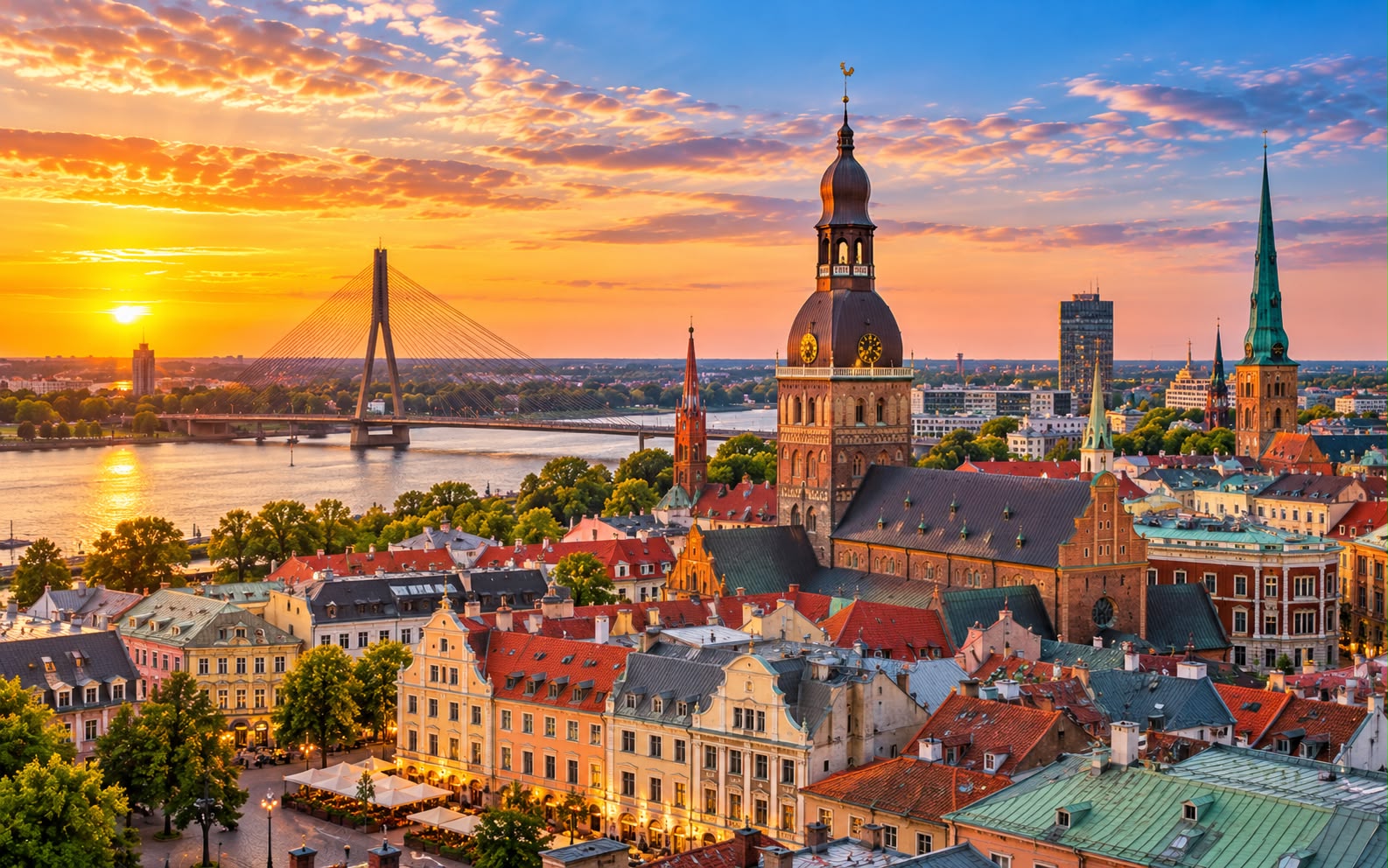
Latvia in 7 days: Riga, Sigulda and Kuldīga
The world's densest art-nouveau district, a food market built inside four WWI zeppelin hangars, a castle-strewn river valley an hour inland, and Europe's widest waterfall in a brick-and-timber town almost nobody has heard of.
- Northern Europe
- 7 days
- ≈ AED 3,750 / person
- Art nouveau + river valleys
Before you go
Riga is the biggest city in the Baltics and the least obvious. The old town does what old towns do — guild halls, a cathedral, a square with the House of the Blackheads rebuilt from photographs — but the thing to come for is the art nouveau district a few streets north, where whole boulevards went up in one burst between 1899 and 1914. It is the densest concentration anywhere in the world, and the faces staring down from the façades on Alberta iela are the reason people stop mid-pavement.
Then the country opens out. Jūrmala is twenty-five minutes by train: white sand, pine, and wooden villas built when this was where the Soviet Union went on holiday. Sigulda sits in the Gauja valley an hour inland, with castles on both sides of a gorge and a cable car strung across it. And Kuldīga, three hours west, has a 249-metre waterfall you can stand beside and a brick bridge from 1874.
The shape: Riga (3 nights) → Sigulda (1) → Kuldīga (1) → Riga (1). Figure EUR 915 (≈ AED 3,747) per person excluding flights. Go May–September; Riga’s Christmas market is the other good answer, and claims the first decorated tree in 1510.
Before you go: the 15-minute admin
Visas
- Latvia is in Schengen. One visa covers it and 28 other countries, and many nationalities enter visa-free — check yours against the current list before booking.
- Combining with Estonia and Lithuania is easy and needs no extra paperwork. The Baltics route does all three capitals in eight days.
Money
- Euro. Cards are accepted almost everywhere, including the market stalls. Keep €20 in coins for rural car parks and castle entries.
- Riga is the priciest of the three Baltic capitals for food, and still cheap by western European standards: mains €14–24.
- Tipping is not expected; rounding up is normal.
SIM and data
- EU roaming applies at home rates. From outside the EU, a prepaid SIM or eSIM costs a few euro for the week.
- Wi-fi is reliable in cafés and on the intercity trains.
Getting around
- Riga airport to the centre is 15 minutes on bus 22 (€2 from the driver) or about €12 by taxi.
- Jūrmala is a commuter train from Riga Central — every 20–30 minutes, €2–3, about 25 minutes to Majori.
- Sigulda is on the same railway line, about 1h10 from Riga, and walkable from the station to the castles.
- Kuldīga needs a car or a long coach. Hire from €40–55/day. If you would rather not drive, swap Kuldīga for a second night in Sigulda and add Cēsis.
Travelling with kids?
- Short train hops, no altitude and a beach day make this an easy route with children.
- The Sigulda cable car across the Gauja gorge and the bobsleigh track are the two they will remember.
- Riga’s Central Market is a good rainy hour — smoked fish, black bread, and the hangars themselves.
- Old-town cobbles are hard on pushchairs; carrier is easier inside the walls.
Day by day
Day 1 — Land in Riga, first loop of the old town
- Afternoon — Land, bus 22 or taxi in, check in. Vecrīga, the old town, is compact and almost entirely pedestrian.
- 16:30 — Orientation on foot: the Town Hall Square and the House of the Blackheads, a 1334 guild house flattened in 1941 and rebuilt from photographs in 1999. Then St Peter’s Church — take the lift up the spire for the roofscape and the river.
- 18:00 — The Three Brothers on Mazā Pils iela, the oldest houses in the city, and the Swedish Gate, the only surviving city gate.
- 19:30 — Dinner in the old town or one street out. Latvian cooking is grey peas, smoked meat, rye bread and sprats; the modern kitchens do interesting things with all four.
Where to stay in Riga (four nights across the trip — old town for atmosphere, the Quiet Centre for art nouveau)
- Luxury: Grand Hotel Kempinski Riga, opposite the Opera, or Neiburgs in a restored art-nouveau building in the old town.
- Mid-range: Hotel Bergs in the Quiet Centre, apartments rather than rooms, walkable to Alberta iela.
- Value: apartments around Elizabetes and Ģertrūdes streets — you sleep inside the art-nouveau district for less than an old-town hotel.
Day 2 — Art nouveau and the zeppelin market
- 10:00 — Alberta iela. Eight buildings here are by Mikhail Eisenstein — father of the film director — and they are the ones on every postcard: screaming masks, sphinxes, peacocks. Walk it slowly and look up; the detail is all above eye level.
- 11:00 — The Art Nouveau Museum at Alberta iela 12, the restored apartment of architect Konstantīns Pēkšēns, with the spiral staircase that is the single most photographed interior in Latvia.
- 13:00 — Riga Central Market: five pavilions built from German zeppelin hangars left over from the First World War. Fish in one, meat in another, dairy, produce, and the gastro hall for lunch.
- 15:30 — The Freedom Monument, then the Occupation Museum behind it — 1940 to 1991, told plainly. It is the context everything else in this country sits inside.
- 18:30 — Sunset from the Latvian Academy of Sciences rooftop, the Stalinist tower locals call the birthday cake. Cheap lift, best view in the city.
Day 3 — Jūrmala, pines and wooden villas
- 10:00 — Train from Riga Central to Majori, about 25 minutes. Buy the ticket at the machine; conductors sell on board too.
- 10:45 — Jomas iela, the pedestrian spine, then straight out to the beach. The sand runs 33km and the water is shallow and cold; the walk is the point.
- 13:00 — Lunch on Jomas, then the wooden villas along Dzintaru prospekts — Dubulti, Dzintari and Bulduri are the richest streets for them, carved verandas and turrets in various states of rescue.
- 15:30 — Dzintari forest park for the observation tower over the pines, or keep walking the beach to Bulduri and take the train back from there.
- 19:00 — Back in Riga for dinner.
Day 4 — Into the Gauja valley
- 09:30 — Train to Sigulda, about 1h10.
- 11:00 — Turaida Museum Reserve: the red-brick castle of 1214 with the tower you climb, the Dainu hill of sculpture, and the grave of the Rose of Turaida, the local legend every Latvian schoolchild learns.
- 13:30 — Lunch in Sigulda, then the cable car across the Gauja gorge — a small red cabin on a wire, 43 metres up, running since 1969.
- 15:00 — Sigulda Medieval Castle ruins and the New Castle gardens, then Gutmanis Cave, the largest in the Baltics, its walls carved with graffiti going back to the 17th century.
- 17:00 — If you have energy: the bobsleigh track built for the Soviet team runs summer rides on a wheeled sled.
- Evening — Stay in Sigulda. It is a small town and goes quiet early.
Day 5 — West to Kuldīga
- 09:00 — Collect a car and drive west, about three hours via Riga’s ring.
- 12:30 — Kuldīga. Lunch first; the town is tiny.
- 14:00 — Ventas rumba, the widest waterfall in Europe — 249 metres across and only about two metres high, which is why you can stand on the rock beside it. In spring, fish jump it; the town once caught them in baskets mid-air.
- 15:30 — The 1874 brick bridge over the Venta, one of the longest of its kind left in Europe, and the old town behind it: timber houses, red roofs, and a UNESCO listing granted in 2023.
- 18:00 — Dinner and the night in Kuldīga.
Day 6 — Rundāle, then back to Riga
- 09:30 — Drive south-east toward Rundāle Palace, about two hours.
- 11:30 — Rundāle: Rastrelli’s baroque palace, built for the Duke of Courland by the architect who did the Winter Palace. The Gold and White halls and the French garden are the reason to stop.
- 14:30 — Drive on to Riga, about 1h20, and return the car.
- 17:00 — Last of the old town, or the Kalnciema quarter across the river if it is a Saturday — restored wooden buildings and a market.
- 19:30 — Final dinner.
Day 7 — Fly home
- Morning — Riga Central for souvenirs: black balsam, amber, rye bread, linen.
- Afternoon — Bus 22 or taxi to the airport, 15–20 minutes.
Costs and practicalities
Best time to visit
May–September. Riga is a northern city and the swing between June’s eighteen hours of daylight and December’s six is the thing that shapes a visit.
- May–June — the best of the year. The parks in use, the Art Nouveau quarter at its best in the light, and Jāņi on 23–24 June, which empties Riga entirely into the countryside for the solstice.
- July–August — warmest, around 22°C, and Jūrmala’s beach season. Busiest with cruise traffic in the Old Town.
- September–October — autumn colour in Gauja National Park, prices down, and the city quiet.
- November–March — cold, dark and snowy, with the Christmas market in Dome Square from late November and Riga’s claim to the first decorated tree in 1510.
The Baltic is cold even in August — around 18–20°C at Jūrmala on a good day.
Travel tips
- Riga has more Art Nouveau than any city in Europe and it is concentrated on Alberta and Elizabetes streets. Look up; the best of it is above eye level.
- Latvia is in Schengen and the eurozone and is close to cashless. Cards work everywhere.
- The Central Market occupies five former Zeppelin hangars and is the best lunch in the city as well as the best photograph.
- Russian is widely spoken and politically sensitive. Open in English; let the other person switch if they want to.
- Avoid the aggressive bar touts in the Old Town — the “come to my bar” approach near Līvu Square ends in an inflated bill. Pick your own.
- Buses link Riga to Tallinn and Vilnius in about four hours each; the trains do not.
- Mosquitoes and ticks in Gauja and the forests from May. Repellent, and check for ticks — tick-borne encephalitis is present and vaccination is worth considering.
What this trip actually costs
Two people, 6 nights, mid-range comfort, flights excluded:
| Item | Cost |
|---|---|
| Hotels, 6 nights (4 Riga + 1 Sigulda + 1 Kuldīga) | EUR 780 (≈ AED 3,194) |
| Car hire, 2 days + fuel | EUR 150 (≈ AED 614) |
| Trains, buses and transfers | EUR 60 (≈ AED 246) |
| Food and drink, 7 days | EUR 640 (≈ AED 2,621) |
| Museums, castles and the cable car | EUR 200 (≈ AED 819) |
| Total for two | EUR 1,830 (≈ AED 7,493) |
- Roughly EUR 915 (≈ AED 3,747) per person, with room both ways: apartments and self-catering pull it under EUR 650 (≈ AED 2,661); old-town hotels and eating well push past EUR 1,400 (≈ AED 5,732).
- Dropping Kuldīga saves the car and about EUR 190 (≈ AED 778) per person. Add a second Sigulda night and Cēsis instead — both are on the train line.
- Riga is the expensive night. Sigulda and Kuldīga are materially cheaper for the same standard.
- Hotel picks here are chosen on location, not on commission — always check prices and recent reviews before booking.
What to pack
- Layers and a rain shell in any month. The Baltic coast makes its own weather.
- Shoes for cobbles and forest paths — Riga’s old town and the Gauja trails want the same pair.
- Swimwear May–September. Jūrmala’s water is cold but people swim anyway.
- Serious winter kit December–February, when the Gauja freezes and Riga’s market moves indoors.
FAQ
Is three nights in Riga too many? No. Two covers the old town and the art nouveau district; the third buys Jūrmala without rushing it, and Jūrmala is the part people are surprised by.
Can I do this without a car? Yes. Riga, Jūrmala and Sigulda are all on trains. Kuldīga is the only stop that really needs driving — swap it for Cēsis, which is on the Sigulda line.
Riga or Tallinn, if I only have one? Tallinn for the intact medieval old town, Riga for architecture and food. Riga is the bigger, less polished city, and the art nouveau is genuinely world-class.
Is Rundāle worth the detour? If you like interiors, yes — it is the finest baroque in the Baltics. If you do not, drive straight back and spend the afternoon in Riga instead.
Prices and entry rules change, and what you need depends on your passport; last checked 8 October 2026, so confirm with the embassy or your airline before booking.


