 The Itinerary
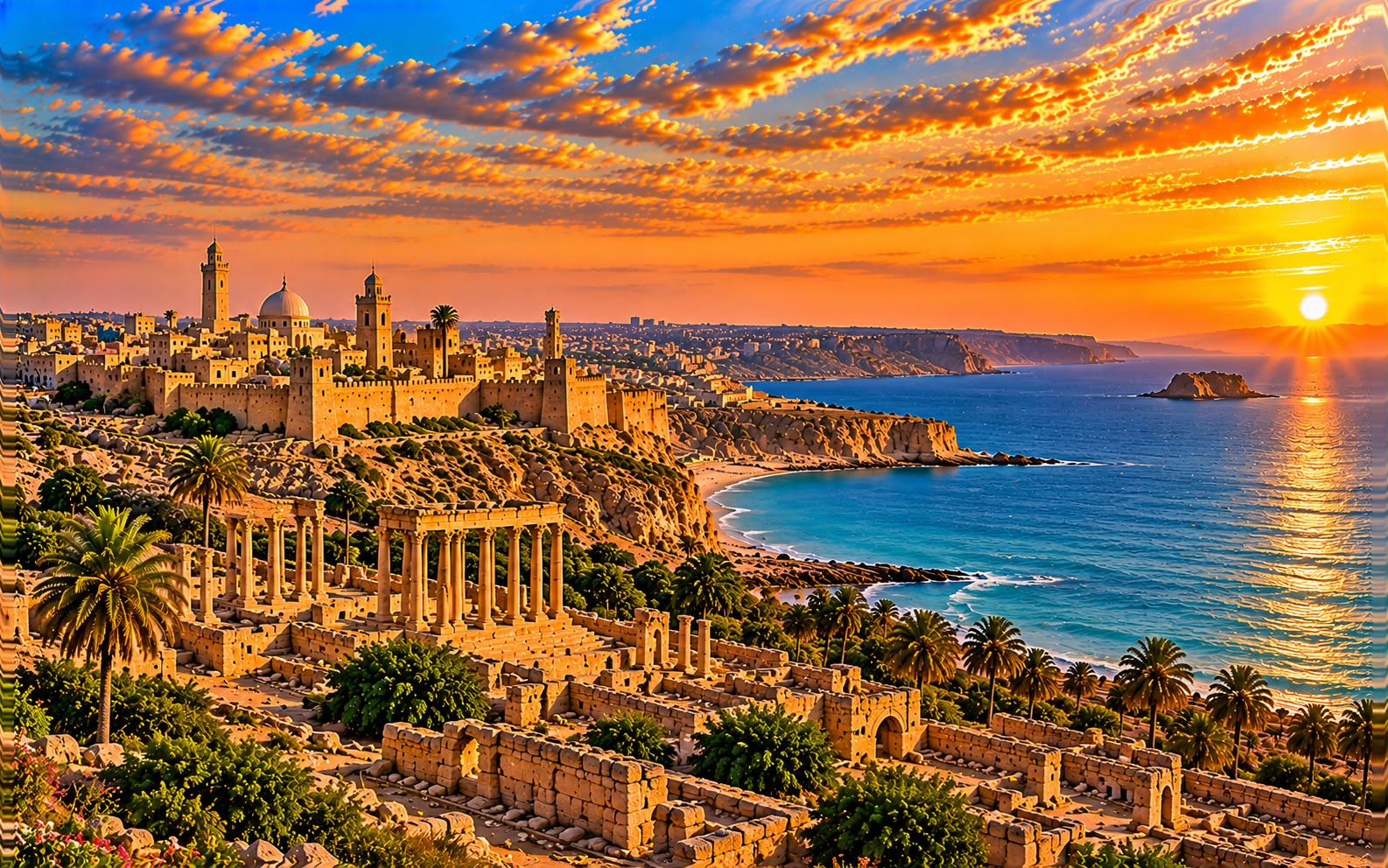
Libya in 9 days: Leptis Magna, Ghadamès and the Acacus rock art
A Roman city an emperor rebuilt as a monument to his own birthplace and the sand then buried for a thousand years, a covered desert town you walk through in shade at midday, and twelve thousand years of painted rock — in a country divided between two governments where every advisory says do not go.
- North Africa
- 9 days
- ≈ AED 7,000 / person
- The best-preserved Roman city in the Mediterranean, with almost nobody in it
Before you go
Read this first
Most governments advise against all travel to Libya, and several state that they have no embassy in the country and cannot assist you there.
- Libya has had two rival governments since 2014 — the internationally recognised administration in Tripoli and the authorities aligned with Khalifa Haftar in the east. Control of territory and of airports can change.
- Armed militias operate with autonomy, including inside Tripoli, and clashes between them have closed roads and the airport at short notice.
- Kidnapping of foreign nationals for ransom is a specific risk, and foreigners have been taken.
- Unexploded ordnance and landmines contaminate areas around Tripoli, Sirte, Benghazi and the south.
- The south and the border regions — with Chad, Niger, Sudan and Algeria — carry the strongest warnings, and the Acacus sits inside them.
- Most Western embassies have been closed or relocated to Tunis since 2014.
- Arbitrary detention of foreigners has occurred, including of people who entered legally.
- Travel insurance will not cover you.
This guide does not tell you to go. A small number of Libyan operators have run archaeological tours from Tripoli in recent years, mainly to the coastal sites. That is their and their clients’ judgement, made with current information. Check your own government’s advice, which reflects this week rather than this year.
Libya has five UNESCO World Heritage sites and all five are on the List of World Heritage in Danger, where they were placed together in 2016.
Leptis Magna is the reason. It was the birthplace of Septimius Severus, who became Roman emperor in 193 and then rebuilt his home town on a scale it had no practical need for: a forum, a basilica with carved pilasters of Dionysus and Hercules, a four-sided triumphal arch, a theatre above the sea, a circus and an amphitheatre. Then the sand covered it, and it stayed covered until Italian archaeologists dug it out in the 1920s. The result is the best-preserved Roman city on the Mediterranean — better than Ephesus, better than anything in Italy outside Pompeii — and in a normal year it sees a few hundred visitors.
Sabratha, an hour west of Tripoli, has a three-storey theatre facade standing almost to its original height, with the sea directly behind the stage.
Cyrene, in the east near Shahat, was the great Greek city of North Africa — the Sanctuary of Apollo, the agora, the necropolis cut into the hillsides. It is in the east and requires a completely different set of permissions and risks.
Ghadamès is the “pearl of the desert”: a mud-brick oasis town near the Algerian and Tunisian borders where the streets are covered, so you walk the old town in shade at midday, and the rooftops form a separate connected level that was traditionally the women’s domain.
The Tadrart Acacus in the far south-west holds rock art spanning roughly twelve thousand years — giraffe, elephant, cattle, and then camels, recording the Sahara’s shift from savanna to desert. It is deep in the area carrying the strongest warnings and has suffered vandalism since 2011.
Nine days, if and when it is possible. Figure USD 1,900 (≈ AED 6,978) per person. October to April.
Before you go: the 15-minute admin
Entry
- A visa is required and must be sponsored by a Libyan operator or company. Independent application is not realistic.
- An Israeli stamp means refusal.
- Tripoli Mitiga is the usual entry point, via Istanbul, Tunis or Cairo. It has closed at short notice during militia clashes.
- The eastern airports (Benghazi, Labraq) work under the eastern authorities and a visa issued by one side is not reliably accepted by the other. Decide east or west; do not plan to cross.
- Journalists need separate accreditation.
Money
- The dinar has an official rate and a parallel rate and they are not close. Transactions with visitors are generally in dollars or euros.
- No international card works. Bring the whole budget in cash.
- Dollars and euros both change; euros are often preferred in the west.
On the ground
- Nobody travels independently. A Libyan operator holds the permissions and knows which checkpoints belong to whom this month, which is the actual security question here.
- Checkpoints are run by militias as well as by the state. Let the guide handle them; do not get out.
- Do not photograph militia, military, checkpoints, government buildings, or the airport.
- Do not go off made surfaces near Sirte, around Tripoli’s southern suburbs, or anywhere in the south. Mines and unexploded ordnance are the specific reason.
- Alcohol is illegal. Possession is taken seriously.
- Fuel queues and power cuts are routine despite the oil.
Day by day
Day 1 — Tripoli
- Entry is by prearranged visa through a licensed operator with a local sponsor, and you will not move without a fixer. Cash dollars or euros only — no cards work.
- 10:00 — The Medina, inside its walls: the Ottoman Gurgi Mosque with its tiled interior, the Ahmed Pasha Karamanli Mosque, and the covered souqs for silver and copper.
- 13:00 — The Arch of Marcus Aurelius, standing in a square at the edge of the old town since 165 AD.
- 15:00 — The Red Castle (Assaraya al-Hamra) and the National Museum inside it — check whether it has reopened, as it has been shut for long stretches since 2011.
- 18:00 — The corniche in the evening, which is where Tripoli actually relaxes.
- Militia checkpoints are a normal feature of movement. Your fixer handles them; keep the camera down.
Day 2 — Sabratha
- 08:00 — An hour and a half west, close to the Tunisian border.
- 10:00 — The theatre, whose three-tier scaenae frons was reconstructed by Italian archaeologists and stands almost complete, with the Mediterranean behind it.
- 12:00 — The Temple of Isis on the shoreline, which is where the site meets the sea and is the best half hour on it.
- 14:00 — The mosaics in the site museum, including the Justinianic basilica floors.
- The site is on the coast and almost always empty.
- 17:00 — Back to Tripoli before dark.
Day 3 — Leptis Magna
- 07:30 — Two hours east of Tripoli at Khoms. Give it two days; one is not enough and people always regret rushing it.
- 10:00 — The Arch of Septimius Severus at the entrance, reassembled from its fallen pieces — Severus was born here, which is why a provincial town has an imperial capital’s architecture.
- 11:30 — The Severan Forum and Basilica — the basilica’s carved pilasters are the single best piece of Roman relief sculpture in North Africa.
- 14:00 — The Hadrianic Baths, the palaestra, and the market with its original measuring tables.
- 17:00 — The theatre above the sea, which takes the late light.
- 19:00 — Overnight at Khoms rather than driving back and out again.
Day 4 — Leptis, the far end
- 08:00 — The circus and amphitheatre a kilometre east, dug into a quarry, with the water beyond. Almost nobody walks down to them and they are the best-sited pair in the Roman world.
- 11:00 — The harbour, silted and overgrown, with the mooring stones and the lighthouse base still in place.
- 13:00 — Villa Sileen nearby for the mosaics, if it is open — it keeps no reliable hours.
- 15:00 — Back through the site once more, which on a second day you read completely differently.
- 18:00 — To Tripoli, and the long drive south starts early.
Day 5 — To Ghadamès
- 06:00 — A long drive south-west, eight to ten hours across the Jeffara plain and up onto the Nafusa escarpment.
- Or a domestic flight when one is running — schedules are irregular and change without notice.
- 13:00 — Nalut or Kabaw on the escarpment if you drive, for the fortified granaries, which are honeycomb cells of mud and gypsum.
- 18:00 — Into Ghadamès.
Day 6 — Ghadamès
- 08:00 — The covered old town: whitewashed, cool, built so that the streets are roofed and the roof terraces connect into a second town above. The men used the streets and the women the roofs, which is the design.
- 11:00 — A house interior, which is the point — red and white painted rooms hung with mirrors and copper, and the explanation of how the two levels worked.
- 14:00 — The oasis gardens and the old mosque.
- 17:30 — Sunset from the dunes outside town, which is the standard excursion and deserves to be.
- It is 45°C in summer and genuinely cold at night in winter. Pack for both.
Day 7 — The Acacus, conditionally
- This is the part that may not happen. The Tadrart Acacus is reached from Ghat, in the far south-west, and the whole region sits inside the strongest advisories.
- Have the alternative planned: more time at Leptis and Sabratha, or Ghadamès extended. Decide this before you travel, not on the day.
- 07:00 — If it runs, it is 4x4 camping among sandstone towers.
- 15:00 — Painted and engraved shelters — Wadi Teshuinat, Awis — where the sequence runs from wild fauna through cattle herding to horses and camels.
- Vandalism has damaged several panels since 2011, and site protection has largely lapsed. Touch nothing and do not wet the rock to bring out colour, which visitors still do.
- 19:00 — Camp.
Day 8 — The Acacus, or back north
- 06:00 — Dawn among the towers, which is the hour the rock art was placed for.
- 10:00 — A second valley, or the drive back toward Ghadamès.
- If the south did not run, this is the second Leptis day or an extra one at Sabratha, and neither is a consolation prize.
- 18:00 — Toward Tripoli.
Day 9 — Tripoli and out
- 09:00 — The museum, if it is open, or the medina again.
- 12:00 — Last silver and copper in the covered souqs.
- Allow a lot of time for Mitiga. Flights move and the airport road can close — sometimes at no notice and for the day.
Costs and practicalities
The east, and why it is a separate trip
- Cyrene, Apollonia, Ptolemais and Tocra are all in Cyrenaica and are superb — Cyrene is arguably the most complete Greek city anywhere outside Greece.
- They fall under the eastern authorities. Permissions, visas and operators are different, and moving between east and west overland is not something to plan around.
- Derna was devastated by flooding in September 2023 when two dams collapsed, killing thousands. The eastern coast’s situation is humanitarian as well as political.
- Treat east and west as two different countries for planning purposes, because in practice they are.
Best time to visit
October–April. The coast is Mediterranean and pleasant in that window; the desert south is only sensible within it, and the summer puts both out of reach.
- October–November — warm, clear, and the best light on Leptis Magna and Sabratha.
- December–February — cool and sometimes wet on the coast, 10–18°C, and genuinely cold at night in Ghadamès and the Acacus, close to freezing in January.
- March–April — the best of the year: warm, clear, and the desert still comfortable.
- May–September — 40°C and more inland, and the ghibli, a hot southerly wind carrying sand, can raise temperatures sharply for days at a time.
The coastal sites are shadeless. Leptis Magna in July is unvisitable after about nine in the morning.
Travel tips
- Nobody travels independently. A Libyan operator holds the permissions and knows which checkpoints belong to whom this month, which is the actual security question.
- Decide east or west and do not plan to cross. Visas and permissions issued by one administration are not reliably accepted by the other.
- No card works. Bring the entire budget in cash; euros are often preferred in the west.
- The dinar has an official rate and a parallel one and they are far apart. Transactions with visitors are generally in euros or dollars.
- Alcohol is illegal and possession is taken seriously.
- Do not photograph militia, military, checkpoints, government buildings or the airport. Let the guide handle every stop and do not get out of the vehicle.
- Stay on made surfaces. Unexploded ordnance and mines contaminate areas around Sirte, southern Tripoli and much of the south.
What this trip would cost
Two people, 8 nights, mid-range comfort, international flights excluded:
| Item | Cost |
|---|---|
| Hotels, 8 nights | USD 960 (≈ AED 3,526) |
| Operator, vehicles, drivers and permissions | USD 1,600 (≈ AED 5,876) |
| Ghadamès and Acacus desert logistics | USD 700 (≈ AED 2,571) |
| Food and drink, 9 days | USD 340 (≈ AED 1,249) |
| Site entries, permits and local guides | USD 200 (≈ AED 735) |
| Total for two | USD 3,800 (≈ AED 13,956) |
- Roughly USD 1,900 (≈ AED 6,978) per person. The operator and the desert logistics are the bulk of it and neither is optional.
- Drop the Acacus and this comes down by roughly a fifth — and it is the leg most likely to be cancelled anyway.
- All of it in cash, in euros or dollars.
- Figures are indicative. Fuel, flights and the parallel exchange rate all move.
- Insurance does not appear because no standard policy covers travel against government advice.
- Hotel picks here are chosen on location, not on commission — always check prices and recent reviews before booking.
What to pack
- Euros or dollars in cash for the entire trip.
- Modest clothing. Libya is conservative and the coast is windier and cooler than people expect in winter.
- Warm layers for the desert at night, which drops close to freezing in January.
- Sturdy shoes, and the discipline to stay on made surfaces.
- A head torch and a power bank for the outages.
- Your own medication; pharmacy supply is uneven.
FAQ
Can I visit Libya now? Most governments advise against all travel and several have no embassy in the country. A small number of visitors go with Libyan operators to the western coastal sites. Check current advice.
Is Leptis Magna really better than sites in Italy? For completeness of an entire city, yes — it is the best-preserved Roman city on the Mediterranean, because sand buried it for a thousand years and nobody quarried it for stone.
Can I see Cyrene? Only on a trip to eastern Libya, under different authorities and with different permissions. Do not plan to cross between east and west.
Is the Acacus reachable? Treat it as unlikely. It is in the far south-west, inside the areas carrying the strongest warnings, and panels have been vandalised since 2011.
Will my cards work? No. Bring the whole budget in cash.
What language do they speak? Arabic. Italian and English are understood by some, and Tamazight is spoken in the west, including at Ghadamès.
Prices and entry rules change, and what you need depends on your passport; last checked 29 October 2026, so confirm with the embassy or your airline before booking.


